


Data Engineering Articles
Apache Iceberg Tutorial: A Practical Guide for Data Engineers
12 Important Data Architect Roles and Responsibilities


Get In Touch For Details! Request More Information
Data Engineer Roles and Responsibilities in 2026: The Complete Career Guide
Jul 08, 2026 7 Min Read 11906 Views
(Last Updated)
Table of contents
- TL;DR
- What Is a Data Engineer?
- What Is a Data Engineer?
- What does a Data Engineer Do daily?
- Data Engineer vs Data Scientist vs Data Analyst
- Top Data Engineer Roles and Responsibilities
- Data Pipeline Development and Management
- Data Integration and Ingestion
- Data Storage and Warehousing
- Data Modelling and Architecture Design
- Data Transformation (ETL/ELT Development)
- Data Governance, Quality, and Security
- Performance Optimisation and System Monitoring
- Top 5 Data Engineering Roles in 2026
- Data Engineer (Core Role)
- Data Architect
- Big Data Engineer
- Machine Learning Engineer
- DataOps Engineer (Emerging Role in 2026)
- Essential Data Engineering Tools in 2026
- Data Engineer Career Path: Fresher to Senior
- How to Become a Data Engineer in 2026
- Step 1: Build Core Programming Skills
- Step 2: Understand Databases and Storage
- Step 3: Learn Big Data Frameworks
- Step 4: Master a Cloud Platform
- Step 5: Learn Pipeline Orchestration
- Step 6: Practice with Real Projects
- Step 7: Get Certified and Build a Portfolio
- Is Data Engineering a Good Career in India in 2026?
- Common Mistakes Aspiring Data Engineers Make
- Start Your Data Engineering Career with HCL GUVI
- Conclusion
- Frequently Asked Questions
- What are the main roles and responsibilities of a data engineer?
- What is the difference between a data engineer and a data scientist?
- Which programming languages are commonly used by data engineers?
- Can a fresher become a data engineer?
- What tools and technologies do data engineers use?
- How is a data engineer different from a software engineer?
- What is the average data engineer salary in India?
- What is ETL in data engineering?
- Is data engineering harder than data science?
- What certifications help data engineers get hired in 2026?
- How long does it take to become a data engineer?
- Is data engineering a good career in 2026?
TL;DR
- A Data Engineer builds and maintains the systems that collect, process, store, and deliver reliable data for businesses.
- Their key responsibilities include data pipeline development, ETL/ELT processes, data integration, data modelling, storage management, data quality, governance, and performance optimisation.
- Data engineers create the foundation that allows data analysts, data scientists, and AI systems to work with accurate and accessible data.
- Common tools include Python, SQL, Apache Spark, Kafka, Airflow, dbt, Snowflake, BigQuery, AWS, Azure, and GCP.
- Major data engineering roles in 2026 include Data Engineer, Data Architect, Big Data Engineer, Machine Learning Engineer, and DataOps Engineer.
- The career path typically progresses from Junior Data Engineer → Data Engineer → Senior Engineer → Lead/Principal Engineer → Data Architect.
- In India, average salaries range from ₹4–7 LPA for freshers, ₹7–15 LPA for mid-level engineers, and ₹20–30+ LPA for experienced professionals.
- Data engineering is among the fastest-growing tech careers in 2026 due to rising demand for cloud, AI, analytics, and real-time data systems.
- Beginners can enter the field by learning Python, SQL, databases, cloud platforms, big data tools, and building real-world pipeline projects.
- A structured learning path with hands-on projects can help aspiring engineers become job-ready within 6–12 months.
What Is a Data Engineer?
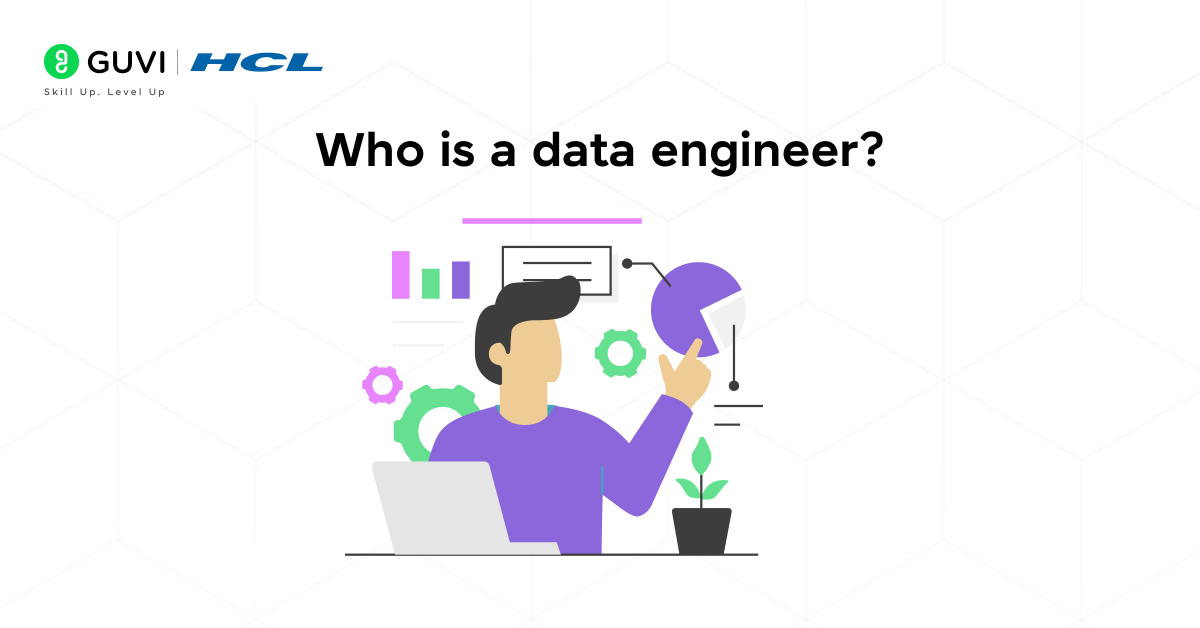
A data engineer is a technology professional who designs, builds, and maintains the systems that collect, store, process, and distribute data. They create automated data pipelines and manage databases, data warehouses, and data lakes, making raw data clean, reliable, and accessible for data scientists, analysts, and business stakeholders.
Think of a data engineer as the plumber of the data world. While data scientists analyse insights, data engineers build and maintain the pipes that make those insights possible.
Data engineers sit at the intersection of software engineering and data science. Their work begins where a software engineer’s ends, once an application generates data, the data engineer takes over to collect, transform, store, and serve it at scale.
What Is a Data Engineer?
A data engineer is a technology professional who designs, builds, and maintains the systems that collect, store, process, and distribute data. They create automated data pipelines and manage databases, data warehouses, and data lakes, making raw data clean, reliable, and accessible for data scientists, analysts, and business stakeholders.
Think of a data engineer as the plumber of the data world. While data scientists analyse insights, data engineers build and maintain the pipes that make those insights possible.
Data engineers sit at the intersection of software engineering and data science. Their work begins where a software engineer’s ends, once an application generates data, the data engineer takes over to collect, transform, store, and serve it at scale.
What does a Data Engineer Do daily?
Many people understand the job title but wonder what the actual day looks like. Here is a realistic picture:
- Morning: Checking pipeline health dashboards (Datadog, Grafana) for overnight job failures
- Mid-morning: Debugging a broken ETL job that failed due to an upstream schema change
- Afternoon: Writing and testing a new ingestion pipeline for a third-party API
- Late afternoon: Collaborating with a data scientist to optimise a slow query in Snowflake
- End of day: Reviewing data quality reports and triaging anomaly alerts
The role combines deep technical work with collaboration. You will spend roughly half your time building and the other half debugging, optimising, and supporting other teams.
Data Engineer vs Data Scientist vs Data Analyst
This is one of the most searched questions by beginners. Here is the clearest breakdown:
| Criteria | Data Engineer | Data Scientist | Data Analyst |
| Primary focus | Build data infrastructure | Extract insights from data | Report and visualise data |
| Key skills | Python, SQL, Spark, Kafka | Python, R, ML algorithms | SQL, Excel, Tableau |
| Daily tools | Airflow, dbt, Snowflake | Jupyter, TensorFlow, scikit-learn | Power BI, Looker, SQL |
| Output | Reliable data pipelines | Predictive models, insights | Dashboards, reports |
| Coding level | Very high | High | Medium |
| India salary (avg) | ₹7–15 LPA | ₹8–18 LPA | ₹4–10 LPA |
Data engineers enable the work of data scientists and analysts. Without reliable pipelines, there is no data to analyse.
Want to explore this comparison in more depth? Read our full guide: Data Scientist vs Data Engineer: Full Comparison 2026.
Top Data Engineer Roles and Responsibilities
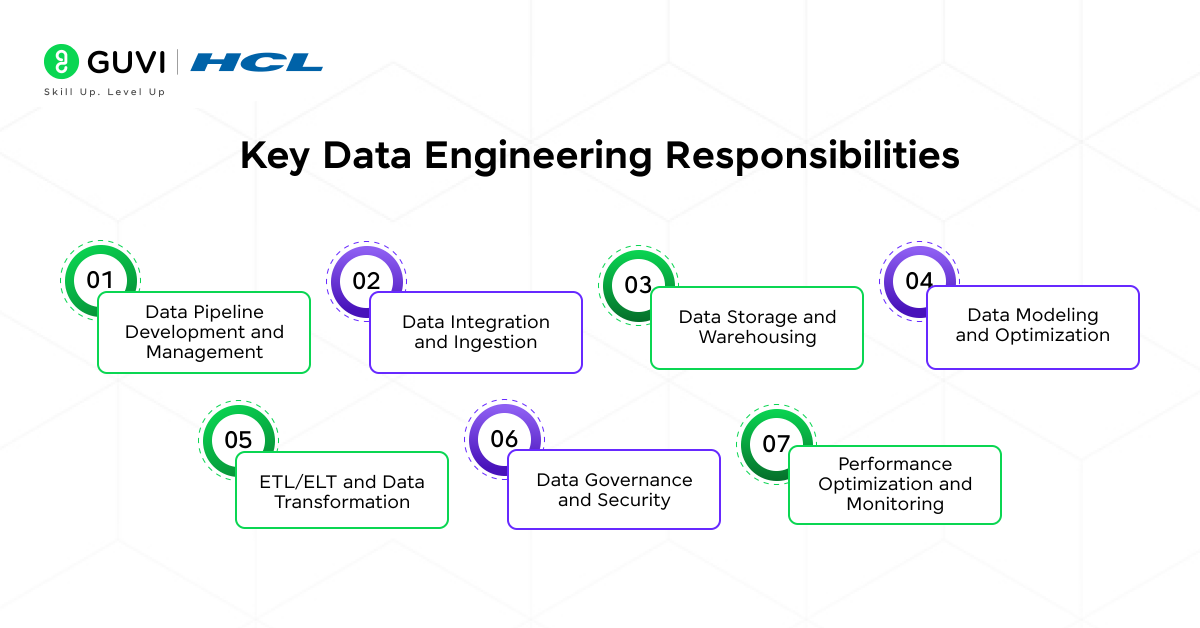
1. Data Pipeline Development and Management
Building and maintaining reliable data pipelines is the number one responsibility of a data engineer. A data pipeline is an automated system that moves data from source to destination, cleaning, transforming, and loading it along the way.
Key tasks:
- Design ETL and ELT pipelines using Apache Airflow, Apache Beam, and AWS Glue
- Handle batch processing (scheduled, large data jobs) and real-time streaming (continuous data flows)
- Monitor pipeline health, set up alerts, and debug failures
- Optimise pipeline performance to minimise data latency
ETL vs ELT – What’s the Difference?
| ETL (Extract, Transform, Load) | ELT (Extract, Load, Transform) | |
| Process order | Transform before loading | Load raw data first, transform later |
| Best for | Structured data, legacy systems | Cloud data warehouses, large-scale analytics |
| Speed | Slower (pre-processing required) | Faster initial load |
| Examples | Informatica, Talend | dbt + Snowflake, BigQuery |
Tools: Apache Airflow, Apache Kafka, Apache Spark, AWS Glue, Google Dataflow, Azure Data Factory
2. Data Integration and Ingestion
Data engineers pull data from dozens of sources, databases, APIs, IoT devices, SaaS tools, web logs, and integrate it into a unified, centralised system.
Key tasks:
- Extract data from structured sources (MySQL, PostgreSQL), semi-structured (JSON, XML, CSV), and unstructured sources (logs, images)
- Use streaming ingestion tools for real-time data: Apache Kafka, AWS Kinesis, Confluent
- Use batch ingestion tools for scheduled loads: Sqoop, Talend, Apache NiFi
- Apply schema mapping, cleaning, and aggregation before storage
Real-world example: At a fintech company, a data engineer builds a pipeline that ingests transaction data from 12 payment gateways every 15 minutes, validates the schema, flags anomalies, and loads clean data into a Snowflake warehouse, all automatically.
3. Data Storage and Warehousing
Data engineers are responsible for choosing the right storage architecture and keeping it performant, cost-effective, and secure.
| Storage Type | Examples | Best Used For |
| Relational Databases | PostgreSQL, MySQL, SQL Server | Transactional data, structured queries |
| NoSQL Databases | MongoDB, Cassandra, DynamoDB | Flexible, high-volume, unstructured data |
| Data Warehouses | Snowflake, BigQuery, Redshift | Analytics, business intelligence |
| Data Lakes | AWS S3, Azure Data Lake, GCS | Raw, large-scale data storage |
| Data Lakehouses | Databricks Delta Lake, Apache Iceberg | Combined analytics + raw storage (2026 trend) |
Key optimisation techniques: Columnar storage (Parquet, ORC), partitioning, indexing, compression, materialized views.
4. Data Modelling and Architecture Design
Effective data modelling determines how efficiently data can be queried and analysed. Data engineers design schemas and database structures that balance performance with flexibility.
Key tasks:
- Design star schemas and snowflake schemas for data warehouses
- Build normalised models for OLTP (transactional) and denormalised models for OLAP (analytics)
- Optimise SQL queries using indexes, partitioning, and caching
- Document data lineage, where data comes from, and how it is transformed
Schema types at a glance:
- Star schema: Central fact table surrounded by dimension tables, fast for BI queries
- Snowflake schema: Normalised dimension tables, less redundancy, more complex queries
- One Big Table (OBT): Popular in modern DBT workflows for simplicity at scale
5. Data Transformation (ETL/ELT Development)
Raw data is rarely usable. Data engineers transform raw inputs into structured, clean, analysis-ready datasets through automated operations.
Transformation operations include:
- Data cleansing (removing nulls, duplicates, formatting errors)
- Feature engineering (creating new calculated fields)
- Schema normalisation and denormalisation
- Aggregation (daily totals, weekly rollups)
- Business rule application (e.g., “mark orders above ₹10,000 as high-value”)
Top ETL/ELT tools in 2026:
- Apache Airflow– workflow orchestration and scheduling
- dbt (Data Build Tool) – SQL-based transformations for modern warehouses (fastest-growing in 2026)
- Apache Spark – large-scale distributed data processing
- Talend / Informatica – enterprise ETL platforms
- Fivetran / Airbyte – automated data connectors
6. Data Governance, Quality, and Security
With regulations like GDPR, HIPAA, and India’s PDPB in force, data governance is no longer optional; it is a core engineering responsibility.
Key tasks:
- Enforce role-based access control (RBAC)
- Implement data encryption at rest (AES-256) and in transit (TLS)
- Set up data lineage tracking, know where every data point came from
- Run automated data quality checks using Great Expectations, Monte Carlo, and Soda
- Anonymise PII (Personally Identifiable Information) before cross-team data sharing
- Audit and log all data access for compliance reporting
7. Performance Optimisation and System Monitoring
Data systems must be fast, reliable, and scalable. Data engineers continuously tune and monitor infrastructure to keep everything running at peak performance.
Key tasks:
- Optimise slow SQL queries using EXPLAIN plans, query rewriting, and indexing
- Monitor system health using Datadog, Prometheus, and Grafana
- Implement auto-scaling and load balancing for peak traffic periods
- Use containerisation (Docker, Kubernetes) for scalable deployments
- Set up alerting for pipeline failures, data quality drops, and latency spikes
Top 5 Data Engineering Roles in 2026
1. Data Engineer (Core Role)
The foundational role. Builds and maintains pipelines, manages data infrastructure, and ensures data quality.
Must-have skills: SQL, Python, Apache Spark, Kafka, Airflow, cloud platforms (AWS/GCP/Azure), data warehousing
India Salary: ₹7–15 LPA
2. Data Architect
Designs the overall data strategy, selects technologies, and sets standards for how data flows across an organisation.
Must-have skills: Cloud architecture, data modelling, governance frameworks, enterprise data platforms
India Salary: ₹18–35 LPA
3. Big Data Engineer
Specialises in handling petabyte-scale data using distributed computing frameworks.
Must-have skills: Hadoop, Apache Spark, HBase, HDFS, distributed systems design.
India Salary: ₹10–22 LPA
4. Machine Learning Engineer
Bridges data engineering and data science, builds production-grade systems to deploy and serve ML models.
Must-have skills: Python, TensorFlow/PyTorch, MLflow, Kubeflow, feature stores, AWS SageMaker.
India Salary: ₹12–25 LPA
5. DataOps Engineer (Emerging Role in 2026)
The newest and fastest-growing role applies DevOps principles to data operations. Focuses on automation, CI/CD for data pipelines, and observability.
Must-have skills: Airflow, dbt, Git, CI/CD pipelines, data observability tools (Monte Carlo, Soda), infrastructure-as-code.

India Salary: ₹10–20 LPA
If you’re looking to build a successful career in data engineering, HCL GUVI’s Big Data Engineering Course is your gateway to mastering cutting-edge tools like Hadoop, Spark, and Kafka. Designed by industry experts, this hands-on program covers data pipelines, cloud platforms, and real-world big data projects to make you job-ready.
Essential Data Engineering Tools in 2026
| Category | Tools | Purpose |
| Pipeline Orchestration | Apache Airflow, Prefect, Dagster | Schedule and manage workflows |
| Stream Processing | Apache Kafka, Apache Flink, AWS Kinesis | Real-time data streaming |
| Batch Processing | Apache Spark, Hadoop MapReduce | Large-scale data processing |
| Data Transformation | dbt, Apache Beam, Spark SQL | Clean and transform data |
| Data Warehouses | Snowflake, BigQuery, Redshift | Analytics storage |
| Data Lakes | AWS S3, Azure Data Lake, GCS | Raw data storage |
| Data Quality | Great Expectations, Monte Carlo, Soda | Validate data integrity |
| Monitoring | Datadog, Prometheus, Grafana | System health and alerts |
| Cloud Platforms | AWS, Google Cloud, Azure | Infrastructure foundation |
Version Control & CI/CD | Git, GitHub Actions, Jenkins | Code management and deployment |
Data Engineer Career Path: Fresher to Senior
| Level | Experience | Key Responsibilities | India Salary |
| Junior Data Engineer | 0–2 years | Build pipelines under guidance, write SQL queries, learn tools | ₹4–7 LPA |
| Data Engineer | 2–5 years | Design and own pipelines, optimise performance, mentor juniors | ₹7–15 LPA |
| Senior Data Engineer | 5–8 years | Architect large-scale systems, set data standards, lead projects | ₹15–25 LPA |
| Lead / Principal Engineer | 8+ years | Define strategy, evaluate tools, lead cross-functional teams | ₹25–40 LPA |
| Data Architect | 10+ years | Enterprise data strategy, governance, C-suite collaboration | ₹30–50 LPA |
The good news for freshers: you do not need 10 years to start strong. A junior engineer with solid Python, SQL, and one cloud platform can land their first role within 6–9 months of structured learning.
Must-Have Skills:
How to Become a Data Engineer in 2026
Step 1: Build Core Programming Skills
Learn Python (primary language) and SQL (essential for all data work). Target: 3–4 months for beginners.
Step 2: Understand Databases and Storage
Get comfortable with relational databases (PostgreSQL, MySQL) and NoSQL databases (MongoDB, DynamoDB).
Step 3: Learn Big Data Frameworks
Study Apache Spark for distributed processing and Apache Kafka for real-time streaming.
Step 4: Master a Cloud Platform
Pick one: AWS (most in-demand), GCP (strong for data), or Azure (enterprise-dominant). Get certified.
Step 5: Learn Pipeline Orchestration
Build and schedule workflows using Apache Airflow or Prefect.
Step 6: Practice with Real Projects
Build end-to-end pipeline projects: ingest data from an API, clean it, load it into a warehouse, and visualise it.
Step 7: Get Certified and Build a Portfolio
Pursue AWS Certified Data Engineer, GCP Professional Data Engineer, or Databricks certifications.
Total timeline for beginners: 6–12 months with consistent, structured learning.
Is Data Engineering a Good Career in India in 2026?
Yes, and here is the data to back it up:
- Data engineering roles in India grew 42% year-on-year (LinkedIn India Jobs Report, 2025)
- Top hiring companies: Flipkart, Swiggy, Razorpay, Zepto, HDFC Bank, TCS, Infosys, Walmart Global Tech, Amazon India
- Demand is highest in Bangalore, Hyderabad, Mumbai, and Pune, but remote and hybrid roles are growing
- Data engineers with cloud + AI skills command a 25–40% salary premium over traditional roles
- India’s PDPB compliance wave is creating new data governance engineering demand
Best industries for data engineering in India: Fintech, e-commerce, healthcare tech, edtech, logistics, and telecom.
Common Mistakes Aspiring Data Engineers Make
1. Skipping SQL fundamentals: Many beginners jump into Spark or Kafka before mastering SQL. Almost every data engineering role requires strong SQL skills; get this right first.
2. Learning tools without understanding concepts: Knowing how to run Airflow commands is not the same as understanding pipeline orchestration. Focus on the concept before the tool.
3. Building pipelines without thinking about failure: A pipeline that works is not enough; it needs to handle failures gracefully. Always build retry logic, alerting, and monitoring from day one.
4. Ignoring data quality: Many junior engineers focus only on moving data, not validating it. Bad data in production causes costly downstream errors. Learn Great Expectations or Soda early.
5. Avoiding cloud platforms: Some beginners try to avoid the cloud to reduce complexity. In 2026, cloud knowledge (AWS, GCP, or Azure) is non-negotiable; nearly every employer expects it.
Start Your Data Engineering Career with HCL GUVI
If you are serious about becoming a data engineer, the fastest path is structured, hands-on learning guided by industry experts.
HCL GUVI Data Engineering and Big Data Course covers Apache Hadoop, Spark, and Kafka from scratch, real-time and batch pipeline development, cloud platforms (AWS/GCP), live projects with industry datasets, and career support with placement assistance.
Conclusion
Data engineering is one of the most in-demand and well-compensated technology careers in India and globally in 2026. The role covers everything from building pipelines and managing storage to ensuring data quality and governance.
Whether you are a fresher exploring your first tech career or a software engineer considering a specialisation, data engineering offers a clear, structured path, with strong salary growth and opportunities across every major industry.
Start with Python and SQL, build your first pipeline project, and pick up one cloud certification. Those three steps alone will put you ahead of most beginners entering the field.
Frequently Asked Questions
What are the main roles and responsibilities of a data engineer?
A data engineer designs, builds, and maintains the systems that collect, store, process, and deliver data. Their responsibilities include creating data pipelines, managing databases, data warehouses, and data lakes, ensuring data quality, implementing data governance, optimising data workflows, and making reliable data available for analysts and data scientists.
What is the difference between a data engineer and a data scientist?
A data engineer builds and manages the data infrastructure, while a data scientist analyses data to create insights and machine learning models. Data engineers focus on data pipelines, storage, processing, and reliability. Data scientists focus on statistics, predictive modelling, AI, and business insights.
Which programming languages are commonly used by data engineers?
Data engineers mainly use Python and SQL. Python is used for automation, pipeline development, and data processing, while SQL is essential for querying and transforming data. Other commonly used languages include Scala for Apache Spark, Java, and Bash scripting.
Can a fresher become a data engineer?
Yes, freshers can become data engineers by learning core skills such as Python, SQL, databases, cloud platforms, and data processing tools. Building real-world projects and gaining hands-on experience with tools like Spark, Airflow, and cloud services can improve job opportunities.
What tools and technologies do data engineers use?
Data engineers use tools for data processing, orchestration, storage, and deployment. Popular tools include Apache Spark, Apache Kafka, Apache Airflow, dbt, Snowflake, BigQuery, Amazon Redshift, AWS, Google Cloud, Microsoft Azure, Docker, Kubernetes, Git, and monitoring platforms.
How is a data engineer different from a software engineer?
A software engineer develops applications, websites, and software systems, while a data engineer builds the infrastructure needed to collect, process, and manage large volumes of data. Data engineering combines software development with database and distributed systems expertise.
What is the average data engineer salary in India?
Data engineer salaries in India vary based on experience, skills, and location. Freshers generally earn around ₹4–7 LPA, mid-level professionals may earn ₹7–15 LPA, and experienced data engineers with cloud and big data expertise can earn ₹20–30+ LPA.
What is ETL in data engineering?
ETL stands for Extract, Transform, and Load. It is the process of collecting data from different sources, cleaning and transforming it, and loading it into a target system such as a data warehouse. Modern data teams also use ELT, where data is loaded first and transformed later.
Is data engineering harder than data science?
Data engineering and data science require different skill sets. Data engineering focuses on programming, databases, cloud systems, and scalable data infrastructure. Data science focuses on statistics, machine learning, and analytics. The difficulty depends on a person’s background and interests.
What certifications help data engineers get hired in 2026?
Popular data engineering certifications include AWS Certified Data Engineer – Associate, Google Cloud Professional Data Engineer, Databricks Certified Data Engineer Associate, Microsoft Azure Data Engineer Associate (DP-203), and Snowflake SnowPro certifications.
How long does it take to become a data engineer?
The time required depends on prior experience. Beginners can build foundational skills in Python, SQL, databases, and cloud technologies within 6–12 months through consistent learning and practical projects.
Is data engineering a good career in 2026?
Yes. Data engineering continues to grow because companies need reliable data systems for analytics, artificial intelligence, and machine learning applications. Professionals with skills in cloud platforms, big data, and modern data tools are in strong demand.
Success Stories

About the Author
Salini Balasubramaniam
A curious, information-savvy writer loves to turn deep insights into authentic and engaging content that connects. With experience in writing for brands and driving audience engagement, I believe that words can make a powerful difference.
View all posts by Salini Balasubramaniam
Connect with me @









Did you enjoy this article?