


Career Articles
Accountant vs Data Analyst Salary in India After Switching Careers - Best Guide
Finance Managers: Could Data Science Be Your Next Career Move?
Insurance Claims Executive to Data Analyst: Is It a Good Switch?
Banking Executive (Loans, KYC) to Data Analyst: Skills and Career Path

Get In Touch For Details! Request More Information
Full Stack Developers: Top Roles, Responsibilities and Salaries 2026
Aug 20, 2026 8 Min Read 22444 Views
(Last Updated)
Every digital product we use today, from e-commerce platforms and banking apps to social media and SaaS tools, is powered by developers who bring both the user experience and the technology behind it together. This is where full-stack developers play a critical role.
A full-stack developer is someone who can build an application from end to end, creating interactive front-end interfaces, developing back-end systems, managing databases, integrating APIs, and deploying applications to the cloud.
In 2026, the role has evolved beyond traditional coding. Companies now look for full-stack developers who understand modern frameworks, AI-assisted development tools, cloud platforms, DevOps practices, and secure application development.
This guide explains the complete role of a full-stack developer, including key responsibilities, required skills, career levels, salary trends, and how to build a successful career in full-stack development.
Table of contents
- TL;DR
- Full Stack vs Front-End vs Back-End Developer
- Key Components of Full Stack Development
- Front-End Development
- Back-End Development
- Database Management
- API Development and Integration
- Cloud Deployment and DevOps
- Security Implementation
- Roles and Responsibilities by Level
- Junior Full Stack Developer
- Mid-Level Full Stack Developer
- Full Stack Tech Lead
- MEAN / MERN Stack Developer
- Java Full Stack Developer
- Full Stack Developer Salary in India (2026)
- Must-Have Full Stack Developer Skills in 2026
- Front-End Skills
- Back-End Skills
- Testing Skills
- Security Skills
- AI Tools for Full Stack Developers (2026 Addition)
- How to Become a Full Stack Developer in 2026
- Will AI Replace Full Stack Developers?
- Real-World Example
- Common Mistakes Full Stack Beginners Make
- Conclusion
- Frequently Asked Questions
- What does a full stack developer do?
- What are the main responsibilities of a full stack developer?
- Is full stack development a good career in 2026?
- Can a beginner become a full stack developer?
- How long does it take to become a full stack developer?
- What skills are needed to become a full stack developer?
- Which full stack technology stack is best to learn?
- Do full stack developers need to learn AI tools?
- Can a full stack developer build an entire application alone?
- What is the salary of a full stack developer in India?
TL;DR
- A full-stack developer builds complete web applications by handling both the front-end (user interface) and back-end (server, APIs, databases).
- Their responsibilities include UI development, backend logic, database management, API creation, cloud deployment, testing, and application security.
- In 2026, full-stack developers are expected to understand AI tools, cloud technologies, DevOps practices, and modern frameworks.
- Key skills include HTML, CSS, JavaScript, React, TypeScript, Node.js, Python/Java, SQL, NoSQL, Git, and cloud platforms.
- Career levels range from Junior Developer to Tech Lead, with responsibilities growing from coding features to managing architecture and teams.
- Popular specialisations include MERN Stack, MEAN Stack, and Java Full Stack Development.
- Full-stack development remains one of the most in-demand tech careers, offering salaries from ₹4 LPA for freshers to ₹35+ LPA for experienced tech leads in India.
- AI is changing the role by automating repetitive coding tasks, while increasing the importance of problem-solving, system design, and product ownership.
- Building real-world projects, deploying applications, and continuously upgrading skills are essential to becoming a successful full-stack developer.
Full Stack vs Front-End vs Back-End Developer
Many beginners confuse these three roles. Here is the clearest way to think about it.
A front-end developer builds what users see. A back-end developer builds the systems that power it. A full stack developer does both, and connects all the layers
| Dimension | Front-End Developer | Back-End Developer | Full Stack Developer |
| What they build | UI, layouts, interactions | Servers, APIs, databases | Both complete applications |
| Languages | HTML, CSS, JavaScript, React | Node.js, Python, Java, PHP | All of the above |
| Key tools | Figma, Tailwind CSS, React | Django, Spring Boot, PostgreSQL | React + Node.js + MongoDB + AWS |
| Salary in India | ₹4–12 LPA | ₹5–18 LPA | ₹4–35+ LPA |
| Best suited for | Visual, UI-focused thinkers | Logic and data enthusiasts | Versatile, product-minded builders |
| Deployment role | Handles front-end assets only | Manages servers and infrastructure | Owns the full deployment pipeline |
The key takeaway: full-stack developers offer the widest coverage across a product, which is why startups and growing teams rely on them heavily.
Key Components of Full Stack Development
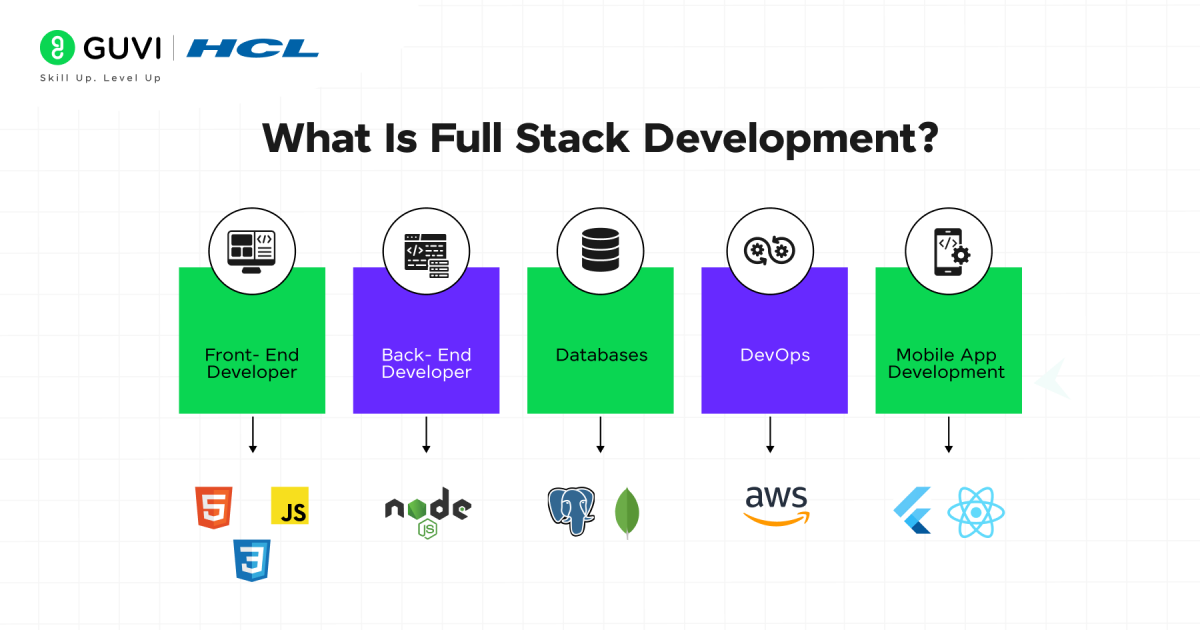
A full-stack developer works across six core layers of every web application.
1. Front-End Development
This is everything the user sees and interacts with. It is built using HTML, CSS, and JavaScript, along with frameworks like React, Angular, or Vue.js.
Good front-end work means the app loads fast, works on every device, and is accessible to all users.
2. Back-End Development
This is the logic layer, the part of the app the user never sees. It handles authentication, business rules, data processing, and API delivery.
Common back-end frameworks include Node.js (Express), Python (Django or FastAPI), and Java (Spring Boot).
3. Database Management
Full-stack developers manage both relational and non-relational databases:
- SQL databases: PostgreSQL, MySQL
- NoSQL databases: MongoDB, Firebase, Redis
4. API Development and Integration
Full stack developers build RESTful APIs and GraphQL endpoints to connect the front-end and back-end. They also integrate third-party services, payment gateways (Razorpay, Stripe), messaging (Twilio), and authentication providers (Google OAuth).
5. Cloud Deployment and DevOps
Applications must be deployed reliably and scale under traffic. Full-stack developers use AWS, Azure, or Google Cloud, along with Docker, Kubernetes, and CI/CD pipelines, to ship and maintain their applications.
6. Security Implementation
Full-stack developers implement OAuth 2.0, JWT tokens, HTTPS encryption, and input validation. They protect against SQL injection, XSS, and CSRF attacks, and security is built into the code, not added later.
Roles and Responsibilities by Level
Full stack development is a career path, not a single job title. Here is a breakdown of every level, what each role does, what companies expect, and what it pays.
Junior Full Stack Developer
Experience required: 0–2 years | Salary in India: ₹4 LPA – ₹8 LPA
A junior full-stack developer builds features under the guidance of senior engineers. The focus at this stage is on learning, writing clean code, and shipping working features, not perfection.
Day-to-day responsibilities:
- Building UI components with HTML, CSS, and JavaScript
- Implementing CRUD operations (Create, Read, Update, Delete) via APIs
- Fixing bugs in both front-end and back-end code
- Participating in code reviews and acting on feedback
- Writing basic unit tests for components and functions
- Converting Figma designs into responsive web pages
- Managing code with Git, branching, committing, and pull requests
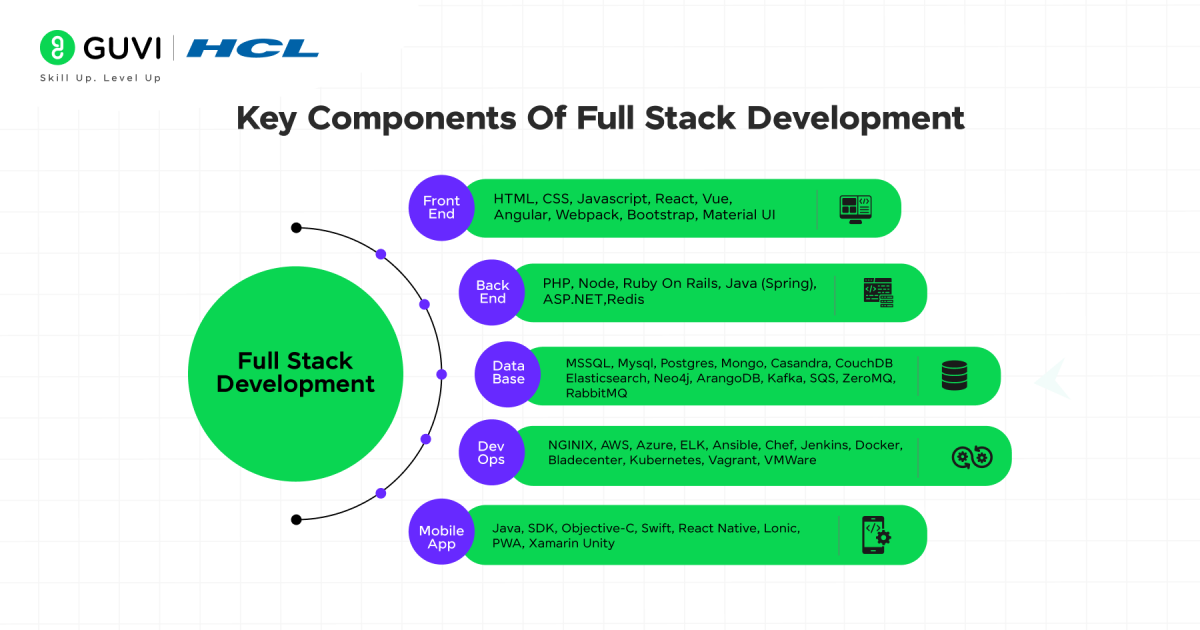
Technologies typically used:
- Front-end: HTML5, CSS3, JavaScript, React (basics)
- Back-end: Node.js (Express) or Python (Flask)
- Database: MySQL or MongoDB (basic queries)
- Tools: Git, GitHub, VS Code, Postman
Technologies typically used:
- Front-end: HTML5, CSS3, JavaScript, React (basics)
- Back-end: Node.js (Express) or Python (Flask)
- Database: MySQL or MongoDB (basic queries)
- Tools: Git, GitHub, VS Code, Postman
Mid-Level Full Stack Developer
Experience required: 2–5 years | Salary in India: ₹8 LPA – ₹15 LPA
Mid-level developers own features end-to-end. They write production-ready code independently, optimise performance, and begin mentoring junior teammates.
Day-to-day responsibilities:
- Designing and building complete features from requirements to deployment
- Building and consuming RESTful and GraphQL APIs
- Optimising database queries, adding indexes, and implementing Redis caching
- Integrating third-party services, payment gateways, cloud storage, email APIs
- Writing unit and integration tests
- Reviewing junior developers’ code and providing constructive feedback
- Contributing to architecture discussions
- Debugging and resolving production issues
Technologies typically used:
- Front-end: React or Vue.js with Redux or Zustand for state management
- Back-end: Node.js, Python (Django), or Java (Spring Boot)
- Database: PostgreSQL, MongoDB, Redis
- Cloud: AWS or GCP basics, S3, EC2, Cloud Functions
- Tools: Docker (basics), CI/CD pipelines
What companies expect: A mid-level developer takes a feature ticket and delivers it with minimal hand-holding, writing the API, connecting the database, and building the UI.
Senior Full Stack Developer
Experience required: 5–8 years | Salary in India: ₹15 LPA – ₹30 LPA
Senior developers lead technical work on large-scale applications. They make architecture decisions, establish coding standards, and are the technical backbone of the engineering team.
Day-to-day responsibilities:
- Designing scalable application architecture, microservices, serverless, or monolith
- Leading high-impact feature development end-to-end
- Setting up and managing CI/CD pipelines (GitHub Actions, Jenkins, ArgoCD)
- Identifying and resolving performance bottlenecks in production
- Conducting thorough code reviews across the entire team
- Mentoring junior and mid-level developers through pair programming and 1:1s
- Collaborating with product managers to translate requirements into technical tasks
- Writing technical documentation, runbooks, and RFC documents
- Evaluating and introducing new tools or technologies to the stack
Technologies typically used:
- Front-end: React / Next.js or Angular with advanced patterns
- Back-end: Node.js, Java (Spring Boot), Go, or Python at scale
- Database: PostgreSQL with query optimisation, MongoDB Atlas, and Elasticsearch
- Cloud: AWS (ECS, Lambda, RDS, CloudFront), Terraform for Infrastructure as Code
- Tools: Kubernetes, Docker, Datadog, or New Relic for monitoring
What companies expect: Senior developers anticipate problems before they happen. Their decisions need to serve the system for the next 2–3 years.
Explore: The best ways to learn full-stack development in 2026
Full Stack Tech Lead
Experience required: 7+ years | Salary in India: ₹18 LPA – ₹35 LPA
A tech lead manages the full software development lifecycle for a team. They balance deep technical work with leadership, stakeholder communication, and delivery ownership.
Day-to-day responsibilities:
- Owning the end-to-end technical delivery of a product or major module
- Breaking down business requirements into technical sprints and tasks
- Coordinating across product, design, QA, DevOps, and data teams
- Making final decisions on architecture, tech stack, and third-party integrations
- Reviewing all critical code before it reaches production
- Running sprint planning, stand-ups, and retrospectives
- Preparing and presenting technical roadmaps to stakeholders
- Setting security, performance, and reliability standards across the codebase
- Making rapid decisions during production incidents and escalations
What companies expect: A tech lead is not just the best coder on the team, they make everyone around them more effective. They translate business goals into technical reality.
MEAN / MERN Stack Developer
Salary in India: ₹7 LPA – ₹15 LPA
MEAN and MERN stack developers specialise in JavaScript-only full stack development. They are common in startups and product teams that want a single language across the entire codebase.
Both stacks share the same back-end, Node.js, Express, and MongoDB. The difference is the front-end framework.
| MEAN Stack | MERN Stack | |
| Front-end | Angular | React |
| Back-end | Node.js + Express | Node.js + Express |
| Database | MongoDB | MongoDB |
| Learning curve | Enterprise apps, structured codebases | Startups, SPAs, fast prototyping |
| Type system | TypeScript throughout | Optional TypeScrip |
Want to go deeper? Read our full comparison: MEAN Stack vs MERN Stack — Which Should You Learn?
Java Full Stack Developer
Salary in India: ₹8 LPA – ₹17 LPA
Java full stack developers build enterprise-grade applications using Java for the back-end and React or Angular for the front-end. This specialisation is highly valued in banking, fintech, insurance, and large enterprise environments.
Key responsibilities:
- Building back-end services with Spring Boot and Hibernate
- Designing APIs with Spring MVC or Spring WebFlux (reactive programming)
- Developing microservices architecture with Spring Cloud
- Managing relational databases (Oracle, PostgreSQL, MySQL) using JPA and ORM
- Containerising applications with Docker and orchestrating with Kubernetes
- Implementing enterprise-grade security with Spring Security, OAuth2, and JWT
- Building front-end UIs with React or Angular (TypeScript)
- Writing integration tests with JUnit 5 and Mockito
Learn more: Java Full Stack Developer Roadmap 2026
Ready to become a Full Stack Developer?
Build job-ready skills with HCL GUVI’s Full Stack Development Course and master front-end, back-end, databases, APIs, and deployment through hands-on projects. With expert mentorship, industry-focused training, and real-world practice, you’ll gain the confidence to build scalable web applications and launch your career in tech.
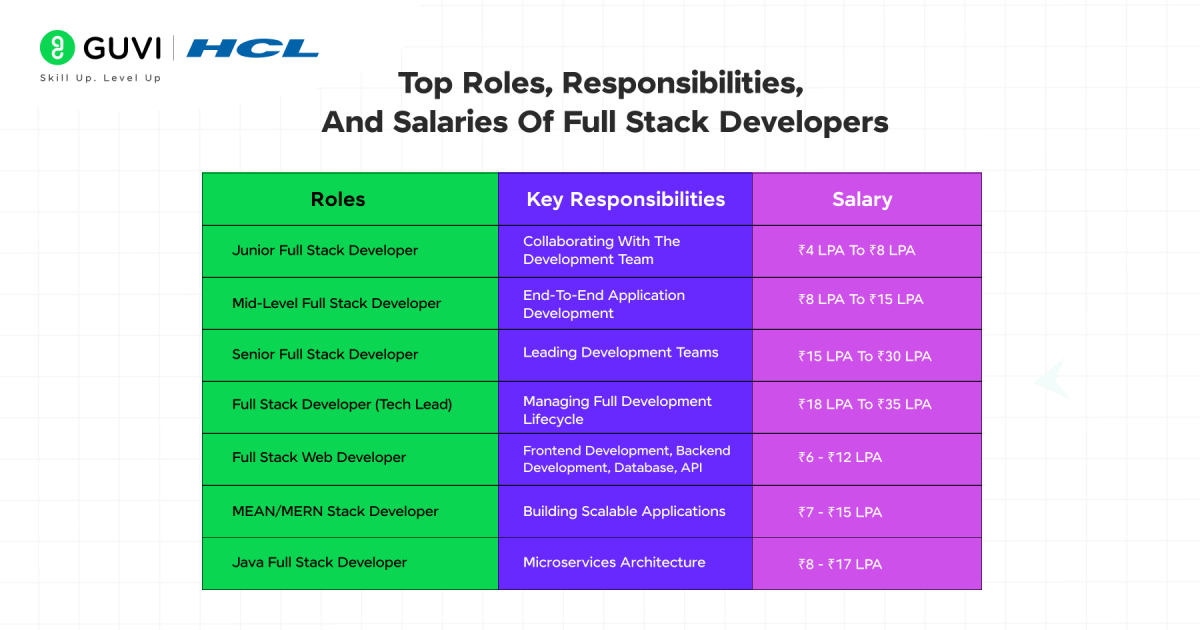
Full Stack Developer Salary in India (2026)
| Role | Experience | Salary Range (India) |
| Junior Full Stack Developer | 0–2 years | ₹4 – ₹8 LPA |
| Full Stack Web Developer | 1–3 years | ₹6 – ₹12 LPA |
| MEAN / MERN Stack Developer | 1–4 years | ₹7 – ₹15 LPA |
| Java Full Stack Developer | 2–5 years | ₹8 – ₹17 LPA |
| Mid-Level Full Stack Developer | 2–5 years | ₹8 – ₹15 LPA |
| Senior Full Stack Developer | 5–8 years | ₹15 – ₹30 LPA |
| Full Stack Tech Lead | 7+ years | ₹18 – ₹35 LPA |
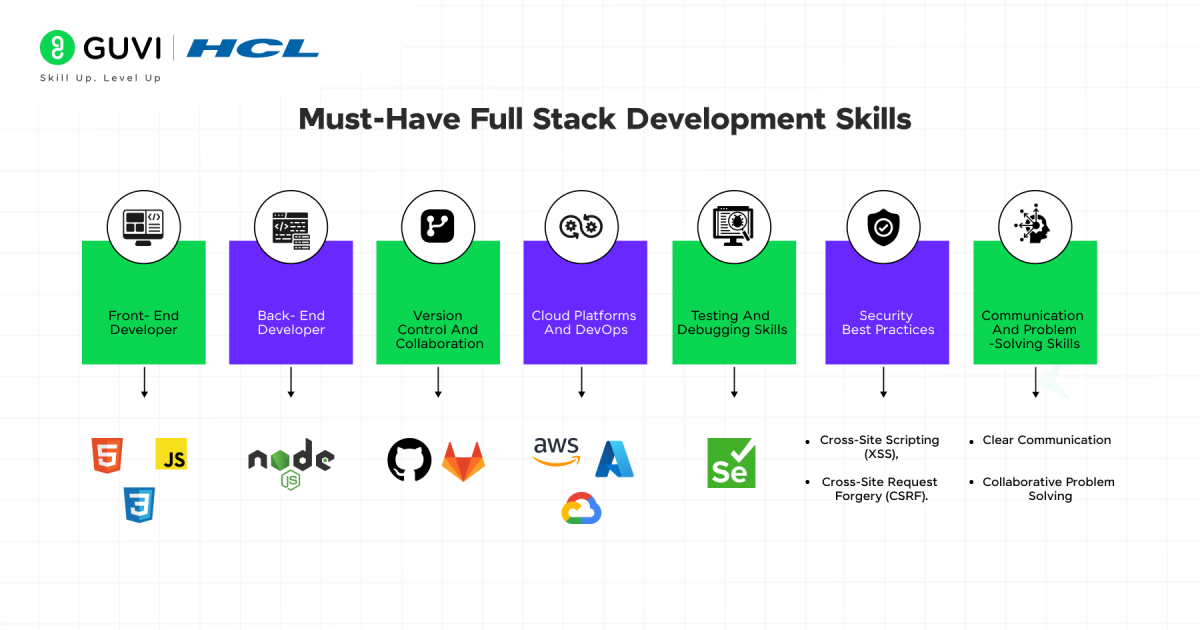
Must-Have Full Stack Developer Skills in 2026
To succeed as a full stack developer, you need skills across five core areas. Here is what the market actually expects in 2026.
Front-End Skills
The front-end is what your users interact with first. These are the non-negotiables:
- HTML5, CSS3, JavaScript (ES6+) the foundation of every web page. You need clean, semantic HTML, responsive CSS, and modern JavaScript, not just copied code.
- React, Angular, or Vue.js – pick one framework and go deep. React is used by over 40% of web developers globally.
- TypeScript – no longer optional. Most production codebases in 2026 use TypeScript. It catches bugs before they reach users.
- Tailwind CSS or Bootstrap – for building responsive, accessible UIs quickly.
- State management – Redux or Zustand (React) or NgRx (Angular) for managing complex application states.
Want to master front-end skills? Read our guide: What is Frontend Development?

Back-End Skills
The back-end handles all the logic, data, and security behind your application.
Server-side languages and frameworks to know:
- Node.js + Express or Fastify – most common for JavaScript full stack
- Python + Django or FastAPI – popular for AI-adjacent and data-heavy applications
- Java + Spring Boot – dominant in enterprise environments
- Go – growing fast for performance-critical microservices
Database options by type:
| Database | Type | Best Used For |
| PostgreSQL | SQL (Relational) | Production apps, complex queries |
| MySQL | SQL (Relational) | Web apps, legacy systems |
| MongoDB | NoSQL (Document) | Flexible schemas, rapid development |
| Redis | NoSQL (In-memory) | Caching, real-time features |
| Firebase | NoSQL (Cloud) | Mobile-first applications |
Learn more: Database Management Guide with Examples
Testing Skills
| Test Type | Tools | What It Checks |
| Unit Testing | Jest, PyTest, JUnit | Individual functions and components |
| Integration Testing | Supertest, Mocha | API endpoints and database interactions |
| End-to-End Testing | Cypress, Playwright | Full user journeys in the browser |
| Performance Testing | k6, JMeter | Load capacity and response times |
Security Skills
Security is no longer a specialist skill; it is expected of every full-stack developer.
- Authentication: OAuth 2.0, JWT tokens, session-based auth, SSO
- Authorization: Role-Based Access Control (RBAC) and permissions systems
- Encryption: HTTPS and TLS for all data in transit
- Input validation: Prevents SQL injection, XSS, and CSRF attacks
- Secrets management: Use AWS Secrets Manager or HashiCorp Vault,never hardcode API keys
- OWASP Top 10: The ten most critical web vulnerabilities, know each one and how to prevent it
AI Tools for Full Stack Developers (2026 Addition)
Using AI coding tools is now a professional skill. Developers who use these tools effectively are 2–4x more productive, and 2026 job descriptions increasingly mention them by name.
- GitHub Copilot / Cursor – AI autocomplete and inline code generation
- Claude Code – agentic coding assistant for complex refactors and multi-file edits
- ChatGPT / Gemini – for debugging explanations and architecture brainstorming
- V0 by Vercel – generates React UI components from a plain-English description
How to Become a Full Stack Developer in 2026
Here is a step-by-step learning path designed for complete beginners.
Step 1 – Learn HTML, CSS, and JavaScript fundamentals (4–6 weeks) Build three small projects: a personal page, a form, and a simple calculator. Get comfortable before moving on.
Step 2 – Learn React (4–6 weeks) React is the most in-demand front-end framework. Build a to-do app and a weather app using a free public API.
Step 3 – Learn Node.js and Express for back-end development (4 weeks) Build a simple REST API with full CRUD operations. Connect it to a MongoDB database using Mongoose.
Step 4 – Add a SQL database (3–4 weeks) Learn PostgreSQL. Practice joins, indexes, and query optimisation. SQL is required for most mid and senior-level roles.
Step 5 – Build your first full stack project (3–4 weeks) Create a complete app with user authentication, database storage, and a working front-end. This is your first portfolio piece.
Step 6 – Learn Git, GitHub, and deployment (2 weeks). Deploy your front-end to Vercel and your back-end to Railway or AWS EC2. Learn branching and how to write good pull requests.
Step 7 – Add TypeScript (2–3 weeks): Rewrite parts of your project in TypeScript. This step significantly improves your hirability at mid and senior levels.
Step 8 – Build two portfolio projects that solve real problems. Avoid calculator clones. Pick a problem you have actually faced and build a working solution. A live URL is worth more than five screenshots.
Step 9 – Apply for jobs. Target junior roles, internships, and small freelance projects. You do not need to know everything; you need to show you can learn, ship, and take feedback.
Total time with 4–6 hours of focused daily learning: 6–12 months.
Master front-end, back-end, databases, APIs, and deployment with HCL GUVI Full Stack Development Course. Build real-world projects and learn the skills companies look for.
Will AI Replace Full Stack Developers?
This is one of the most searched questions in tech right now. The short answer is no, but the role is evolving.
AI tools like GitHub Copilot and Claude Code can generate boilerplate, suggest bug fixes, and build basic components quickly. But there are things they cannot do:
- Understand the business context behind a feature request
- Make architecture decisions with long-term consequences for a live product
- Debug complex production issues that span multiple systems and services
- Lead a team, manage delivery, and communicate tradeoffs to non-technical stakeholders
- Solve genuinely novel problems that have no existing pattern to replicate
The developers most at risk are those who only write repetitive, low-complexity code and do not understand why it works.
The developers who will thrive are those who use AI as a productivity multiplier and focus their energy on system design, architecture decisions, and delivery ownership.
Real-World Example
A fintech startup in Bengaluru needed to launch a loan application portal in 12 weeks with a team of four engineers.
They hired two mid-level MERN stack developers and one senior full-stack developer. The senior developer designed the API architecture, set up the CI/CD pipeline, and handled the PostgreSQL database schema. The mid-level developers built the React front-end and integrated Razorpay for loan disbursements and Aadhaar-based KYC verification.
The result: the entire product, front-end, back-end, payments, and authentication, was shipped by a small team because every developer could work across the full stack without waiting on handoffs between specialists.
This is the practical value of full-stack development: speed, flexibility, and product ownership.
Common Mistakes Full Stack Beginners Make
1. Trying to learn everything at once. Many beginners jump between React, Node.js, Python, and three databases simultaneously without mastering any of them. Pick one front-end framework and one back-end language, build solid projects with them, and only expand once you feel genuinely confident.
2. Skipping JavaScript fundamentals to learn frameworks. Learning React without a solid understanding of core JavaScript leads to confusion and brittle code. Spend at least four weeks on JavaScript basics, closures, promises, event loops, and array methods, before touching any framework.
3. Building only tutorial clone projects, Calculator clones, and Netflix UI replicas do not stand out in a portfolio. Build something that solves a real problem, even a small one. Real-world context makes your work memorable to hiring managers and interviewers.
4. Ignoring testing and version control Most beginners never write tests or use Git properly beyond basic commits. Employers notice this immediately. Even a handful of unit tests and clean, descriptive commit history signals professional readiness far more than a flashy UI.
5. Not deploying your projects. A project that only runs on your local machine is not a portfolio piece. Deploy everything, use Vercel for front-end and Railway or AWS Free Tier for back-end. A working live URL with a real domain is worth more than ten screenshots.
Conclusion
Full-stack development has become one of the most valuable and versatile careers in the technology industry. A full-stack developer does not just write code, they transform ideas into complete, scalable, and secure digital products.
As businesses continue to adopt AI, cloud computing, and modern software practices, the expectations from full-stack developers are also evolving. Professionals who combine strong technical foundations with problem-solving skills, AI tools, and product thinking will have a major advantage.
Whether you are a beginner starting your first tech career or an experienced developer expanding your skills, full-stack development offers strong growth opportunities. Build real-world projects, understand the complete development lifecycle, keep learning new technologies, and you can build a future-ready career in this fast-growing field.
Frequently Asked Questions
What does a full stack developer do?
A full stack developer builds complete web applications by working on the front-end, back-end, databases, APIs, and deployment.
What are the main responsibilities of a full stack developer?
Their responsibilities include designing user interfaces, developing server-side logic, managing databases, creating APIs, testing applications, and maintaining security.
Is full stack development a good career in 2026?
Yes. Full stack development remains a high-demand career because companies need developers who can build and manage complete applications.
Can a beginner become a full stack developer?
Yes. Beginners can start with HTML, CSS, JavaScript, frameworks, backend technologies, databases, and practical projects.
How long does it take to become a full stack developer?
With consistent learning and practice, beginners can become job-ready within 6–12 months.
What skills are needed to become a full stack developer?
Important skills include JavaScript, React, TypeScript, Node.js, Python/Java, databases, APIs, Git, cloud, and DevOps basics.
Which full stack technology stack is best to learn?
MERN, MEAN, and Java Full Stack are popular choices. The best stack depends on career goals and industry requirements.
Do full stack developers need to learn AI tools?
Yes. AI tools help developers code faster, debug efficiently, and improve productivity.
Can a full stack developer build an entire application alone?
Yes. A skilled full stack developer can design, develop, deploy, and maintain an application independently.
What is the salary of a full stack developer in India?
Full stack developer salaries range from around ₹4 LPA for freshers to ₹35+ LPA for experienced tech leads.
Success Stories

About the Author
Salini Balasubramaniam
A curious, information-savvy writer loves to turn deep insights into authentic and engaging content that connects. With experience in writing for brands and driving audience engagement, I believe that words can make a powerful difference.
View all posts by Salini Balasubramaniam
Connect with me @











Did you enjoy this article?