


Data Science Articles
Best Data Analytics Programs for Senior Finance Professionals in 2026
Accountant to Data Scientist: A Realistic Career Path in 2026
Quality Analyst to Data Analyst: Skills and Career Roadmap for 2026
Operations Analyst to Data Scientist: Best Skills, Roadmap & Career Transition (2026)

Get In Touch For Details! Request More Information
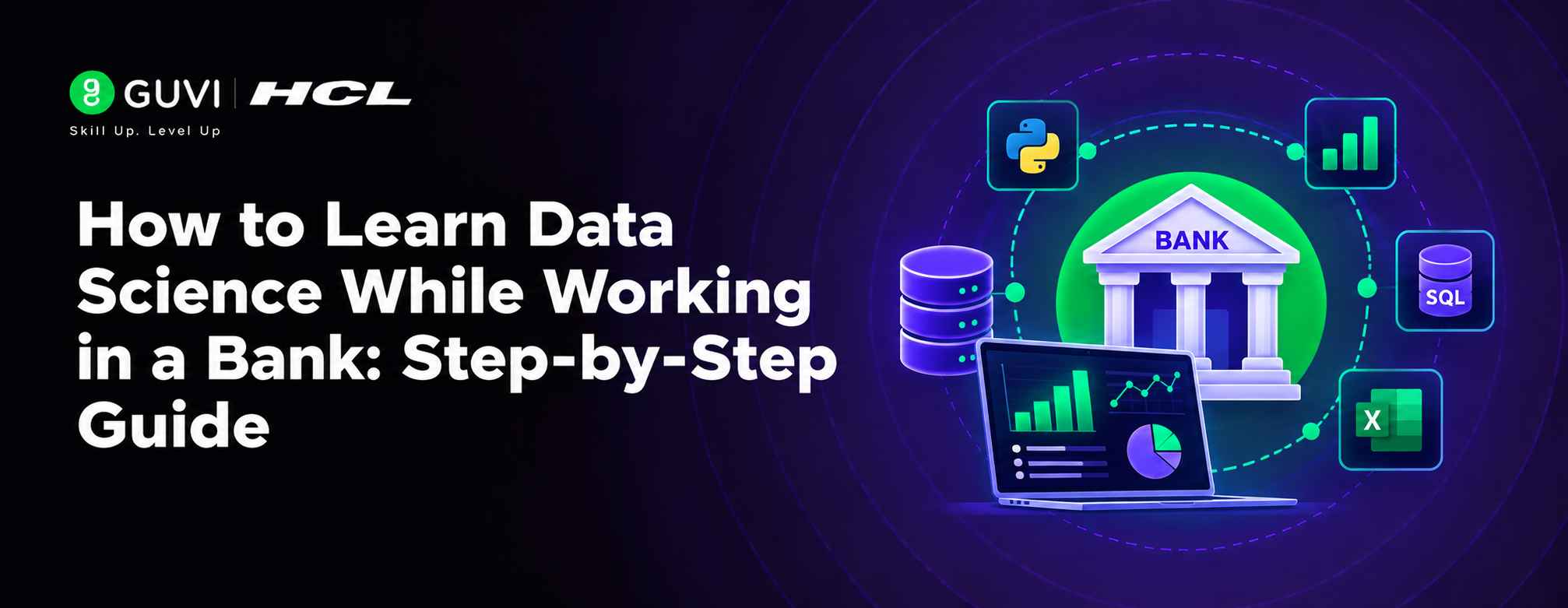
How to Learn Data Science While Working in a Bank: Step-by-Step Guide
Oct 28, 2026 5 Min Read 23 Views
(Last Updated)
Are long banking hours stopping you from learning data science? With demanding work schedules, daily targets, and limited free time, finding time to develop new technical skills can feel challenging. However, your existing experience in financial reporting, customer analysis, and risk assessment can give you a head start.
Learning Python, SQL, statistics, and machine learning can help you build on that experience and explore opportunities in banking analytics, fintech, and data science.
Read this guide to learn how to study data science while working in a bank, with a practical learning roadmap, essential skills, and career opportunities.
Table of contents
- Quick Answer
- Why Should Banking Professionals Learn Data Science?
- Better Career Opportunities in Banking and Fintech
- Growing Applications of AI and Machine Learning in Banking
- Proficiency to Automate Financial Reporting and Analysis
- Essential Data Science Skills Banking Professionals Need to Learn
- Advanced Excel for Financial Data Analysis
- SQL for Banking and Transaction Data
- Python Programming for Data Science
- Statistics and Probability for Financial Risk Analysis
- Power BI and Data Visualisation
- Machine Learning and Predictive Analytics
- How to Learn Data Science While Working in a Bank: Step-by-Step Roadmap
- Best Platforms to Learn Data Science While Working in a Bank
- HCL GUVI
- Google Colab
- GitHub
- Six-Month Data Science Learning Roadmap for Working Bankers
- How to Manage Data Science Studies Alongside Banking Working Hours
- Conclusion
- FAQs
- Do I need a computer science degree to learn data science while working in a bank?
- Does banking experience count when applying for data science jobs?
- Should banking professionals become data analysts before data scientists?
- Can bank employees transition into data science through internal job opportunities?
- What interview questions should bankers expect when switching to data science?
Quick Answer
Yes, you can learn data science while working in a bank with a structured study plan.
- Study Time: 7–9 hours weekly.
- Essential Skills: Excel, SQL, Python, Power BI, and machine learning.
- Roadmap: Six months for foundational learning.
- Projects: Credit risk analysis, fraud detection, and financial dashboards.
- Platforms: HCL GUVI, Google Colab, and GitHub.
- Career Options: Financial Data Analyst, Risk Analyst, and Banking Data Scientist.
Why Should Banking Professionals Learn Data Science?
1. Better Career Opportunities in Banking and Fintech
Banks, NBFCs, and fintech companies need professionals who can turn financial records into useful business insights. A loan officer, for example, can combine credit assessment experience with SQL and Python to analyse repayment patterns and identify borrowers at higher risk of default.
These skills can help banking employees transition into Credit Risk Analyst, Financial Data Analyst, and Fintech Data Analyst roles.
2. Growing Applications of AI and Machine Learning in Banking
Banks increasingly use machine learning to assess loan default probabilities, detect unusual transactions, and predict customer churn. For example, a fraud detection model can flag transactions that differ significantly from a customer’s usual spending patterns for further review.
Learning Python, statistics, and machine learning helps banking professionals understand how these models work, interpret their predictions, and recognise risks related to accuracy, fairness, and compliance.
3. Proficiency to Automate Financial Reporting and Analysis
Preparing daily MIS reports, consolidating branch figures, and checking transaction records can consume significant time. Banking professionals can use SQL to extract authorised financial data, Python to clean and combine reports, and Power BI to track loan disbursements, overdue accounts, and branch performance. This reduces repetitive spreadsheet work and makes it easier to identify discrepancies and financial trends.
Build data science skills alongside your banking career with HCL GUVI’s Data Science Course. Learn Python, SQL, statistics, and machine learning through 6 months of live online classes, real-world projects, expert mentorship, and flexible weekday or weekend batches. Benefit from placement assistance with 1000+ hiring partners and prepare for career opportunities in financial analytics and data science.
Essential Data Science Skills Banking Professionals Need to Learn
1. Advanced Excel for Financial Data Analysis
Excel is a familiar starting point because many banks already use it for MIS reporting, loan tracking, and financial reconciliation. Learning PivotTables, XLOOKUP, Power Query, and advanced formulas can help you analyse larger datasets more efficiently.
For example, you can compare branch-wise loan disbursements, identify overdue accounts, and prepare monthly performance reports without manually consolidating multiple spreadsheets.
2. SQL for Banking and Transaction Data
Banks maintain large databases containing customer accounts, loan records, and financial transactions. SQL helps you retrieve and analyse this information using queries, JOINs, GROUP BY, and aggregate functions.
For instance, you can practise writing queries to calculate overdue loan amounts by branch or identify customers with multiple active loans. Understanding SQL also prepares you for financial data analyst and banking business intelligence roles.
3. Python Programming for Data Science
Python allows banking professionals to analyse datasets that are difficult to manage through spreadsheets alone. Start with variables, loops, functions, and data structures before learning Pandas and NumPy.
You can then practise cleaning transaction records, identifying missing values, and combining monthly financial reports. For example, a Python script can automatically categorise synthetic loan records by repayment status and calculate overdue balances.
4. Statistics and Probability for Financial Risk Analysis
Statistics helps you understand financial patterns rather than simply report numbers. Focus on averages, distributions, probability, correlation, hypothesis testing, and regression.
A credit officer, for example, can use statistical analysis to investigate whether debt-to-income ratios are associated with loan defaults. Understanding these relationships is essential before building reliable predictive models.
5. Power BI and Data Visualisation
Power BI helps turn complex financial datasets into dashboards that banking teams can interpret quickly. Learn Power Query, data modelling, DAX measures, and dashboard design.
You can build a loan portfolio dashboard showing disbursement amounts, overdue balances, non-performing asset ratios, and branch-wise performance. These projects demonstrate how technical analysis supports practical banking decisions.
6. Machine Learning and Predictive Analytics
Machine learning is particularly useful for banking applications involving fraud detection, credit scoring, and customer churn prediction. Begin with linear regression, logistic regression, decision trees, random forests, and clustering.
For example, a loan default prediction model can use repayment history, income, and existing liabilities to estimate credit risk. Learn model evaluation, data leakage prevention, and class imbalance handling before interpreting predictions.
How to Learn Data Science While Working in a Bank: Step-by-Step Roadmap
- Identify Your Existing Banking Skills: Review tasks involving financial reporting, credit assessment, or transaction analysis. For example, credit officers understand repayment risks, while operations executives handle reconciliation. Use this experience to identify relevant data science applications and skill gaps.
- Build a Foundation in Excel and SQL: Learn advanced Excel functions, PivotTables, and Power Query, followed by SQL commands such as SELECT, WHERE, JOIN, and GROUP BY. Practise analysing branch-wise overdue balances and average loan amounts using sample banking datasets.
- Learn Python Through Banking Examples: Start with Python fundamentals before progressing to Pandas, NumPy, and data cleaning. Practise combining monthly loan files, removing duplicate transactions, and calculating repayment delays using synthetic financial data.
- Understand Statistics and Machine Learning: Study probability, correlation, regression, classification, and clustering. Apply these concepts to credit risk and customer behaviour analysis. Build a loan default prediction model and evaluate it using precision, recall, and a confusion matrix.
- Build Banking-Focused Data Science Projects: Create a Power BI loan portfolio dashboard, SQL transaction analysis, or Python credit risk project using public or synthetic datasets. Document the business problem, data preparation, analytical methods, and findings to demonstrate practical skills.
- Prepare for Banking Analytics and Data Science Roles: Organise projects into a documented portfolio and highlight transferable banking skills on your resume. For example, loan processing experience paired with a credit risk project can support applications for Financial Data Analyst, Risk Analyst, or Business Intelligence Analyst positions before advancing into data science roles.

Best Platforms to Learn Data Science While Working in a Bank
1. HCL GUVI
At HCL GUVI, our Advanced Data Science and Generative AI Program helps working professionals develop skills in Python, SQL, statistics, machine learning, and data analytics through structured training.
Our program offers live online classes, weekday and weekend batches, hands-on projects, mentor support, and placement assistance. Banking professionals can apply these skills to transaction analysis, credit risk modelling, and financial dashboards while building a job-relevant portfolio.
Explore our HCL GUVI Data Science Course to develop practical analytics skills and prepare for opportunities in banking analytics and fintech without leaving your current job.
2. Google Colab
Google Colab is a browser-based Python coding environment that helps beginners practise without installing software. Banking professionals can use it to clean sample transaction datasets with Pandas, analyse repayment trends, and experiment with machine learning models during short study sessions.
3. GitHub
GitHub helps learners organise coding projects and showcase technical skills to potential employers. Banking professionals can upload SQL queries, Python analysis notebooks, and credit risk prediction projects with clear documentation. A well-maintained GitHub portfolio can support applications for financial data analyst and banking data science roles.
Six-Month Data Science Learning Roadmap for Working Bankers
| Month | What to Learn | Banking-Focused Practice | Expected Outcome |
| Month 1 | Advanced Excel, Power Query, descriptive statistics | Analyse branch-wise loan disbursements and overdue balances | Financial analysis workbook |
| Month 2 | SQL queries, JOINs, GROUP BY, subqueries | Analyse synthetic customer accounts, deposits, and loans | SQL banking analysis project |
| Month 3 | Python basics, Pandas, NumPy, data cleaning | Clean transaction records and automate monthly loan reports | Python financial data analysis project |
| Month 4 | Power BI, DAX, probability, regression | Create dashboards for loan performance and repayment trends | Interactive banking dashboard |
| Month 5 | Machine learning, classification, model evaluation | Build and evaluate a loan default prediction model | Credit risk machine learning project |
| Month 6 | Portfolio development, GitHub, SQL and Python interview preparation | Document projects and practise banking analytics interview questions | Portfolio with 2–3 completed projects |
How to Manage Data Science Studies Alongside Banking Working Hours
- Set Weekly Study Targets: Aim for 7–9 hours weekly instead of following a rigid daily schedule. Four 45-minute weekday sessions and two 2-hour weekend sessions provide seven hours. Reduce study time during audits or month-end reporting and resume your routine afterward.
- Separate Theory From Practice: Use weekdays to learn concepts such as SQL JOINs, Python functions, and statistics. Reserve weekends for practical exercises, such as calculating branch-wise loan totals using SQL. Applying concepts to banking datasets helps reinforce learning.
- Learn One Skill at a Time: Start with SQL fundamentals before progressing to Python, statistics, and machine learning. Introduce Power BI for visualisation once you understand basic data analysis. This sequence prevents confusion and builds skills progressively.
- Build Small Banking Projects: Start by analysing deposit growth in Excel, identifying overdue loans using SQL, or developing a branch performance dashboard in Power BI. Gradually combine these skills into larger projects using public or synthetic datasets, never confidential customer records.
- Review Weekly Progress: Set measurable goals, such as writing five SQL queries, cleaning a financial dataset, or completing a dashboard. Review your progress every weekend, identify weak areas, and adjust your next week’s learning targets before moving to advanced topics.
Conclusion
Learning data science while working in a bank is possible when you follow a realistic schedule and build on your existing financial knowledge. Start with Excel and SQL, progress to Python and statistics, and gradually explore machine learning through banking-related projects.
The goal is not simply to learn new tools but to apply them to credit risk analysis, financial reporting, fraud detection, and customer analytics. With consistent practice and structured training, you can develop the skills needed to explore opportunities in financial analytics and data science without immediately leaving your banking job.
FAQs
Do I need a computer science degree to learn data science while working in a bank?
No, a computer science degree is not compulsory for every data science role. Banking professionals from commerce, finance, or management backgrounds can enter the field by developing programming, statistics, and analytical skills. However, some advanced positions may require specific technical qualifications.
Does banking experience count when applying for data science jobs?
Banking experience is valuable for finance-focused data science roles, particularly in lending, credit risk, and regulatory compliance. However, employers may not count all banking experience as technical data science experience. Demonstrating independent analytical work can strengthen your application.
Should banking professionals become data analysts before data scientists?
A data analyst role is often a practical starting point for banking professionals with limited programming experience. Data analyst positions generally emphasise reporting and business insights, whereas data scientist roles require stronger predictive modelling and machine learning expertise.
Can bank employees transition into data science through internal job opportunities?
Yes, some banks offer internal opportunities in analytics, digital banking, risk modelling, and technology teams. Employees can explore internal vacancies, discuss eligibility with HR, and apply through their organisation’s internal recruitment process. Availability depends on the bank’s policies and staffing requirements.
What interview questions should bankers expect when switching to data science?
Interviewers may ask candidates to explain SQL queries, Python data cleaning, statistical concepts, and model evaluation techniques. Banking-focused interviews may also include case studies on credit scoring, fraud detection, customer profitability, or financial risk. Candidates should be prepared to explain both their technical approach and its business relevance.
Success Stories

About the Author
Vaishali
I'm a seasoned writer with four years of experience across technical, non-technical, and just about every genre or niche you can imagine. Adaptable and curious, I enjoy exploring new topics and making information engaging and easy to understand. Fueled by a steady stream of tea, I approach each project with creativity, reliability, and genuine enthusiasm for storytelling.
View all posts by Vaishali
Connect with me @







Did you enjoy this article?