


Artificial Intelligence and Machine Learning Articles
CI/CD Pipelines for Machine Learning Projects
A/B Testing for Machine Learning Models
Canary Deployment Strategies for ML Models
What is Model Drift Detection: Keeping Models Accurate in Production


Get In Touch For Details! Request More Information
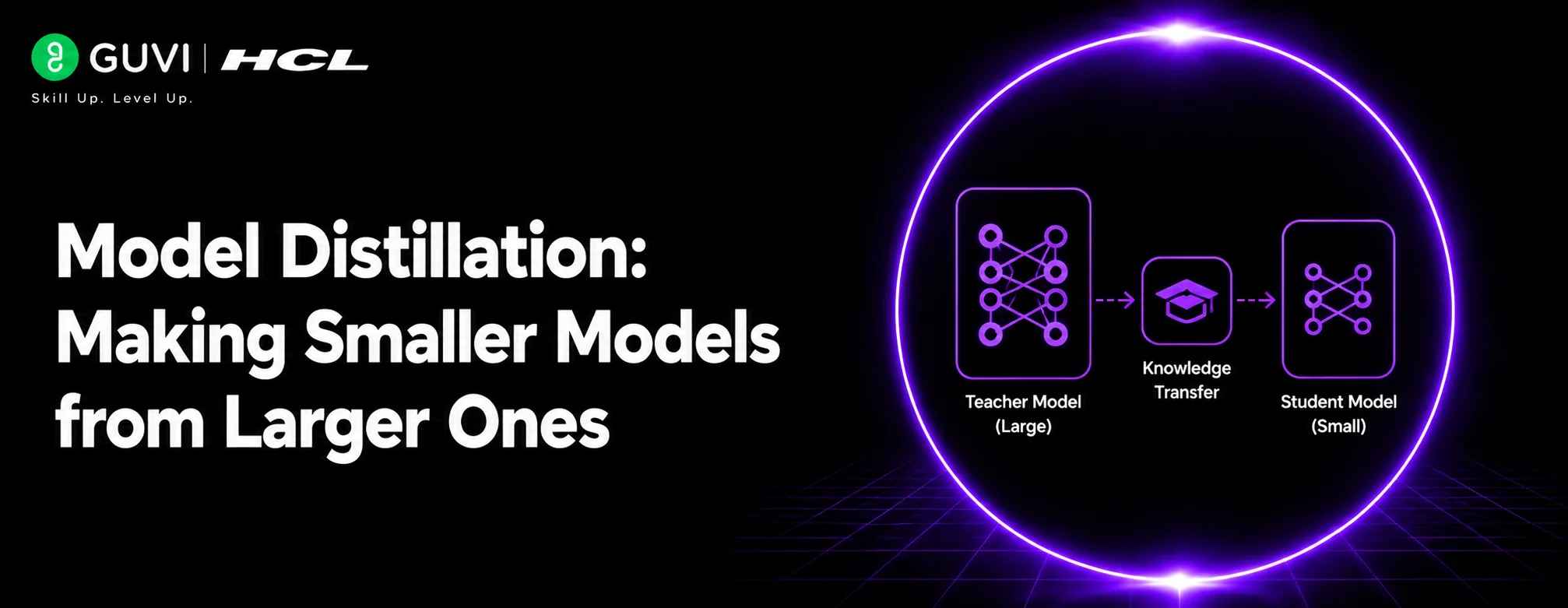
What is Model Distillation: Making Smaller Models from Larger Ones
Sep 01, 2026 3 Min Read 21 Views
(Last Updated)
Large AI models can deliver impressive results, but their size often makes them expensive and difficult to deploy on devices with limited computing resources. Model Distillation provides a practical solution by transferring knowledge from a large teacher model to a smaller student model. This allows developers to build faster, more efficient models while retaining much of the original model’s capabilities. This guide explains Model Distillation, how knowledge transfer works, its benefits, and real-world applications.
Table of contents
- TL;DR Summary
- Why Model Distillation Matters
- What Is Model Distillation?
- How Model Distillation Works
- Step 1: Train or Select the Teacher
- Step 2: Generate Teacher Predictions
- Step 3: Train the Student
- Step 4: Optimize the Student
- Step 5: Deploy the Student
- Teacher Model vs Student Model
- Teacher Model
- Student Model
- What Is Knowledge Transfer?
- Applications of Model Distillation
- Generative AI
- Mobile AI
- Computer Vision
- Enterprise AI
- Edge Computing
- Benefits of Model Distillation
- Faster Inference
- Lower Memory Requirements
- Reduced Deployment Costs
- Edge Deployment
- When Should You Use Model Distillation?
- Edge AI Deployment
- Real-Time Applications
- Enterprise AI
- Mobile Applications
- High-Volume AI Systems
- Key Concepts to Remember
- Best Practices
- Conclusion
- FAQs
- What is Model Distillation?
- What is a teacher model?
- What is a student model?
- Why is Model Distillation useful?
- Can Model Distillation be used for LLMs?
- Does the student model always perform as well as the teacher?
- Where is Model Distillation used?
TL;DR Summary
- Model Distillation transfers knowledge from a larger model to a smaller one.
- The large model acts as the teacher.
- The smaller model acts as the student.
- Student models require fewer computational resources.
- Distillation can improve inference speed and deployment efficiency.
Direct Answer
| Model Distillation is a machine learning technique that transfers knowledge from a large, powerful teacher model to a smaller student model. Instead of learning only from original training labels, the student learns from the teacher’s predictions and representations. This creates smaller models that can provide strong performance while requiring less memory, computation, and deployment resources. |
Why Model Distillation Matters
Modern AI models can contain billions of parameters, creating significant infrastructure and latency challenges. Distillation helps organizations create smaller models that are easier and cheaper to deploy.
Key benefits include:
- Smaller model size
- Faster inference
- Lower memory usage
- Reduced computational requirements
- Lower deployment costs
- Better edge-device compatibility
What Is Model Distillation?
Model Distillation, also called knowledge distillation, is a technique where a smaller student model learns to reproduce useful behavior from a larger teacher model.
The teacher is usually a more capable model with greater capacity, while the student is designed to be smaller and faster.
The goal is not necessarily to make the student identical to the teacher. Instead, the student learns useful patterns and predictive behavior that allow it to perform efficiently on its target tasks.
How Model Distillation Works
Knowledge distillation typically involves a teacher-student learning process.
Step 1: Train or Select the Teacher
A large, capable model is trained or selected as the teacher.
Step 2: Generate Teacher Predictions
The teacher processes training examples and produces predictions, often containing more information than simple class labels.
Step 3: Train the Student
The smaller student model learns from both the original training information and the teacher’s outputs.
Step 4: Optimize the Student
Training encourages the student to reproduce important patterns learned by the teacher.
Step 5: Deploy the Student
The resulting smaller model can be deployed with lower latency and reduced computational requirements.
Teacher Model vs Student Model
Teacher Model
The teacher is typically larger and more capable.
It may provide:
- High predictive accuracy
- Rich probability distributions
- Complex learned representations
- Strong generalization
Student Model
The student is intentionally smaller and more efficient.
It aims to provide:
- Faster inference
- Lower memory consumption
- Easier deployment
- Lower infrastructure requirements
What Is Knowledge Transfer?
The key idea behind Model Distillation is that a teacher model’s output contains more information than simply identifying the correct answer.
For example, instead of saying that an image belongs to one class with certainty, the teacher can provide probabilities across several possible classes. These relationships can help the student understand similarities between classes and learn a richer representation.
Applications of Model Distillation
Generative AI
- Smaller language models
- Efficient AI assistants
- Faster text generation
- Domain-specific models
Mobile AI
- On-device assistants
- Mobile translation
- Smart applications
- Offline AI features
Computer Vision
- Image classification
- Object detection
- Facial recognition
- Visual inspection
Enterprise AI
- Customer support
- Document classification
- Knowledge assistants
- Business automation
Edge Computing
- IoT intelligence
- Robotics
- Smart cameras
- Industrial monitoring
Model distillation is especially useful when a large model performs well but is too expensive or slow for your target environment. Instead of deploying the entire teacher model, distillation can produce a smaller student that captures much of the teacher’s useful behavior.
Benefits of Model Distillation
Faster Inference
Smaller models generally require fewer computations, enabling faster responses.
Lower Memory Requirements
Students contain fewer parameters and therefore require less memory.
Reduced Deployment Costs
Smaller models can run on less expensive hardware.
Edge Deployment
Distillation makes sophisticated AI capabilities more practical on mobile and edge devices.

Professionals interested in model optimization, generative AI, machine learning, and efficient AI deployment can strengthen their expertise through HCL GUVI’s Artificial Intelligence and Machine Learning Course.
When Should You Use Model Distillation?
Model Distillation is most useful when a large model provides strong performance but is too expensive, slow, or resource-intensive for the intended deployment environment.
Edge AI Deployment
Use distillation to create smaller models that can run on smartphones, IoT devices, embedded systems, and other hardware with limited resources.
Real-Time Applications
Smaller student models can reduce inference latency, making them useful for applications that require fast responses.
Enterprise AI
Organizations can distill large models into smaller versions for customer support, document processing, internal assistants, and business automation.
Mobile Applications
Distilled models can bring AI capabilities directly to mobile devices while reducing memory and computational requirements.
High-Volume AI Systems
When an application handles a large number of requests, smaller models can reduce infrastructure requirements and improve serving efficiency.
Key Concepts to Remember
Understanding these concepts makes Model Distillation easier to learn.
- The teacher model is usually larger and more capable.
- The student model is smaller and more efficient.
- Knowledge is transferred through teacher-generated outputs or representations.
- The student learns to approximate useful teacher behavior.
- Distillation can reduce inference cost and latency.
- The student may not reproduce every capability of the teacher.
The HCL GUVI’s Artificial Intelligence eBook introduces the fundamentals of generative AI, machine learning, model optimization, and intelligent automation. It helps learners understand how AI models can be developed and optimized for practical applications across modern technology environments.
Best Practices
- Choose a teacher model that performs well on the target task.
- Define the student’s size and latency requirements before training.
- Use representative training data.
- Evaluate the student against the teacher and original benchmarks.
- Measure both accuracy and inference efficiency.
- Test the distilled model on unseen data.
- Verify that important task-specific capabilities are retained.
Conclusion
Model Distillation makes powerful AI models more practical by transferring useful knowledge from large teacher models to smaller student models. This approach can reduce memory requirements, inference latency, and deployment costs while retaining much of the teacher’s task performance. From mobile applications to enterprise AI and edge computing, distillation provides an effective strategy for building efficient models.
FAQs
1. What is Model Distillation?
Model Distillation is a machine learning technique in which a smaller student model learns useful knowledge from a larger teacher model.
2. What is a teacher model?
A teacher model is typically a larger, more capable model that generates predictions or representations used to train a smaller student model.
3. What is a student model?
A student model is a smaller model trained to reproduce useful behavior from the teacher while requiring fewer computational resources.
4. Why is Model Distillation useful?
It can reduce model size, inference latency, memory requirements, and deployment costs while maintaining much of the teacher model’s performance.
5. Can Model Distillation be used for LLMs?
Yes. Distillation can transfer useful language-model behavior into smaller models, making them more practical for applications with limited computational resources.
6. Does the student model always perform as well as the teacher?
No. The student may lose some capabilities because it has fewer parameters and less capacity. The goal is usually to achieve a useful balance between performance and efficiency.
7. Where is Model Distillation used?
It is used in generative AI, NLP, computer vision, mobile AI, edge computing, robotics, and enterprise applications where smaller and faster models are valuable.
Success Stories

About the Author
HCL GUVI
This article was selected and published as part of the HCL GUVI AI Blogathon 2026, an initiative designed to encourage students, AI enthusiasts, and aspiring tech writers to simplify complex AI concepts through impactful technical content. The contest recognized high-quality, original, and insightful AI-focused blogs, with selected authors receiving publication opportunities on the HCL GUVI blog platform along with official author credits and recognition.
View all posts by HCL GUVI
Connect with me @





Did you enjoy this article?