


Artificial Intelligence and Machine Learning Articles
LoRA and QLoRA Explained: Efficient Fine-Tuning
Word Embeddings vs Sentence Embeddings: What's the Difference?
U-Net Architecture for Image Segmentation
ResNet Architecture Explained: Skip Connections and Deep Networks


Get In Touch For Details! Request More Information
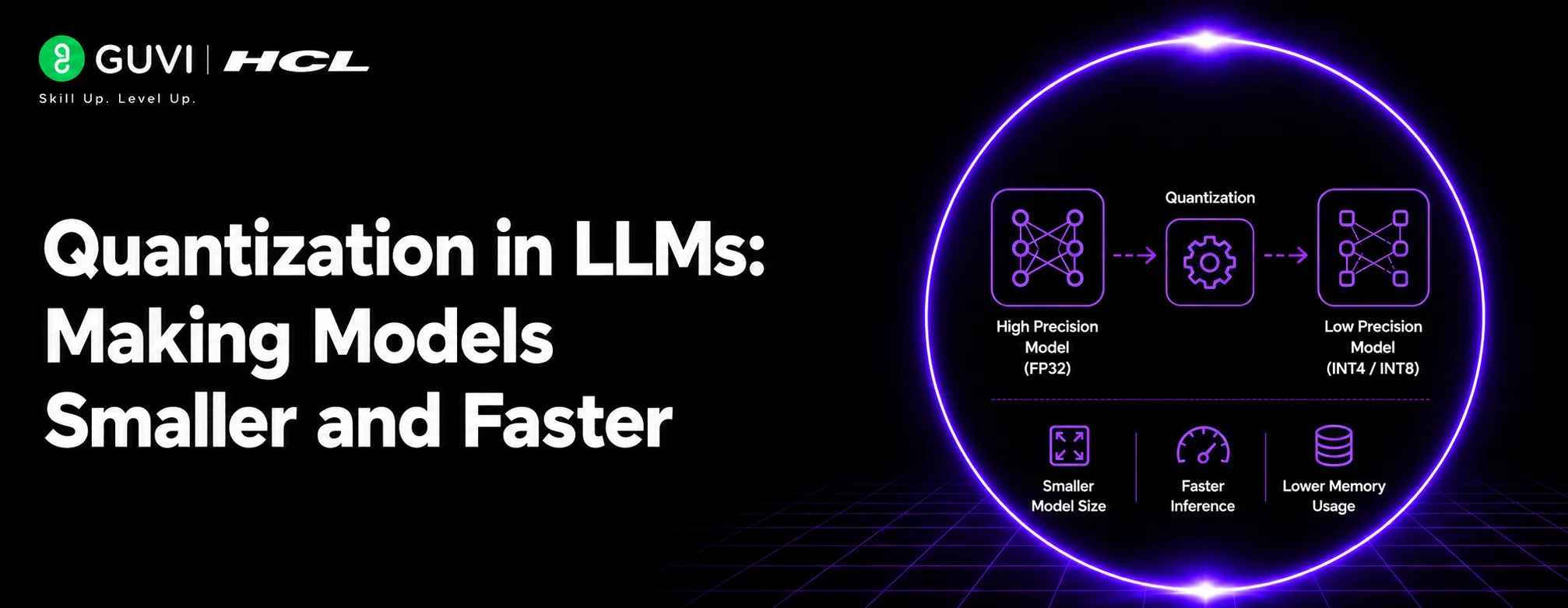
Quantization in LLMs: Making Models Smaller and Faster
Sep 01, 2026 3 Min Read 14 Views
(Last Updated)
Large Language Models (LLMs) deliver impressive performance but often require significant computational resources, memory, and storage. Quantization in LLMs addresses this challenge by reducing the numerical precision of model parameters while preserving most of the model’s accuracy. This optimization enables faster inference, lower memory consumption, and more efficient deployment across cloud, edge, and mobile devices.
Table of contents
- TL;DR Summary
- Why LLM Quantization Matters
- What is LLM Quantization?
- How Quantization Works
- Step 1: Train the Original Model
- Step 2: Convert Model Weights
- Step 3: Optimize Computation
- Step 4: Deploy the Quantized Model
- Common Quantization Techniques
- Dynamic Quantization
- Static Quantization
- Quantization-Aware Training (QAT)
- Post-Training Quantization (PTQ)
- Applications of LLM Quantization
- Edge AI
- Cloud AI
- Enterprise AI
- Generative AI
- Research
- Benefits of LLM Quantization
- Reduced Memory Usage
- Faster Inference
- Lower Infrastructure Costs
- Broader Hardware Support
- When Should You Use LLM Quantization?
- Edge AI Deployment
- Cloud Inference
- Enterprise AI Applications
- Real-Time AI Systems
- Resource-Constrained Hardware
- Key Concepts to Remember
- Real-World Applications
- Generative AI
- Enterprise AI
- Mobile AI
- Edge Computing
- Best Practices
- Conclusion
- FAQs
- What is LLM Quantization?
- Why is quantization important for LLMs?
- Does quantization reduce model accuracy?
- What is the difference between Post-Training Quantization and Quantization-Aware Training?
- Where is LLM Quantization used?
- Can quantized models run on CPUs?
- Why is LLM Quantization important?
TL;DR Summary
- LLM Quantization reduces model size.
- Lower numerical precision improves inference speed.
- Quantization decreases memory usage.
- It enables deployment on resource-constrained devices.
- Most model accuracy is preserved after quantization.
Direct Answer
| LLM Quantization is a model optimization technique that reduces the numerical precision of neural network weights and activations to decrease memory usage and accelerate inference. Instead of using high-precision values, quantized models use lower-bit representations while maintaining similar performance, enabling faster deployment of large language models on cloud servers, edge devices, and consumer hardware. |
Why LLM Quantization Matters
Modern language models contain billions of parameters, making deployment expensive and resource-intensive. Quantization allows organizations to run powerful AI models more efficiently.
Benefits include:
- Smaller model size
- Faster inference
- Lower memory consumption
- Reduced hardware requirements
- Lower deployment costs
- Improved edge AI performance
What is LLM Quantization?
LLM Quantization is the process of converting high-precision numerical values into lower-precision representations.
For example, instead of storing weights as 32-bit floating-point numbers, a quantized model may use:
- FP16 (16-bit floating point)
- INT8 (8-bit integers)
- INT4 (4-bit integers)
Reducing precision significantly decreases storage requirements while maintaining strong model performance.
How Quantization Works
Quantization simplifies numerical representations without substantially affecting prediction quality.
Step 1: Train the Original Model
The language model is first trained using high-precision numerical values.
Step 2: Convert Model Weights
Model weights are transformed into lower-bit numerical representations.
Step 3: Optimize Computation
Lower-precision arithmetic reduces memory usage and accelerates inference.
Step 4: Deploy the Quantized Model
The optimized model runs more efficiently on available hardware with minimal accuracy loss.
Common Quantization Techniques
Several quantization approaches are widely used in modern AI systems.
Dynamic Quantization
Weights are quantized while activations remain dynamic during inference.
Static Quantization
Weights and activations are calibrated before deployment to maximize inference efficiency.
Quantization-Aware Training (QAT)
The model learns to operate under lower precision during training, often preserving higher accuracy after quantization.
Post-Training Quantization (PTQ)
Quantization is applied after the model has already been trained, making deployment faster and simpler.
Applications of LLM Quantization
Edge AI
- Mobile AI applications
- Smart devices
- IoT deployments
- Offline AI assistants
Cloud AI
- Faster API responses
- Lower inference costs
- Improved scalability
- Efficient resource utilization
Enterprise AI
- Internal AI assistants
- Document analysis
- Customer support automation
- Knowledge management
Generative AI
- Chatbots
- Content generation
- Code assistants
- AI-powered search
Research
- Efficient experimentation
- Model benchmarking
- Resource optimization
- Faster inference testing
Quantization is one of the most effective optimization techniques for deploying large language models in production. Many modern LLM deployments combine quantization with pruning, efficient attention mechanisms, and optimized inference engines to maximize performance while minimizing hardware requirements.
Benefits of LLM Quantization
Reduced Memory Usage
Quantized models require significantly less RAM and storage.
Faster Inference
Lower-precision arithmetic enables quicker response times.
Lower Infrastructure Costs
Organizations can deploy AI models using fewer computing resources.
Broader Hardware Support
Quantized models run efficiently on cloud servers, GPUs, CPUs, mobile devices, and edge hardware.
Professionals interested in LLM optimization, AI deployment, model compression, and efficient machine learning systems can strengthen their expertise through HCL GUVI’s Artificial Intelligence and Machine Learning Course.
When Should You Use LLM Quantization?
LLM Quantization is most beneficial when deploying large language models in production environments where memory, inference speed, and hardware efficiency are critical.
Edge AI Deployment
Run language models on smartphones, IoT devices, embedded systems, and edge hardware with limited computing resources.

Cloud Inference
Reduce infrastructure costs while serving thousands of AI requests with faster inference and improved scalability.
Enterprise AI Applications
Deploy internal chatbots, document assistants, and knowledge management systems using fewer hardware resources.
Real-Time AI Systems
Applications requiring low-latency responses, such as virtual assistants and customer support chatbots, benefit from quantized models.
Resource-Constrained Hardware
Organizations without high-end GPUs can run optimized LLMs more efficiently using quantization techniques.
Key Concepts to Remember
Understanding these concepts makes LLM Quantization easier to learn.
- Quantization reduces numerical precision.
- Lower-bit models consume less memory.
- Smaller models often deliver faster inference.
- Most quantized models maintain high accuracy.
- Post-Training Quantization is easier to implement.
- Quantization-Aware Training usually preserves better accuracy.
Real-World Applications
LLM Quantization powers efficient AI deployment across many industries.
Generative AI
- AI chatbots
- Writing assistants
- Code generation
- Content creation
Enterprise AI
- Document analysis
- Knowledge management
- Internal AI assistants
- Business automation
Mobile AI
- Offline AI assistants
- Smart keyboards
- On-device translation
- Mobile productivity apps
Edge Computing
- Smart cameras
- IoT devices
- Industrial automation
- Robotics
The HCL GUVI’s Artificial Intelligence eBook introduces the fundamentals of generative AI, transformer models, machine learning, prompt engineering, and intelligent automation. It helps learners understand model optimization, LLM deployment, AI infrastructure, and practical techniques for building efficient AI systems.
Best Practices
- Select the appropriate quantization method for your deployment.
- Evaluate accuracy before deploying quantized models.
- Test inference speed on target hardware.
- Benchmark memory usage after optimization.
- Consider Quantization-Aware Training for critical applications.
- Monitor production performance regularly.
- Combine quantization with other optimization techniques when appropriate.
Conclusion
LLM Quantization enables organizations to deploy powerful language models more efficiently by reducing memory usage, accelerating inference, and lowering hardware requirements. Whether running AI in cloud environments, mobile devices, or edge systems, quantization makes large language models more practical without significantly compromising performance, making it one of the most important optimization techniques in modern AI deployment.
FAQs
1. What is LLM Quantization?
LLM Quantization is a model optimization technique that reduces the numerical precision of neural network weights and activations to decrease model size, memory usage, and inference time.
2. Why is quantization important for LLMs?
Quantization makes large language models faster, smaller, and more efficient, allowing them to run on hardware with limited memory and computational resources.
3. Does quantization reduce model accuracy?
In most cases, quantization causes only a small reduction in accuracy while providing significant improvements in speed and memory efficiency. The exact impact depends on the quantization method and model.
4. What is the difference between Post-Training Quantization and Quantization-Aware Training?
Post-Training Quantization (PTQ) is applied after a model has been trained, whereas Quantization-Aware Training (QAT) incorporates quantization effects during training to better preserve model accuracy.
5. Where is LLM Quantization used?
It is widely used in cloud AI platforms, mobile applications, edge computing, enterprise AI systems, robotics, virtual assistants, and real-time inference services.
6. Can quantized models run on CPUs?
Yes. Quantized models are often optimized for CPUs as well as GPUs, enabling efficient inference even on devices without specialized AI hardware.
7. Why is LLM Quantization important?
LLM Quantization reduces deployment costs, improves inference speed, lowers memory consumption, and enables large language models to run efficiently across cloud servers, edge devices, mobile platforms, and enterprise AI applications, making advanced AI more accessible and scalable.
Success Stories

About the Author
HCL GUVI
This article was selected and published as part of the HCL GUVI AI Blogathon 2026, an initiative designed to encourage students, AI enthusiasts, and aspiring tech writers to simplify complex AI concepts through impactful technical content. The contest recognized high-quality, original, and insightful AI-focused blogs, with selected authors receiving publication opportunities on the HCL GUVI blog platform along with official author credits and recognition.
View all posts by HCL GUVI
Connect with me @









Did you enjoy this article?