


Artificial Intelligence and Machine Learning Articles
LoRA and QLoRA Explained: Efficient Fine-Tuning
Quantization in LLMs: Making Models Smaller and Faster
Word Embeddings vs Sentence Embeddings: What's the Difference?


Get In Touch For Details! Request More Information
ResNet Architecture Explained: Skip Connections and Deep Networks
Sep 01, 2026 3 Min Read 12 Views
(Last Updated)
Training very deep neural networks was once difficult because model accuracy often degraded as more layers were added. ResNet Architecture solved this challenge by introducing skip connections, allowing information to flow directly across layers and making deep learning models easier to train. Today, ResNet powers many computer vision applications, from image classification to medical imaging. This guide explains ResNet Architecture, skip connections, and how deep networks transformed modern artificial intelligence.
Table of contents
- TL;DR Summary
- Why ResNet Architecture Matters
- What is ResNet Architecture?
- How Skip Connections Work
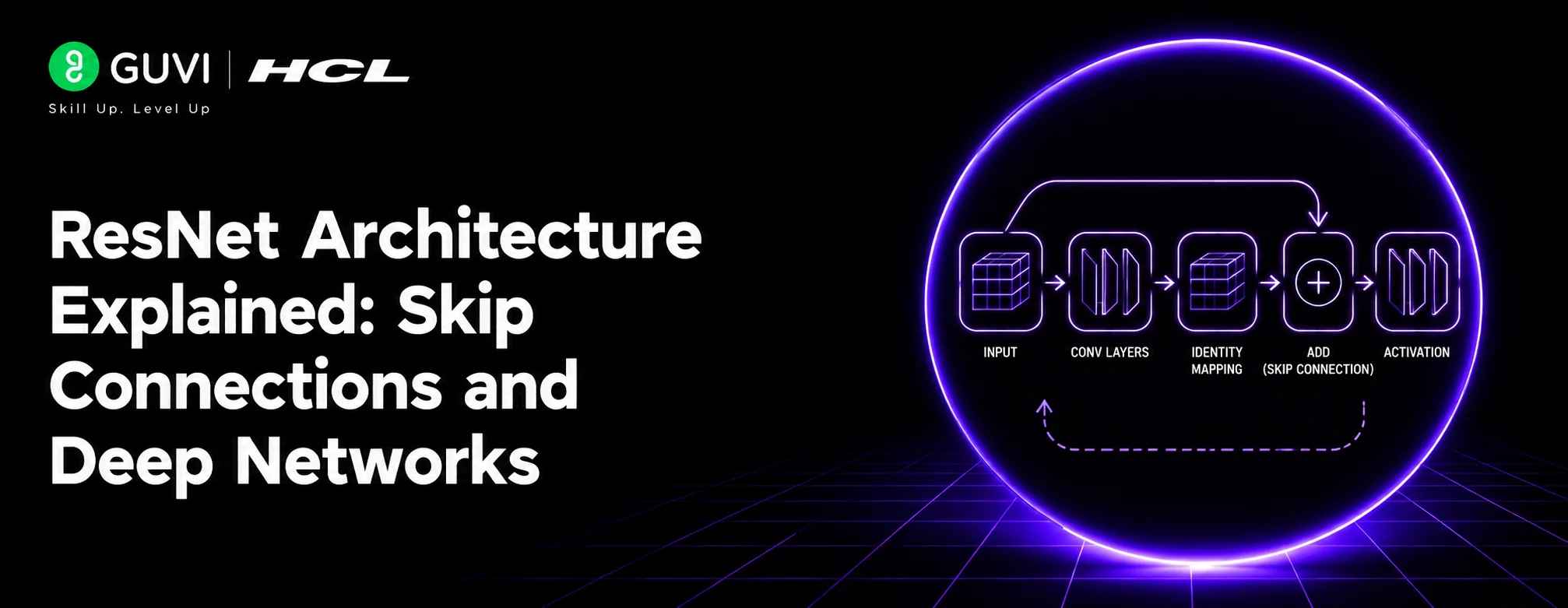
- Step 1: Input Enters a Residual Block
- Step 2: Learn the Residual
- Step 3: Add the Original Input
- Step 4: Continue Through the Network
- Why Skip Connections Are Important
- Reduce Vanishing Gradients
- Enable Deeper Networks
- Improve Accuracy
- Faster Convergence
- Popular ResNet Variants
- ResNet-18
- ResNet-34
- ResNet-50
- ResNet-101 and ResNet-152
- Applications of ResNet Architecture
- Healthcare
- Autonomous Vehicles
- Retail
- Security
- Manufacturing
- Benefits of ResNet Architecture
- Excellent Accuracy
- Easier Optimization
- Strong Transfer Learning
- Broad Industry Adoption
- When Should You Use ResNet?
- Large Image Classification Tasks
- Transfer Learning Projects
- Medical Imaging
- Object Detection
- Industrial Inspection
- Key Concepts to Remember
- Real-World Applications
- Healthcare
- Autonomous Vehicles
- Retail
- Manufacturing
- Best Practices
- Conclusion
- FAQs
- What is ResNet Architecture?
- What are skip connections?
- Why is ResNet important?
- What are common ResNet versions?
- Is ResNet still used today?
- Can beginners learn ResNet easily?
- What makes ResNet different from traditional CNNs?
TL;DR Summary
- ResNet introduced skip connections to deep learning.
- Skip connections help train very deep neural networks.
- ResNet reduces the vanishing gradient problem.
- It improves image recognition accuracy.
- ResNet remains one of the most influential CNN architectures.
Direct Answer
| ResNet Architecture is a deep convolutional neural network (CNN) that introduces skip connections to improve the training of deep networks. Instead of learning complete mappings, ResNet learns residual functions, allowing gradients to flow more effectively through many layers. This innovation enables highly accurate image classification while reducing training difficulties such as vanishing gradients and model degradation. |
Why ResNet Architecture Matters
As neural networks became deeper, researchers discovered that simply adding more layers did not always improve performance. ResNet addressed this challenge, making very deep networks practical for real-world AI applications.
Professionals interested in computer vision, deep learning, and ResNet architectures can strengthen their expertise through HCL GUVI’s Artificial Intelligence and Machine Learning Course.
What is ResNet Architecture?
ResNet (Residual Network) is a convolutional neural network introduced by Microsoft Research in 2015.
Instead of forcing every layer to learn an entirely new transformation, ResNet allows some information to bypass intermediate layers through skip connections, making optimization significantly easier.
This simple idea enabled networks with dozens or even hundreds of layers to achieve remarkable performance.
How Skip Connections Work
Skip connections are the defining feature of ResNet.
Step 1: Input Enters a Residual Block
The input passes through several convolutional layers inside a residual block.
Step 2: Learn the Residual
Instead of learning the complete output, the network learns only the difference (residual) between the input and the desired output.
Step 3: Add the Original Input
The original input is added directly to the block’s output using a skip connection.
Step 4: Continue Through the Network
The combined output becomes the input for the next residual block, allowing gradients to propagate more effectively during training.
Why Skip Connections Are Important
Skip connections solve several challenges associated with training very deep neural networks.
Reduce Vanishing Gradients
Gradients flow more efficiently through the network, making optimization easier.
Enable Deeper Networks
Architectures with 50, 101, or even 152 layers become practical to train.
Improve Accuracy
Residual learning often produces better image classification performance than traditional deep CNNs.
Faster Convergence
Training generally becomes more stable and requires fewer optimization difficulties.
Popular ResNet Variants
Several versions of ResNet are commonly used.
ResNet-18
A lightweight architecture suitable for smaller datasets and faster training.
ResNet-34
Provides improved accuracy while maintaining reasonable computational efficiency.
ResNet-50
One of the most widely used deep learning models for computer vision applications.
ResNet-101 and ResNet-152
Very deep architectures designed for large-scale image recognition and advanced research.
Applications of ResNet Architecture
ResNet supports numerous computer vision applications.
Healthcare
- Medical image classification
- Disease detection
- Radiology image analysis
Autonomous Vehicles
- Object detection
- Traffic sign recognition
- Pedestrian identification
Retail
- Product recognition
- Visual search
- Inventory automation
Security
- Face recognition
- Surveillance analysis
- Identity verification
Manufacturing
- Quality inspection
- Defect detection
- Industrial automation
TinyML can allow devices to continue performing certain AI tasks even when they have limited or no internet connectivity because inference can happen directly on the device.
Benefits of ResNet Architecture
Excellent Accuracy
ResNet delivers highly accurate image classification across many benchmark datasets.
Easier Optimization
Residual learning simplifies the training of deep neural networks.
Strong Transfer Learning
Pretrained ResNet models can be fine-tuned for many computer vision tasks.
Broad Industry Adoption
ResNet is widely used in healthcare, manufacturing, retail, autonomous driving, and AI research.

When Should You Use ResNet?
ResNet is an excellent choice when building deep learning models for computer vision tasks that require high accuracy and reliable performance.
Large Image Classification Tasks
ResNet performs exceptionally well on datasets containing thousands or millions of labeled images.
Transfer Learning Projects
Developers frequently fine-tune pretrained ResNet models instead of training CNNs from scratch, reducing both training time and data requirements.
Medical Imaging
Hospitals and research institutions use ResNet for disease detection, X-ray analysis, MRI interpretation, and pathology image classification.
Object Detection
Many object detection frameworks use ResNet as a feature extraction backbone for identifying people, vehicles, products, and other objects.
Industrial Inspection
Manufacturers use ResNet to detect product defects, classify components, and automate quality control processes.
Key Concepts to Remember
When learning ResNet Architecture, remember these important ideas:
- Skip connections allow information to bypass layers.
- Residual learning makes optimization easier.
- Deep networks become easier to train.
- Vanishing gradients are significantly reduced.
- Pretrained ResNet models are widely used for transfer learning.
- ResNet serves as the backbone for many modern computer vision systems.
Real-World Applications
ResNet powers AI solutions across multiple industries.
Healthcare
- Medical image diagnosis
- Tumor detection
- Disease classification
- Organ segmentation
Autonomous Vehicles
- Traffic sign recognition
- Lane detection
- Object recognition
- Pedestrian detection
Retail
- Product recognition
- Visual search
- Shelf monitoring
- Inventory automation
Manufacturing
- Defect detection
- Product quality inspection
- Assembly verification
- Predictive maintenance through image analysis
The HCL GUVI’s Artificial Intelligence eBook introduces the fundamentals of generative AI, deep learning, computer vision, neural networks, and practical AI development. It helps learners understand how modern architectures like ResNet power real-world intelligent applications.
Best Practices
- Start with pretrained ResNet models whenever possible.
- Choose the ResNet variant based on your computational resources.
- Apply data augmentation to improve model generalization.
- Fine-tune only the necessary layers for transfer learning.
- Monitor validation accuracy to prevent overfitting.
- Optimize hyperparameters before increasing network depth.
- Evaluate performance using unseen test data.
Conclusion
ResNet Architecture transformed deep learning by introducing skip connections, making it possible to train very deep networks efficiently. Its ability to improve gradient flow, boost image classification accuracy, and support transfer learning has made ResNet one of the most influential CNN architectures, powering countless computer vision applications across healthcare, manufacturing, autonomous driving, and AI research.
FAQs
1. What is ResNet Architecture?
ResNet Architecture is a deep convolutional neural network that uses residual learning and skip connections to improve the training of very deep models.
2. What are skip connections?
Skip connections allow information to bypass one or more neural network layers, helping gradients flow more effectively during training.
3. Why is ResNet important?
ResNet solved the degradation and vanishing gradient problems, making it practical to train neural networks with dozens or even hundreds of layers.
4. What are common ResNet versions?
Popular versions include ResNet-18, ResNet-34, ResNet-50, ResNet-101, and ResNet-152, each offering different trade-offs between speed and accuracy.
5. Is ResNet still used today?
Yes. ResNet remains widely used for transfer learning, image classification, object detection, medical imaging, and as a backbone in many computer vision models.
6. Can beginners learn ResNet easily?
Yes. Once you understand convolutional neural networks and residual blocks, ResNet is one of the easiest advanced architectures to learn because of its straightforward design.
7. What makes ResNet different from traditional CNNs?
Unlike traditional CNNs, the ResNet Architecture uses skip connections that allow information to flow across layers, enabling deeper models to train more effectively while maintaining strong predictive performance.
Success Stories

About the Author
HCL GUVI
This article was selected and published as part of the HCL GUVI AI Blogathon 2026, an initiative designed to encourage students, AI enthusiasts, and aspiring tech writers to simplify complex AI concepts through impactful technical content. The contest recognized high-quality, original, and insightful AI-focused blogs, with selected authors receiving publication opportunities on the HCL GUVI blog platform along with official author credits and recognition.
View all posts by HCL GUVI
Connect with me @





Did you enjoy this article?