


Artificial Intelligence and Machine Learning Articles
LoRA and QLoRA Explained: Efficient Fine-Tuning
Quantization in LLMs: Making Models Smaller and Faster
Word Embeddings vs Sentence Embeddings: What's the Difference?
ResNet Architecture Explained: Skip Connections and Deep Networks


Get In Touch For Details! Request More Information
U-Net Architecture for Image Segmentation
Sep 01, 2026 3 Min Read 11 Views
(Last Updated)
Accurately identifying the boundaries of objects within an image is a fundamental challenge in computer vision. U-Net Architecture was specifically designed for image segmentation, enabling pixel-level classification with remarkable precision. Originally developed for biomedical image analysis, U-Net is now widely used in healthcare, satellite imagery, autonomous vehicles, and industrial inspection. This guide explains U-Net Architecture, how it works, and why it has become one of the most influential deep learning models for segmentation tasks.
Table of contents
- TL;DR Summary
- Why U-Net Architecture Matters
- What is U-Net Architecture?
- How U-Net Works
- Step 1: Encoder (Contracting Path)
- Step 2: Bottleneck
- Step 3: Decoder (Expanding Path)
- Step 4: Skip Connections
- Key Components of U-Net
- Encoder
- Decoder
- Skip Connections
- Segmentation Output
- Why Skip Connections Are Important
- Applications of U-Net Architecture
- Healthcare
- Autonomous Vehicles
- Satellite Imaging
- Manufacturing
- Agriculture
- Benefits of U-Net Architecture
- Pixel-Level Accuracy
- Excellent Medical Imaging Performance
- Efficient Learning
- Broad Industry Adoption
- When Should You Use U-Net?
- Medical Image Segmentation
- Autonomous Driving
- Satellite Image Analysis
- Industrial Inspection
- Agriculture
- Key Concepts to Remember
- Real-World Applications
- Healthcare
- Autonomous Vehicles
- Satellite Imaging
- Manufacturing
- Best Practices
- Conclusion
- FAQs
- What is U-Net Architecture?
- Why is U-Net called U-Net?
- What are skip connections in U-Net?
- What is image segmentation?
- Where is U-Net used?
- Why is U-Net popular for medical imaging?
- What makes U-Net different from image classification models?
TL;DR Summary
- U-Net is designed for image segmentation.
- It performs pixel-level image classification.
- Skip connections preserve fine image details.
- The encoder captures features while the decoder reconstructs the image.
- U-Net is widely used in medical imaging and computer vision.
Direct Answer
| U-Net Architecture is a convolutional neural network (CNN) developed for image segmentation. Unlike image classification, which predicts a single label, U-Net assigns a class to every pixel in an image. Its encoder-decoder structure and skip connections preserve detailed spatial information, enabling highly accurate segmentation in medical imaging, autonomous driving, satellite analysis, and industrial inspection. |
Why U-Net Architecture Matters
Many computer vision tasks require identifying the exact location and boundaries of objects rather than simply recognizing their presence. U-Net solves this challenge by performing pixel-level predictions.
Benefits include:
- Precise object segmentation
- High localization accuracy
- Effective with limited training data
- Strong feature preservation
- Excellent medical imaging performance
- Reliable transfer learning
Professionals interested in U-Net architecture, semantic segmentation, convolutional neural networks, and deep learning can strengthen their expertise through HCL GUVI’s Artificial Intelligence and Machine Learning Course.
What is U-Net Architecture?
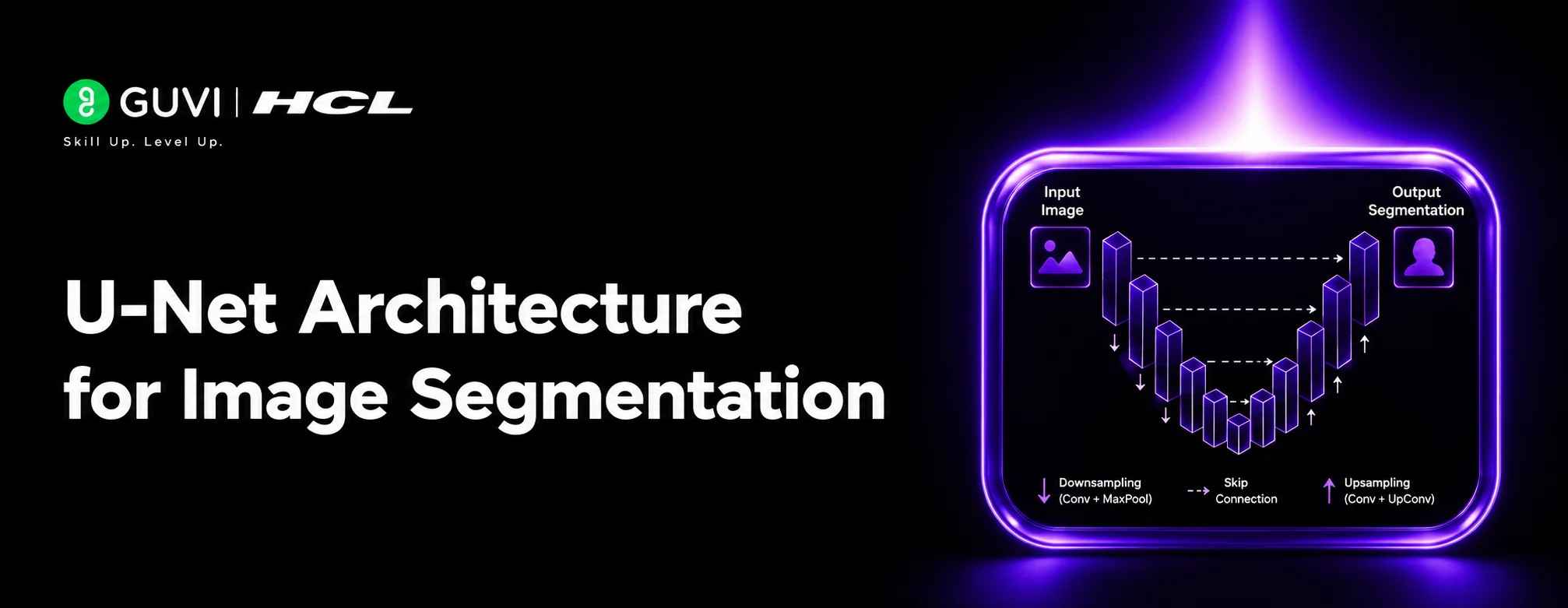
U-Net is a convolutional neural network introduced in 2015 for biomedical image segmentation.
Its architecture resembles the letter “U”, consisting of:
- An Encoder that extracts image features.
- A Decoder that reconstructs detailed segmentation maps.
- Skip Connections that transfer fine-grained spatial information between corresponding encoder and decoder layers.
This design allows U-Net to capture both global context and precise object boundaries.
How U-Net Works
U-Net processes images through two complementary paths.
Step 1: Encoder (Contracting Path)
The encoder applies convolution and pooling operations to extract increasingly complex image features while reducing spatial dimensions.
Step 2: Bottleneck
The bottleneck captures the most abstract representation of the image before reconstruction begins.
Step 3: Decoder (Expanding Path)
The decoder upsamples feature maps to restore the original image resolution while predicting pixel-level labels.
Step 4: Skip Connections
Feature maps from the encoder are combined with corresponding decoder layers, preserving important details lost during downsampling.
Key Components of U-Net
Encoder
Extracts low-level and high-level visual features through stacked convolutional layers.
Decoder
Gradually restores image resolution while generating accurate segmentation masks.
Skip Connections
Transfer detailed spatial information from encoder layers to decoder layers for better localization.
Segmentation Output
Produces a prediction for every pixel, creating a complete segmentation mask instead of a single image label.
Why Skip Connections Are Important
Skip connections are one of the most important innovations in U-Net.
They help:
- Preserve fine image details.
- Improve object boundary detection.
- Recover information lost during pooling.
- Increase segmentation accuracy.
- Enable better learning with fewer training images.
Applications of U-Net Architecture
Healthcare
- Tumor segmentation
- Organ detection
- MRI analysis
- CT scan segmentation
Autonomous Vehicles
- Road segmentation
- Lane detection
- Pedestrian segmentation
- Obstacle recognition
Satellite Imaging
- Land-use classification
- Building segmentation
- Road extraction
- Flood mapping
Manufacturing
- Surface defect detection
- Quality inspection
- Component segmentation
- Industrial automation
Agriculture
- Crop monitoring
- Plant disease segmentation
- Field mapping
- Precision farming
U-Net performs particularly well when precise object boundaries are important. While classification models identify what an object is, U-Net determines exactly where every pixel belonging to that object is located, making it ideal for segmentation tasks.
Benefits of U-Net Architecture
Pixel-Level Accuracy
Every pixel receives its own prediction, resulting in highly detailed segmentation maps.
Excellent Medical Imaging Performance
U-Net remains one of the most widely used architectures for biomedical image analysis.
Efficient Learning
The architecture performs well even with relatively small annotated datasets.
Broad Industry Adoption
U-Net is widely applied across healthcare, manufacturing, agriculture, satellite imaging, and autonomous systems.
When Should You Use U-Net?
U-Net is the preferred choice when a task requires identifying the exact location and shape of objects rather than simply classifying an image. It performs exceptionally well in applications requiring precise pixel-level predictions.

Medical Image Segmentation
Hospitals and research institutions use U-Net to segment tumors, organs, blood vessels, and other anatomical structures from MRI, CT, ultrasound, and X-ray images.
Autonomous Driving
Self-driving systems use U-Net to segment roads, lane markings, pedestrians, vehicles, and obstacles for safer navigation.
Satellite Image Analysis
Remote sensing applications use U-Net for land cover classification, road extraction, building detection, flood mapping, and environmental monitoring.
Industrial Inspection
Manufacturers apply U-Net to detect product defects, identify damaged components, and automate quality inspection on production lines.
Agriculture
U-Net helps monitor crop health, segment agricultural fields, detect plant diseases, and support precision farming using drone and satellite imagery.
Key Concepts to Remember
Understanding these concepts makes U-Net Architecture easier to learn.
- U-Net performs pixel-level image segmentation.
- The encoder extracts important image features.
- The decoder reconstructs high-resolution segmentation maps.
- Skip connections preserve detailed spatial information.
- Every pixel receives an individual class prediction.
- U-Net performs well even with limited labeled datasets.
Real-World Applications
U-Net powers numerous AI-driven image segmentation systems.
Healthcare
- Tumor segmentation
- Organ segmentation
- Medical image analysis
- Disease localization
Autonomous Vehicles
- Road segmentation
- Lane detection
- Vehicle segmentation
- Pedestrian detection
Satellite Imaging
- Building detection
- Land-use mapping
- Road extraction
- Environmental monitoring
Manufacturing
- Surface defect detection
- Product inspection
- Component segmentation
- Quality control automation
The HCL GUVI’s Artificial Intelligence eBook introduces the fundamentals of generative AI, computer vision, convolutional neural networks, deep learning, and practical AI development. It helps learners understand semantic segmentation, modern neural network architectures, and real-world AI applications across multiple industries.
Best Practices
- Use high-quality labeled segmentation datasets.
- Apply data augmentation to improve model generalization.
- Normalize input images before training.
- Start with pretrained encoder backbones when available.
- Monitor IoU and Dice Score during evaluation.
- Fine-tune hyperparameters for different datasets.
- Validate model performance using unseen test images.
Conclusion
U-Net Architecture transformed image segmentation by combining an encoder-decoder design with skip connections that preserve fine image details. Its ability to deliver accurate pixel-level predictions has made it one of the most widely used deep learning models for medical imaging, autonomous driving, satellite analysis, and industrial inspection, providing a strong foundation for modern computer vision applications.
FAQs
1. What is U-Net Architecture?
U-Net Architecture is a convolutional neural network (CNN) designed specifically for image segmentation, where every pixel in an image is assigned a class label.
2. Why is U-Net called U-Net?
The architecture forms a U-shaped structure with an encoder that extracts features and a decoder that reconstructs detailed segmentation maps.
3. What are skip connections in U-Net?
Skip connections transfer feature maps from encoder layers directly to decoder layers, helping preserve spatial information and improve segmentation accuracy.
4. What is image segmentation?
Image segmentation is a computer vision task that divides an image into meaningful regions by assigning a class label to each individual pixel.
5. Where is U-Net used?
U-Net is widely used in healthcare, autonomous vehicles, satellite imaging, agriculture, manufacturing, and scientific research for precise object segmentation.
6. Why is U-Net popular for medical imaging?
U-Net achieves highly accurate segmentation while performing well with relatively small labeled medical datasets, making it suitable for many healthcare applications.
7. What makes U-Net different from image classification models?
Unlike image classification models that assign one label to an entire image, U-Net Architecture predicts the class of every pixel, enabling precise object localization and segmentation.
Success Stories

About the Author
HCL GUVI
This article was selected and published as part of the HCL GUVI AI Blogathon 2026, an initiative designed to encourage students, AI enthusiasts, and aspiring tech writers to simplify complex AI concepts through impactful technical content. The contest recognized high-quality, original, and insightful AI-focused blogs, with selected authors receiving publication opportunities on the HCL GUVI blog platform along with official author credits and recognition.
View all posts by HCL GUVI
Connect with me @





Did you enjoy this article?