


Artificial Intelligence and Machine Learning Articles
LoRA and QLoRA Explained: Efficient Fine-Tuning
Quantization in LLMs: Making Models Smaller and Faster
U-Net Architecture for Image Segmentation
ResNet Architecture Explained: Skip Connections and Deep Networks


Get In Touch For Details! Request More Information
Word Embeddings vs Sentence Embeddings: What’s the Difference?
Sep 01, 2026 3 Min Read 9 Views
(Last Updated)
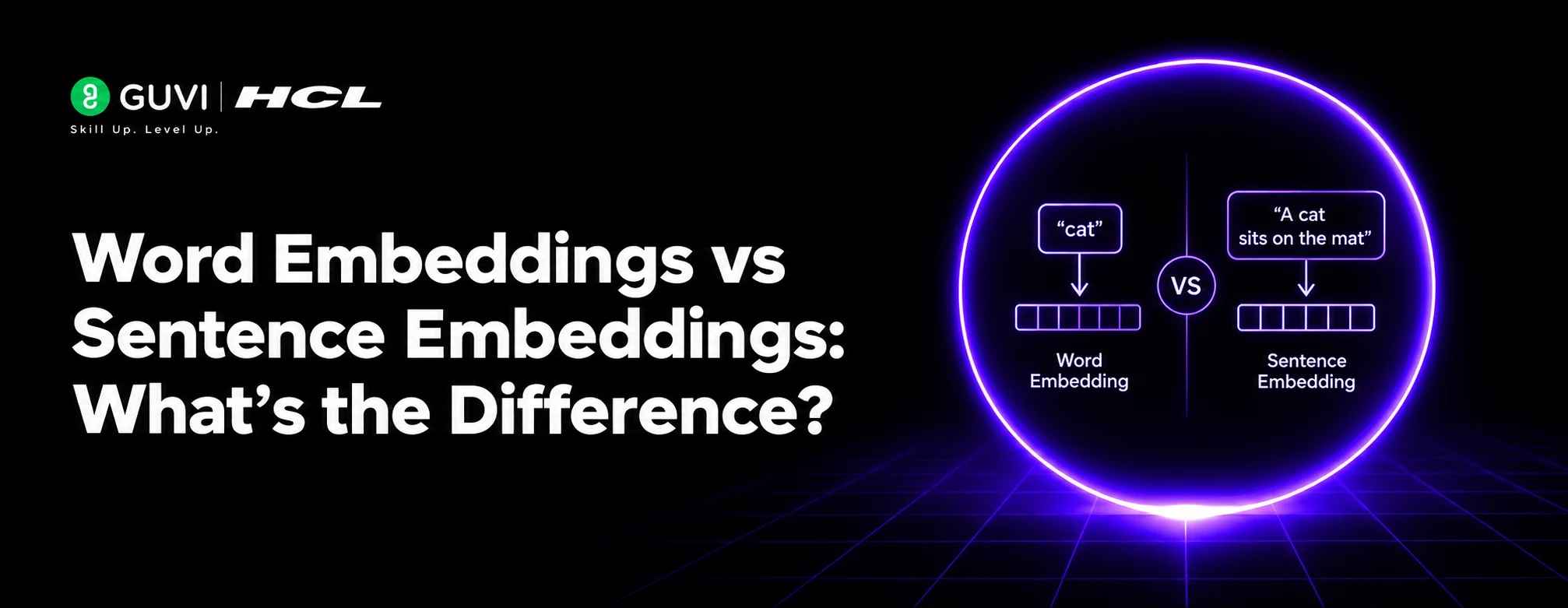
Computers cannot understand human language directly, so words and sentences must first be converted into numerical representations that machine learning models can process. This is where Word Embedding vs Sentence Embeddings becomes an important concept in Natural Language Processing (NLP). While word embeddings represent individual words as vectors, sentence embeddings capture the meaning of an entire sentence. This guide explains the differences, how each works, and when to use them in real-world AI applications.
Table of contents
- TL;DR Summary
- Why Embeddings Matter
- What Are Word Embeddings?
- What Are Sentence Embeddings?
- Word Embeddings
- Sentence Embeddings
- How Embeddings Work
- Step 1: Process Text
- Step 2: Learn Numerical Representations
- Step 3: Capture Semantic Relationships
- Step 4: Support NLP Tasks
- Common Applications
- Search Engines
- Chatbots
- Recommendation Systems
- Text Analytics
- Healthcare
- Benefits of Embeddings
- Better Semantic Understanding
- Faster NLP Processing
- Broad Industry Adoption
- Foundation of Modern NLP
- When Should You Use Word Embeddings or Sentence Embeddings?
- Word-Level Analysis
- Semantic Search
- Chatbots and Virtual Assistants
- Document Similarity
- Recommendation Systems
- Key Concepts to Remember
- Real-World Applications
- Search Engines
- Conversational AI
- Recommendation Systems
- Business Intelligence
- Best Practices
- Conclusion
- FAQs
- What are word embeddings?
- What are sentence embeddings?
- What is the main difference between word and sentence embeddings?
- Which is better for semantic search?
- Are embeddings used in Large Language Models?
- Can sentence embeddings replace word embeddings?
- Why are embeddings important in NLP?
TL;DR Summary
- Word embeddings represent individual words.
- Sentence embeddings represent complete sentences.
- Both convert text into numerical vectors.
- Sentence embeddings capture overall context better.
- Both are fundamental techniques in Natural Language Processing.
Direct Answer
| The main difference in Word Embeddings vs Sentence Embeddings is the level of representation. Word embeddings convert individual words into numerical vectors, preserving semantic relationships between words. Sentence embeddings represent the meaning of an entire sentence in a single vector by capturing context, word relationships, and sentence structure, making them suitable for modern Natural Language Processing applications. |
Why Embeddings Matter
Machine learning models require numerical inputs instead of raw text. Embeddings convert language into mathematical representations while preserving semantic meaning.
Benefits include:
- Better text understanding
- Improved semantic similarity
- Efficient NLP processing
- Enhanced search performance
- Better recommendation systems
- Improved language model accuracy
What Are Word Embeddings?
Word embeddings convert each individual word into a dense numerical vector.
Instead of treating words as isolated symbols, embeddings position similar words close together in a multidimensional vector space.
For example:
- “King” and “Queen” appear close together.
- “Doctor” and “Hospital” share similar semantic relationships.
- “Cat” and “Dog” have nearby vector representations.
Popular word embedding models include:
- Word2Vec
- GloVe
- FastText
What Are Sentence Embeddings?
Sentence embeddings represent an entire sentence using a single numerical vector.
Instead of encoding words independently, sentence embeddings capture:
- Overall meaning
- Context
- Word relationships
- Sentence structure
Modern language models generate sentence embeddings that are highly effective for semantic search, retrieval, clustering, and question answering.
Word Embeddings vs Sentence Embeddings
Understanding their differences helps select the right representation for an NLP task.
Word Embeddings
- Represent individual words
- Capture word similarity
- Smaller vector representations
- Best for word-level tasks
Sentence Embeddings
- Represent complete sentences
- Capture contextual meaning
- Preserve sentence semantics
- Best for document-level understanding
How Embeddings Work
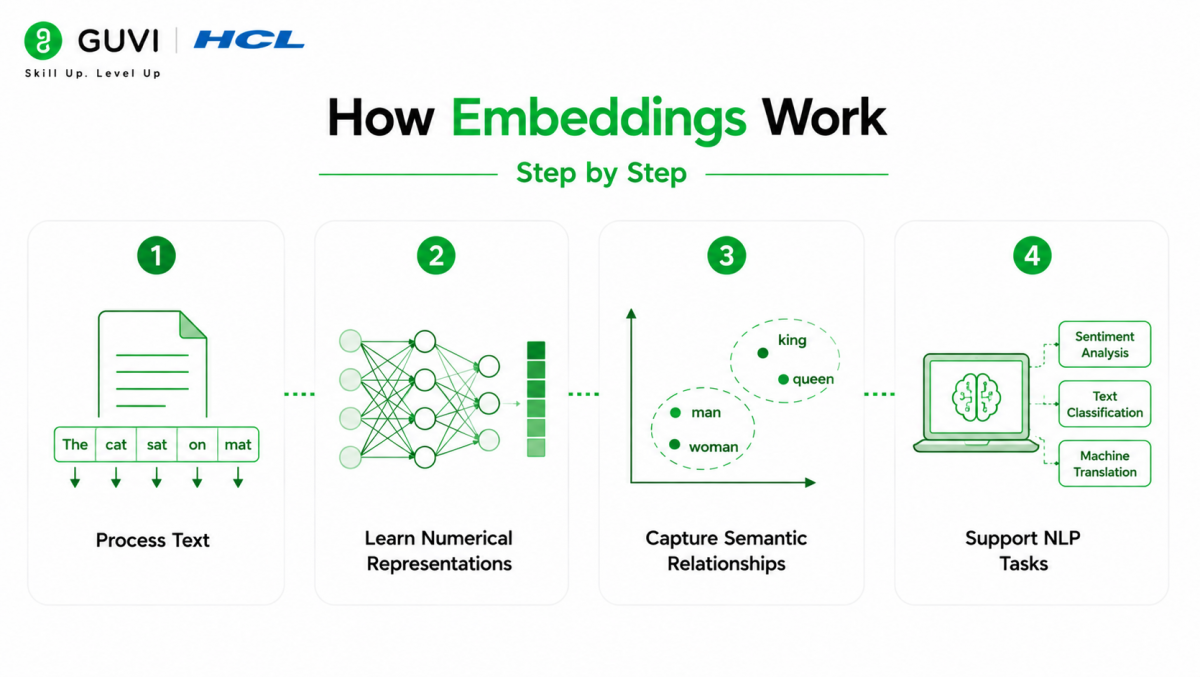
Although implementation varies, most embedding models follow a similar process.
Step 1: Process Text
Words or sentences are converted into tokens.
Step 2: Learn Numerical Representations
Neural networks learn vector representations from large text datasets.
Step 3: Capture Semantic Relationships
Similar words or sentences receive similar vector representations.
Step 4: Support NLP Tasks
Embeddings become input features for downstream NLP models.
Common Applications
Search Engines
- Semantic search
- Query understanding
- Document retrieval
Chatbots
- Intent detection
- Response generation
- Conversation understanding
Recommendation Systems
- Content recommendations
- Similarity matching
- Personalized suggestions
Text Analytics
- Document clustering
- Topic classification
- Sentiment analysis
Healthcare
- Clinical document analysis
- Medical text mining
- Healthcare NLP
If your application needs to understand individual words, use word embeddings. If one needs to understand the meaning of an entire sentence or paragraph, sentence embeddings usually provide much better performance because they preserve contextual information rather than treating each word independently.
Benefits of Embeddings
Better Semantic Understanding
Embeddings capture relationships between words and sentences beyond simple keyword matching.
Faster NLP Processing
Dense vector representations improve the efficiency of many machine learning algorithms.
Broad Industry Adoption
Embeddings power search engines, recommendation systems, virtual assistants, translation systems, and enterprise AI solutions.
Foundation of Modern NLP
Many transformer models build upon embedding representations to perform advanced language understanding tasks.
Professionals interested in Natural Language Processing, transformer models, semantic search, and AI development can strengthen their expertise through HCL GUVI’s Artificial Intelligence and Machine Learning Course.
When Should You Use Word Embeddings or Sentence Embeddings?
Choosing between word and sentence embeddings depends on what your NLP application needs to understand. Word embeddings focus on individual words, while sentence embeddings capture the meaning of complete sentences.

Word-Level Analysis
Use word embeddings when analyzing individual words, finding synonyms, studying semantic relationships, or building word-level NLP features.
Semantic Search
Use sentence embeddings to compare the meaning of search queries and documents instead of relying only on keyword matching.
Chatbots and Virtual Assistants
Sentence embeddings help AI understand complete user queries, improving intent detection and generating more relevant responses.
Document Similarity
Sentence embeddings enable applications to compare articles, reports, emails, and documents based on overall meaning rather than exact wording.
Recommendation Systems
Content recommendation platforms use embeddings to identify semantically similar products, articles, videos, or learning resources.
Key Concepts to Remember
Understanding these concepts makes Word Embeddings vs Sentence Embeddings much easier.
- Word embeddings represent individual words.
- Sentence embeddings represent complete sentences.
- Both convert text into numerical vectors.
- Similar meanings produce similar vector representations.
- Sentence embeddings preserve contextual information.
- Modern NLP models rely heavily on embeddings.
Real-World Applications
Embeddings power many AI applications used every day.
Search Engines
- Semantic search
- Query understanding
- Document retrieval
- Search ranking
Conversational AI
- Chatbots
- Virtual assistants
- Intent detection
- Response retrieval
Recommendation Systems
- Content recommendations
- Product matching
- Similar article suggestions
- Personalized recommendations
Business Intelligence
- Document clustering
- Customer feedback analysis
- Email classification
- Knowledge management
The HCL GUVI’s Artificial Intelligence eBook introduces the fundamentals of generative AI, Natural Language Processing, transformer models, machine learning, and intelligent automation. It helps learners understand embeddings, semantic search, large language models, and practical NLP applications used across modern AI systems.
Best Practices
- Choose word embeddings for word-level NLP tasks.
- Use sentence embeddings for semantic understanding.
- Fine-tune embedding models for domain-specific applications.
- Normalize text before generating embeddings.
- Evaluate embeddings using real-world datasets.
- Select embedding models based on application requirements.
- Regularly update models as NLP technologies evolve.
Conclusion
Understanding Word Embeddings vs Sentence Embeddings is fundamental to modern Natural Language Processing. Word embeddings capture the meaning of individual words, while sentence embeddings represent complete thoughts by preserving context and semantics. Choosing the appropriate embedding technique improves search, recommendation systems, chatbots, document analysis, and many other AI-powered language applications across industries.
FAQs
1. What are word embeddings?
Word embeddings are numerical vector representations of individual words that capture semantic relationships between words based on their usage in large text datasets.
2. What are sentence embeddings?
Sentence embeddings represent an entire sentence as a single vector, preserving its overall meaning, context, and relationships between words.
3. What is the main difference between word and sentence embeddings?
Word embeddings represent individual words, whereas sentence embeddings represent the semantic meaning of an entire sentence or short paragraph.
4. Which is better for semantic search?
Sentence embeddings are generally better because they compare the meaning of complete queries and documents rather than matching individual keywords.
5. Are embeddings used in Large Language Models?
Yes. Modern Large Language Models (LLMs) use embeddings to convert text into numerical representations before processing language through transformer architectures.
6. Can sentence embeddings replace word embeddings?
Not always. Word embeddings remain useful for word-level tasks such as synonym detection, keyword analysis, and linguistic research, while sentence embeddings are better for understanding complete text.
7. Why are embeddings important in NLP?
Embeddings convert human language into meaningful numerical representations that enable AI models to understand semantics, measure similarity, perform semantic search, power chatbots, analyze documents, and improve language understanding across numerous Natural Language Processing applications.
Success Stories

About the Author
HCL GUVI
This article was selected and published as part of the HCL GUVI AI Blogathon 2026, an initiative designed to encourage students, AI enthusiasts, and aspiring tech writers to simplify complex AI concepts through impactful technical content. The contest recognized high-quality, original, and insightful AI-focused blogs, with selected authors receiving publication opportunities on the HCL GUVI blog platform along with official author credits and recognition.
View all posts by HCL GUVI
Connect with me @











Did you enjoy this article?