


Artificial Intelligence and Machine Learning Articles
Finance Manager to Data Analytics: Career Growth, Salary and Seniority
How to Evaluate LLM Outputs in Production Deployments
AI/ML Skills Gap 2026: Why Companies Can't Find Job-Ready Talent
20 AI/ML Interview Questions Recruiters Can Use Without a Tech Background - Best Guide


Get In Touch For Details! Request More Information
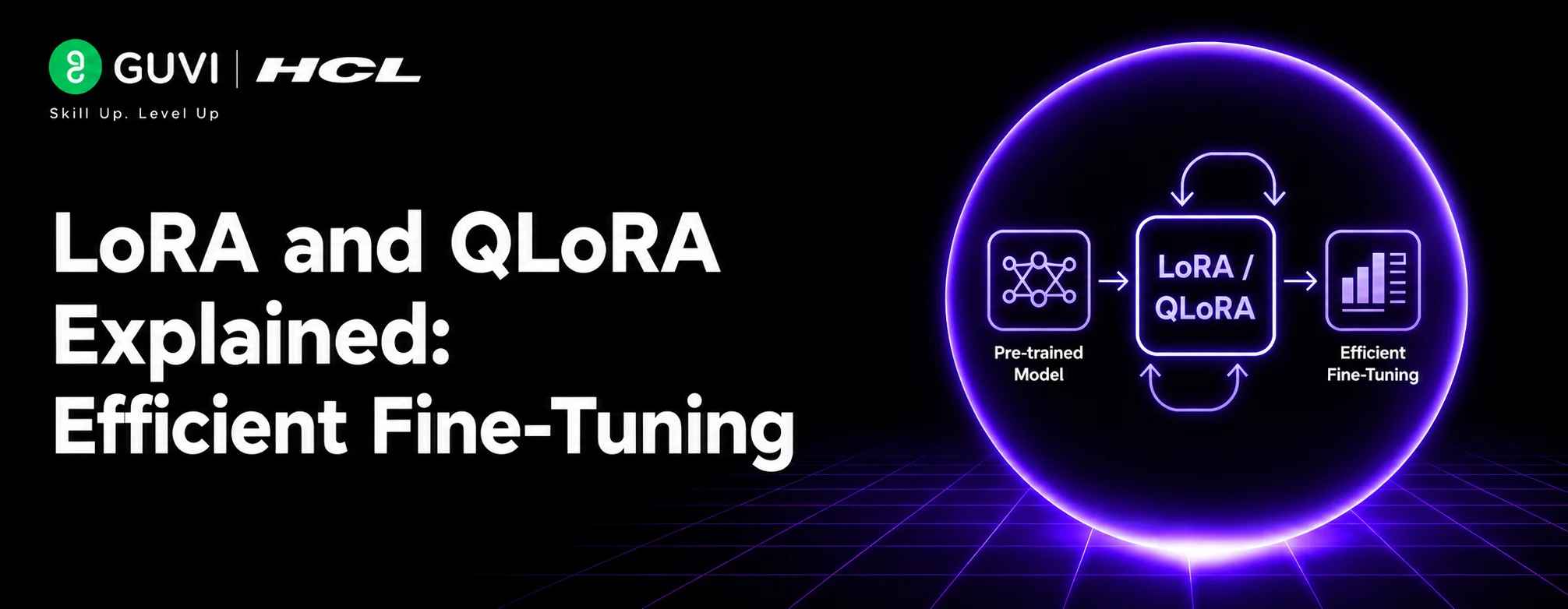
LoRA and QLoRA Explained: Efficient Fine-Tuning
Sep 01, 2026 3 Min Read 333 Views
(Last Updated)
Fine-tuning large language models traditionally requires enormous computational resources, making customization expensive for many organizations. LoRA and QLoRA solve this challenge by enabling efficient fine-tuning with significantly lower memory requirements while maintaining strong model performance. Instead of updating every model parameter, these techniques train only a small subset of parameters, making LLM customization faster and more affordable.
Table of contents
- TL;DR Summary
- Why Efficient Fine-Tuning Matters
- What is LoRA?
- What is QLoRA?
- How LoRA and QLoRA Work
- Step 1: Load a Pretrained Model
- Step 2: Freeze Original Parameters
- Step 3: Train Adapter Layers
- Step 4: Optimize the Model
- Key Components of LoRA and QLoRA
- Low-Rank Adapters
- Frozen Base Model
- Quantization (QLoRA)
- Parameter-Efficient Training
- Common Applications
- Enterprise AI
- Customer Support
- Software Development
- Research
- Healthcare
- Benefits of LoRA and QLoRA
- Lower Training Costs
- Reduced Memory Usage
- Faster Experimentation
- Broader AI Accessibility
- When Should You Use LoRA or QLoRA?
- Domain-Specific AI Models
- Enterprise AI Applications
- Limited GPU Resources
- Research and Experimentation
- Personalized AI Assistants
- Key Concepts to Remember
- Real-World Applications
- Enterprise AI
- Customer Support
- Software Development
- Healthcare
- Best Practices
- Conclusion
- FAQs
- What is LoRA?
- What is QLoRA?
- What is the difference between LoRA and QLoRA?
- Why are LoRA and QLoRA important?
- Can LoRA and QLoRA be used with different LLMs?
- When should I choose QLoRA instead of LoRA?
- What are the benefits of efficient fine-tuning?
TL;DR Summary
- LoRA reduces the cost of LLM fine-tuning.
- QLoRA combines quantization with LoRA.
- Both require significantly less GPU memory.
- Efficient fine-tuning lowers deployment costs.
- They enable customization of large language models.
Direct Answer
| LoRA and QLoRA are efficient fine-tuning techniques for large language models. LoRA updates only a small number of trainable parameters instead of modifying the entire model, reducing computational costs. QLoRA extends this approach by combining parameter-efficient fine-tuning with model quantization, enabling high-quality LLM customization using significantly less GPU memory and hardware resources. |
Why Efficient Fine-Tuning Matters
Training or fine-tuning large language models can require expensive GPUs and substantial memory. Efficient fine-tuning techniques make AI customization more accessible for researchers, startups, and enterprises.
Benefits include:
- Lower GPU memory usage
- Faster model training
- Reduced infrastructure costs
- Efficient LLM customization
- Easier deployment
- Better scalability
What is LoRA?
LoRA (Low-Rank Adaptation) is a parameter-efficient fine-tuning technique.
Instead of updating billions of model parameters, LoRA inserts small trainable matrices into selected neural network layers while keeping the original model weights frozen.
This dramatically reduces the number of parameters that need to be trained.
What is QLoRA?
QLoRA (Quantized Low-Rank Adaptation) builds upon LoRA by combining parameter-efficient fine-tuning with model quantization.
The base model is stored in a quantized format, while LoRA adapters are trained separately.
This approach significantly reduces GPU memory usage without requiring full-precision model training.
How LoRA and QLoRA Work
Both techniques simplify LLM fine-tuning while preserving model quality.
Step 1: Load a Pretrained Model
Start with an existing large language model instead of training one from scratch.
Step 2: Freeze Original Parameters
The original model weights remain unchanged during training.
Step 3: Train Adapter Layers
LoRA trains only lightweight adapter matrices inserted into selected layers.
Step 4: Optimize the Model
QLoRA additionally stores the base model using lower-precision representations, further reducing memory requirements.
Key Components of LoRA and QLoRA
Low-Rank Adapters
Small trainable matrices capture task-specific knowledge while leaving the base model unchanged.
Frozen Base Model
Most pretrained parameters remain fixed throughout fine-tuning.
Quantization (QLoRA)
Lower-precision weights reduce memory consumption during training and inference.
Parameter-Efficient Training
Only a tiny fraction of model parameters are updated, significantly lowering computational costs.
Common Applications
Enterprise AI
- Internal AI assistants
- Knowledge management
- Business automation
- Document analysis
Customer Support
- Domain-specific chatbots
- Personalized virtual assistants
- FAQ automation
- Help desk systems
Software Development
- Code assistants
- Documentation generation
- API support
- Developer productivity
Research
- Domain adaptation
- LLM experimentation
- Academic research
- Model benchmarking
Healthcare
- Medical document analysis
- Clinical assistants
- Healthcare knowledge systems
- Research support
If GPU memory is limited, QLoRA is often the preferred choice because it combines LoRA’s parameter-efficient fine-tuning with model quantization. This allows developers to fine-tune large language models that would otherwise require significantly more computational resources.
Benefits of LoRA and QLoRA
Lower Training Costs
Fine-tune large models without expensive hardware requirements.
Reduced Memory Usage
Train models using significantly less GPU memory.
Faster Experimentation
Developers can iterate and test customized models more quickly.
Broader AI Accessibility
Efficient fine-tuning enables startups, researchers, and organizations to customize powerful LLMs without training them from scratch.
Professionals interested in LLM engineering, model optimization, generative AI, and efficient AI deployment can strengthen their expertise through HCL GUVI’s Artificial Intelligence and Machine Learning Course.
When Should You Use LoRA or QLoRA?
LoRA and QLoRA are excellent choices when you need to customize a pretrained large language model without the cost of full fine-tuning. They reduce GPU memory usage while maintaining strong performance for domain-specific AI applications.

Domain-Specific AI Models
Fine-tune LLMs for industries such as healthcare, finance, legal services, education, or customer support without modifying the entire model.
Enterprise AI Applications
Organizations can customize AI assistants for internal documentation, knowledge management, and business workflows while minimizing infrastructure costs.
Limited GPU Resources
Developers with limited GPU memory can use QLoRA to fine-tune large language models that would otherwise require expensive hardware.
Research and Experimentation
Researchers can quickly evaluate multiple fine-tuning strategies and domain adaptations without repeatedly training complete language models.
Personalized AI Assistants
Businesses can build specialized chatbots, coding assistants, and recommendation systems tailored to their own data and workflows.
Key Concepts to Remember
Understanding these concepts makes LoRA and QLoRA easier to learn.
- LoRA trains lightweight adapter layers.
- The original model weights remain frozen.
- QLoRA combines quantization with LoRA.
- QLoRA significantly reduces GPU memory usage.
- Both support efficient LLM fine-tuning.
- Fine-tuning becomes faster and more affordable.
Real-World Applications
LoRA and QLoRA power numerous AI customization workflows.
Enterprise AI
- Knowledge assistants
- Document automation
- Internal chatbots
- Workflow automation
Customer Support
- AI help desks
- FAQ assistants
- Technical support bots
- Personalized customer service
Software Development
- Code assistants
- API documentation
- Programming support
- Developer productivity tools
Healthcare
- Clinical documentation
- Medical knowledge assistants
- Healthcare chatbots
- Research support
The HCL GUVI’s Artificial Intelligence eBook introduces the fundamentals of generative AI, transformer models, machine learning, prompt engineering, and intelligent automation. It helps learners understand efficient fine-tuning, LLM optimization, model deployment, and practical AI engineering techniques used in modern enterprise applications.
Best Practices
- Start with a high-quality pretrained model.
- Select LoRA or QLoRA based on available hardware.
- Fine-tune using clean, domain-specific datasets.
- Monitor validation performance during training.
- Evaluate the adapted model on real-world tasks.
- Store adapter weights separately from the base model.
- Benchmark performance before deploying to production.
Conclusion
LoRA and QLoRA have transformed efficient LLM fine-tuning by enabling organizations to customize powerful language models without updating billions of parameters. By reducing GPU memory requirements, lowering training costs, and accelerating experimentation, these techniques make large language model adaptation more practical for researchers, startups, and enterprises building specialized AI applications across diverse industries.
FAQs
1. What is LoRA?
LoRA (Low-Rank Adaptation) is a parameter-efficient fine-tuning technique that trains small adapter layers while keeping the original pretrained model weights unchanged.
2. What is QLoRA?
QLoRA (Quantized Low-Rank Adaptation) extends LoRA by combining parameter-efficient fine-tuning with model quantization, significantly reducing GPU memory requirements during training.
3. What is the difference between LoRA and QLoRA?
LoRA fine-tunes lightweight adapter layers on a standard pretrained model, while QLoRA additionally stores the base model in a quantized format to reduce memory consumption and hardware requirements.
4. Why are LoRA and QLoRA important?
They make large language model customization faster, more affordable, and accessible by reducing computational costs without sacrificing much model performance.
5. Can LoRA and QLoRA be used with different LLMs?
Yes. They are widely used with many transformer-based language models, allowing efficient domain adaptation without retraining the entire network.
6. When should I choose QLoRA instead of LoRA?
Choose QLoRA when GPU memory is limited or when fine-tuning very large language models, as quantization enables efficient training on less powerful hardware.
7. What are the benefits of efficient fine-tuning?
Efficient fine-tuning reduces GPU memory usage, lowers infrastructure costs, speeds up experimentation, simplifies deployment, and enables organizations to build domain-specific AI solutions without training large language models from scratch
Success Stories

About the Author
HCL GUVI
This article was selected and published as part of the HCL GUVI AI Blogathon 2026, an initiative designed to encourage students, AI enthusiasts, and aspiring tech writers to simplify complex AI concepts through impactful technical content. The contest recognized high-quality, original, and insightful AI-focused blogs, with selected authors receiving publication opportunities on the HCL GUVI blog platform along with official author credits and recognition.
View all posts by HCL GUVI
Connect with me @






Did you enjoy this article?