


VLSI Design Articles
Why Chips Fail: A Basic Guide to Chip Defects and IC Failure Analysis
Fun Facts About the Semiconductor Industry
Why Are Semiconductor Chips Expensive? Manufacturing Cost Explained
PLI Scheme for Semiconductors: India’s Chip Manufacturing Push Explained

Get In Touch For Details! Request More Information
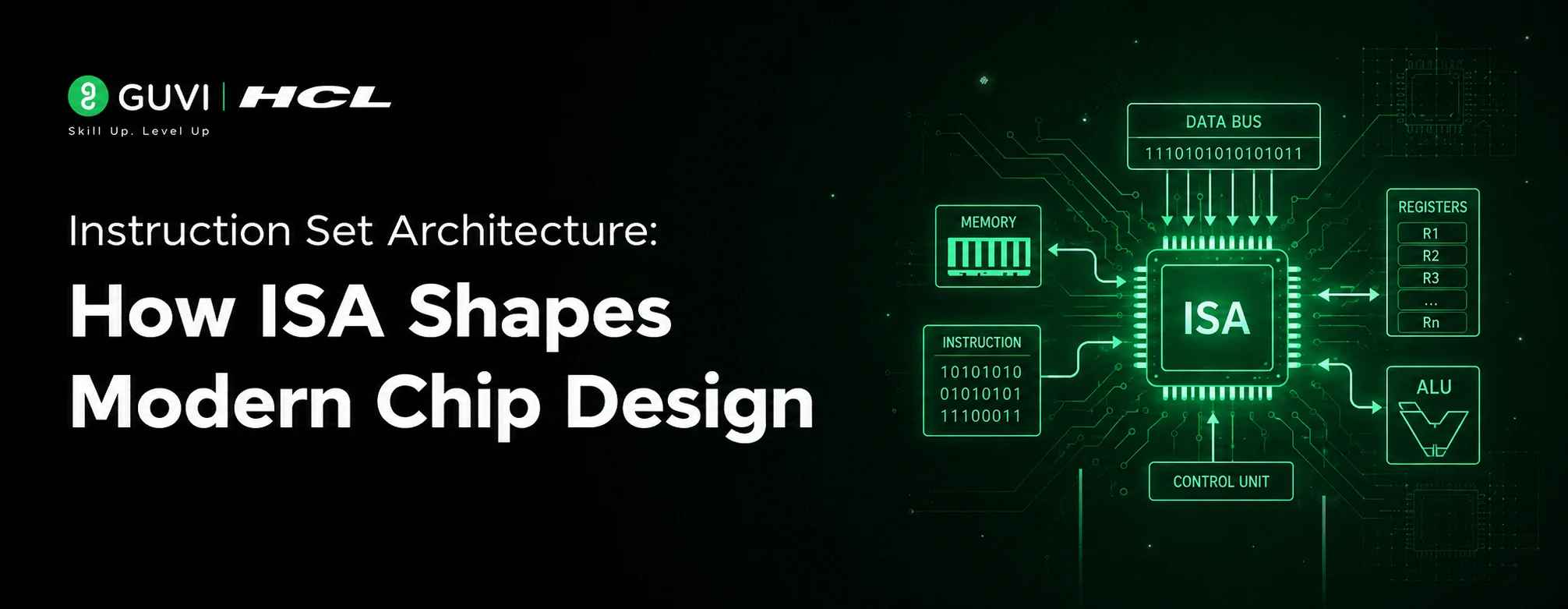
Instruction Set Architecture: How ISA Shapes Modern Chip Design
Aug 06, 2026 7 Min Read 424 Views
(Last Updated)
Table of contents
- TL;DR Summary
- Introduction
- What is Instruction Set Architecture?
- Instruction Set Architecture Definition for Beginners
- ISA in Computer Architecture: A Simple Example
- Why Instruction Set Architecture Matters in Chip Design
- ISA Decides What the Hardware Must Support
- ISA Affects Power, Performance, and Area
- ISA Builds the Software Ecosystem
- How ISA Shapes Processor Architecture
- Instruction Format and Decoder Design
- Registers and Data Path Design
- Memory Model and Load-Store Behavior
- Extensions and Custom Instructions
- RISC vs CISC: What is the Difference?
- When RISC Makes Sense
- When CISC Makes Sense
- Why the Industry Uses Both
- Where ISA Decisions Show Up in Industry
- Smartphones and Edge Devices
- Automotive and IoT Chips
- AI and Data Center Chips
- Career Relevance for VLSI Learners
- How to Learn Instruction Set Architecture for Chip Design
- Step-by-Step Learning Roadmap for Beginners
- Practical Mini Project Idea
- Common Mistakes Learners Make While Studying ISA
- Confusing ISA with Microarchitecture
- Memorizing RISC vs CISC Without Understanding Trade-Offs
- Ignoring the Compiler’s Role
- Studying ISA Without Building Anything
- Thinking ISA Is Only for CPU Designers
- Wrapping Up
- Frequently Asked Questions
- What is Instruction Set Architecture in simple words?
- Why is ISA important in computer architecture?
- What is the difference between ISA and processor architecture?
- What is the difference between RISC vs CISC?
- Is RISC-V an Instruction Set Architecture?
- Does ISA affect chip performance?
- Which ISA is best for beginners to learn?
- Do VLSI engineers need to learn ISA?
TL;DR Summary
Instruction Set Architecture is the rulebook that defines how software communicates with processor hardware. In chip design, ISA decides what instructions a CPU can execute, how memory is accessed, how registers behave, and how efficiently software runs on silicon. Whether you study RISC vs CISC, Arm, x86, or RISC-V, ISA in computer architecture directly influences performance, power consumption, compiler design, verification complexity, and long-term processor scalability.
Introduction
Instruction Set Architecture is one of the most important concepts behind every processor you use, from smartphones and laptops to AI servers and automotive chips.
At a simple level, ISA defines the “language” a processor understands. But in real chip design, it does much more. It affects instruction decoding, pipeline design, memory access, compiler support, power efficiency, and even how easily a processor can evolve over time.
The demand for chip design talent is also rising fast. Global semiconductor sales reached $791.7 billion in 2025, up 25.6% from 2024, and SIA projected 2026 sales to reach roughly $1 trillion.
What is Instruction Set Architecture?
Instruction Set Architecture is the abstract interface between software and processor hardware. It defines the instructions a processor can execute, the registers it exposes, the memory model it follows, the data types it supports, and how programs control execution.
In simpler words, ISA tells software what the processor can do and tells hardware designers what the processor must correctly implement.
Instruction Set Architecture Definition for Beginners
Instruction Set Architecture is the visible part of a processor architecture that programmers, compilers, and operating systems depend on. It specifies machine instructions, registers, addressing modes, data formats, and execution behavior so that software can run correctly on compatible hardware.
This is why two different chips can run the same software if they implement the same ISA. For example, multiple Arm-based processors can run software built for the same Arm architecture, even if their internal microarchitecture is different.
ISA in Computer Architecture: A Simple Example
Imagine you write a C program that adds two numbers.
The compiler does not directly tell the hardware, “please add these values” in plain English. It translates your code into machine instructions supported by the ISA.
For example, a simplified instruction may look like:
- Load value from memory
- Add value to register
- Store result back to memory
The ISA defines what these instructions mean. The processor architecture decides how efficiently the chip executes them.
Your processor does not understand Python, Java, or C directly. It only understands machine instructions defined by its Instruction Set Architecture. So every app you open is secretly being translated into tiny ISA-level commands before the chip can act on it.
Why Instruction Set Architecture Matters in Chip Design
ISA is not just a theory topic in computer architecture. It becomes a practical design decision when engineers build CPUs, embedded processors, AI accelerators, and system-on-chips.
A good ISA can simplify hardware implementation, improve compiler optimization, reduce power usage, and make software ecosystems easier to build. A poor ISA choice can increase decode complexity, slow down performance, or make verification harder.
ISA Decides What the Hardware Must Support
Every instruction in an ISA becomes a hardware responsibility.
If the ISA supports complex memory operations, the processor must decode and execute them correctly. If it supports vector instructions, the design may need wider datapaths and more advanced execution units.
That means ISA affects:
- Instruction decoder design
- Register file size
- Arithmetic logic unit behavior
- Pipeline stages
- Memory access logic
- Exception and interrupt handling
- Verification workload
ISA Affects Power, Performance, and Area
Chip designers often think in terms of PPA: power, performance, and area.
Instruction Set Architecture influences all three. A simpler ISA can reduce decode complexity and make pipelining easier. A richer ISA can reduce the number of instructions needed for some tasks, but it may also require more complex hardware.
This is why ISA choices matter in smartphones, where battery life is critical, and in data centers, where performance per watt directly affects operating cost.
ISA Builds the Software Ecosystem
A processor is useful only when software can run on it.
ISA compatibility helps operating systems, compilers, debuggers, firmware, and applications work across different processor implementations. This is one reason x86 remains important in PCs, Arm dominates many mobile and embedded markets, and RISC-V is gaining attention for customizable and open-standard designs.
How ISA Shapes Processor Architecture
Processor architecture is the broader design of how a processor works. ISA is one layer of that design, but it strongly influences the rest.
Before you study advanced VLSI or CPU design, it helps to see how one ISA decision can ripple across the entire chip.
Instruction Format and Decoder Design
Instruction format decides how instructions are represented in binary.
A fixed-length instruction format can make decoding simpler because every instruction follows a predictable size. A variable-length instruction format can improve code density, but it usually makes instruction fetch and decode more complex.
For chip designers, this affects:
- Front-end pipeline design
- Instruction cache behavior
- Branch prediction flow
- Decode-stage timing
- Verification test cases
Registers and Data Path Design
The number and type of registers in an ISA affect the processor datapath.
More registers can reduce memory access because programs can keep more values close to execution units. But more registers can also increase register file area and access time.
This is where ISA in computer architecture becomes highly practical. A register decision is not just a software feature. It becomes a silicon cost.
Memory Model and Load-Store Behavior
Some ISAs use a clean load-store model, where only load and store instructions access memory. Arithmetic instructions usually work on registers.
This approach is common in RISC-style designs and can simplify pipeline implementation. In contrast, some CISC-style instructions may operate directly on memory, which can reduce instruction count but increase hardware complexity.
Extensions and Custom Instructions
Modern processor architecture often uses ISA extensions.
Extensions add specialized instructions for tasks such as cryptography, AI, signal processing, vector operations, or embedded control. RISC-V is especially discussed in this area because its modular design allows standard and custom extensions.
For example, an automotive chip may add safety-related features, while an AI edge chip may add matrix or vector instructions for faster inference.
RISC vs CISC: What is the Difference?
RISC vs CISC is one of the most common comparisons in processor architecture. The difference is not about which one is always better. It is about design philosophy and trade-offs.
RISC focuses on simpler instructions that are easier to pipeline. CISC focuses on richer instructions that can perform more complex tasks per instruction.
RISC vs CISC in Processor Architecture
| Factor | RISC | CISC |
| Full Form | Reduced Instruction Set Computer | Complex Instruction Set Computer |
| Instruction Style | Simple, regular instructions | Complex, feature-rich instructions |
| Instruction Length | Often fixed-length | Often variable-length |
| Hardware Complexity | Usually simpler decode logic | Usually more complex decode logic |
| Compiler Role | Compiler does more optimization work | Hardware handles more complex operations |
| Performance Approach | Fast execution through pipelining | Fewer instructions for some tasks |
| Common Examples | Arm, RISC-V | x86 |
| Best Fit | Embedded systems, mobile, custom chips, energy-efficient designs | PCs, servers, legacy software ecosystems |
When RISC Makes Sense
RISC-style ISA designs are useful when power efficiency, predictable execution, and simpler hardware implementation matter.
This is why RISC ideas are popular in embedded systems, mobile processors, and many modern chip design projects. Arm describes its CPU architecture as a reduced instruction set computing architecture that defines how Arm processors execute instructions and interact with software.
When CISC Makes Sense
CISC-style ISA designs are useful when software compatibility and dense instruction behavior are important.
x86 is a strong example. It has decades of software ecosystem support, especially in desktop, laptop, and server computing. Even though modern x86 processors internally use advanced techniques to execute instructions efficiently, the ISA remains important for compatibility.
Why the Industry Uses Both
The semiconductor industry does not choose RISC or CISC blindly.
Companies choose based on product goals. A smartphone chip may prioritize power efficiency. A server CPU may prioritize software compatibility and throughput. An AI accelerator may use specialized instructions for matrix operations.
NVIDIA’s Grace CPU platform, for instance, uses Arm-based CPU cores for accelerated computing, cloud, edge, and data center workloads, and the Grace CPU Superchip packs 144 Arm Neoverse V2 cores with up to 1 TB/s memory bandwidth.
Where ISA Decisions Show Up in Industry
ISA decisions are visible across industries, even when users never see the term.
From your phone’s battery life to a cloud server’s AI inference speed, Instruction Set Architecture quietly shapes the final product experience.
Smartphones and Edge Devices
Smartphones need strong performance without draining the battery.
That is why mobile processor architecture often favors energy-efficient ISA implementations. Arm-based processors became popular in this space because they support efficient designs across different performance levels.
For learners, this is a good reminder: processor architecture is not only about speed. It is also about thermal limits, battery life, silicon area, and software support.
Automotive and IoT Chips
Automotive chips need reliability, real-time response, and long product lifecycles.

In this sector, ISA choices affect safety certification, toolchain stability, interrupt handling, and embedded software development. RISC-V is increasingly discussed for automotive and IoT because open-standard architectures can support customization and ecosystem control.
Reuters reported that chips with RISC-V cores accounted for $52 billion in sales in 2024, representing 10.4% market penetration, and cited SHD Group estimates that the RISC-V market could top $260 billion by 2030.
AI and Data Center Chips
AI workloads need huge data movement, parallel processing, and efficient CPU-GPU coordination.
ISA extensions matter here because AI chips often need specialized operations. These may include vector instructions, matrix instructions, lower-precision arithmetic, and memory-coherent operations.
This is why processor architecture for AI is no longer only about general-purpose CPU speed. It is about matching the ISA, microarchitecture, memory system, and software stack to the workload.
Career Relevance for VLSI Learners
If you want to enter chip design in India, ISA knowledge gives you a strong edge because it helps you understand how software requirements become hardware decisions.
India’s semiconductor ecosystem is expanding through chip design, verification, embedded systems, packaging, and fabrication-linked projects. The Press Information Bureau noted that India’s semiconductor market was estimated at $45–50 billion in 2024–25 and is expected to reach $100–110 billion by 2030.
In India, VLSI design engineer salaries vary widely by company, role, skill depth, and location. Glassdoor salary listings show examples ranging from around ₹4–9 LPA at some service companies to around ₹10–21 LPA for VLSI design engineer roles at leading semiconductor firms.
So, if you are learning VLSI, do not treat Instruction Set Architecture as just a computer architecture topic. Treat it as a career foundation. It helps you understand processor architecture, debug hardware-software issues, work better with verification teams, and build stronger projects around RISC-V, Arm, or custom SoC designs.
How to Learn Instruction Set Architecture for Chip Design
Learning ISA becomes easier when you connect theory with implementation.
Instead of memorizing definitions, study how instructions move through a processor pipeline and how design decisions affect power, area, and performance.
Step-by-Step Learning Roadmap for Beginners
| Stage | What to Learn | Practical Outcome |
| 1 | Digital logic basics | Understand gates, registers, ALUs |
| 2 | Computer organization | Learn memory, datapath, control unit |
| 3 | ISA basics | Understand registers, instructions, addressing modes |
| 4 | RISC vs CISC | Compare design trade-offs |
| 5 | Assembly programming | See how software maps to instructions |
| 6 | Pipelining | Learn instruction fetch, decode, execute flow |
| 7 | Verilog/SystemVerilog | Implement simple processor blocks |
| 8 | RISC-V basics | Build or simulate a simple open-standard CPU |
Practical Mini Project Idea
Build a tiny RISC-style processor in Verilog.
Start with a small instruction set:
- ADD
- SUB
- LOAD
- STORE
- BRANCH
Then create a basic data path, control unit, register file, and memory interface. This project will help you understand how Instruction Set Architecture becomes real hardware.
The difference between ISA and microarchitecture is important. ISA defines what the processor must do. Microarchitecture defines how the processor does it internally.
Common Mistakes Learners Make While Studying ISA
ISA is a concept-heavy topic, so beginners often get stuck because they study it only from a textbook angle.
Here are the mistakes to avoid if you want industry-ready understanding.
Confusing ISA with Microarchitecture
Many learners think ISA and microarchitecture are the same thing, but they are not.
ISA defines the processor’s visible behavior, such as instructions, registers, and memory access rules. Microarchitecture defines the internal implementation, such as pipeline depth, cache design, branch prediction, and execution units.
The fix is simple: ask two questions. “What must the processor support?” is ISA. “How does the processor implement it?” is microarchitecture.
Memorizing RISC vs CISC Without Understanding Trade-Offs
RISC vs CISC is often taught as a simple comparison, but real processors are more nuanced.
A RISC ISA does not automatically mean faster performance, and a CISC ISA does not automatically mean outdated design. Performance depends on implementation, workload, compiler quality, memory system, and power constraints.
The fix is to compare actual use cases. Study why Arm works well in mobile, why x86 remains strong in PCs and servers, and why RISC-V is growing in custom chip design.
Ignoring the Compiler’s Role
A processor does not work alone. Compilers translate high-level code into ISA-level instructions.
If you ignore compilers, you miss why instruction selection, register allocation, and optimization matter. A clean ISA can make compiler design easier, while specialized instructions may need better compiler support to be useful.
The fix is to write small C programs, compile them to assembly, and observe how instructions are generated.
Studying ISA Without Building Anything
Reading about ISA is useful, but building a small processor teaches the real lessons.
When you implement even five instructions in Verilog, you understand instruction decoding, control signals, register reads, ALU operations, and memory writes much better.
The fix is to simulate a small CPU design using open-source tools or FPGA-friendly workflows. Even a toy processor can make ISA concepts clear.
Thinking ISA Is Only for CPU Designers
ISA knowledge is useful beyond CPU design.
Verification engineers need ISA knowledge to test correctness. Compiler engineers need it for code generation. Embedded engineers need it for firmware. Performance engineers need it to optimize software for hardware.
The fix is to treat ISA as a bridge skill. It connects software, hardware, verification, embedded systems, and VLSI design.
If you are planning to move from computer architecture basics into practical chip design, structured mentorship can shorten your learning curve. You can explore the IIT Delhi’ s VLSI Design Program to build stronger foundations in VLSI workflows, processor design thinking, and industry-aligned hardware skills.
Wrapping Up
Instruction Set Architecture is the foundation that connects software instructions with processor hardware. It shapes chip design by influencing instruction decoding, data path design, memory access, compiler support, verification complexity, and performance-per-watt decisions. If you are learning VLSI, embedded systems, or processor architecture, do not treat ISA as a definition to memorize. Treat it as a design lens. Start with RISC vs CISC, study ISA in computer architecture, explore RISC-V or Arm examples, and then build small processor projects to make the concept practical.
Frequently Asked Questions
1. What is Instruction Set Architecture in simple words?
Instruction Set Architecture is the set of rules that defines how software talks to processor hardware. It includes instructions, registers, memory access methods, and execution behavior.
2. Why is ISA important in computer architecture?
ISA in computer architecture is important because it defines the processor’s software-visible behavior. It allows compilers, operating systems, and applications to run correctly on compatible hardware.
3. What is the difference between ISA and processor architecture?
ISA is one part of processor architecture. ISA defines what the processor must support, while processor architecture also includes implementation choices such as pipelines, caches, buses, and execution units.
4. What is the difference between RISC vs CISC?
RISC uses simpler, regular instructions that are easier to pipeline. CISC uses more complex instructions that can perform richer operations but often need more complex decoding.
5. Is RISC-V an Instruction Set Architecture?
Yes. RISC-V is an open-standard Instruction Set Architecture based on RISC principles. It is widely studied because it supports modular extensions and customization.
6. Does ISA affect chip performance?
Yes. ISA affects instruction count, decoding complexity, compiler optimization, memory behavior, and power efficiency. However, final performance also depends on microarchitecture and workload.
7. Which ISA is best for beginners to learn?
RISC-V is beginner-friendly because it is open, modular, and easier to study in academic and project environments. Arm is also useful if you are interested in embedded and mobile systems.
8. Do VLSI engineers need to learn ISA?
Yes, especially if they work in processor design, verification, embedded systems, SoC design, or performance engineering. ISA knowledge helps engineers understand how software behavior maps to hardware design.
Success Stories








Did you enjoy this article?