


Programming Languages Articles
Product Manager Portfolio: How to Build The Best One That Gets You Hired in 2026
Accumulate Function in C++: Syntax, Examples, Use Cases
Bubble Sort in C: A Complete Beginner’s Guide
Cracking the Code: Your First Dive into the Fractional Knapsack Problem


Get In Touch For Details! Request More Information
Code Review Best Practices: How to Give and Receive Feedback Effectively
Aug 06, 2026 3 Min Read 428 Views
(Last Updated)
Writing code is only one part of software development. Before code changes become part of a production application, they undergo reviews where developers evaluate implementations, identify issues, and suggest improvements. Code reviews help maintain quality, reduce bugs, encourage knowledge sharing, and strengthen collaboration.
Table of contents
- TL;DR
- Data Point
- Direct Answer
- What Are Code Review Best Practices?
- Key Components of a Code Review
- Did You Know?
- Why Are Code Review Skills Important for Developers?
- Benefits of Strong Code Review Skills
- Data Point
- How to Give Effective Code Review Feedback
- Step 1: Understand the Context
- Step 2: Focus on Functionality First
- Step 3: Evaluate Readability and Maintainability
- Step 4: Provide Constructive Feedback
- Step 5: Acknowledge Good Work
- Warning
- How to Receive Code Review Feedback Effectively
- Step 1: Read Feedback Carefully
- Step 2: Avoid Defensive Reactions
- Step 3: Ask Questions
- Step 4: Learn from Suggestions
- Step 5: Update and Resubmit
- How Does the Code Review Process Work?
- Key Stages
- Data Point
- Popular Code Review Tools
- Key Takeaways
- What To Do Next
- Conclusion
- FAQs
- What is a code review?
- Why are code reviews important?
- What should reviewers focus on?
- How do I handle critical feedback?
- Which tools are commonly used for code reviews?
- How large should a pull request be?
- Can beginners benefit from code reviews?
TL;DR
- Code review is a collaborative process where developers examine code changes before they are merged into a project.
- Following code review best practices helps improve code quality, maintainability, security, and team collaboration.
- Effective code reviews focus on functionality, readability, performance, and adherence to coding standards.
- Developers should learn both how to provide constructive feedback and how to receive feedback professionally.
- Modern development teams commonly use platforms such as GitHub to manage pull requests and code reviews.
To build these essential skills, HCL GUVI’s GitHub Course provides hands-on training in repositories, pull requests, version control, and collaborative development workflows.
Data Point
According to SmartBear’s peer review research, reviewing approximately 200–400 lines of code at a time produces the most effective results, while larger reviews tend to reduce defect detection rates.
Source: https://smartbear.com/learn/code-review/best-practices-for-peer-code-review/
Direct Answer
Code review best practices are a set of guidelines that help developers review code changes effectively by focusing on code quality, functionality, maintainability, security, and collaboration. These practices ensure feedback remains constructive, actionable, and valuable for both reviewers and code authors.
Source: https://smartbear.com/learn/code-review/what-is-code-review/
What Are Code Review Best Practices?
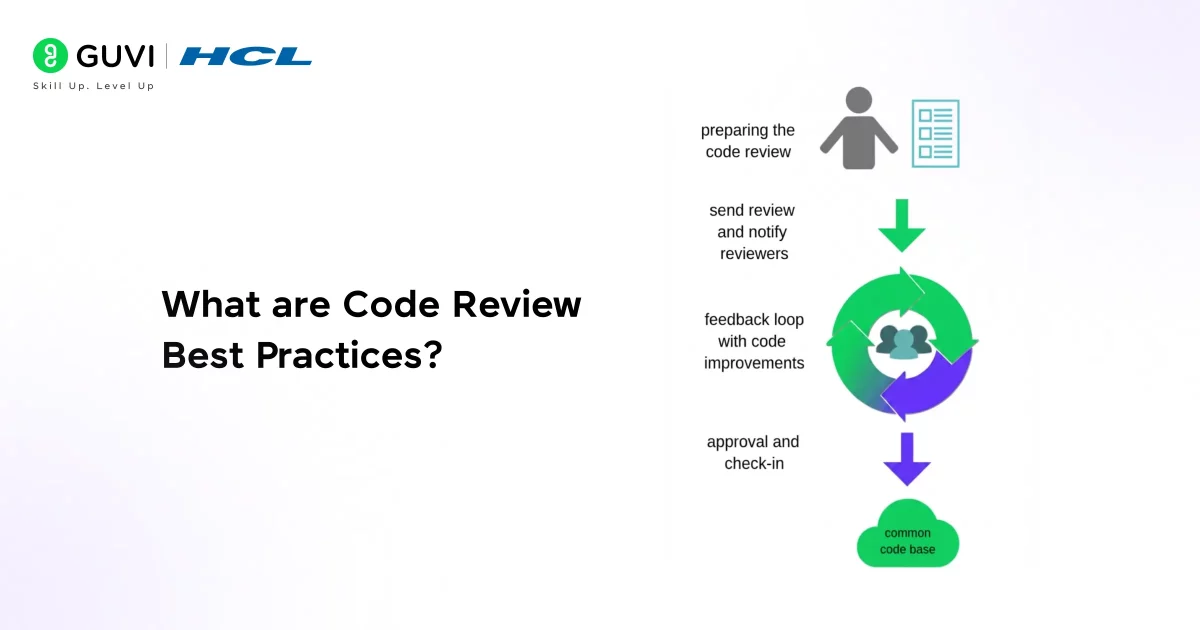
Code review is the process of evaluating source code before it is merged into a shared codebase. During this process, reviewers examine the implementation to ensure it meets quality standards and project requirements.
Effective code review best practices help teams identify defects early, improve readability, enforce coding standards, and encourage knowledge sharing among developers.
Key Components of a Code Review
- Code Author – Developer who submits the code changes.
- Reviewer – Team member responsible for evaluating the changes.
- Pull Request – Proposed code changes awaiting review.
- Review Comments – Suggestions, questions, and feedback provided during the review.
- Coding Standards – Team guidelines that maintain consistency.
- Approval Process – Final verification before merging changes.
Did You Know?
Many engineering teams use code reviews not only to identify bugs but also to onboard new developers, share domain knowledge, and maintain consistent development practices across large projects.
Why Are Code Review Skills Important for Developers?
Code review skills are valuable because they improve both technical and communication abilities. Developers learn how to analyze code critically while collaborating effectively with teammates.
Benefits of Strong Code Review Skills
| Benefit | Why It Matters |
| Better Code Quality | Helps identify bugs and defects early |
| Knowledge Sharing | Encourages learning across teams |
| Stronger Collaboration | Improves communication between developers |
| Security Awareness | Helps identify risky implementations |
| Career Growth | Builds professional software engineering skills |
Data Point
GitHub’s pull request review system allows reviewers to comment on changes, suggest modifications, approve code, and request updates before changes are merged into a project.
How to Give Effective Code Review Feedback
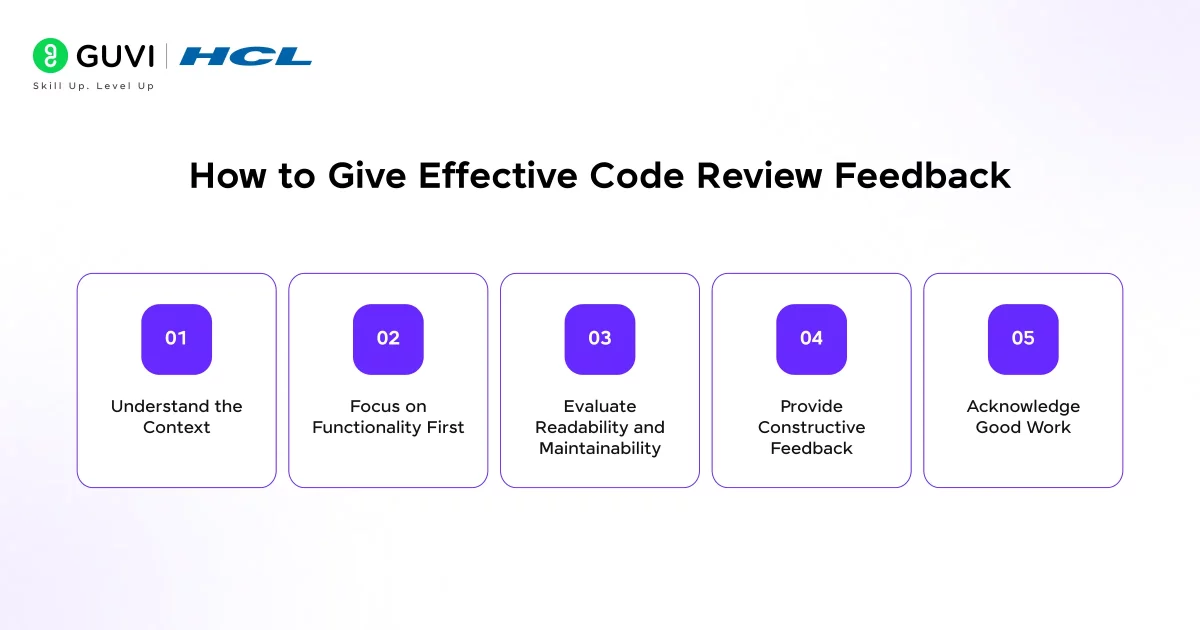
Let’s explore how professional developers conduct effective code reviews.
Step 1: Understand the Context
Review the purpose of the change before evaluating the implementation.
Example:
- What problem is being solved?
- Why was this approach selected?
- Are there related requirements?
Step 2: Focus on Functionality First
Verify that the code behaves as expected and satisfies project requirements.
Check for:
- Logic errors
- Edge cases
- Missing validations
- Functional correctness
Step 3: Evaluate Readability and Maintainability
Well-structured code is easier to understand and maintain.
Review:
- Naming conventions
- Code organization
- Documentation
- Complexity
Step 4: Provide Constructive Feedback
Avoid vague comments.
“This is wrong.”
“This loop may become inefficient with larger datasets. Consider using a dictionary lookup for faster access.”
Step 5: Acknowledge Good Work
Recognizing strong implementations encourages collaboration and learning.
Example:
“Great use of helper functions here. It improves readability significantly.”
Warning
Avoid turning code reviews into personal criticism. Feedback should focus on code quality, maintainability, performance, security, and project requirements rather than on individual developers. Personal attacks or vague comments can reduce collaboration and make reviews less effective.
Once you’re comfortable reviewing code, you can expand your skills by learning architectural reviews, security reviews, and large-scale software quality practices.

Teams can further improve review efficiency by following the branching strategies discussed in Git Flow Best Practices.
How to Receive Code Review Feedback Effectively
Receiving feedback professionally is just as important as providing it.
Step 1: Read Feedback Carefully
Take time to understand the reviewer’s perspective before responding.
Step 2: Avoid Defensive Reactions
Remember that reviewers are evaluating the code, not you personally.
Step 3: Ask Questions
Seek clarification when suggestions are unclear.
Step 4: Learn from Suggestions
Code reviews are valuable opportunities to improve technical skills.
Step 5: Update and Resubmit
Implement improvements and continue the discussion if needed.
Developers who actively learn from reviews often improve faster than those who work in isolation.
How Does the Code Review Process Work?
A code review workflow helps ensure software quality before changes reach production.
Instead of merging code immediately, developers collaborate through a structured review process.
Key Stages
- Code Development
- Pull Request Creation
- Reviewer Assignment
- Code Examination
- Feedback Discussion
- Code Updates
- Approval
- Merge to Main Branch
Data Point
Atlassian highlights code reviews as an important practice for maintaining code quality, sharing knowledge, and ensuring software consistency across development teams.
Source: https://www.atlassian.com/agile/software-development/code-reviews
To strengthen your collaboration skills, HCL GUVI’s GitHub Course provides practical experience with repositories, pull requests, branching strategies, and modern software development workflows.
Popular Code Review Tools
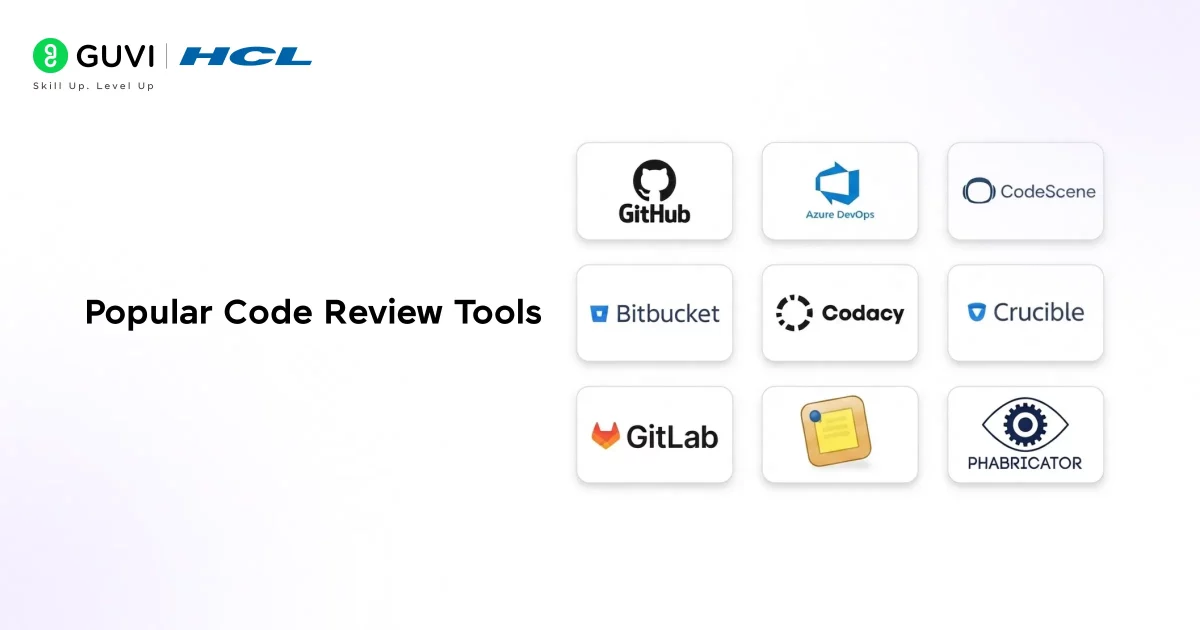
- GitHub – Helps developers create pull requests, review code changes, leave comments, and approve updates before merging.
- GitLab – Helps teams conduct merge request reviews, collaborate through inline comments, and automate review workflows.
- Bitbucket – Helps reviewers discuss code changes, assign reviewers, and manage pull request approvals efficiently.
- Azure DevOps – Helps development teams review code, track work items, and integrate reviews with testing and deployment pipelines.
- Crucible – Helps teams perform peer reviews, identify defects, and improve collaboration throughout the development process.
Key Takeaways
- Code reviews improve software quality and maintainability.
- Constructive feedback should focus on the code rather than the developer.
- Receiving feedback professionally helps developers learn and grow.
- Smaller pull requests generally lead to better review outcomes.
- Consistent review practices support stronger development teams.
What To Do Next
After learning code review best practices, explore:
- GitHub Pull Requests
- Branching Strategies
- Secure Coding Reviews
- Open Source Contributions
- Software Architecture Reviews
Developing these skills will help you become a more effective software engineer and collaborator.
Conclusion
Code reviews are a critical part of modern software development. By learning how to provide constructive feedback and receive suggestions professionally, developers can improve code quality, strengthen collaboration, and accelerate their technical growth. Following code review best practices enables teams to build reliable software while fostering a culture of continuous improvement and knowledge sharing.
FAQs
1. What is a code review?
A code review is the process of examining code changes before they are merged into a project.
2. Why are code reviews important?
They help identify bugs, improve maintainability, and promote collaboration.
3. What should reviewers focus on?
Reviewers should focus on functionality, readability, maintainability, security, and coding standards.
4. How do I handle critical feedback?
Remain professional, ask clarifying questions, and treat feedback as a learning opportunity.
5. Which tools are commonly used for code reviews?
GitHub, GitLab, Bitbucket, and Azure DevOps are popular code review platforms.
6. How large should a pull request be?
Smaller pull requests are generally easier and more effective to review.
7. Can beginners benefit from code reviews?
Yes. Code reviews help beginners learn best practices, improve coding habits, and gain valuable insights from experienced developers.
Success Stories

About the Author
Vishalini Devarajan
An Aerospace Engineer turned content writer, I focus on making complex concepts easy to understand through well-structured, reader-friendly blogs. Whether it’s a technical topic or a non-technical one, I love creating content that is clear, engaging, and impactful.
View all posts by Vishalini Devarajan
Connect with me @









Did you enjoy this article?