


VLSI Design Articles
Why Chips Fail: A Basic Guide to Chip Defects and IC Failure Analysis
Fun Facts About the Semiconductor Industry
Why Are Semiconductor Chips Expensive? Manufacturing Cost Explained
Instruction Set Architecture: How ISA Shapes Modern Chip Design


Get In Touch For Details! Request More Information
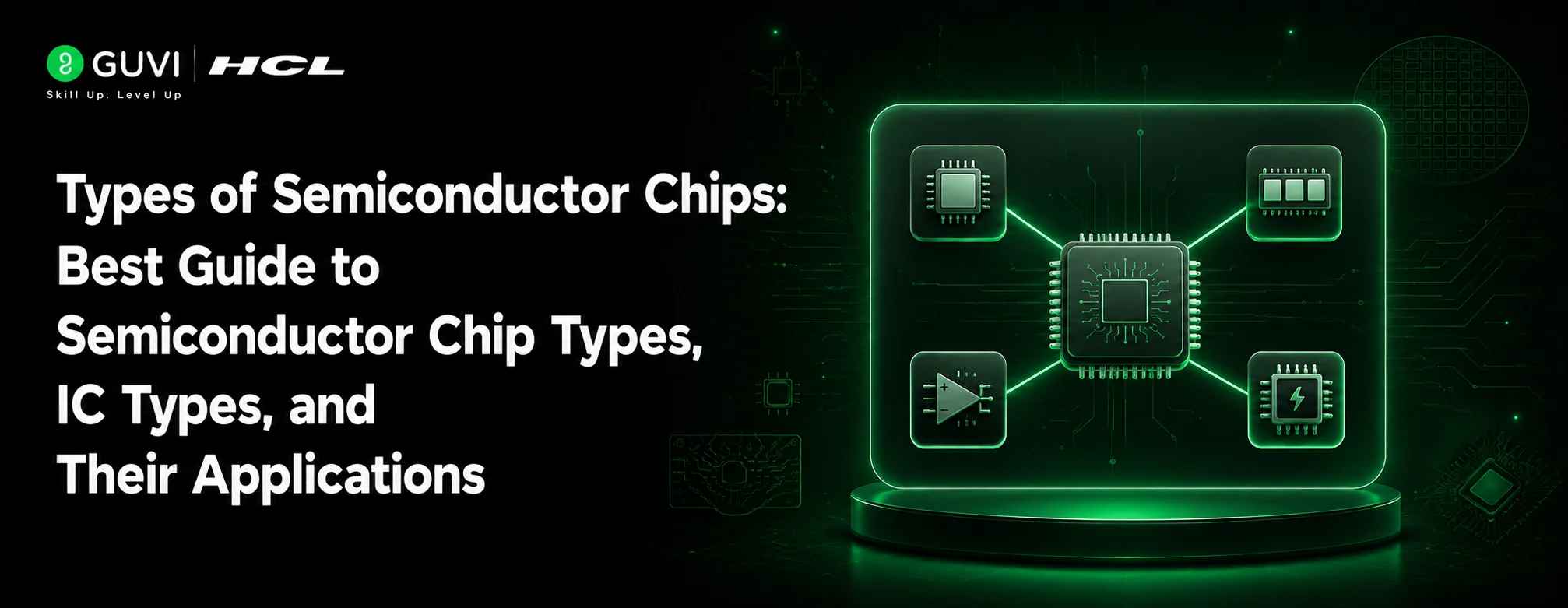
Types of Semiconductor Chips: Best Guide to Semiconductor Chip Types, IC Types, and Their Applications (2026)
Jul 22, 2026 7 Min Read 562 Views
(Last Updated)
Table of contents
- TL;DR
- Introduction
- What Are Semiconductor Chips?
- Why Are Semiconductor Chips So Important?
- Industry Statistics Of Semiconductor
- What Are the Major Categories of Semiconductor Chip Types?
- Comparison of Major Semiconductor Chip Types
- Types of Semiconductor Chips Explained: Functions, Features, and Real-World Applications
- Logic Chips: The Brain of Electronic Devices
- Memory Chips: Storing Digital Information
- Analog ICs: Processing Real-World Signals
- Example
- Mixed-Signal ICs: Combining Analog and Digital Processing
- Power Semiconductor Chips: Managing Electrical Energy
- RF Chips: Enabling Wireless Communication
- ASICs and SoCs: Specialized Semiconductor Chips
- Microcontrollers (MCUs): The Hidden Computers Around You
- Industry Insight
- Applications of Semiconductor Chips Across Industries
- Smartphones and Consumer Electronics
- Automotive and Electric Vehicles
- AI and Data Centers
- Industrial Systems and IoT
- Future Trends Shaping Semiconductor Chips
- AI-Optimized Chips
- Chiplet-Based Design
- Wide Bandgap Semiconductors
- 3D Chip Packaging
- Common Mistakes Beginners Make When Learning Semiconductor Chip Types
- Assuming All Chips Perform the Same Function
- Ignoring Analog Electronics
- Confusing Microprocessors and Microcontrollers
- Overlooking Power Semiconductor Devices
- Learning Theory Without Practical Tools
- Ready to Build a Career in VLSI?
- Final Words
- Frequently Asked Questions (FAQs)
- What are the main types of semiconductor chips?
- What is the difference between logic chips and memory chips?
- Where are semiconductor chips used?
- Which semiconductor chip is used in AI?
- What are IC types?
- Why are power semiconductor chips important?
- What skills are required to become a VLSI engineer?
- Is VLSI a good career in 2026?
TL;DR
- The Types of Semiconductor Chips determine how every electronic device processes, stores, and manages information.
- From logic chips powering CPUs and GPUs to memory chips storing data and power semiconductor chips managing electricity in EVs, each chip serves a unique purpose.
- Understanding these semiconductor chip types is essential for students, electronics enthusiasts, and aspiring VLSI engineers looking to build careers in the rapidly growing semiconductor industry.
Introduction
The semiconductor industry is at the heart of modern technology. According to the Semiconductor Industry Association (SIA), global semiconductor sales exceeded $120.6 billion in the may month, driven by growing demand for AI, automotive electronics, cloud computing, and consumer devices.
As industries continue to digitize, semiconductor chips have become one of the world’s most valuable technologies.
Using a smartphone, driving an electric vehicle, or interacting with an AI chatbot, semiconductor chips are working behind the scenes. However, not all chips perform the same function. Different Types of Semiconductor Chips are designed for computing, memory, power management, communication, or sensing, making them the building blocks of nearly every electronic system.
If you’re planning a career in electronics or VLSI, understanding these semiconductor chip types is one of the first concepts you should master. In this guide, you’ll learn how different IC types work, where they’re used, and why they are critical to industries ranging from healthcare and aerospace to automotive and artificial intelligence.
What Are Semiconductor Chips?
A semiconductor chip, also called an integrated circuit (IC), is a piece of silicon that packs transistors, resistors, and interconnects into a single compact package.
The “semiconductor” part refers to the material itself, usually silicon, which conducts electricity better than an insulator but not as freely as a metal, letting engineers switch current on and off with precision.
Every type of semiconductor chip does one of a few basic jobs: computing, storing, converting signals, sensing the environment, or moving data across a network.
A single modern smartphone system-on-chip can contain more than 15 billion transistors, packed into an area smaller than a fingernail. That density is why chip design is now treated as its own specialised engineering discipline rather than a subset of electronics.
Why Are Semiconductor Chips So Important?
Every electronic system relies on multiple IC types working together. A smartphone, for example, contains dozens of chips, each handling a different task.
These include:
- Processing instructions
- Storing applications and user data
- Managing battery power
- Connecting to Wi-Fi and 5G networks
- Processing camera images
- Enabling AI features
Without specialized semiconductor chips, modern computing would not be possible.
Before exploring the different Types of Semiconductor Chips, it’s helpful to understand how semiconductors evolved from simple silicon-based components into the foundation of today’s AI systems, smartphones, and supercomputers.
Read our guide on Semiconductors: From Silicon to Supercomputers to build a strong foundation before diving deeper into chip classifications.
Industry Statistics Of Semiconductor
| Statistic | Source |
| Global semiconductor market exceeded $630 billion in 2024 | Semiconductor Industry Association (SIA) |
| More than 1 trillion semiconductor chips are manufactured annually worldwide | Semiconductor Industry Association |
| The semiconductor market is projected to exceed $1 trillion before 2030 due to AI, automotive electronics, and high-performance computing demand | McKinsey & Company |
A modern AI accelerator or high-end GPU can contain over 80 billion transistors on a single chip, enabling massive parallel processing for generative AI, scientific computing, and deep learning workloads.
What Are the Major Categories of Semiconductor Chip Types?
Although there are hundreds of specialized chips, most Types of Semiconductor Chips fall into the following categories.
Comparison of Major Semiconductor Chip Types
| Chip Type | Main Function | Examples | Common Applications |
| Logic Chips | Data processing | CPU, GPU | PCs, AI, servers |
| Memory Chips | Data storage | RAM, Flash | Smartphones, SSDs |
| Analog ICs | Process analog signals | Op-Amps | Medical, audio |
| Mixed-Signal ICs | Analog + Digital | ADC/DAC | IoT, smartphones |
| Power Chips | Power conversion | MOSFET, IGBT | EVs, chargers |
| RF Chips | Wireless communication | RF Front-End | 5G, Wi-Fi |
| ASICs | Dedicated computing | Bitcoin Miner | AI, networking |
| SoCs | Integrated computing | Snapdragon | Smartphones |
| MCUs | Embedded control | STM32 | Home appliances |
This functional classification helps engineers select the right semiconductor technology for a given application while optimizing performance, cost, and power efficiency.
Types of Semiconductor Chips Explained: Functions, Features, and Real-World Applications
Now that you understand what semiconductor chips are and why they matter, let’s explore the major Types of Semiconductor Chips in detail.
Each chip category is designed to solve a specific problem from processing billions of calculations every second to storing your photos or efficiently powering an electric vehicle.
Understanding these semiconductor chip types will help you appreciate how modern electronic systems are built and why VLSI engineers specialize in designing different IC types.
Logic Chips: The Brain of Electronic Devices
What Are Logic Chips?
Logic chips are semiconductor chips that process digital information by performing arithmetic, logical, and control operations. They execute instructions received from software and coordinate communication between hardware components.
Simply put, if a device needs to “think,” it relies on a logic chip.
How Logic Chips Work
Logic chips are built from millions or billions of logic gates that perform operations on binary values (0s and 1s). Together, these gates execute complex programs in fractions of a second.
Common logic chip architectures include:
- CPUs (Central Processing Units)
- GPUs (Graphics Processing Units)
- DSPs (Digital Signal Processors)
- AI Accelerators
- Neural Processing Units (NPUs)
Applications of Logic Chips
Logic chips are found in almost every smart device.
| Device | Logic Chip Used |
| Laptop | CPU |
| Gaming PC | CPU + GPU |
| Smartphone | Mobile Processor |
| AI Servers | GPU / AI Accelerator |
| Industrial Robots | Embedded Processor |
Real-World Example
Apple’s M-series chips combine CPU, GPU, Neural Engine, and memory controller into a single System-on-Chip (SoC), enabling high performance with lower power consumption.
Modern AI processors, such as NVIDIA’s latest GPUs, contain tens of billions of transistors, enabling them to perform trillions of AI operations per second.
Memory Chips: Storing Digital Information
What Are Memory Chips?
Memory chips are semiconductor devices designed to store digital data either temporarily or permanently. Unlike logic chips that process information, memory chips retain instructions, applications, images, videos, and operating system files.
They are among the most widely manufactured semiconductor chip types.
Types of Memory Chips
RAM (Random Access Memory)
RAM temporarily stores data while applications are running.
Characteristics:
- Very fast
- Volatile memory
- Data disappears when power is turned off
Applications:
- Computers
- Smartphones
- Gaming consoles
- AI servers
ROM (Read-Only Memory)
ROM permanently stores firmware and startup instructions.
Applications include:
- BIOS firmware
- Embedded devices
- Automotive ECUs
- Medical electronics
Flash Memory
Flash memory stores data permanently while allowing rewriting.
Examples include:
- SSDs
- USB drives
- Memory cards
- Smartphones
EEPROM
Electrically Erasable Programmable ROM is commonly used for storing configuration settings in embedded electronics.
Applications of Memory Chips
Memory chips enable:
- Operating systems
- Mobile applications
- AI model storage
- Cloud data centers
- Automotive infotainment
- Smart TVs
Real-World Example
Every smartphone combines LPDDR RAM for active processing with NAND Flash storage for apps, photos, and videos.
Analog ICs: Processing Real-World Signals
What Are Analog ICs?
Unlike digital chips that process binary data, Analog Integrated Circuits (Analog ICs) work with continuously varying electrical signals such as voltage, current, temperature, and sound.
These chips bridge the physical world and digital electronics.
Common Analog IC Types
- Operational Amplifiers (Op-Amps)
- Voltage Regulators
- Comparators
- Oscillators
- Power Amplifiers
Semiconductor Applications of Analog ICs
Analog ICs are widely used in:
- Medical devices
- Audio equipment
- Industrial automation
- Automotive electronics
- Sensor systems
- Battery management
Example
A wearable fitness tracker continuously measures tiny voltage variations from heart-rate sensors using analog circuits before converting them into digital data.
Mixed-Signal ICs: Combining Analog and Digital Processing
What Are Mixed-Signal ICs?
Mixed-signal ICs combine analog and digital circuits on the same semiconductor chip.
These IC types are essential whenever real-world analog signals must be processed digitally.
Key Components
Mixed-signal chips typically include:
- Analog Front End
- ADC (Analog-to-Digital Converter)
- DAC (Digital-to-Analog Converter)
- Digital Controller
Semiconductor Applications
Mixed-signal ICs are common in:
- Smartphones
- IoT devices
- Smartwatches
- Medical equipment
- Automotive sensors
- Consumer electronics
Real-World Example
When you speak into your smartphone, the microphone captures analog sound waves. A mixed-signal IC converts those signals into digital data so your phone can process, store, or transmit your voice.
Power Semiconductor Chips: Managing Electrical Energy
What Are Power Semiconductor Chips?
Power semiconductor chips regulate, switch, and convert electrical power efficiently. These chips are critical for reducing energy losses and improving battery performance.
They have become one of the fastest-growing semiconductor applications due to the rise of electric vehicles and renewable energy.
Common Power Devices
- MOSFETs
- IGBTs
- Silicon Carbide (SiC) devices
- Gallium Nitride (GaN) devices
- Power Management ICs (PMICs)
Applications
Power semiconductor chips are used in:
- Electric Vehicles (EVs)
- Solar inverters
- Fast chargers
- Industrial drives
- UPS systems
- Smart grids
Silicon Carbide (SiC) power chips can operate at significantly higher temperatures and voltages than traditional silicon devices, making them ideal for electric vehicles and renewable energy systems.
RF Chips: Enabling Wireless Communication
What Are RF Chips?
Radio Frequency (RF) chips transmit and receive wireless signals.
Without RF chips, technologies like Wi-Fi, Bluetooth, GPS, NFC, and 5G would not exist.
Applications
RF semiconductor chips power:
- Smartphones
- Satellite communication
- Wi-Fi routers
- Bluetooth earbuds
- Smart homes
- Automotive radar
Real-World Example
Every time your smartphone connects to a 5G network, dedicated RF front-end chips manage signal amplification, filtering, and frequency conversion.
ASICs and SoCs: Specialized Semiconductor Chips
What Is an ASIC?
An Application-Specific Integrated Circuit (ASIC) is designed for one dedicated purpose rather than general computing.

Advantages include:
- High performance
- Lower power consumption
- Improved efficiency
- Better security
Applications include:
- Cryptocurrency mining
- AI inference
- Network switches
- Data centers
What Is a System-on-Chip (SoC)?
A System-on-Chip integrates multiple components into one semiconductor chip.
Typically, an SoC contains:
- CPU
- GPU
- Memory Controller
- AI Engine
- Security Module
- Communication Interfaces
Real-World Example
Qualcomm Snapdragon and Apple A-series processors are examples of SoCs used in smartphones, combining processing, graphics, AI acceleration, and connectivity into a single chip.
Microcontrollers (MCUs): The Hidden Computers Around You
What Is a Microcontroller?
A microcontroller is a compact semiconductor chip that integrates:
- Processor
- Memory
- Input/Output peripherals
Unlike high-performance processors, MCUs are optimized for controlling specific tasks in embedded systems.
Applications
Microcontrollers are widely used in:
- Washing machines
- Microwave ovens
- Smart TVs
- Air conditioners
- Medical devices
- Automotive ECUs
- IoT sensors
Industry Insight
Modern smartphones typically contain 20–30 specialized semiconductor chips, each optimized for a unique function such as computing, memory, connectivity, imaging, security, audio, and power management.
Rather than relying on a single chip, manufacturers combine multiple IC types to deliver better performance, energy efficiency, and advanced features.
Applications of Semiconductor Chips Across Industries
Understanding chip types matters most once you see where each one actually gets deployed. The applications of semiconductor chips now stretch across nearly every industry.
Smartphones and Consumer Electronics
A single smartphone combines a logic-heavy system-on-chip, DRAM and NAND memory, a PMIC, MEMS sensors for motion and fingerprint detection, and RF chips for cellular and Wi-Fi connectivity.
This mix is exactly why smartphone SoC design is one of the most competitive segments in the industry.
Automotive and Electric Vehicles
Modern vehicles, especially EVs, rely on power management chips for battery control, sensor chips for Advanced Driver-Assistance Systems (ADAS), and microcontrollers distributed across dozens of electronic control units.
CG Power’s facility in Sanand, built with Japan’s Renesas, is specifically qualified for AEC-Q100 automotive-grade chip packaging, closing a gap that became painfully visible during the 2021-2023 global automotive chip shortage.
AI and Data Centers
The AI boom has made logic chips, particularly GPUs and custom AI accelerators, the most closely watched semiconductor chip type today.
These chips need advanced packaging and high-bandwidth memory paired closely together, and India’s National AI compute infrastructure buildout, which now includes over 45,000 GPUs, depends directly on this category.
Industrial Systems and IoT
Factories, smart grids, and connected sensors depend on rugged microcontrollers, power ICs, and RF chips built for reliability rather than raw speed.
Suchi Semicon’s new OSAT facility in Surat, approved in May 2026, is specifically aimed at power electronics, analog ICs, and industrial chip packaging with a projected capacity of 1,033 million chips per year.
Future Trends Shaping Semiconductor Chips
The semiconductor industry is evolving rapidly as emerging technologies like artificial intelligence (AI), autonomous vehicles, 6G, and edge computing demand faster, smaller, and more energy-efficient chips.
Understanding these trends can help learners and professionals stay ahead in the VLSI ecosystem.
AI-Optimized Chips
AI workloads require specialized hardware capable of processing massive amounts of data in parallel.
This has led to the rise of AI accelerators, Neural Processing Units (NPUs), and Tensor Processing Units (TPUs), which are designed specifically for machine learning and deep learning applications.
Applications:
- Generative AI
- Autonomous vehicles
- Robotics
- Data centers
- Smart surveillance
Chiplet-Based Design
Instead of manufacturing a large monolithic chip, companies are increasingly adopting chiplet architecture, where multiple smaller chips are integrated into a single package.
Benefits
- Lower manufacturing costs
- Higher yield
- Easier scalability
- Faster product development
Companies such as AMD and Intel have already embraced chiplet-based processors for high-performance computing.
Wide Bandgap Semiconductors
Materials like Silicon Carbide (SiC) and Gallium Nitride (GaN) are replacing traditional silicon in high-power applications because they offer:
- Higher efficiency
- Faster switching speeds
- Better thermal performance
- Reduced energy loss
These materials are driving innovation in electric vehicles, renewable energy, and industrial automation.
3D Chip Packaging
Traditional chips are arranged side by side on a circuit board. Modern semiconductor manufacturers are increasingly stacking chips vertically to improve performance and reduce latency.
This technology enables:
- Higher bandwidth
- Better energy efficiency
- Compact designs
- Improved AI computing performance
Common Mistakes Beginners Make When Learning Semiconductor Chip Types
Learning about Types of Semiconductor Chips can feel overwhelming at first. Here are some common mistakes to avoid.
1. Assuming All Chips Perform the Same Function
Many beginners believe every semiconductor chip works like a CPU. In reality, different IC types are designed for specific tasks such as processing, storage, communication, or power management.
2. Ignoring Analog Electronics
Digital electronics often receive the most attention, but analog circuits remain essential for sensors, audio systems, battery management, and medical devices.
3. Confusing Microprocessors and Microcontrollers
A microprocessor mainly performs computations, while a microcontroller integrates processing, memory, and peripherals for embedded applications.
4. Overlooking Power Semiconductor Devices
Power chips are critical in electric vehicles, renewable energy systems, and industrial automation. They represent one of the fastest-growing areas in semiconductor engineering.
5. Learning Theory Without Practical Tools
Understanding semiconductor concepts is important, but hands-on experience with HDL languages, FPGA development boards, simulation tools, and VLSI design software significantly improves practical skills.
Ready to Build a Career in VLSI?
If learning about the types of Semiconductor Chips has sparked your interest, the next step is gaining hands-on experience in chip design.
The HCL GUVI VLSI Design Course helps you move beyond theory with practical exposure to digital design, RTL development, FPGA programming, and industry-relevant VLSI tools.
It’s a structured way to build the skills expected by semiconductor companies and prepare for real-world engineering roles.
Final Words
Semiconductor chips are not a single category of component; they are a family of specialised technologies, each solving a different problem inside a device. Logic chips compute, memory chips store, analog and power chips manage real-world signals and energy, and sensor and RF chips connect devices to their surroundings and to each other.
As India’s semiconductor manufacturing ecosystem scales from ATMP facilities toward full wafer fabrication, understanding these chip types is becoming genuinely useful for engineering students, not just an academic exercise.
India’s semiconductor ecosystem is expanding rapidly through government initiatives, new fabrication projects, and global investments. If you’d like to understand how these developments are shaping the country’s electronics industry, explore our detailed guide on India’s Semiconductor Mission.
Frequently Asked Questions (FAQs)
1. What are the main types of semiconductor chips?
The major Types of Semiconductor Chips include logic chips, memory chips, analog ICs, mixed-signal ICs, power semiconductor chips, RF chips, ASICs, SoCs, and microcontrollers.
2. What is the difference between logic chips and memory chips?
Logic chips process and execute instructions, whereas memory chips store data either temporarily (RAM) or permanently (Flash and ROM).
3. Where are semiconductor chips used?
Semiconductor applications include smartphones, laptops, electric vehicles, industrial automation, medical devices, aerospace, telecommunications, consumer electronics, and AI data centers.
4. Which semiconductor chip is used in AI?
AI systems primarily use GPUs, TPUs, NPUs, and specialized AI accelerators designed for parallel processing and machine learning workloads.
5. What are IC types?
IC types (Integrated Circuit types) are classifications of semiconductor chips based on their functionality, including digital ICs, analog ICs, mixed-signal ICs, memory ICs, and power ICs.
6. Why are power semiconductor chips important?
Power semiconductor chips improve energy efficiency by controlling and converting electrical power in applications such as electric vehicles, renewable energy systems, industrial drives, and fast chargers.
7. What skills are required to become a VLSI engineer?
Key skills include digital electronics, CMOS technology, Verilog, VHDL, FPGA programming, RTL design, ASIC design flow, verification methodologies, and physical design.
8. Is VLSI a good career in 2026?
Yes. With increasing investments in semiconductor manufacturing, AI hardware, automotive electronics, and advanced chip design, VLSI engineering remains one of the most promising and high-paying career paths in electronics.
Success Stories

About the Author
Hashmithaa
Hi, I’m Hashmithaa — a content writer with a love for words. Writing isn’t just what I do; it’s how I connect, communicate, and create meaning in a noisy digital world. And if my words help someone make a better decision, learn something new, or feel more confident, then I’ve done my job well.
View all posts by Hashmithaa
Connect with me @










Did you enjoy this article?