


VLSI Design Articles
Why Chips Fail: A Basic Guide to Chip Defects and IC Failure Analysis
Fun Facts About the Semiconductor Industry
Why Are Semiconductor Chips Expensive? Manufacturing Cost Explained
Instruction Set Architecture: How ISA Shapes Modern Chip Design


Get In Touch For Details! Request More Information
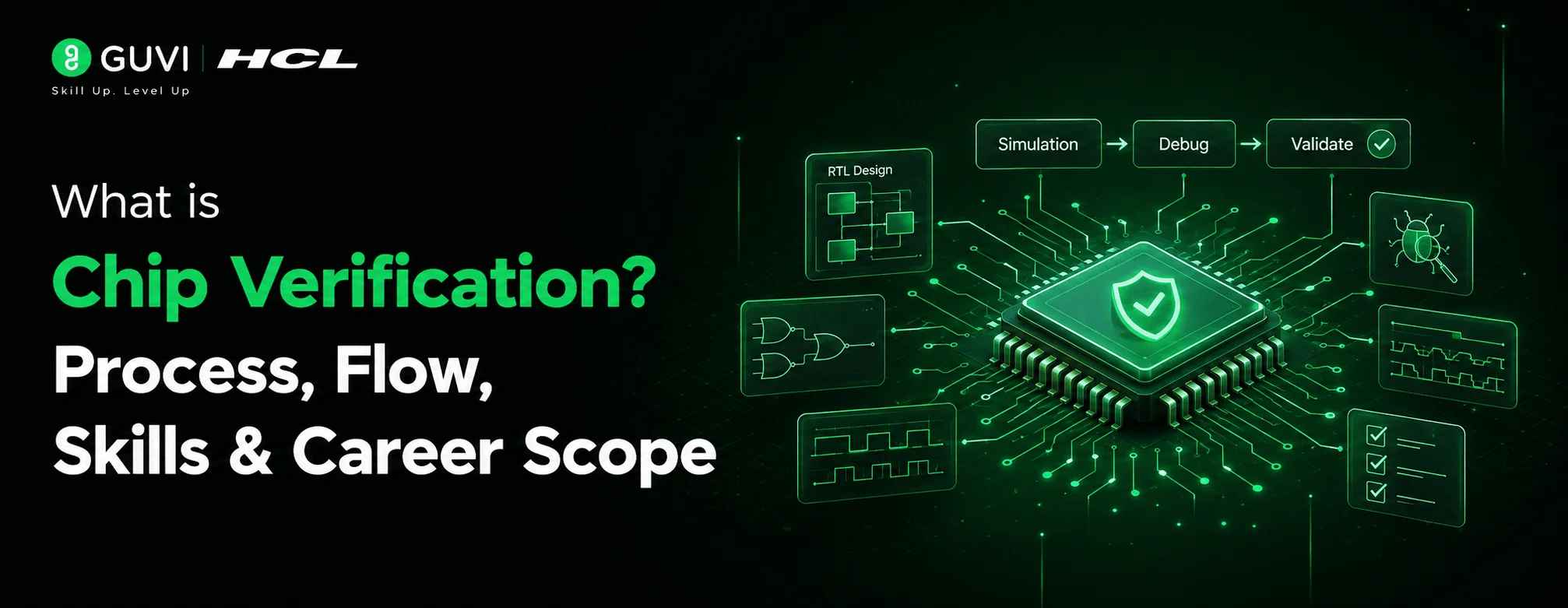
What is Chip Verification? Process, Flow, Skills & Career Scope
Jul 21, 2026 5 Min Read 361 Views
(Last Updated)
Table of contents
- TL;DR Summary
- Introduction
- What is Chip Verification?
- What is Chip Verification? A Simple Definition
- Why is Chip Verification Important in VLSI?
- Chip Verification Process and Verification Flow
- Typical Chip Verification Flow
- What Happens in a Testbench?
- Example: Verifying a Simple SPI Controller
- Functional Verification vs ASIC Verification vs VLSI Verification
- Where Functional Verification Fits
- Skills Required to Become a Verification Engineer
- Core Technical Skills
- Soft Skills That Matter
- Chip Verification Use Cases
- Example 1: Automotive Chips
- Example 2: AI Accelerator Chips
- Example 3: Medical Electronics
- Common Mistakes in Chip Verification
- Mistake 1: Testing Only Happy Paths
- Mistake 2: Ignoring the Specification
- Mistake 3: Confusing Code Coverage with Verification Completion
- Mistake 4: Not Learning Debugging Deeply
- Mistake 5: Learning UVM Too Early
- Salary and Career Scope in Chip Verification
- Salary Snapshot in India
- Career Paths After Learning Chip Verification
- Wrapping Up
- Frequently Asked Questions
- What is chip verification?
- Is chip verification the same as VLSI verification?
- What is functional verification in chip design?
- What skills are needed for a verification engineer?
- Is SystemVerilog verification important?
- What is the chip verification process?
- Is chip verification a good career in India?
- Do I need coding for chip verification?
- Which is better: design or verification?
- Can beginners learn ASIC verification?
TL;DR Summary
Chip Verification is the process of checking whether a chip design works exactly as intended before it is manufactured. It is one of the most important steps in VLSI verification and ASIC verification because a small design bug can lead to costly silicon failure. Verification engineers use simulation, testbenches, assertions, coverage, formal methods, and SystemVerilog verification to catch bugs early. With semiconductor demand rising, this is a strong career path for electronics, ECE, EEE, and embedded systems learners.
Introduction
The semiconductor industry is moving fast, and every AI accelerator, smartphone, EV, medical device, and data center chip depends on one thing before production: correctness.
That is where Chip Verification becomes critical.
The global semiconductor industry is expected to reach about US$975 billion in annual sales in 2026, driven strongly by AI infrastructure demand. India’s semiconductor market is also projected to grow from about US$45–50 billion in 2024–2025 to US$100–110 billion by 2030, creating demand for skilled VLSI professionals.
So, what is chip verification? In simple terms, it is the engineering process of testing a chip design before fabrication to make sure it performs the required functions correctly, handles edge cases, and avoids expensive post-silicon failures.
What is Chip Verification?
Before learning the tools, you need to understand the core idea. Chip design is like creating the blueprint of a complex city. Chip verification checks whether every road, signal, rule, and emergency path works before construction begins.
What is Chip Verification? A Simple Definition
Chip Verification is the process of validating a digital or mixed-signal chip design against its specification before manufacturing. It uses simulation, testbenches, assertions, coverage, and formal methods to confirm that the design behaves correctly across normal, corner-case, and unexpected operating conditions.
In practical terms, a verification engineer asks:
- Does the chip follow the specification?
- Does the RTL behave correctly?
- What happens during reset, overflow, low power, or invalid input?
- Are all features tested?
- Is the design ready for tape-out?
Why is Chip Verification Important in VLSI?
Chip manufacturing is expensive, and once a chip is fabricated, fixing bugs is not as simple as updating software.
If a bug escapes into silicon, companies may face:
- Re-spin costs
- Product delays
- Hardware recalls
- Customer trust issues
- Lost market opportunity
A 2024 Wilson Research Group functional verification study reported that only 14% of IC/ASIC projects achieved first-silicon success, showing how difficult modern chip correctness has become.
Did You Know?
Verification often takes more project time than RTL design in complex SoCs because engineers must test not only intended behavior but also corner cases that designers may not initially imagine.
Chip Verification Process and Verification Flow
The chip verification process usually starts as soon as the design specification is available. It runs in parallel with RTL development and continues until tape-out readiness.
Typical Chip Verification Flow
| Step | What Happens | Output |
| Specification Review | Understand chip features, interfaces, and constraints | Verification plan |
| Test Plan Creation | Define what must be tested | Feature-wise test matrix |
| Testbench Development | Build environment using SystemVerilog/UVM | Reusable testbench |
| Test Writing | Create directed and random tests | Test cases |
| Simulation | Run tests on RTL | Logs and waveforms |
| Debugging | Identify design or testbench bugs | Bug reports |
| Coverage Analysis | Check tested vs untested scenarios | Functional/code coverage |
| Regression Testing | Run large automated test suites | Stability results |
| Sign-off | Confirm verification completeness | Tape-out confidence |
What Happens in a Testbench?
A testbench is a verification environment that applies inputs to the design and checks outputs.
In SystemVerilog verification, a testbench may include:
- Driver to send signals
- Monitor to observe design behavior
- Scoreboard to compare expected and actual outputs
- Assertions to catch rule violations
- Coverage model to track tested scenarios
Accellera describes UVM as a standardized methodology meant to improve design productivity by enabling modular, scalable, and reusable verification environments.
Example: Verifying a Simple SPI Controller
Assume a chip has an SPI controller used to communicate with sensors.
A verification engineer will test:
- Correct data transfer
- Clock polarity and phase modes
- Reset behavior
- Invalid command handling
- Back-to-back transactions
- Overflow and underflow conditions
- Interrupt generation
This is where functional verification becomes practical. You are not just checking whether the circuit compiles; you are proving that it behaves correctly in real use.
Functional Verification vs ASIC Verification vs VLSI Verification
These terms are related, but they are not exactly the same. Understanding the difference helps you choose the right learning path.
| Term | Meaning | Used For |
| Chip Verification | Overall process of checking chip correctness before manufacturing | Digital chips, SoCs, ASICs |
| VLSI Verification | Verification within Very Large Scale Integration design | RTL, SoC, IP blocks |
| ASIC Verification | Verification of application-specific integrated circuits | Custom chips |
| Functional Verification | Checks whether design behavior matches specification | Pre-silicon logic correctness |
| Post-Silicon Validation | Tests fabricated chip in real hardware | Silicon bring-up |
Where Functional Verification Fits
Functional verification ensures that a chip behaves as intended before production. Synopsys explains that it helps identify functional bugs early, improves reliability, and reduces costly errors before manufacturing.
In most digital chip projects, functional verification is the largest pre-silicon verification activity.
Skills Required to Become a Verification Engineer
A verification engineer needs a mix of hardware thinking, programming logic, debugging ability, and patience. You do not need to master everything on day one, but you should build skills in the right order.
Core Technical Skills
| Stage | Skills to Learn | Why It Matters |
| Foundation | Digital electronics, Boolean logic, FSMs | Understand hardware behavior |
| HDL Basics | Verilog, RTL concepts | Read and understand design code |
| Verification Basics | Testbench, simulation, waveform debug | Start validating designs |
| Advanced Verification | SystemVerilog verification, assertions, coverage | Build industry-style environments |
| Methodology | UVM, reusable components, constrained random testing | Work on complex SoCs |
| Tools | QuestaSim, VCS, Xcelium, Verdi-style debugging | Industry execution |
| Career Layer | Git, Linux, scripting, Python/Tcl basics | Automation and productivity |
Soft Skills That Matter
Good verification engineers are not just tool users. They are bug hunters.
You need:
- Curiosity to ask “what can go wrong?”
- Clear communication to report bugs
- Patience for waveform debugging
- Structured thinking for coverage closure
- Collaboration with RTL designers
Chip Verification Use Cases
Chip Verification matters wherever hardware failure is costly, risky, or difficult to fix.
Example 1: Automotive Chips
Modern cars use chips for braking, battery management, ADAS, infotainment, and power control.
In automotive scenarios, verification must check safety conditions such as:
- Sensor failure
- Incorrect control signals
- Reset during active operation
- Low-power transitions
- Fault recovery
Example 2: AI Accelerator Chips
AI chips handle massive matrix operations, memory movement, and parallel processing.
Verification teams test:
- Data path correctness
- Memory access ordering
- Performance counters
- Power modes
- Interconnect behavior
- Hardware-software interaction
This is especially important as AI demand pushes semiconductor growth globally. Deloitte projects record semiconductor sales in 2026, with AI infrastructure as a major driver.

Example 3: Medical Electronics
A medical device chip used in imaging or monitoring must be reliable because incorrect outputs can affect diagnosis or patient safety.
Verification engineers test abnormal inputs, timing issues, fault states, and reset recovery to reduce real-world risk.
Common Mistakes in Chip Verification
Even smart beginners make avoidable mistakes when learning ASIC verification or VLSI verification. The goal is not just to run tests, but to build confidence that the chip will behave correctly in real-world conditions.
Mistake 1: Testing Only Happy Paths
Many beginners test only expected inputs.
Real verification requires edge cases, illegal values, reset conditions, protocol violations, and stress scenarios. A chip may work perfectly in normal cases but fail when two events happen at the same time, such as reset during data transfer or overflow during continuous operation.
Mistake 2: Ignoring the Specification
The specification is the source of truth.
If you write tests without understanding the spec, you may verify the wrong behavior very confidently. Always map every test case back to a requirement so that your verification flow covers what the design is actually expected to do.
Mistake 3: Confusing Code Coverage with Verification Completion
Code coverage shows which lines or branches ran.
Functional coverage shows whether meaningful design scenarios were tested. Both matter, but neither alone guarantees bug-free silicon. A design can show high code coverage while still missing important business logic, protocol behavior, or corner-case combinations.
Mistake 4: Not Learning Debugging Deeply
Running simulations is easy.
Understanding why a signal changed at the wrong time is the real skill. Spend time reading waveforms, tracing transactions, checking logs, and comparing expected versus actual behavior instead of only focusing on writing more tests.
Mistake 5: Learning UVM Too Early
UVM is powerful, but beginners should first understand Verilog, testbenches, simulation, and SystemVerilog basics.
Jumping directly into UVM can make verification feel confusing because you may use components without understanding what they do internally. Build confidence with simple testbenches first, then move into reusable UVM environments step by step.
Salary and Career Scope in Chip Verification
Chip Verification is becoming a strong career path because semiconductor companies need engineers who can reduce silicon risk.
Salary Snapshot in India
| Role | Indicative Salary Range |
| Entry-Level VLSI/Verification Engineer | ₹4.5 LPA – ₹8 LPA |
| ASIC Verification Engineer | Average around ₹7 LPA |
| Experienced Design Verification Engineer | ₹14 LPA – ₹25 LPA+ |
Glassdoor salary data for India lists the average ASIC Verification Engineer salary at around ₹7,00,000 per year, with top earners reported around ₹25,00,000 per year.
Career Paths After Learning Chip Verification
A career in Chip Design offers roles from beginner to advanced level.
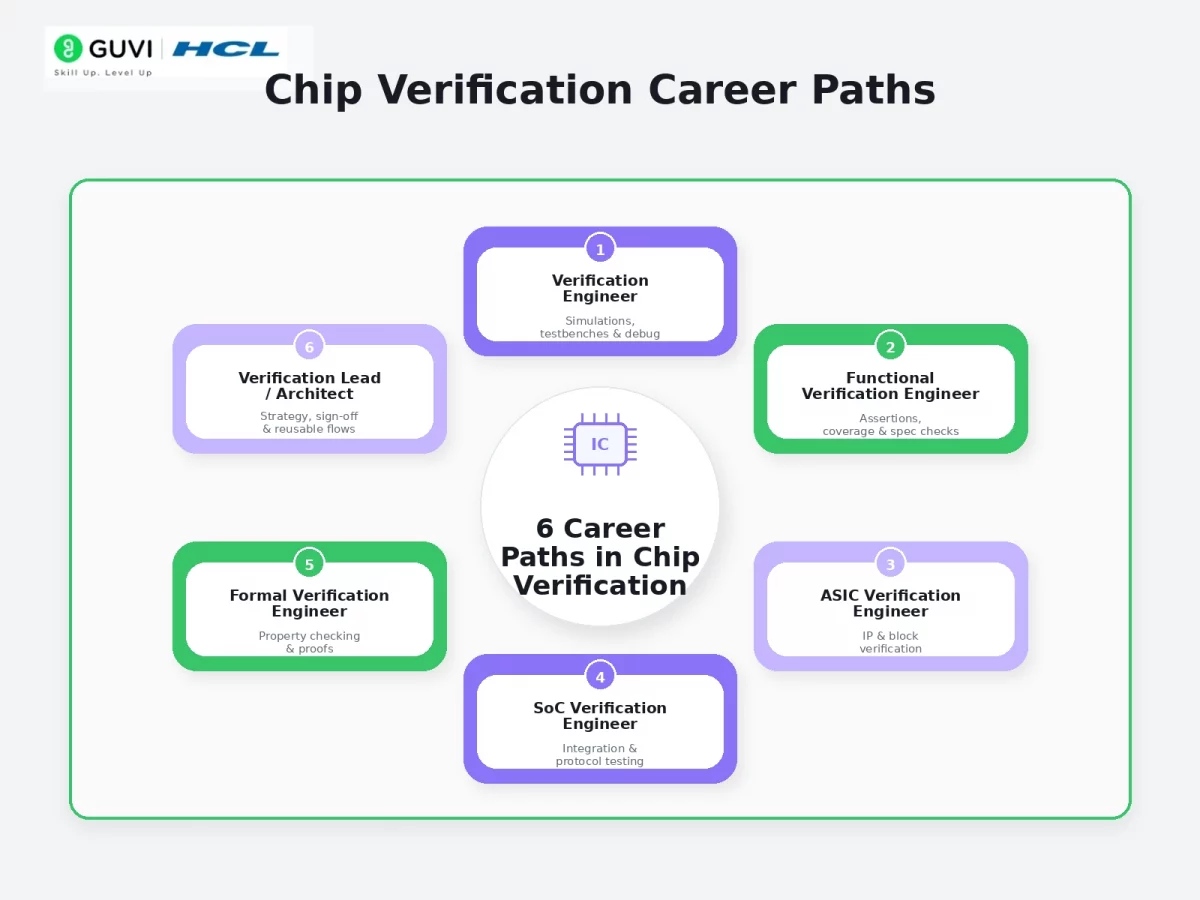
As you gain experience, you may move towards verification architecture, technical leadership, or SoC sign-off roles.
Wrapping Up
Chip Verification is the safety net of modern semiconductor design. It ensures that a chip works as specified before it reaches costly manufacturing stages. For learners, this field offers a strong blend of digital logic, coding, debugging, and problem-solving. Start with digital design, learn Verilog, move into SystemVerilog verification, understand the verification flow, and then build confidence with UVM-based projects. As India’s semiconductor ecosystem grows, verification engineers who can find bugs early and think deeply about hardware behavior will remain highly valuable.
If you are serious about moving from digital electronics basics to industry-style VLSI workflows, a structured path can save months of confusion. You can explore the IIT Delhi CEP Certified VLSI Design Program to build practical skills in VLSI design, verification fundamentals, and job-oriented project work with guided learning.
Frequently Asked Questions
1. What is chip verification?
Chip Verification is the process of checking whether a chip design behaves according to its specification before manufacturing. It helps catch bugs early using simulation, testbenches, assertions, coverage, and formal methods.
2. Is chip verification the same as VLSI verification?
Chip Verification is a broad term, while VLSI verification refers to verification within Very Large Scale Integration design. In practice, both terms often overlap in digital chip and SoC projects.
3. What is functional verification in chip design?
Functional verification checks whether the RTL design performs the intended functions correctly. It focuses on design behavior, protocol rules, edge cases, and specification compliance.
4. What skills are needed for a verification engineer?
A verification engineer should know digital electronics, Verilog, SystemVerilog verification, testbenches, assertions, coverage, debugging, scripting, and preferably UVM for advanced ASIC verification roles.
5. Is SystemVerilog verification important?
Yes. SystemVerilog verification is widely used because it supports object-oriented testbenches, constrained random testing, assertions, and coverage-driven verification.
6. What is the chip verification process?
The chip verification process includes specification review, verification planning, testbench creation, test writing, simulation, debugging, coverage analysis, regression testing, and sign-off.
7. Is chip verification a good career in India?
Yes. India’s semiconductor market is projected to reach US$100–110 billion by 2030, and demand for VLSI design and verification talent is increasing.
8. Do I need coding for chip verification?
Yes, but it is hardware-oriented coding. You should learn Verilog, SystemVerilog, scripting basics, and debugging workflows.
9. Which is better: design or verification?
Both are valuable. RTL design focuses on creating hardware logic, while verification focuses on proving that logic works correctly. Many semiconductor teams hire more verification engineers because complex chips need extensive testing.
10. Can beginners learn ASIC verification?
Yes. Start with digital logic and Verilog, then learn testbenches, SystemVerilog, assertions, coverage, and UVM gradually.
Success Stories










Did you enjoy this article?