


Data Science Articles
Data Warehouse vs. Data Lake vs. Lakehouse: What's the Difference?
SQL Window Functions: Practical Examples Every Analyst Needs
dbt for Beginners: Transform Data Like an Engineer
Data Storytelling: Turning Numbers into Narratives That Persuade


Get In Touch For Details! Request More Information
Skills to Become a Quantitative Analyst in 2026
Aug 13, 2026 5 Min Read 456 Views
(Last Updated)
Table of contents
- TL;DR Summary:
- What Does a Quantitative Analyst Actually Do?
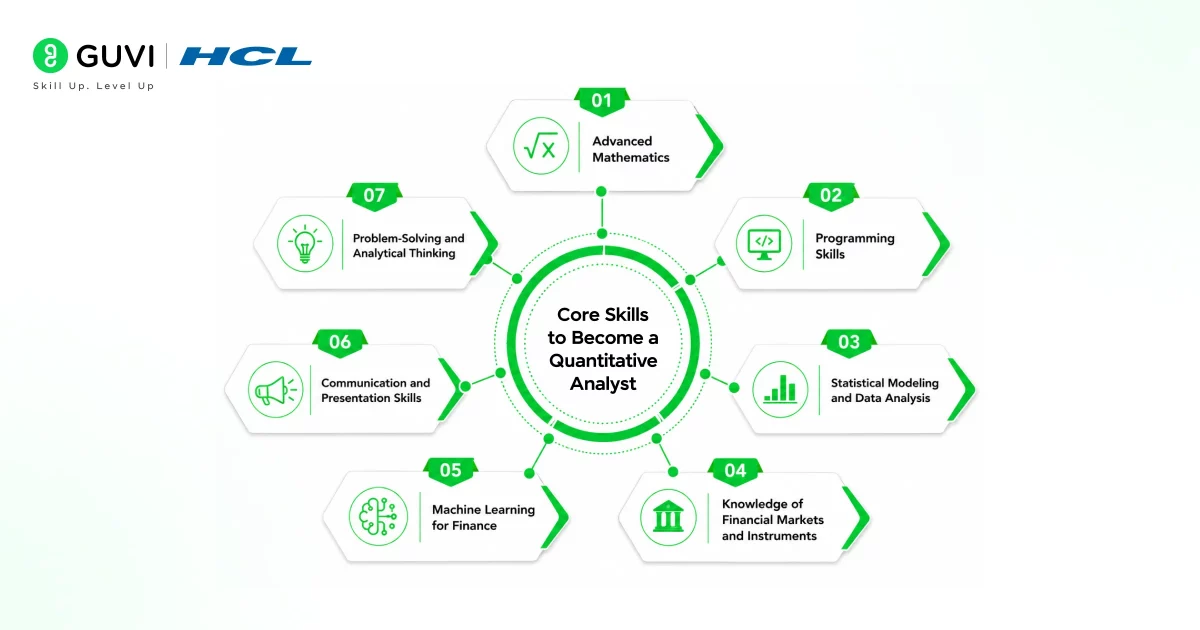
- Core Skills to Become a Quantitative Analyst
- Advanced Mathematics
- Programming Skills
- Statistical Modeling and Data Analysis
- Knowledge of Financial Markets and Instruments
- Machine Learning for Finance
- Communication and Presentation Skills
- Problem-Solving and Analytical Thinking
- Tools Every Quant Should Know
- Common Mistakes Aspiring Quants Make
- Real-World Example
- Conclusion
- FAQs
- What is a quantitative analyst?
- What programming language should I learn first as a quant?
- Do I need a PhD to become a quantitative analyst?
- What mathematical topics are most important for quants?
- Is machine learning important for quantitative analysts?
- What certifications help in a quant career?
- Can I become a quant without a finance background?
- What is the difference between a quant and a data scientist?
TL;DR Summary:
A quantitative analyst (or “quant”) uses mathematics, statistics, and programming to model financial markets, manage risk, and drive investment decisions. To build a career in this field, you need a strong foundation in advanced math, proficiency in Python or R, a working knowledge of financial markets, and the ability to communicate complex findings clearly. This article breaks down every skill you need, why it matters, and how to start building it.
What Does a Quantitative Analyst Actually Do?
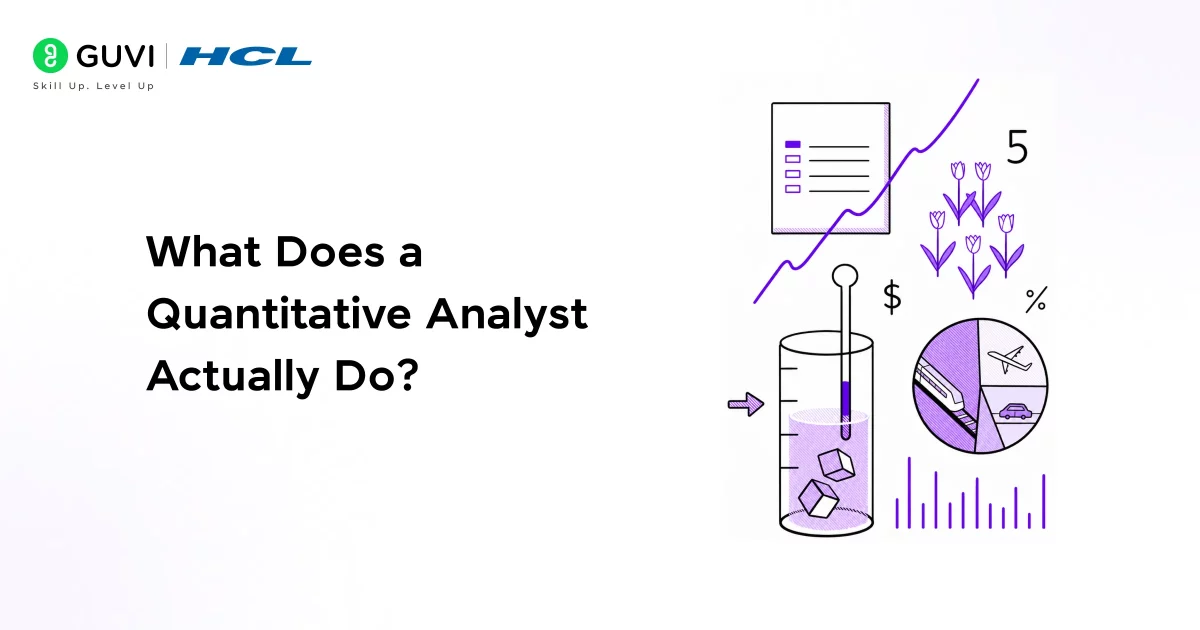
A quantitative analyst, or “quant,” is a financial professional who applies mathematical models, statistical techniques, and programming skills to analyze financial markets, develop trading strategies, and manage risk.
Some quants work on the buy-side of an investment bank, helping these large companies increase profits with automated trading algorithms. Others, on the sell-side, determine prices for marketable securities like stocks and bonds based on vast amounts of data and risk metrics.
The work is highly technical and often collaborative. You will be building models, back-testing strategies, and presenting findings to traders, portfolio managers, and risk teams. That mix of depth and breadth is exactly why the skill set for this role is broad.
Core Skills to Become a Quantitative Analyst
1. Advanced Mathematics
This is the non-negotiable foundation of the entire role.
Quantitative analysts need a strong understanding of mathematics, including calculus, linear algebra, probability theory, and statistics. Being able to apply this knowledge to solve complex problems is just as important as knowing it theoretically.
Here is what you should specifically be comfortable with:
- Calculus (differential and integral) for pricing models
- Linear algebra for portfolio optimization and machine learning
- Probability theory for risk modeling and derivatives pricing
- Statistics for data analysis and pattern recognition
- Stochastic calculus for more advanced quantitative finance work
You do not need to master all of these on day one. But the further you want to go in this field, the more deeply these topics will matter.
2. Programming Skills
If math is the brain of a quant, programming is the hands. You need to be able to turn your models into working code.
The technical domain for quants covers programming in Python, C, C++, or C#, along with knowledge of software packages like MATLAB, R, and SAS. Machine learning and data science skills are also increasingly in demand as part of the quant skill set.
Python is the most widely used language in the field right now. Python has emerged as the de facto standard in many areas of quantitative finance. Libraries like Pandas and NumPy are the cornerstones for data manipulation and numerical computation, while Scikit-learn and Statsmodels provide robust frameworks for statistical modeling and machine learning.
R is particularly strong for statistical work and is preferred in some research-focused roles. MATLAB is still used in areas like derivatives pricing and signal processing. And if you want to work in high-frequency trading, C++ is often a requirement due to its speed.
A practical starting point would be:
- Learn Python first (focus on Pandas, NumPy, Matplotlib)
- Get comfortable with SQL for querying financial databases
- Explore R if you are heading toward a research-heavy role
Entry-level quants at top-tier firms earn competitive salaries often exceeding $225,000, with experienced professionals making over $500,000 annually. The steep learning curve is very much worth it for those who put in the work early.

3. Statistical Modeling and Data Analysis
Quantitative analysts must be able to interpret and analyze large amounts of data, identify patterns and trends, and draw meaningful conclusions from it.
This is where your math and programming skills come together. In practice, this means:
- Building regression models to identify market relationships
- Running time series analysis to forecast price movements
- Performing hypothesis testing to validate trading strategies
- Using Monte Carlo simulations to estimate risk
The goal is not just to crunch numbers. It is to extract insights that can actually drive a financial decision.
4. Knowledge of Financial Markets and Instruments
You can be an excellent statistician and still struggle as a quant if you do not understand what you are modelling.
You cannot price what you do not understand. Deep knowledge of equities, fixed income, derivatives, and foreign exchange is the prerequisite for all pricing and risk work.
As a starting point, you should be familiar with:
- How equity markets and stock exchanges operate
- Fixed income instruments like bonds and their pricing
- Derivatives (options, futures, swaps) and what they are used for
- Risk management frameworks like Value at Risk (VaR)
Most of this can be picked up through self-study, online courses, or by pursuing a CFA certification, which shows advanced knowledge in economics, financial ethics, security analysis, accounting, and wealth management.
5. Machine Learning for Finance
This is one of the fastest-growing areas within quantitative finance. Some quant roles require knowledge of machine learning and natural language processing techniques, especially at hedge funds and algorithmic trading firms.
Practically speaking, machine learning in finance is used for:
- Predicting asset price movements
- Detecting anomalies and market signals
- Building algorithmic trading strategies
- Risk classification and portfolio optimization
You do not need to be a machine learning researcher. But knowing how to apply models like random forests, gradient boosting, or LSTMs to financial data gives you a real edge.
6. Communication and Presentation Skills
This one often gets underestimated, but it matters more than most people expect.
Quantitative analysts must be able to effectively communicate their findings to others. This includes explaining complex concepts in an easy-to-understand manner, as well as presenting data in a visually appealing way.
Your model might be technically brilliant, but if you cannot explain its assumptions, limitations, and outputs to a non-technical stakeholder, it will not get used. Clear communication is what turns analysis into action.
7. Problem-Solving and Analytical Thinking
Quantitative analysts must be able to analyze a problem and come up with creative and innovative solutions. This requires a combination of analytical and creative thinking.
Quant interviews are known for testing this directly through brain teasers, probability puzzles, and logic problems. Quant interviews test analytical, programming, and financial skills, including probability puzzles, combinatorics problems, and algorithmic coding challenges.
The best way to build this skill is through practice. Platforms like LeetCode, Project Euler, and quantitative finance communities are great places to start.
Tools Every Quant Should Know
| Tool | Primary Use |
| Python (Pandas, NumPy) | Data analysis and modelling |
| R | Statistical computing and research |
| MATLAB | Derivatives pricing and signal processing |
| SQL | Database querying |
| Excel | Financial modelling and reporting |
| Scikit-learn / TensorFlow | Machine learning |
| QuantLib | Quantitative finance library |
Common Mistakes Aspiring Quants Make
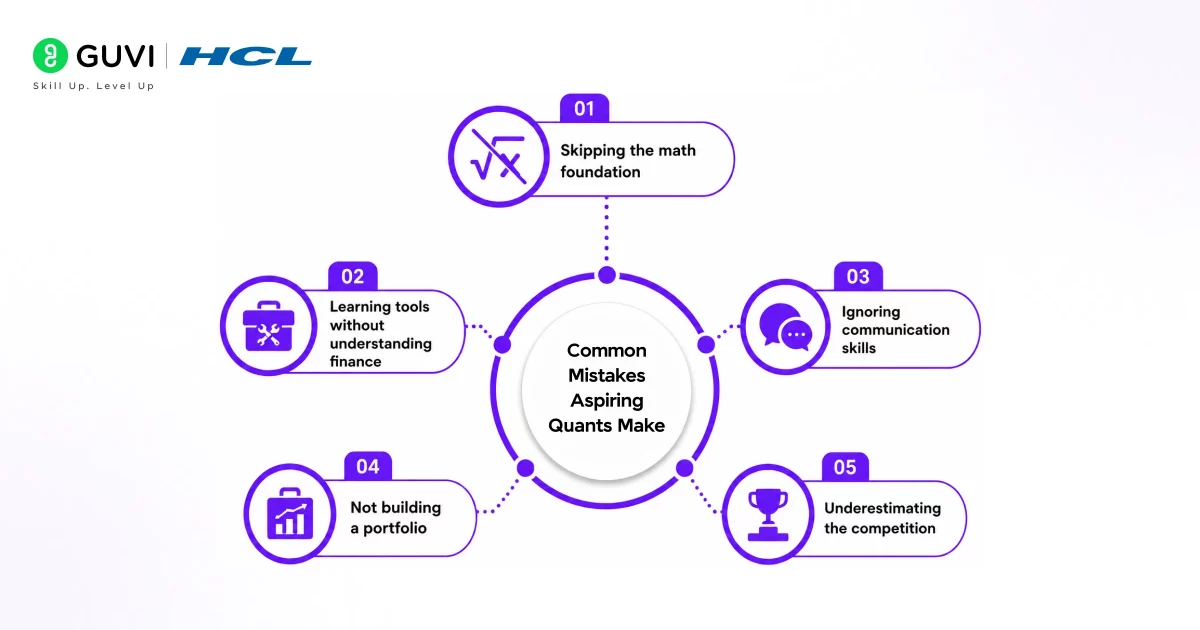
1. Skipping the math foundation: Many beginners try to jump straight into Python and trading strategies without building solid math skills first. This leads to gaps when models need to be derived or explained from first principles.
2. Learning tools without understanding finance: Knowing how to code does not automatically make you a quant. If you do not understand what a derivative or a risk metric means, the code you write will not produce useful outputs.
3. Ignoring communication skills: Some candidates assume the technical work speaks for itself. In reality, being unable to explain your model to a portfolio manager or risk committee is a serious career limiter.
4. Not building a portfolio: Keep an active GitHub profile showcasing your coding work and back-tested strategies. Firms want proof of your skills, not just your degree.
5. Underestimating the competition: Quant roles at top firms are highly competitive. While analyst positions in banks are numerous, working your way up the ladder can be cutthroat. Consistent practice and continuous learning are what separate candidates.
Real-World Example
Consider a hedge fund that wants to identify arbitrage opportunities across global equity markets. A quant on their team would:
- Pull large volumes of price data using Python and SQL
- Build a statistical model to detect pricing inefficiencies
- Back-test the strategy against five years of historical data
- Implement the algorithm in a live trading environment
- Continuously monitor and refine the model as market conditions shift
That end-to-end workflow touches every skill covered in this article, which is exactly why quants need to develop across all of these areas, not just one or two.
If you want to learn more about data science related domains like this and its functionalities in the real world, then consider enrolling in HCL GUVI’s Certified Data Science Course which not only gives you theoretical knowledge but also practical knowledge with the help of real-world projects.
Conclusion
Becoming a quantitative analyst is a demanding path, but it is one of the most intellectually rewarding careers in finance. The role sits at the intersection of mathematics, technology, and financial markets. You need to be strong in advanced math, comfortable writing code in Python or R, familiar with financial instruments, and capable of communicating complex ideas clearly
Start by building your math and Python fundamentals, then layer in financial knowledge and machine learning as you go. The quant field rewards consistent effort and genuine curiosity more than anything else.
FAQs
What is a quantitative analyst?
A quantitative analyst is a finance professional who uses mathematics, statistics, and programming to build models that help organizations make investment decisions, manage risk, and develop trading strategies.
What programming language should I learn first as a quant?
Python is the best starting point. It has a rich ecosystem of libraries like Pandas, NumPy, and Scikit-learn that are widely used in quantitative finance for data analysis, modelling, and machine learning.
Do I need a PhD to become a quantitative analyst?
What mathematical topics are most important for quants?
Probability theory, statistics, linear algebra, calculus, and stochastic calculus are the core mathematical areas. Probability and statistics tend to be the most immediately applicable at the junior level.
Is machine learning important for quantitative analysts?
Increasingly, yes. Many firms now look for quants who can apply machine learning techniques to financial data for trading strategy development, risk classification, and predictive modelling.
What certifications help in a quant career?
The Chartered Financial Analyst (CFA) designation and the Certificate in Quantitative Finance (CQF) are both well-regarded. The CFA is more widely recognized across finance, while the CQF is more technical and quant-specific.
Can I become a quant without a finance background?
Yes. Many quants come from mathematics, physics, computer science, or engineering. The financial knowledge can be learned on the job or through structured study, as long as your technical foundation is strong.
What is the difference between a quant and a data scientist?
Both roles use programming and statistical modelling, but quants focus specifically on financial applications like pricing, risk, and trading strategy. Data scientists work across industries and tend to focus more on predictive modelling and machine learning at scale.
Success Stories

About the Author
Lukesh S
A professional content writer who has experience in freelancing and now working as a Technical Content Writer at HCL GUVI having sound knowledge in Blog Writing and Creative Writing!
View all posts by Lukesh S
Connect with me @








Did you enjoy this article?