


Artificial Intelligence and Machine Learning Articles
Finance Manager to Data Analytics: Career Growth, Salary and Seniority
How to Evaluate LLM Outputs in Production Deployments
AI/ML Skills Gap 2026: Why Companies Can't Find Job-Ready Talent
20 AI/ML Interview Questions Recruiters Can Use Without a Tech Background - Best Guide
Get In Touch For Details! Request More Information
Computer Vision Engineer Skills Roadmap: A Step-by-Step Guide
Aug 18, 2026 3 Min Read 853 Views
(Last Updated)
Wondering what it actually takes to become a computer vision engineer in 2026? You’re not alone, and the good news is that the path is more structured than it looks from the outside.
Table of contents
- TL;DR Summary
- What Does a Computer Vision Engineer Actually Do?
- Step 1: Build Your Programming and Math Foundation
- Why This Stage Matters
- Step 2: Learn Image Processing Fundamentals
- Step 3: Move Into Machine Learning and Deep Learning
- Core Concepts to Learn
- Frameworks to Get Hands-On With
- Step 4: Specialise in Core Computer Vision Tasks
- Step 5: Learn Deployment and MLOps Basics
- Step 6: Build a Portfolio That Proves Your Skills
- Common Mistakes to Avoid
- Conclusion
- FAQs
- Is coding knowledge required to become a computer vision engineer?
- How long does it take to become a computer vision engineer?
- Do I need a degree to work in computer vision?
- Which is more important, OpenCV or deep learning frameworks?
- What is the difference between a computer vision engineer and a computer vision researcher?
- Can I learn computer vision without a machine learning background?
- What industries hire computer vision engineers the most?
- Is computer vision a good career choice in 2026?
TL;DR Summary
A computer vision engineer roadmap starts with Python and math foundations, moves into image processing with OpenCV, then deep learning frameworks like PyTorch or TensorFlow, and finally specialised Computer Vision Engineer skills like object detection, segmentation, and model deployment.
You’ll also need a portfolio of real projects to get hired, since most recruiters look for applied work over certificates alone. The full journey typically takes six to nine months of consistent learning.
What Does a Computer Vision Engineer Actually Do?
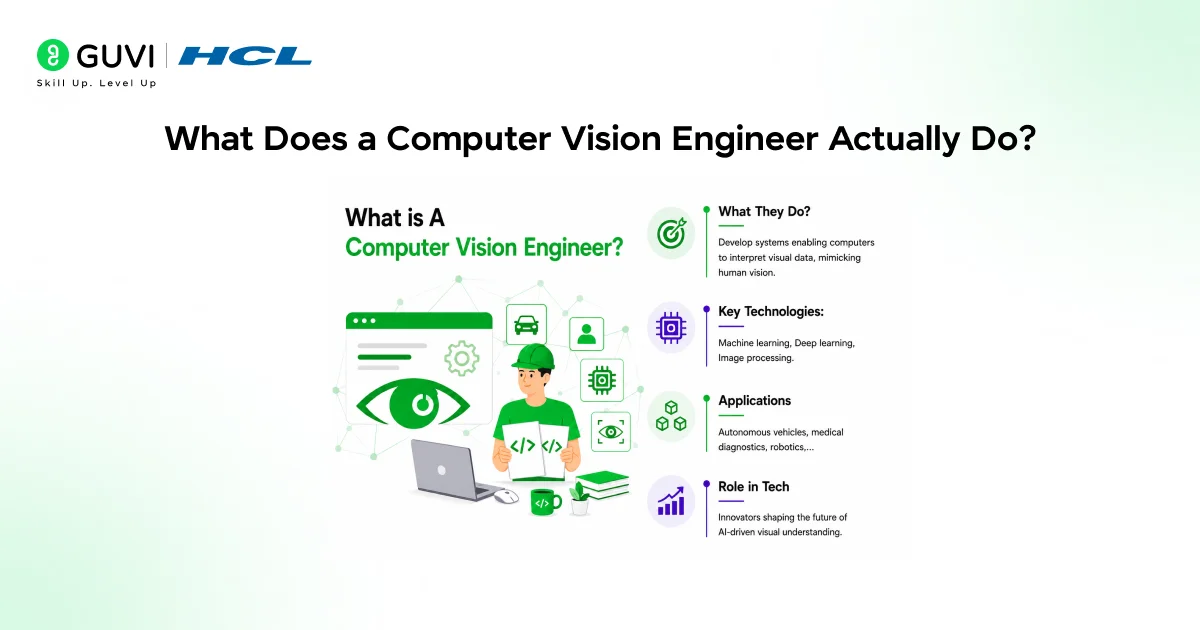
A computer vision engineer builds systems that let machines interpret images and videos the way humans do. Think of facial recognition in your phone, defect detection on a factory line, or self-driving cars reading road signs. All of that runs on computer vision.
You’ll be working at the intersection of software engineering and machine learning. That means writing production code, training models, and making sure those models work reliably outside a lab environment.
The global computer vision market is projected to cross USD 50 billion by 2030, driven largely by demand in healthcare imaging, retail automation, and autonomous vehicles.
Step 1: Build Your Programming and Math Foundation
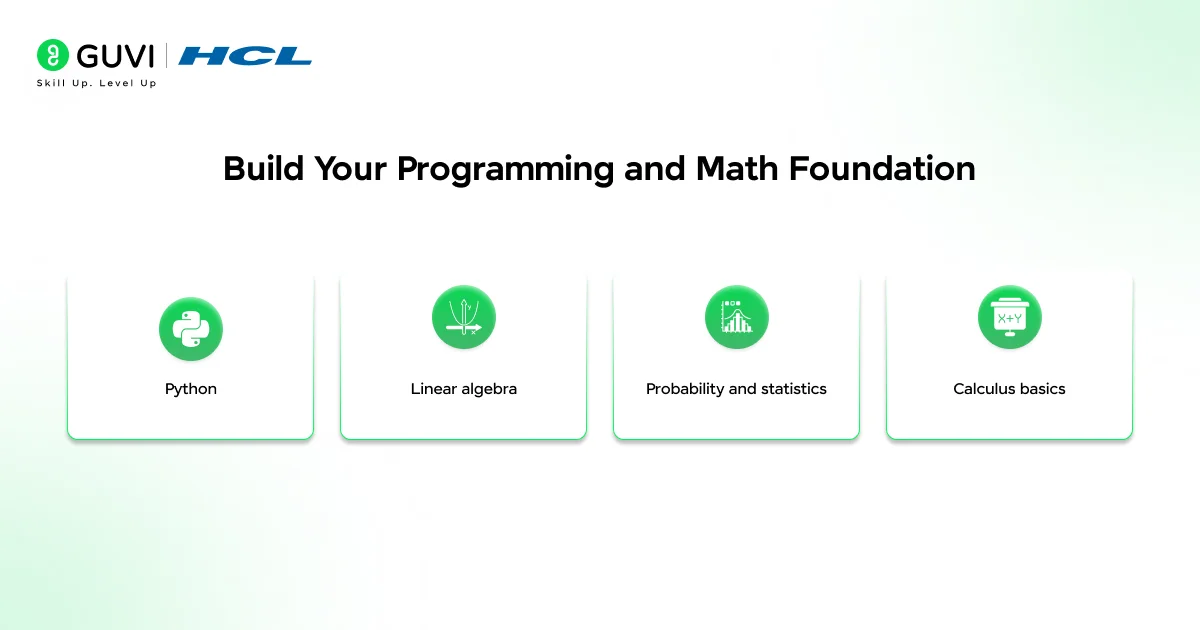
Before touching any computer vision library, you need the basics in place.
- Python: Variables, loops, functions, and object-oriented programming. Almost every CV library is Python-first.
- Linear algebra: Vectors, matrices, and transformations, since images are essentially matrices of pixel values.
- Probability and statistics: Needed to understand how models make predictions and handle uncertainty.
- Calculus basics: Helps you understand how neural networks learn through gradients.
You don’t need to master research-level math here. A working understanding is enough to follow how algorithms behave.
Why This Stage Matters
Skipping math fundamentals is one of the most common mistakes beginners make. You can copy code from tutorials without understanding it, but you’ll struggle the moment a model doesn’t perform as expected.
Step 2: Learn Image Processing Fundamentals
This is where computer vision starts feeling real. You’ll learn how images are represented, manipulated, and prepared for machine learning models.
Key topics to cover:
- Image representation (pixels, channels, colour spaces)
- Filtering and edge detection
- Image transformations like rotation, scaling, and cropping
- Histogram equalisation and noise reduction
OpenCV is the standard library here. It’s open source, well documented, and used heavily in both academic and industry projects.
Step 3: Move Into Machine Learning and Deep Learning
Once you’re comfortable manipulating images, the next step is teaching machines to learn patterns from them.
Core Concepts to Learn
- Supervised learning basics (classification, regression)
- Neural networks and how they process data
- Convolutional Neural Networks (CNNs), which form the backbone of most computer vision tasks
Frameworks to Get Hands-On With
| Framework | Best For |
| PyTorch | Research, flexibility, widely used in industry |
| TensorFlow | Production deployment, mobile and edge devices |
| Keras | Beginner-friendly, sits on top of TensorFlow |
Most learners pick one framework and go deep rather than splitting attention across all three.
CNNs were inspired by how the human visual cortex processes information in layers, starting with simple edges and building up to complex shapes.
Step 4: Specialise in Core Computer Vision Tasks
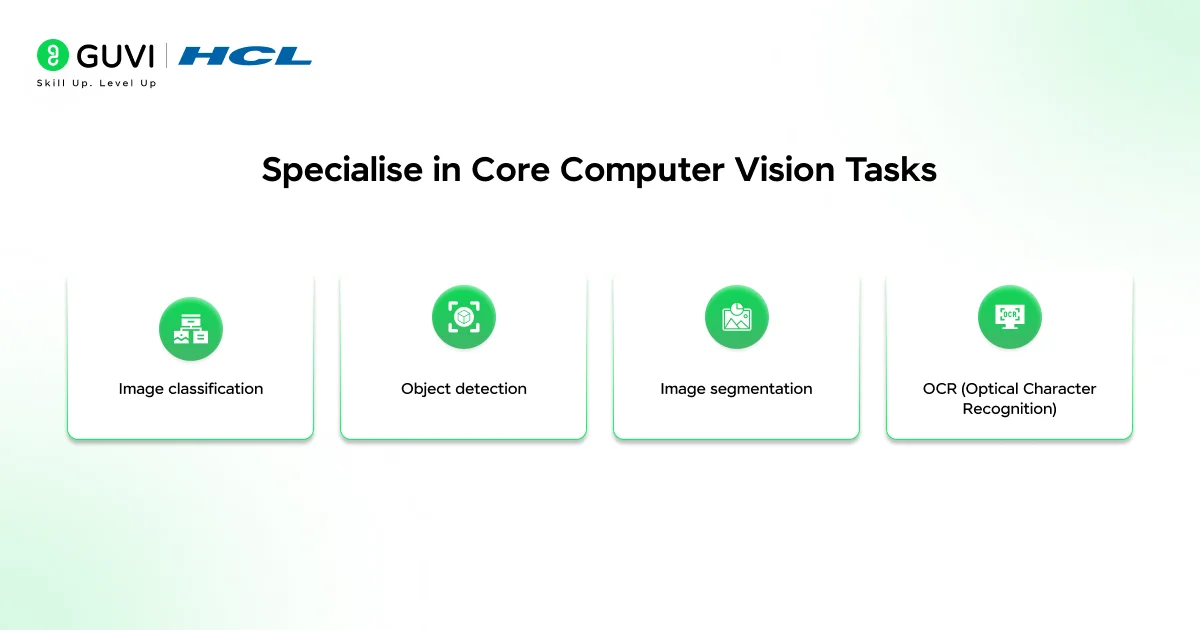
This is where your roadmap branches into specific, in-demand skills that employers actually screen for.
- Image classification: Teaching a model to label what’s in an image
- Object detection: Identifying and locating multiple objects in a single image, using models like YOLO or Faster R-CNN
- Image segmentation: Pixel-level classification, useful in medical imaging and autonomous driving
- OCR (Optical Character Recognition): Extracting text from images or scanned documents
You don’t need to master every specialisation. Pick one or two based on the industry you want to enter.
Step 5: Learn Deployment and MLOps Basics
A model that only runs in a notebook isn’t useful to a company. You’ll need to know how to take it from experiment to production.
Skills to pick up here include:

- Building APIs with FastAPI or Flask to serve your model
- Containerisation with Docker
- Model optimisation using ONNX Runtime or TensorRT for faster inference
- Basic cloud deployment on AWS, GCP, or Azure
A retail company, for example, might use a deployed object detection API to scan shelf images and flag out-of-stock products in real time, exactly the kind of end-to-end skill that separates job-ready engineers from tutorial followers.
Step 6: Build a Portfolio That Proves Your Skills
Recruiters in this field look for applied projects, not just course completion certificates. Your portfolio should ideally include:
- One image classification project (CNN-based)
- One object detection project
- One segmentation or OCR project
- At least one deployed, real-time application
Each project should have a clean code repository, a short demo video, and a clear explanation of the problem it solves.
Common Mistakes to Avoid
- Jumping straight into deep learning: Skipping image processing fundamentals leaves gaps that show up later when debugging model behaviour.
- Collecting certificates instead of projects: Certificates show you completed a course. Projects show you can solve a problem.
- Ignoring deployment: A model stuck in a Jupyter notebook won’t impress hiring panels looking for production-ready engineers.
- Learning every framework at once: Spreading effort across PyTorch, TensorFlow, and Keras simultaneously slows progress. Pick one and go deep first.
If you’re serious about learning effective AI prompts and want to apply them in real-world scenarios, don’t miss the chance to enroll in HCL GUVI’s Intel & IITM Pravartak Certified Artificial Intelligence & Machine Learning Course, co-designed by Intel. It covers Python, Machine Learning, Deep Learning, Generative AI, Agentic AI, and MLOps through live online classes, 20+ industry-grade projects, and 1:1 doubt sessions, with placement support from 1000+ hiring partners.
Conclusion
Becoming a computer vision engineer isn’t about memorising every algorithm at once. It’s about following a sequence: solid programming and math, image processing, deep learning, specialisation, and finally deployment.
Each stage builds directly on the last, and skipping ahead usually means backtracking later. If you’re just starting out, focus on consistency over speed. Build one project at a time, understand why it works, and let your portfolio do the talking when you start applying for roles.
FAQs
1. Is coding knowledge required to become a computer vision engineer?
Yes, Python is essential. Most computer libraries and frameworks are built around it.
2. How long does it take to become a computer vision engineer?
Most beginners take six to nine months of consistent learning to reach a job-ready level, depending on prior programming experience.
3. Do I need a degree to work in computer vision?
A degree helps but isn’t mandatory. A strong portfolio of real projects often carries more weight with recruiters.
4. Which is more important, OpenCV or deep learning frameworks?
Both matter. OpenCV handles image processing fundamentals, while PyTorch or TensorFlow handle model training.
5. What is the difference between a computer vision engineer and a computer vision researcher?
Engineers focus on building and deploying applications, while researchers focus on developing new algorithms and techniques.
6. Can I learn computer vision without a machine learning background?
Yes, but you’ll need to learn basic machine learning concepts alongside computer vision, since most modern CV work relies on deep learning.
7. What industries hire computer vision engineers the most?
Healthcare, automotive, retail, manufacturing, and security are currently the biggest hirers for this role.
8. Is computer vision a good career choice in 2026?
Yes, demand continues to grow as more industries adopt automation, especially in healthcare imaging and autonomous systems.
Success Stories

About the Author
Lukesh S
A professional content writer who has experience in freelancing and now working as a Technical Content Writer at HCL GUVI having sound knowledge in Blog Writing and Creative Writing!
View all posts by Lukesh S
Connect with me @









Did you enjoy this article?