


Artificial Intelligence and Machine Learning Articles
Claude vs AI Writing Tools: Jasper, Copy.ai, and Writesonic Compared
Claude API Caching: Reduce Costs on Repeated Prompts


Get In Touch For Details! Request More Information
Does Claude Have Opinions? How It Handles Controversial Topics
Aug 17, 2026 4 Min Read 38 Views
(Last Updated)
Many users ask, does Claude have opinions when interacting with AI. While Claude can discuss different viewpoints, explain controversial topics, and present balanced perspectives, it does not hold personal beliefs or opinions. Understanding does Claude have opinions helps users interpret AI-generated responses more accurately.
TL;DR
- Claude does not have personal opinions or beliefs.
- It presents balanced information on controversial topics.
- AI explains multiple perspectives when appropriate.
- Claude aims to provide helpful, accurate, and responsible responses.
- Users should verify important information using trusted sources.
Data Point: As organizations continue adopting artificial intelligence across industries, responsible AI development has become a major priority. Modern AI assistants are increasingly designed to improve transparency, reduce harmful bias, and provide balanced responses to complex or sensitive questions.
Table of contents
- Direct Answer Box
- Why People Think Claude Has Opinions
- How Claude Handles Controversial Topics
- Types of Controversial Topics Claude Can Discuss
- How Claude Tries to Stay Neutral
- When Claude May Decline to Answer
- Common Misconceptions About Claude's Opinions
- Myth 1: Claude has personal beliefs.
- Myth 2: Claude always takes one side.
- Myth 3: Claude is always correct.
- Myth 4: Claude thinks like a human.
- Best Ways to Ask Claude About Sensitive Topics
- Tasks You Can Automate with Claude
- What Claude Should Not Replace
- Best Practices for Using Claude on Controversial Topics
- Conclusion
- FAQs
- Does Claude have personal opinions?
- Does Claude take sides in political discussions?
- Can Claude discuss controversial topics?
- Is Claude completely unbiased?
- Why do Claude's responses sometimes sound opinionated?
- Should I trust Claude for important decisions?
- How can I get better answers from Claude about controversial topics?
Direct Answer Box
| No, Claude does not have personal opinions. It cannot form beliefs, emotions, political preferences, or personal experiences like humans do. Instead, Claude generates responses by analyzing patterns in information and presenting balanced, context-aware explanations. When discussing controversial topics, it aims to explain different viewpoints while avoiding unnecessary bias and encouraging users to evaluate evidence critically. |
Why People Think Claude Has Opinions
Claude often produces thoughtful, detailed responses that sound conversational and well-reasoned. Because of this, many users assume it is expressing its own beliefs.
In reality, Claude is not sharing personal viewpoints. It generates responses by understanding your question, analyzing relevant information, and presenting an answer that is intended to be useful, balanced, and appropriate for the conversation.
This distinction is important because AI-generated responses may sound confident, but they are not based on personal experiences, emotions, or individual beliefs.
How Claude Handles Controversial Topics
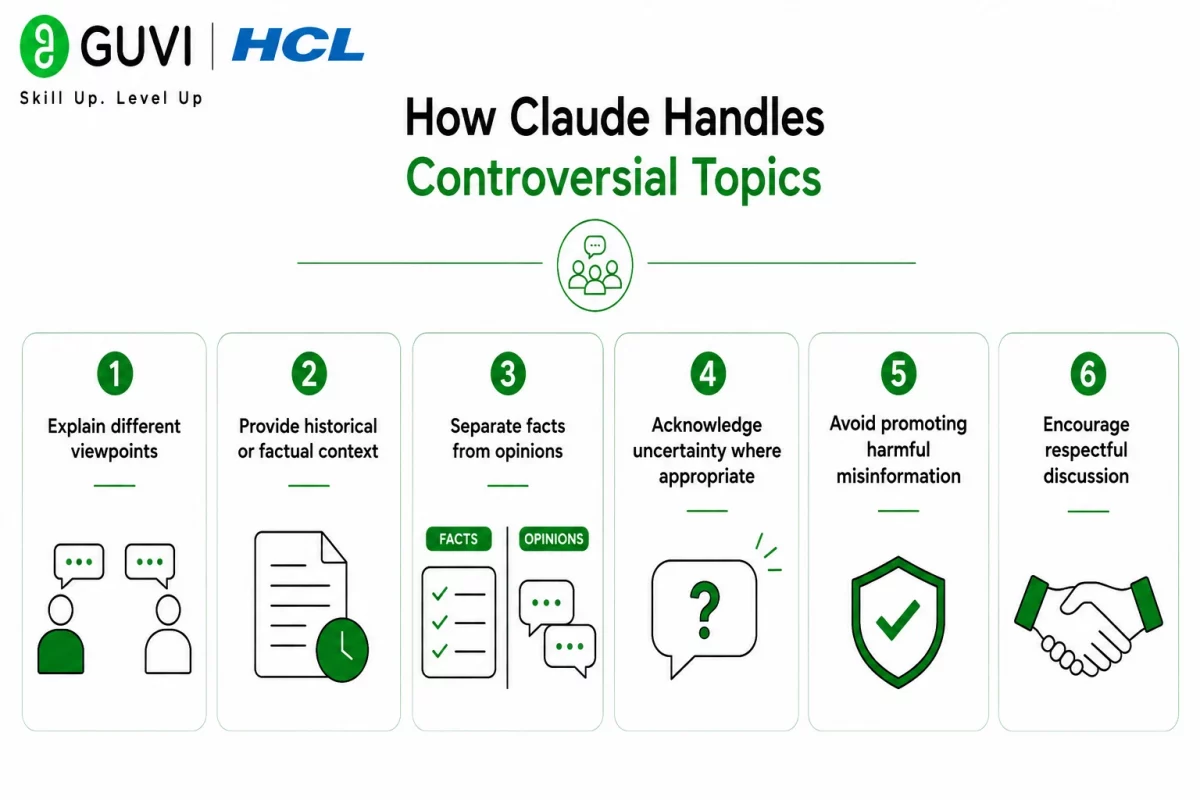
Some discussions involve multiple perspectives and strong opinions. Instead of automatically supporting one side, Claude attempts to provide context that helps users understand the broader picture.
When discussing controversial topics, Claude typically tries to:
- Explain different viewpoints
- Provide historical or factual context
- Separate facts from opinions
- Acknowledge uncertainty where appropriate
- Avoid promoting harmful misinformation
- Encourage respectful discussion
This approach allows users to explore complex subjects while considering multiple perspectives instead of receiving one-sided answers.
Types of Controversial Topics Claude Can Discuss
Claude can assist with many sensitive or debated subjects while maintaining a balanced and informative approach.
These may include:
- Climate change
- Artificial intelligence ethics
- Healthcare policies
- Education reforms
- Economic policies
- Social issues
- Technology regulations
- Environmental concerns
- Business ethics
- Scientific debates
The goal is to help users understand these topics rather than persuade them to adopt a particular viewpoint.
How Claude Tries to Stay Neutral
Neutrality does not always mean presenting every opinion as equally valid. Instead, Claude attempts to explain well-supported information while recognizing that some issues involve ongoing debate.
To maintain balanced responses, Claude generally:
- Focuses on evidence-based information
- Explains multiple viewpoints
- Avoids emotional arguments
- Clarifies when evidence is limited
- Distinguishes facts from opinions
- Encourages independent thinking
This helps users evaluate information more effectively instead of relying solely on AI-generated responses.
When Claude May Decline to Answer
Although Claude answers a wide variety of questions, there are situations where it may refuse or limit a response.
Examples include:
- Requests that promote harm
- Dangerous instructions
- Illegal activities
- Hate speech
- Harassment
- Privacy violations
- Fraudulent activities
- Misinformation that could cause harm
In these situations, Claude prioritizes user safety while still attempting to provide helpful alternatives whenever possible.
Many modern AI assistants are designed not only to answer questions but also to identify uncertainty, acknowledge multiple viewpoints, and encourage users to verify important information before making significant decisions.

Common Misconceptions About Claude’s Opinions
Several misconceptions contribute to confusion about how AI works.
Myth 1: Claude has personal beliefs.
Reality: Claude does not possess beliefs, emotions, or personal experiences.
Myth 2: Claude always takes one side.
Reality: Claude generally aims to explain different perspectives rather than automatically supporting one viewpoint.
Myth 3: Claude is always correct.
Reality: AI can make mistakes and should not replace expert advice or trusted sources.
Myth 4: Claude thinks like a human.
Reality: Claude generates responses using learned language patterns rather than human consciousness or reasoning.
Understanding these differences helps users interact with AI more effectively.
Best Ways to Ask Claude About Sensitive Topics
The quality of Claude’s responses often depends on how questions are asked.
For better discussions:
- Ask specific questions.
- Request evidence-based explanations.
- Ask for multiple viewpoints.
- Avoid emotionally loaded wording.
- Request historical context.
- Ask follow-up questions.
- Compare different perspectives.
- Verify important information independently.
Balanced questions usually produce more balanced and informative responses.
Learners who want to understand artificial intelligence more deeply and build practical AI skills can strengthen their expertise through HCL GUVI’s Artificial Intelligence and Machine Learning Course, which covers AI fundamentals, machine learning, prompt engineering, and real-world applications.
Tasks You Can Automate with Claude
Claude can assist with many research and learning activities related to complex topics.
Claude can help with:
- Topic research
- Information summaries
- Comparing viewpoints
- Explaining difficult concepts
- Creating study notes
- Literature reviews
- Question answering
- Debate preparation
- Fact organization
- Report drafting
- Brainstorming ideas
- Learning assistance
The HCL GUVI’s Artificial Intelligence eBook introduces the fundamentals of artificial intelligence, prompt engineering techniques, responsible AI practices, and practical use cases across education, business, and everyday productivity. It serves as an excellent resource for beginners looking to understand how AI assistants like Claude work and how to use them effectively.
What Claude Should Not Replace
While Claude is a powerful AI assistant, it should not replace human expertise in situations requiring professional judgment.
Claude should not replace:
- Legal advice
- Medical diagnosis
- Mental health treatment
- Financial planning
- Professional counseling
- Academic integrity
- Human judgment
- Critical thinking
- Expert consultation
AI works best when it supports human decision-making rather than replacing it.
⚠️ Warning: Claude generates responses based on patterns in data and available information, but AI-generated content may occasionally contain inaccuracies, outdated information, or incomplete context. Always verify important claims using reliable sources, especially when making decisions involving health, law, finance, or other high-impact areas.
Best Practices for Using Claude on Controversial Topics
- Ask clear and unbiased questions.
- Request evidence-based explanations.
- Explore multiple perspectives.
- Verify important information independently.
- Understand the difference between facts and opinions.
- Use trusted sources for major decisions.
- Avoid relying solely on AI for sensitive issues.
- Apply critical thinking to every response.
- Continue learning from diverse and credible resources.
Conclusion
Claude does not have personal opinions, beliefs, or emotions. Instead, it is designed to provide balanced, informative, and context-aware responses that help users understand complex topics more effectively. Whether discussing politics, ethics, religion, or emerging technologies, Claude aims to explain different perspectives while encouraging critical thinking and responsible decision-making. By combining AI assistance with trusted sources and independent evaluation, users can make better-informed decisions and gain a deeper understanding of challenging subjects.
FAQs
1. Does Claude have personal opinions?
No. Claude does not possess personal beliefs, emotions, or opinions. It generates responses based on patterns in information rather than individual experiences.
2. Does Claude take sides in political discussions?
Claude generally aims to explain different viewpoints and provide balanced information instead of promoting a particular political position.
3. Can Claude discuss controversial topics?
Yes. Claude can discuss many controversial subjects while attempting to provide context, explain multiple perspectives, and encourage critical thinking.
4. Is Claude completely unbiased?
No AI system can guarantee perfect neutrality in every situation. Claude is designed to reduce unnecessary bias and provide balanced, evidence-based responses whenever possible.
5. Why do Claude’s responses sometimes sound opinionated?
Claude generates natural, conversational language that may sound like personal opinions, even though it does not have beliefs or emotions.
6. Should I trust Claude for important decisions?
Claude can provide useful information, but important decisions should always be supported by trusted sources and, when appropriate, advice from qualified professionals.
7. How can I get better answers from Claude about controversial topics?
Ask clear, neutral questions, request multiple perspectives, seek evidence-based explanations, and verify important information using reliable sources before drawing conclusions.
Success Stories

About the Author
HCL GUVI
This article was selected and published as part of the HCL GUVI AI Blogathon 2026, an initiative designed to encourage students, AI enthusiasts, and aspiring tech writers to simplify complex AI concepts through impactful technical content. The contest recognized high-quality, original, and insightful AI-focused blogs, with selected authors receiving publication opportunities on the HCL GUVI blog platform along with official author credits and recognition.
View all posts by HCL GUVI
Connect with me @












Did you enjoy this article?