


Artificial Intelligence and Machine Learning Articles
Finance Manager to Data Analytics: Career Growth, Salary and Seniority
How to Evaluate LLM Outputs in Production Deployments
AI/ML Skills Gap 2026: Why Companies Can't Find Job-Ready Talent
20 AI/ML Interview Questions Recruiters Can Use Without a Tech Background - Best Guide


Get In Touch For Details! Request More Information
Backpropagation in Deep Learning Explained
Aug 19, 2026 5 Min Read 1066 Views
(Last Updated)
Deep learning models can now write essays, generate images, detect diseases, and even understand human conversations. But behind all these impressive AI systems is one core learning mechanism that quietly powers the training process.
Whenever a neural network makes a mistake, backpropagation helps it understand what went wrong and how to improve. Instead of randomly changing values and hoping for better results, the model learns through calculated corrections.
In this article, you will understand how backpropagation works, why it matters in deep learning, how gradients and weight updates happen internally, and why this decades-old concept still powers some of the most advanced AI systems.
Table of contents
- TL;DR
- Why Neural Networks Need Backpropagation
- Understanding the Forward Pass
- What Happens During Loss Calculation?
- How the Backward Pass Actually Works
- Why the Chain Rule Matters in Deep Learning
- Understanding Gradient Descent and Weight Updates
- A Simple Backpropagation Example
- Backpropagation Using TensorFlow
- Why Backpropagation Still Matters
- Common Challenges in Backpropagation
- Vanishing Gradients
- Exploding Gradients
- High Computational Cost
- Overfitting
- Real World Applications of Backpropagation
- Recommendation Systems
- Medical Imaging
- Natural Language Processing
- Computer Vision
- Fraud Detection
- Conclusion
- FAQs
- What is backpropagation in deep learning?
- Why is backpropagation important?
- What is the role of gradient descent in backpropagation?
- Does modern AI still use backpropagation?
- Which frameworks automate backpropagation?
- What are the biggest challenges in backpropagation?
TL;DR
- Backpropagation is the core learning algorithm used in deep learning and neural networks.
- It helps AI models learn from mistakes by calculating errors and updating weights.
- The training process includes forward pass, loss calculation, backward pass, and gradient updates.
- The chain rule from calculus helps neural networks calculate gradients efficiently.
- Frameworks like TensorFlow and PyTorch automate most of the backpropagation process.
What is Backpropagation in Deep Learning?
Backpropagation in deep learning is a training algorithm that helps neural networks improve prediction accuracy over time. It works by calculating the model’s error, sending that error backward through the network, and adjusting weights to reduce future mistakes. In simple terms, backpropagation is the process that allows AI systems to learn from feedback and continuously improve their performance during training.
Why Neural Networks Need Backpropagation
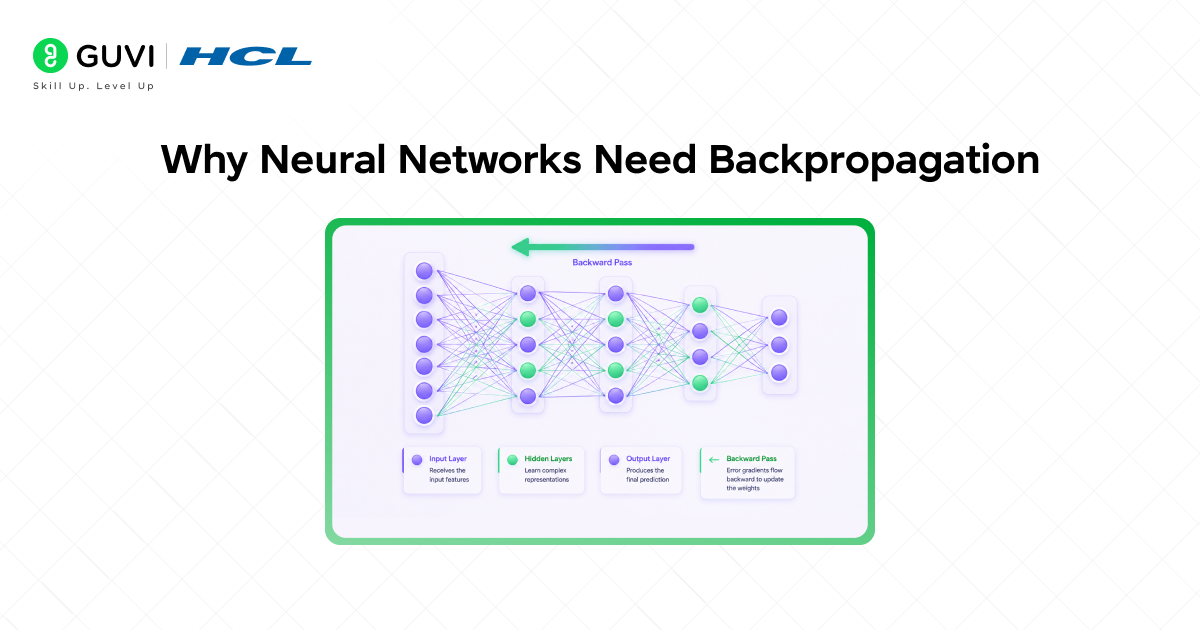
A neural network starts with random weights, so its early predictions are usually inaccurate. The model only improves when it receives feedback about its mistakes.
Backpropagation acts as the correction mechanism behind deep learning. After every prediction, the network measures the error and adjusts itself slightly to improve future results.
Modern AI systems like recommendation engines and Large Language Models rely heavily on this learning process. If you are new to the topic, learn more about neural networks in AI.
Understanding the Forward Pass
Training starts with something called the forward pass.
During this stage, input data travels through the neural network layer by layer until the model generates an output.
For example, imagine a neural network trained to identify handwritten digits.
The image first enters the input layer. Hidden layers then process patterns like curves, edges, and shapes before the final layer predicts the number.
A simplified flow looks like this:
Input → Hidden Layers → Output
At this point, the network has only made a prediction. It still has not learned whether the answer is correct.
Interestingly, the forward pass usually receives most of the attention in beginner tutorials because it is easier to visualize. But in large AI systems, the backward pass often consumes far more computational resources.
What Happens During Loss Calculation?
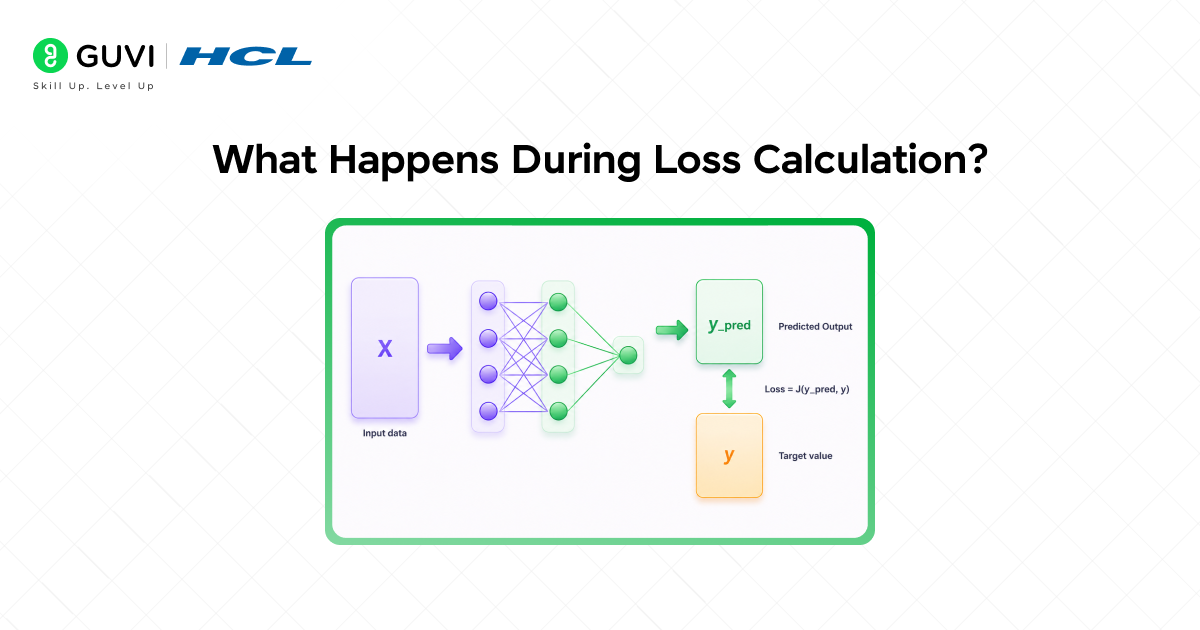
Once the model produces an output, the prediction must be compared with the actual answer.
The difference between the predicted output and the correct output is called loss.
Loss functions help neural networks measure how wrong they are.
For example:
- Mean Squared Error is commonly used for regression problems.
- Cross-entropy loss is popular for classification tasks.
- Hinge Loss is sometimes used in margin-based models.
A lower loss value means the model is improving.
A higher loss value means the network still has a lot to learn.
A simple representation of a loss function looks like this:
Loss = (Prediction − Actual)^2
This number becomes extremely important because the entire training process revolves around reducing it.
How the Backward Pass Actually Works
After calculating the loss, the network moves backward through every layer and checks how much each neuron contributed to the error.
This process is called the backward pass.
Instead of randomly updating all parameters, the algorithm performs targeted corrections.
It figures out:
- Which neurons influenced the prediction the most?
- Which weights caused larger errors?
- Which parameters need stronger updates?
This correction process happens repeatedly across thousands or even millions of training cycles.
A surprising thing many people do not realize is that neural networks usually improve gradually rather than suddenly. Early training stages often look messy.
Predictions improve step by step.
Why the Chain Rule Matters in Deep Learning
Backpropagation relies heavily on the chain rule from calculus.
In deep neural networks, predictions depend on many layers working together. The chain rule helps the model trace how errors flow backward through those layers.
A simplified expression looks like this:
dL/dw = dL/do × do/dw
Here:
- L represents loss.
- w represents weight.
- o represents output.
If the gradient becomes large, the model performs stronger corrections.
If the gradient becomes tiny, updates become smaller.
When training suddenly becomes unstable, understanding gradients often helps developers identify what went wrong.
Understanding Gradient Descent and Weight Updates
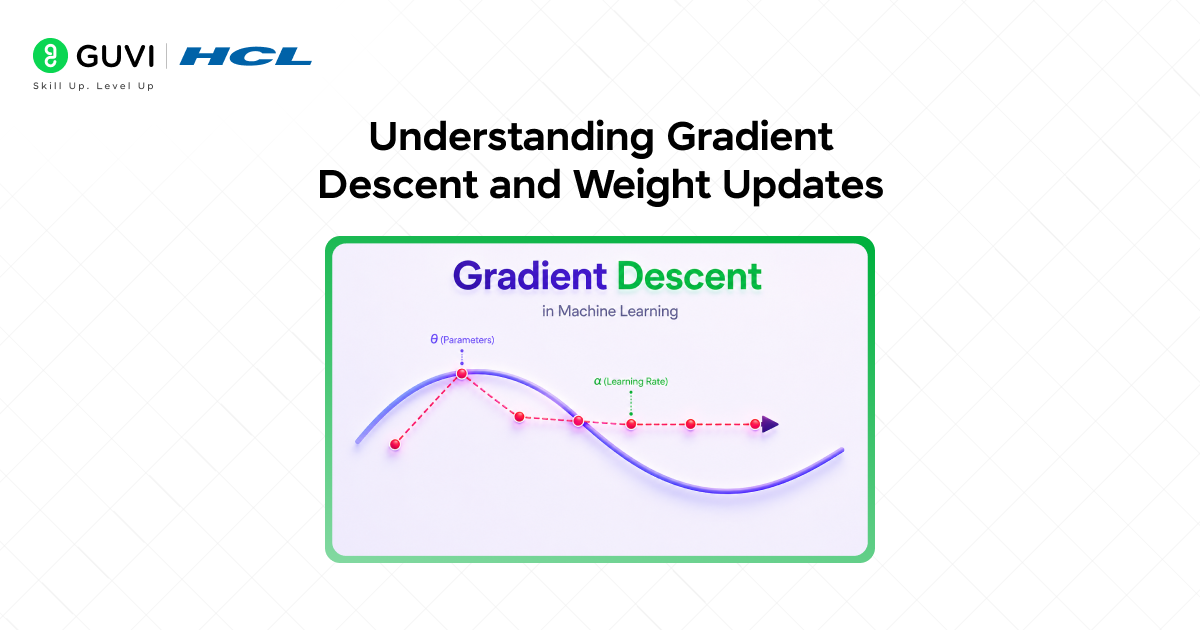
Once gradients are calculated, the network updates its weights using gradient descent.
Gradient descent is an optimization algorithm that pushes the model toward lower loss values.
A simple way to imagine this is hiking down a mountain during heavy fog. You cannot see the full path clearly, but you can still figure out which direction goes downward.
The update formula looks like this:
w(new) = w(old) − η × dL/dw
Here:
- w represents weight.
- η represents the learning rate.
- dL/dw represents the gradient.
The learning rate controls how aggressively the network updates itself.
A very small learning rate can make training painfully slow, and a large learning rate can make the model unstable.
This balance becomes extremely important in modern deep learning because large AI systems train on massive datasets for long durations.
That is also why advanced optimizers like Adam and RMSProp became popular, and help models train faster while handling gradient updates more efficiently.
A Simple Backpropagation Example
Suppose a neural network predicts apartment prices.
The model predicts an apartment will cost ₹80 lakhs.
But the actual price is ₹72 lakhs.
That difference becomes the prediction error.
- The loss function measures how wrong the prediction is.
- Backpropagation calculates which neurons contributed to that error.
- Gradients determine how weights should change.
- The optimizer updates the network.
- The process repeats.
After many training cycles, prediction accuracy improves gradually.

This learning pattern is what allows AI systems to detect fraud, recognize speech, and generate human-like text.
Backpropagation Using TensorFlow
Modern frameworks automate most of the difficult mathematical calculations internally.
Here is a simple TensorFlow example:
import tensorflow as tf
model = tf.keras.Sequential([
tf.keras.layers.Dense(8, activation=’relu’),
tf.keras.layers.Dense(1)
])
model.compile(
optimizer=’adam’,
loss=’mse’
)
x_train = [[1], [2], [3], [4]]
y_train = [[2], [4], [6], [8]]
model.fit(x_train, y_train, epochs=100)
In this example, TensorFlow automatically handles:
- Forward pass.
- Loss calculation.
- Gradient computation.
- Backpropagation.
- Weight updates.
Today, frameworks like TensorFlow and PyTorch drastically simplify the process. For more practical learning, explore how to build a neural network using TensorFlow.
If you want to strengthen your deep learning fundamentals further, explore this ebook on neural networks and optimization algorithms to understand how modern AI systems are trained in real-world environments.
Training massive AI models is extremely resource-intensive because the backward pass used during backpropagation often requires storing large intermediate activations and gradients, making it even more memory-demanding than the forward pass itself. In modern Transformer-based models, gradient computation and parameter updates contribute heavily to total training cost, which is why companies are investing aggressively in techniques such as sparse training, memory-efficient gradient methods, and specialized GPU and accelerator architectures. A single large-scale model training run can consume enormous computational resources continuously for weeks or even months.
Why Backpropagation Still Matters
Some people assume backpropagation became outdated after the rise of Transformers and generative AI.
Modern AI systems still depend heavily on backpropagation during training.
In fact, larger models made efficient backpropagation even more important.
Today, it powers:
- Large Language Models.
- AI image generators.
- Recommendation systems.
- Speech recognition tools.
- Medical imaging systems.
- Autonomous driving technologies.
Researchers are now trying to improve training efficiency rather than replace backpropagation entirely.
Current research areas include:
- Faster gradient computation.
- Energy-efficient training.
- Sparse backpropagation.
- Memory-optimized architectures.
AI systems still learn by calculating errors and updating weights.
That is exactly why backpropagation remains one of the most important concepts in deep learning.
Common Challenges in Backpropagation
Even though backpropagation is powerful, it is not perfect.
Training deep neural networks still comes with several major challenges.
1. Vanishing Gradients
Sometimes gradients become extremely small while moving backward through deep layers.
When this happens, earlier layers learn very slowly because weight updates become tiny.
Activation functions like ReLU helped reduce this problem significantly.
2. Exploding Gradients
In some cases, gradients become excessively large.
This creates unstable updates and unpredictable training behavior.
Gradient clipping is often used to control this issue.
3. High Computational Cost
Training large neural networks requires serious computational resources.
Modern AI models may train for days or even weeks using GPUs or TPUs.
This is one reason optimization research has become so important recently.
4. Overfitting
Some networks memorize training data instead of learning meaningful patterns.
Techniques like dropout, regularization, and data augmentation help reduce overfitting.
Real World Applications of Backpropagation
1. Recommendation Systems
Streaming platforms and e-commerce websites use neural networks to personalize recommendations based on user behavior.
2. Medical Imaging
Deep learning models analyze scans like X-rays and MRIs to help doctors identify abnormalities.
3. Natural Language Processing
Chatbots, AI assistants, and translation systems rely heavily on neural network training.
4. Computer Vision
Object detection, facial recognition, and autonomous driving systems improve through continuous training and error correction.
5. Fraud Detection
Banks use neural networks to identify suspicious transaction patterns and financial anomalies.
Backpropagation powers many AI systems that people interact with daily. To understand these systems better, read about neural networks and their components.
If you want practical experience building neural networks and training AI models from scratch, HCL GUVI’s AI and Machine Learning Course offers beginner-friendly projects, TensorFlow workflows, and hands-on deep learning applications.
Conclusion
Backpropagation is the core learning mechanism behind modern deep learning. It helps neural networks improve by calculating errors and updating weights during training.
Modern AI systems like Large Language Models and computer vision models still rely heavily on backpropagation. Understanding this concept gives you a stronger foundation in how deep learning systems actually learn and improve over time.
FAQs
1. What is backpropagation in deep learning?
Backpropagation is a training algorithm that helps neural networks learn by calculating errors and updating weights.
2. Why is backpropagation important?
It allows AI models to improve prediction accuracy through continuous error correction.
3. What is the role of gradient descent in backpropagation?
Gradient descent helps update weights in the direction that reduces prediction error.
4. Does modern AI still use backpropagation?
Yes. Large Language Models, image generators, and Transformer architectures still rely heavily on backpropagation during training.
5. Which frameworks automate backpropagation?
TensorFlow, PyTorch, and JAX automate most backpropagation calculations using automatic differentiation systems.
6. What are the biggest challenges in backpropagation?
Vanishing gradients, exploding gradients, overfitting, and high computational cost remain major challenges in deep learning training.
Success Stories

About the Author
Vishalini Devarajan
An Aerospace Engineer turned content writer, I focus on making complex concepts easy to understand through well-structured, reader-friendly blogs. Whether it’s a technical topic or a non-technical one, I love creating content that is clear, engaging, and impactful.
View all posts by Vishalini Devarajan
Connect with me @










Did you enjoy this article?