


Programming Languages Articles
Product Manager Portfolio: How to Build The Best One That Gets You Hired in 2026
Code Review Best Practices: How to Give and Receive Feedback Effectively


Get In Touch For Details! Request More Information

Best Websites Built with Python (And What Makes Them Great)
Sep 22, 2026 6 Min Read 62868 Views
(Last Updated)
Python quietly runs some of the biggest sites online. Websites built with Python include Instagram, Spotify, and Reddit, and each one handles millions of users every single day. Yet most visitors never notice the language working behind the scenes.
This post covers ten such websites, one at a time. For each one, you will find what Python is used for, which parts of the site rely on it, and why it still holds up at that scale.
Quick Answer:
Websites built with Python include Instagram, Spotify, Pinterest, Reddit, Dropbox, Mozilla, The Washington Post, Quora, Venmo, and Bitbucket. These platforms use Python for backend services, APIs, data processing, content management, automation, and other web infrastructure.
Table of contents
- Why Python is a Popular Choice for Building Websites
- Python vs JavaScript and Other Popular Stacks
- Best Websites Built with Python
- Spotify
- Dropbox
- Mozilla
- The Washington Post
- Quora
- Venmo
- Bitbucket
- Websites Built with Python: Quick Comparative Overview
- Conclusion
- FAQs
- What are some popular websites built with Python?
- Why do companies use Python for websites?
- Is Python good for building large websites?
- Which Python framework is commonly used for websites?
- What can Python be used for in a website?
- Can Python be used for both frontend and backend development?
- Can Python handle high-traffic websites?
- What types of websites can be built with Python?
Why Python is a Popular Choice for Building Websites
Python did not become popular in web development by accident. Companies running some of the most visited websites built with Python picked it because it solves real problems: readable code, faster development cycles, and a massive ecosystem that scales with the business.
For teams shipping features under pressure, that combination matters more than almost anything else.
Python vs JavaScript and Other Popular Stacks
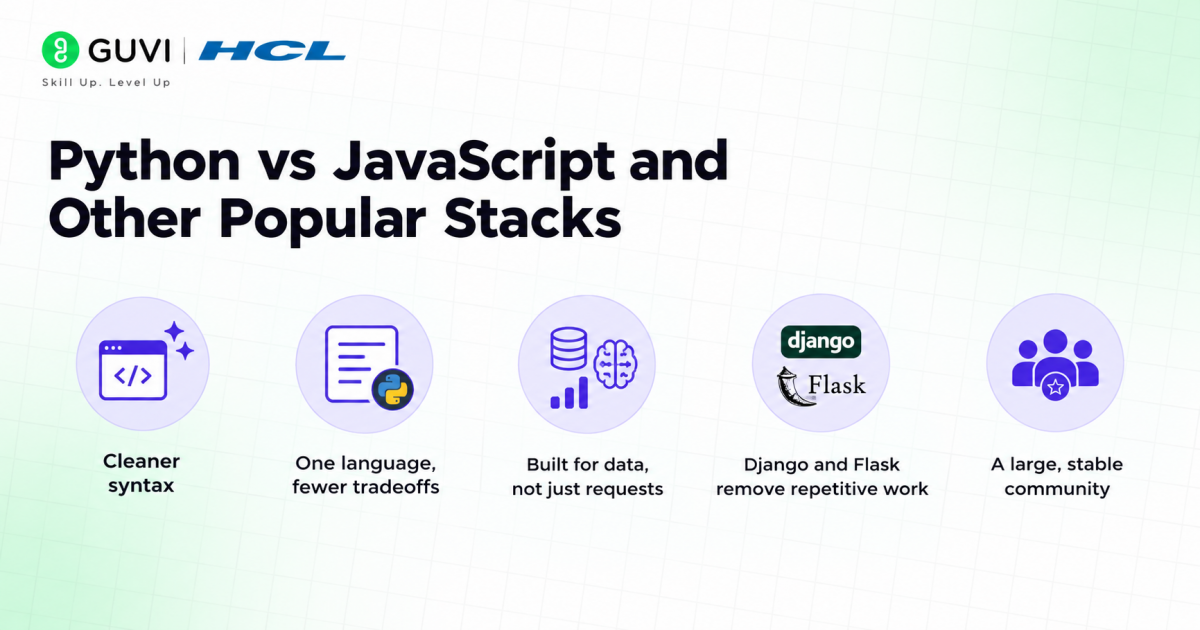
JavaScript dominates the frontend, and frameworks like Node.js pushed it into the backend too. So why do companies still pick Python for the server side?
- Cleaner syntax. Python code reads closer to plain English, which means new engineers get productive faster and bugs get caught sooner during review.
- One language, fewer tradeoffs. Unlike JavaScript’s async-heavy callback patterns, Python’s structure stays predictable even as codebases grow large.
- Built for data, not just requests. Python’s libraries for data processing, machine learning, and analytics are far ahead of what Node.js or PHP offer, which matters once a site needs recommendations, search ranking, or fraud detection.
- Django and Flask remove repetitive work. Both frameworks ship with authentication, database handling, and admin tools out of the box, so teams don’t rebuild the basics.
- A large, stable community. Python has been around for over three decades, and its library ecosystem is deep enough that most problems already have a tested solution.
Ready to level up your tech career? HCL GUVI’s Software and AI Engineer Course helps you build real-world skills in full-stack development, backend engineering, DevOps, and AI through hands-on projects, expert mentorship, and career support. If you’re serious about becoming job-ready for today’s tech industry, this is your sign to get started. Enroll today and transform your tech career!
Best Websites Built with Python
Here are ten websites built with Python, along with what the language handles for each one:
1. Instagram
Official Site: Instagram
Instagram is a photo-and-video sharing platform owned by Meta, with over 2 billion monthly active users. It remains one of the largest and most cited examples of Django running in production.
Where Python Is Implemented
- Core backend logic and APIs (application programming interfaces)
- User authentication and account management
- Content feed generation
- Server-side request handling at scale
How Python Enhances the User Experience
- Faster-loading feeds, even with billions of daily posts.
- Smoother photo and video uploads, backed by efficient backend processing.
- Stable performance during high-traffic moments like viral posts.
Technical Challenges Python Helped Solve
- Scaling the backend to handle billions of daily requests.
- Supporting fast feature development with a small early engineering team.
- Keeping the codebase maintainable as the team grew after Meta’s acquisition.
Master Python from basics to advanced concepts with HCL GUVI’s Python Zero to Hero Course. Enroll today and level up your coding skills!
2. Spotify
Official Site: Spotify
Spotify is a music and podcast streaming service used by hundreds of millions of people worldwide. Spotify’s own engineers have stated that Python runs a large majority of their backend, roughly four out of every five services.
Where Python Is Implemented
- Backend services connected through an internal messaging system
- Data pipelines for large-scale analytics, built using Spotify’s in-house Luigi framework
- Machine learning models behind recommendations and discovery features
- The majority of Spotify’s batch processing jobs run on Python
How Python Enhances the User Experience
- Personalized playlists like Discover Weekly, powered by Python-driven recommendation models.
- Faster music search and playback response, thanks to efficient backend service handling.
- Continuous feature updates, since Python speeds up how quickly Spotify’s engineers can build and test new ideas.
Technical Challenges Python Helped Solve
- Processing massive volumes of listening data across millions of users daily.
- Running thousands of parallel jobs efficiently across a large computing cluster.
- Balancing compute-heavy tasks, which Spotify tackled through profiling and native code optimization.
Also Read: What is Backend Development?
3. Pinterest
Official Site: Pinterest
Pinterest is a visual discovery platform where people search and save ideas using images and boards. Python has powered Pinterest since its early days, and the engineering team later carried out a major shift from Python 2 to Python 3 across a codebase of over two million lines.
Where Python Is Implemented
- Core backend services and internal APIs
- Caching layer, built using Pinterest’s own open source pymemcache library
- Visual search and content recommendation systems
- Large-scale data processing pipelines
How Python Enhances the User Experience
- Faster board and pin loading, supported by an optimized backend caching setup.
- More relevant recommendations, driven by Python-based ranking systems.
- Consistent performance even as Pinterest’s content library keeps growing.
Technical Challenges Python Helped Solve
- Rewriting a massive, tightly connected codebase without disrupting the live platform.
- Reducing infrastructure costs after the Python 3 migration.
- Keeping code quality high across a large engineering team working on the same backend.
4. Reddit
Official Site: Reddit
Reddit started out written in Lisp, but the team rebuilt it in Python within months of launch, back in 2005. Python has remained core to Reddit’s backend ever since, even after the site’s frontend was later rebuilt using React and TypeScript.
Where Python Is Implemented
- Backend services and internal APIs
- Comment ranking and content sorting logic
- Moderation tools used across communities
- Rate limiting and request handling infrastructure
How Python Enhances the User Experience
- Comments and posts sort and load without noticeable delay, even in large threads.
- Backend moderation systems filter spam and rule-breaking content faster.
- The platform stays responsive during high-traffic events, like major news moments.
Technical Challenges Python Helped Solve
- Supporting millions of daily posts and comments without slowing down.
- Running moderation across thousands of active communities at once.
- Keeping a decades-old backend maintainable as new features get added.
5. Dropbox
Official Site: Dropbox
Dropbox is a cloud storage and file-sharing service used by hundreds of millions of people. Python was so central to Dropbox that the company hired Guido van Rossum, Python’s creator, to work on its engineering team for over six years.
Where Python Is Implemented
- Core server infrastructure for file storage and sync
- Internal tools and automation systems
- Mypy, an open source type checker Dropbox built to manage large Python codebases
- Parts of the original desktop client software
How Python Enhances the User Experience
- Reliable file syncing across devices, backed by a stable server architecture.
- Fewer bugs reaching users, thanks to tools like Mypy catching errors before deployment.
- Smooth handling of file sharing and permissions, even at massive scale.
Technical Challenges Python Helped Solve
- Managing a Python codebase that grew to over two million lines of code.
- Making old, loosely structured code easier for new engineers to understand.
- Balancing Python with newer languages like Go and Rust as performance needs grew.
6. Mozilla
Official Site: Mozilla Support
Mozilla is the non-profit organization behind Firefox and other open web projects. Its support platform and add-ons marketplace, used by millions of Firefox users, both run on Python through the Django framework.
Where Python Is Implemented
- Backend for Mozilla Support (SUMO), including knowledge base and forums
- Backend for the Firefox add-ons marketplace
- Localization tools used to translate content into multiple languages
- User authentication and account systems
How Python Enhances the User Experience

- Support articles and forum answers load quickly, even across millions of weekly visits.
- Add-ons and extensions install smoothly through a stable backend system.
- Content stays available in many languages, thanks to Python-based localization tools.
Technical Challenges Python Helped Solve
- Handling extremely high traffic on the add-ons marketplace, tens of thousands of hits per second at peak.
- Supporting contributors and translators across many countries and languages.
- Keeping two large, separate platforms (support and add-ons) reliable at the same time.
7. The Washington Post
Official Site: The Washington Post
The Washington Post is a large digital news website with a complex publishing system. Python is used in parts of its backend, data processing, and content-processing workflows.
Where Python Is Implemented
- Backend services and internal tools that support the website’s publishing system
- Data processing for large datasets used in digital journalism
- Content-processing tools that convert and validate structured web content.
How Python Enhances the User Experience
- Processes content efficiently before it appears on the website.
- Helps power data-driven stories and interactive features.
- Makes backend workflows easier to maintain as the website grows.
Technical Challenges Python Helped Solve
- Processing large amounts of news and structured data efficiently.
- Moving content between different publishing systems without manual work.
- Automating repetitive backend tasks while keeping the publishing workflow reliable.
8. Quora
Official Site: Quora
Quora is a large knowledge-sharing website with hundreds of millions of monthly visitors. Its engineering stack includes Python for backend infrastructure, ranking systems, and machine-learning work that helps organize the huge amount of content on the site.
Where Python Is Implemented
- Backend infrastructure that handles questions, answers, users, and feed data
- Ranking systems that decide which questions and answers appear more prominently
- Machine-learning workflows used to process and understand large amounts of content
Technical Challenges Python Helped Solve
- Processing large volumes of user-generated content and interaction data.
- Building ranking and recommendation systems that can work with many users and topics.
- Supporting a backend that must serve a global audience while keeping content discovery fast.
9. Venmo
Official Site: Venmo
Venmo is a digital payment platform with a web interface built around secure backend services. Python works well in this type of system because it provides strong support for APIs, data processing, and web development.
Where Python Is Implemented
- Backend services that handle user requests and payment-related data
- REST APIs that exchange data between the website and backend systems
- Data-processing workflows for transactions and account information
How Python Enhances the User Experience
- Helps payment pages respond quickly during heavy user traffic and high request volumes.
- Keeps transaction details updated as payment requests move through the backend processing flow.
- Supports reliable account and payment workflows, helping reduce transaction errors and failed requests.
- Handles high volumes of concurrent requests without making the website feel slow or unresponsive.
Technical Challenges Python Helped Solve
- Handling large volumes of API requests and transaction data.
- Building secure server-side workflows around authentication and authorization.
- Connecting payment events with backend services through HTTP POST webhooks.
10. Bitbucket
Official Site: Bitbucket
Bitbucket is a web-based Git repository hosting platform that development teams use to manage and collaborate on source code. Python is used in parts of its backend and infrastructure, including services that support repository management and development workflows.
Where Python Is Implemented
- Backend services that handle repository and project data.
- APIs that connect repository operations with other development tools.
- Automation and data-processing workflows used across the platform.
How Python Enhances the User Experience
- Helps repository pages respond quickly during heavy user traffic.
- Keeps commits, branches, pull requests, and other repository activity up to date.
- Supports smooth code-review workflows even when teams perform frequent Git operations.
Technical Challenges Python Helped Solve
- Handling high volumes of Git operations and API requests.
- Processing repository metadata and activity across large projects.
- Automating backend tasks while keeping distributed services reliable and maintainable.
Websites Built with Python: Quick Comparative Overview
Here’s a quick comparison of these websites built with Python, highlighting their key features, primary use cases, and how Python supports their web infrastructure:
| Website | Primary Use Case | Key Features | Role of Python |
|---|---|---|---|
| Social networking and media sharing | Content feeds, media uploads, user accounts | Backend logic, APIs, content processing, and large-scale infrastructure | |
| Spotify | Music streaming and content discovery | Music streaming, recommendations, personalized content | Backend services, data processing, recommendation systems, and APIs |
| Visual discovery and content sharing | Pins, boards, search, recommendations | Backend development, data processing, and recommendation systems | |
| Online communities and discussions | Subreddits, posts, comments, voting | Backend services, APIs, content ranking, and data processing | |
| Dropbox | Cloud file storage and collaboration | File storage, synchronization, sharing | Backend services, file processing, APIs, and automation |
| Mozilla | Web browsing and online services | Web technologies, developer tools, online platforms | Web services, automation, testing, and data-processing tools |
| The Washington Post | Digital news and journalism | News publishing, interactive stories, data journalism | Content processing, backend tools, data processing, and publishing workflows |
| Quora | Knowledge sharing and Q&A | Questions, answers, recommendations, content ranking | Backend infrastructure, ranking systems, APIs, and machine learning |
| Venmo | Digital payments | Payments, transactions, account management | Backend services, APIs, authentication workflows, and data processing |
| Bitbucket | Git repository hosting and collaboration | Repositories, pull requests, code reviews, CI/CD | Backend services, APIs, repository management, and automation |
Conclusion
Python continues to be a strong choice for building large, reliable web platforms. From social networks and streaming services to news, payments, and developer tools, these websites built with Python show how the language fits into different types of modern web infrastructure while supporting real-world features and heavy traffic.
FAQs
1. What are some popular websites built with Python?
Popular websites built with Python include Instagram, Spotify, Pinterest, Reddit, Dropbox, Quora, Venmo, and Bitbucket. Python is commonly used for backend services, APIs, data processing, and automation.
2. Why do companies use Python for websites?
Python offers a large ecosystem, strong web frameworks, and libraries for APIs, data processing, automation, and machine learning. This makes it suitable for both startups and large-scale web platforms.
3. Is Python good for building large websites?
Yes. Websites built with Python can handle heavy user traffic with proper architecture, caching, databases, and load balancing.
4. Which Python framework is commonly used for websites?
Django and Flask are two popular Python frameworks. Django is more full-featured, while Flask is lightweight and flexible.
5. What can Python be used for in a website?
Python can handle backend logic, APIs, authentication, data processing, automation, and machine-learning tasks.
6. Can Python be used for both frontend and backend development?
Python is mainly used for the backend. HTML, CSS, and JavaScript are typically used to build the frontend.
7. Can Python handle high-traffic websites?
Yes. Websites built with Python can handle heavy user traffic when supported by scalable databases, caching, load balancing, and well-designed backend services.
8. What types of websites can be built with Python?
Python can be used for social networks, streaming platforms, news websites, payment platforms, Q&A sites, and developer tools. Many websites built with Python use it mainly for backend services.
Success Stories














Did you enjoy this article?