


Artificial Intelligence and Machine Learning Articles
AI/ML Skills Gap 2026: Why Companies Can't Find Job-Ready Talent
20 AI/ML Interview Questions Recruiters Can Use Without a Tech Background - Best Guide
How Industry-Backed AI/ML Bootcamps Are Changing the AI/ML Hiring Pipeline - Best Guide 2026
From IT Support to AI Engineer: A Realistic Career Switch Guide 2026

Get In Touch For Details! Request More Information
What is ModelOps? The Ultimate Guide to ModelOps
Nov 19, 2025 4 Min Read 1669 Views
(Last Updated)
Creating an AI model is only half the challenge; making it successfully work in the real world is the actual challenge. Many organizations can build a model with accuracy that does nothing but sit in production because it cannot adapt to new data or changing business situations. This is the purpose of ModelOps.
ModelOps centers on governance, deployment, monitoring, and continuous performance improvement. This ensures that AI and ML models in the organization remain valuable and dependable throughout the lifecycle. ModelOps is the operational foundation for transitioning models from experimentation to business operational intelligence.
Table of contents
- Understanding ModelOps
- Why Does ModelOps Matter?
- The Stages of ModelOps
- Model Development
- Model Validation
- Deployment and Integration
- Monitoring and Maintenance
- Governance and Compliance
- Retirement and Replacement
- ModelOps vs. MLOps: Are They the Same?
- Popular ModelOps Tools and Platforms
- Challenges in Implementing ModelOps
- Cultural Gaps Among Teams
- Tool Fragmentation
- Data Quality & Drift
- Efficient Scaling
- Governance & Compliance
- Best Practices for ModelOps Success
- Wrapping it up
- FAQs
- What is ModelOps?
- What is the difference between ModelOps and MLOps?
- Why is ModelOps important?
- Which sectors use ModelOps?
- What tools are used for ModelOps?
Understanding ModelOps
ModelOps is short for Model Operations, which is the entire process of managing the end-to-end lifecycle of AI and ML models, from creation and validation to deployment, monitoring, and governing.
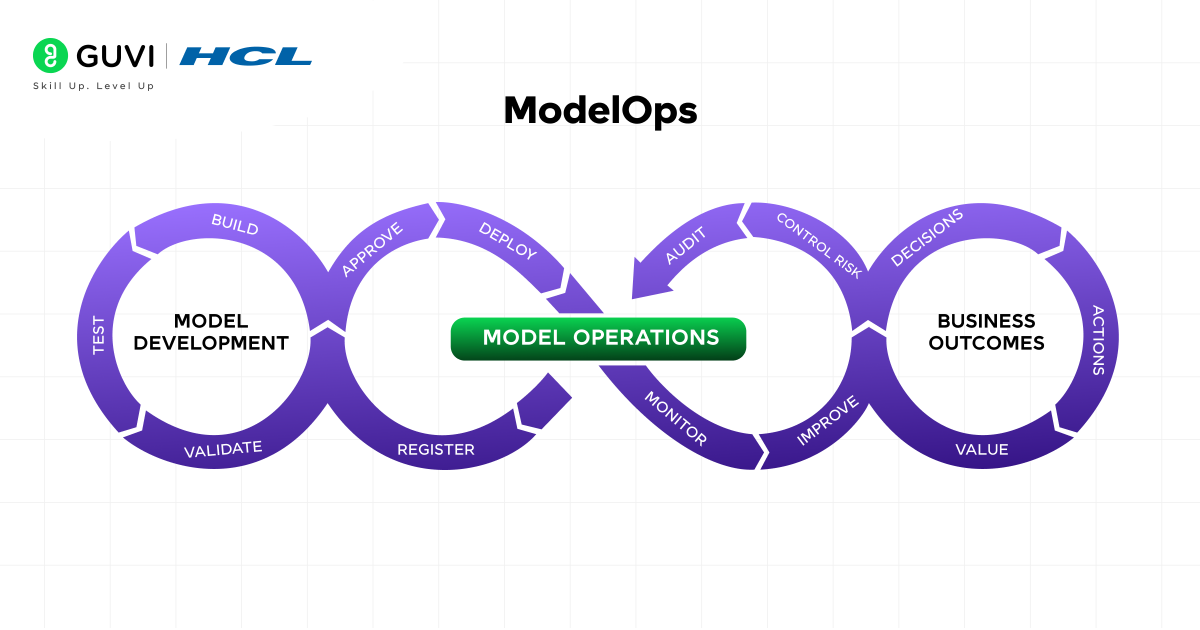
If DevOps transformed the delivery of software by bridging a gap between development and operations, ModelOps bring a similar transformation on AI by aligning data scientists, ML engineers, and IT teams to operationalize models quicker and more efficiently.
ModelOps provides the necessary process, automation, and governance to ensure that once a model is built it can still be valuable in production without continuous manual inputs.
Why Does ModelOps Matter?
Companies from multiple industries are pouring money into AI and data science. Research indicates that many machine learning projects don’t make it into production. And of those that do, many stop being accurate over time.
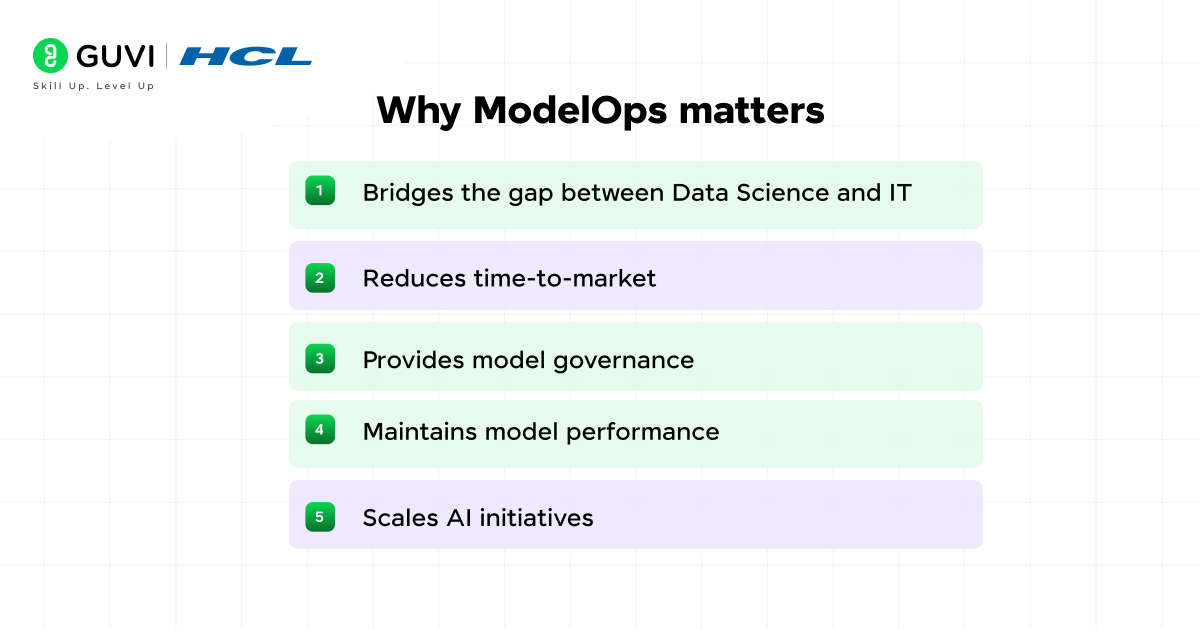
Here’s why ModelOps is a critical part of solving these challenges:
1. Bridges the gap between Data Science and IT: ModelOps creates a unified workflow from model development to deployment to align each group with common business objectives.
2. Reduces time-to-market: Models go from being an experiment to being deployed much faster by automating deployment pipelines and monitoring.
3. Provides model governance: ModelOps creates compliance, version control, audit trails, and reproducibility needed for highly regulated industries like banking, insurance, and healthcare.
4. Maintains model performance: Continuous monitoring detects and remediates model drift and data quality issues early.
5. Scales AI initiatives: ModelOps allows companies to deploy and oversee hundreds of models without unduly overloading the engineering group.
Join HCL GUVI’s Free 5-Day AI & ML Email Course and build a rock-solid foundation for creating production-ready models.
The Stages of ModelOps
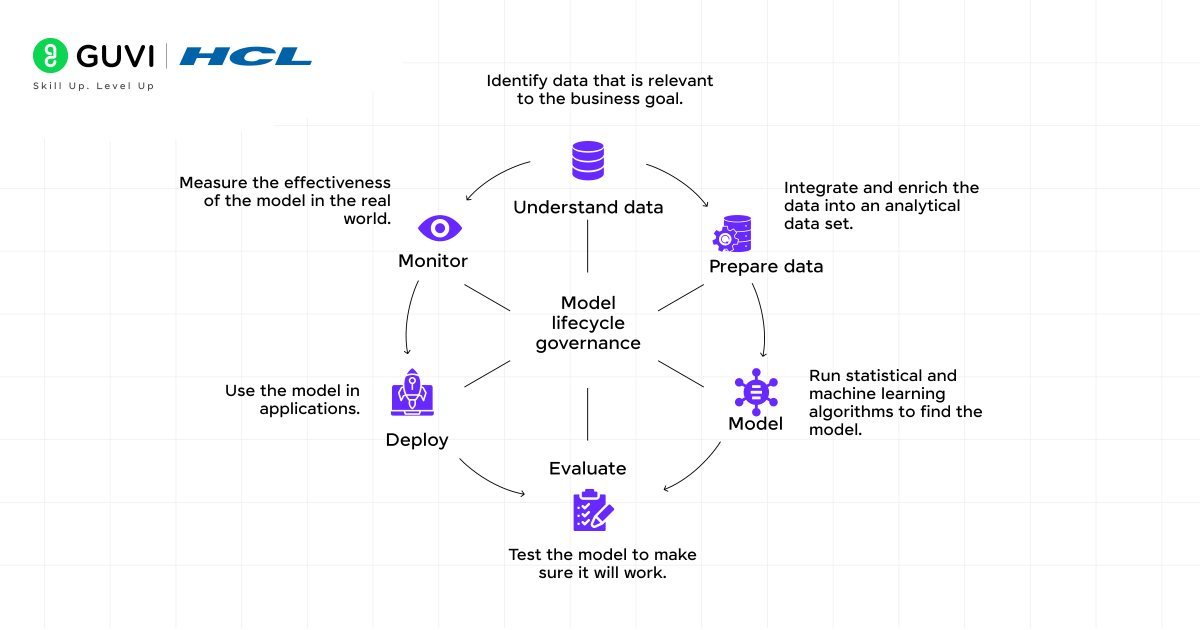
A strong ModelOps framework is built around a continuous lifecycle, much like the DevOps loop. Let’s break it down into key stages:
1. Model Development
This step involves collecting data, preprocessing, and training a model. To create the most precise model possible, data scientists run different algorithms, features, and parameters through experimentation.
Although this part is data science-heavy, ModelOps is starting to formulate how the model will be packaged, versioned, and integrated in the future.
2. Model Validation
Performance, fairness, interpretability, and robustness validation are carried out on a model before it is deployed. Validation is necessary to determine the reliability of the model and its compatibility to the organization.
3. Deployment and Integration
After being validated, the model is deployed in production systems either via APIs or embedded services.
This process is standardized and automated by ModelOps using model pipelines (also referred to as CI/ML pipelines).
Human error is minimized through automated deployment, and it increases the speed of to production transition.
4. Monitoring and Maintenance
Models may also degrade with time as data patterns change, a process known as model drift.
Accuracy, latency, and bias are some of the metrics that are measured at all times by modelops frameworks.
On the occurrence of drift, automated alerts trigger retraining processes or resets to older stable versions.
5. Governance and Compliance
Governance is a significant aspect of ModelOps, making all production models traceable, auditable, and observant of internal and external regulations.
This includes:
- Version control
- Access management
- Audit trails
- Ethical AI standards
- Explainability documentation.
6. Retirement and Replacement
Over time, models become outdated due to new data or requirements. ModelOps ensures seamless replacement or retirement, maintaining system stability and continuity.
Download our free “Generative AI eBook” to level up your AI knowledge.
ModelOps vs. MLOps: Are They the Same?
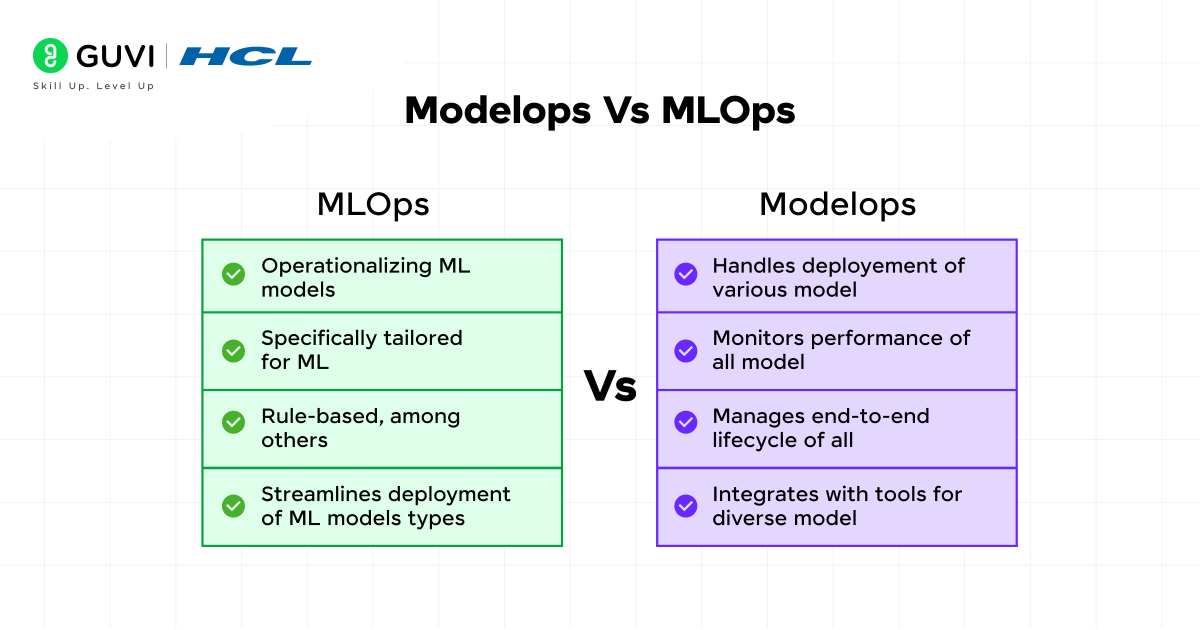
| Aspect | MLOps | ModelOps |
| Focus | Automating the ML pipeline (training, testing, deploying) | Managing all AI and ML models in production (including governance and compliance) |
| Scope | Primarily technical (Dev + Data Science collaboration) | Broader includes business, IT, and compliance processes |
| Goal | Operationalize ML workflows efficiently | Govern, monitor, and optimize all deployed models |
| Tools | TensorFlow Extended, MLflow, Kubeflow | IBM Watson OpenScale, DataRobot MLOps, AWS SageMaker Model Monitor |
| Outcome | Reliable and automated model deployment | Sustained model performance and governance over time |

Popular ModelOps Tools and Platforms
Some leading platforms that support ModelOps include:
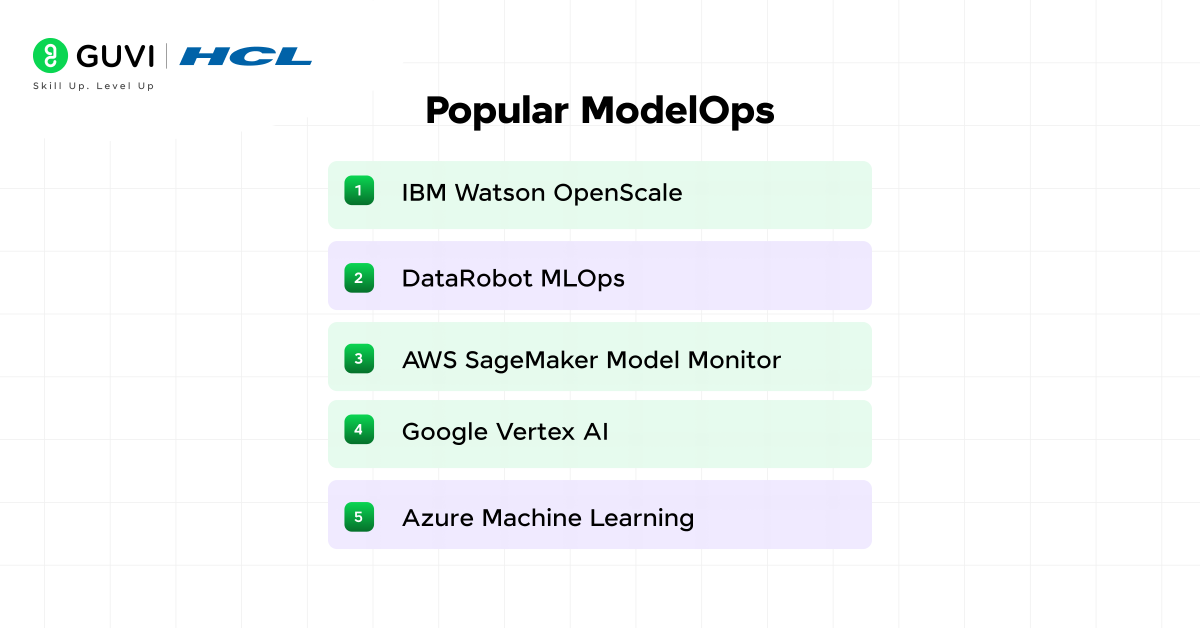
- IBM Watson OpenScale: Provides explainability, fairness monitoring, and lifecycle management capabilities.
- DataRobot MLOps: Streamlines governance, model monitoring, and deployment across multi-cloud environments.
- AWS SageMaker Model Monitor: Provides drift detection and retraining workflows that can be automated.
- Google Vertex AI: Centralized ModelOps environment for metadata, monitoring, and deployment functionalities.
- Azure Machine Learning: Provides end-to-end ModelOps workflows with supporting compliance and governance capabilities.
Each of these platforms helps enterprises operationalize AI more efficiently and at scale.
Challenges in Implementing ModelOps
1. Cultural Gaps Among Teams
Data scientists focus on innovation. At the same time, IT teams focus on stability. These conflicting priorities can cause delays in deployment. It is important to find a way to bridge cultural gaps through collaboration and a shared vision.
2. Tool Fragmentation
Utilizing various tools for training, deployment, and monitoring creates chaos. A consistent ModelOps pipeline can help maintain consistency and visibility.
3. Data Quality & Drift
Models degrade as data in the real world changes. Using ModelOps keeps you actively monitoring your models, retraining, and keeping performance behaviors steady.
4. Efficient Scaling
Scaling from a few models to hundreds requires automation. ModelOps brings orchestration across teams and systems.
5. Governance & Compliance
As regulations around AI increase, ModelOps enables you to ensure your models are transparent, fair, and compliant during the full model lifecycle.
Best Practices for ModelOps Success
To achieve a ModelOps framework with replicable outcomes, consider the following best practices:
- Use a standard lifecycle: Consistent frameworks ensure smoother collaboration.
- Automate with CI/CD efforts: Always use an automated approach to model deployment and retraining.
- Continuous monitoring: Monitor accuracy, drift, and bias metrics in real-time.
- Governance should be a priority: Have clear audit trails for accountability.
- Collaboration is key: Unite the data, DevOps, & business teams with the same goals.
- Implement feedback loops: Continuous improvement of models using real-world data.
These practices will help to ensure AI projects maintain the reliability, scale, and alignment with business objectives.
Take your skills beyond theory with HCL GUVI’s Artificial Intelligence & Machine Learning Course, co-designed with IIT-M Pravartak. Learn the tools behind ModelOps, automate ML workflows, and gain the expertise employers are hiring for.
Wrapping it up
The question is no longer if AI will disrupt industries; what organizations will be able to harness AI reliably, safely, and at scale. The businesses that think AI is a collection of fragile prototypes are at a disadvantage. The winners will be those companies that treat AI as an essential operational competence.
This is the ultimate promise of ModelOps. It is an important discipline that brings AI from the lab to the core of the enterprise, moderating the brilliant models your data scientists create, and becoming the durable, trustworthy, and value-driving engines of your business future.
FAQs
1. What is ModelOps?
ModelOps (Model Operations) manages the end-to-end lifecycle of AI and ML models across all functions, inclusive of model development, deployment, monitoring, and governance to ensure their reliability and compliance.
2. What is the difference between ModelOps and MLOps?
MLOps focus on automating the ML pipelines, but ModelOps covers all AI models, and it does not just focus on pipelines; it considers things like governance and compliance as well as maintaining accurate performance over time.
3. Why is ModelOps important?
ModelOps ensures AI models are accurate, compliant, and scalable, which means you can transition from experimentation into business value.
4. Which sectors use ModelOps?
Industries that utilize data and AI in their processes, particularly regulated sectors (like finance, health care, insurance, and retail) that are heavily focused on compliance, also are focused on making business data-driven.
5. What tools are used for ModelOps?
Some popular ModelOps tools include; IBM Watson OpenScale, DataRobot, AWS SageMaker, Google Vertex AI, and Azure Machine Learning.
Success Stories

About the Author
Vishalini Devarajan
An Aerospace Engineer turned content writer, I focus on making complex concepts easy to understand through well-structured, reader-friendly blogs. Whether it’s a technical topic or a non-technical one, I love creating content that is clear, engaging, and impactful.
View all posts by Vishalini Devarajan
Connect with me @







Did you enjoy this article?