


Programming Languages Articles
Product Manager Portfolio: How to Build The Best One That Gets You Hired in 2026
Code Review Best Practices: How to Give and Receive Feedback Effectively


Get In Touch For Details! Request More Information
Understanding Recursion in C Programming (2026 Guide)
Aug 05, 2026 5 Min Read 1818 Views
(Last Updated)
Recursion in C, a technique for solving computational problems, is often neglected by beginners starting their software development journey. When I use the word “neglect,” it doesn’t mean they completely ignore it; it simply means most individuals don’t delve deeply into this particular method.
Recursion, if properly understood and implemented, can help programmers write clean, modular code to solve technical issues efficiently. In this blog, we will understand the Recursion technique in C programming along with its other aspects. So, let’s begin.
Table of contents
- TL;DR Summary
- What is the Recursion Method
- How Recursion Works in Programming
- Example: Recursive Factorial (5!)
- Working Mechanism Explanation:
- Recursion in C: Practical Example
- Input:
- Output:
- Case 1: Without Recursion
- Case 2: With Recursion
- Importance of Recursion in C Programming
- Real-World Example of Recursion
- FAQs
- Why does recursion use more memory than loops?
- What happens if a recursive function never reaches the base case?
- Why is recursion sometimes slower than iteration?
- When should recursion be avoided in real projects?
- How does the program know which function call to return first?
- Can recursion and loops solve the same problems?
TL;DR Summary
- This blog helps you understand how recursion actually works, step by step, in a very simple, visual way, rather than just theory.
- It makes it easier to understand the difference between solving a particular coding problem with and without recursion.
- It clearly shows why recursion is important in C programming, especially for problems such as tree traversal and handling structured data.
- It helps connect concepts to real-world use by explaining practical examples of recursion, making it easier to remember and apply.
John McCarthy made Recursion a key idea in programming through LISP (LISt Processing language), where a function can call itself to solve problems step by step.
What is the Recursion Method
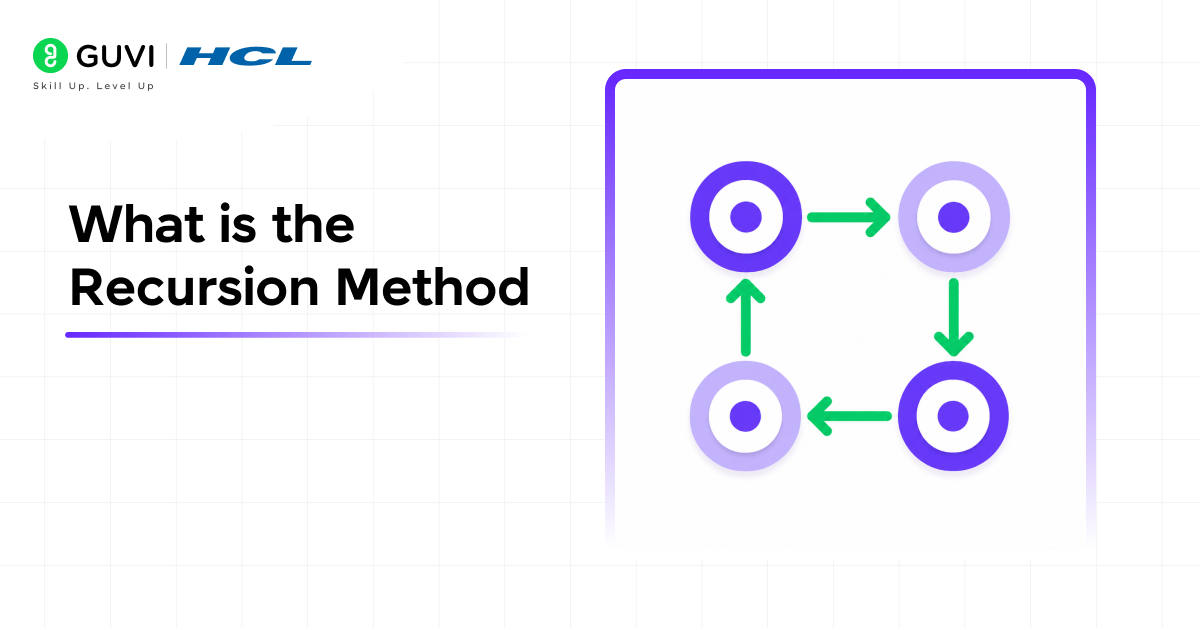
Recursion is a programming technique for solving problems by breaking them into smaller units, and this process of subdivision continues until the base condition is satisfied.
In this method, the function invokes itself (directly or indirectly) repeatedly within its own code.
In simple terms, the final output depends on the solutions of smaller instances of the same problem.
Also Read: Recursion Algorithms in DSA?
Begin your software engineering journey with HCL GUVI’s free C Programming Course, where you will learn to write efficient programs in C by mastering all the essential concepts.
How Recursion Works in Programming
“Please remember that Recursion is a technique that works the same way in almost every programming language, such as C, Java, C++, Python, or JavaScript. The logic behind its implementation is the same; only the syntax changes across languages.”
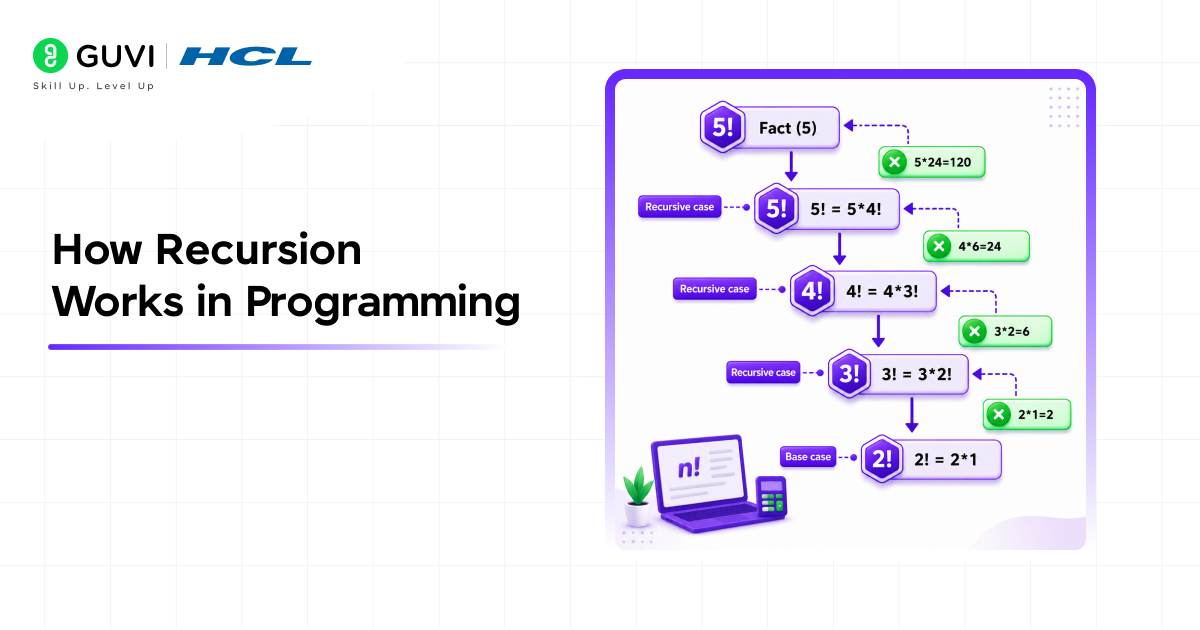
To get a clear picture of the working mechanism of Recursion in programming, we will use the Recursive Factorial example.
Example: Recursive Factorial (5!)
#include <stdio.h>
int factorial(int n) {
// Base Case
if (n == 1) {
return 1;
}
// Recursive Case
return n * factorial(n – 1);
}
int main() {
int result = factorial(5);
printf(“Factorial of 5 is: %d\n”, result);
return 0;
}
Working Mechanism Explanation:
These are the sequential steps through which this Recursive problem is solved:
Step 1: Function Call Starts
The program starts by calling the factorial(5) function. This is the first call, so it goes into memory (call stack) and waits for its result. At this point, nothing has been calculated yet; it just remembers that 5! needs to be evaluated.
Step 2: Recursive Calls Begin
Now the function keeps calling itself with smaller values: factorial(4), factorial(3), factorial(2), and factorial(1). Each call is pushed into the call stack, like stacking plates one on top of another. Every call is waiting for the next one to finish before it can complete its own work.
Step 3: Base Case Reached
When the function reaches factorial(1), it stops calling itself. This is called the base case. It returns 1 immediately because we already know the answer for 1!. This is the point where recursion stops going deeper.
Step 4: Stack Starts Unwinding
Now the stack starts coming back. factorial(1) returns 1 to factorial(2), which multiplies 1 × 2 = 2 and returns it. Then factorial(3) becomes 3 × 2 = 6, and so on. Each function completes its waiting work as results come back.
Step 5: Final Result Returned
Finally, factorial(5) receives the value from factorial(4) and calculates 5 × 24 = 120. The stack is now completely empty, and the final answer, 120, is returned.
Understanding how a function calling itself eventually resolves is much easier once you run a factorial or Fibonacci example and watch each call stack up and unwind. HCL GUVI’s online IDE lets you write and trace recursive functions instantly, no setup needed.
Recursion in C: Practical Example
Now we will understand the Recursion technique with an example in C.
So, to provide you with a clear understanding of how Recursion can be a better option for solving coding problems, we will now consider “Tree Traversal”.
For example, if the company hierarchy consists of multiple levels of employees, including managers and employees, then the output must print all company members sequentially, one by one.
Input:
CEO
├── Manager1
│ ├── Employee1
│ └── Employee2
└── Manager2
└── Employee3
Output:
CEO
Manager1
Employee1
Employee2
Manager2
Employee3
Case 1: Without Recursion
#include <stdio.h>
#include <stdlib.h>
struct Node {
char name[20];
struct Node* left;
struct Node* right;
};
struct Stack {
struct Node* data[100];
int top;
};
struct Node* createNode(char name[]) {
struct Node* newNode = (struct Node*)malloc(sizeof(struct Node));
int i = 0;
while (name[i] != ‘\0’) {
newNode->name[i] = name[i];
i++;
}
newNode->name[i] = ‘\0’;
newNode->left = NULL;
newNode->right = NULL;
return newNode;
}
void push(struct Stack* stack, struct Node* node) {
stack->data[++stack->top] = node;
}
struct Node* pop(struct Stack* stack) {
return stack->data[stack->top–];
}
int isEmpty(struct Stack* stack) {
return stack->top == -1;
}
void traverseTree(struct Node* root) {
struct Stack stack;
stack.top = -1;
push(&stack, root);
while (!isEmpty(&stack)) {
struct Node* current = pop(&stack);
printf(“%s\n”, current->name);
if (current->right != NULL) {
push(&stack, current->right);
}
if (current->left != NULL) {

push(&stack, current->left);
}
}
}
int main() {
struct Node* CEO = createNode(“CEO”);
struct Node* Manager1 = createNode(“Manager1”);
struct Node* Manager2 = createNode(“Manager2”);
struct Node* Employee1 = createNode(“Employee1”);
struct Node* Employee2 = createNode(“Employee2”);
struct Node* Employee3 = createNode(“Employee3”);
CEO->left = Manager1;
CEO->right = Manager2;
Manager1->left = Employee1;
Manager1->right = Employee2;
Manager2->left = Employee3;
traverseTree(CEO);
return 0;
}
Case 2: With Recursion
#include <stdio.h>
#include <stdlib.h>
struct Node {
char name[20];
struct Node* left;
struct Node* right;
};
struct Node* createNode(char name[]) {
struct Node* newNode = (struct Node*)malloc(sizeof(struct Node));
int i = 0;
while (name[i] != ‘\0’) {
newNode->name[i] = name[i];
i++;
}
newNode->name[i] = ‘\0’;
newNode->left = NULL;
newNode->right = NULL;
return newNode;
}
void traverseTree(struct Node* root) {
if (root == NULL) {
return;
}
printf(“%s\n”, root->name);
traverseTree(root->left);
traverseTree(root->right);
}
int main() {
struct Node* CEO = createNode(“CEO”);
struct Node* Manager1 = createNode(“Manager1”);
struct Node* Manager2 = createNode(“Manager2”);
struct Node* Employee1 = createNode(“Employee1”);
struct Node* Employee2 = createNode(“Employee2”);
struct Node* Employee3 = createNode(“Employee3”);
CEO->left = Manager1;
CEO->right = Manager2;
Manager1->left = Employee1;
Manager1->right = Employee2;
Manager2->left = Employee3;
traverseTree(CEO);
return 0;
}
Explanation:
Without recursion, we had to build and manage our own stack in order to store all nodes. Our code grew longer, became difficult to comprehend and even more complicated to maintain.
When dealing with a tree data structure with intricate branches (such as folders, websites, or a company hierarchy), it can be overwhelming to handle all the branches individually when the program must store data indicating which branch each item belongs to.
Using recursion, we can write a simple, short, and clean function that traverses all branches of our tree by calling itself repeatedly.
Importance of Recursion in C Programming
Even in 2026, C programming remains important and relevant. There are many such tech companies that still prefer C for designing and developing fast, efficient software, as it allows them to have low-level control over both the hardware and system resources.
From operating systems (OSs), embedded systems, and drivers to game engines, C is used as the primary tool when speed and efficiency are prioritised. So this is how capable and robust the C language really is. And this capability reaches a higher level when the Recursion method is implemented correctly.
- When used effectively, this technique not only improves code quality but also transforms complex logic into much cleaner, modular, and easier-to-maintain code.
- Several computational problems related to trees, graphs, folder systems, and parsing structures can be solved using recursion rather than writing redundant code, such as lengthy conditional loops or manual tracking functions.
Enhance your career in modern software development with HCL GUVI’s IITM Pravartak & MongoDB Certified AI Software Development Course, where you build job-ready skills through hands-on projects, strengthen your expertise with GenAI tools like OpenAI and Gemini, and grow under expert mentorship. Build smart, learn fast, and step into the AI era with confidence.
Real-World Example of Recursion
Another practical example of Recursion implementation is how companies such as:
- Google uses recursion in its search engine to read and index web pages by following links from page to page.
- Amazon uses it for structured product display within categories and subcategories, e.g., Electronics > Phones > Smartphones.
- Facebook uses recursion to traverse connections among users to retrieve common friends, for example, via friends’ profiles, which are also linked to other profiles.
FAQs
Why does recursion use more memory than loops?
Each function call is stored in the call stack, so multiple calls stay in memory until they finish.
What happens if a recursive function never reaches the base case?
The program keeps calling itself until the stack overflows and crashes.
Why is recursion sometimes slower than iteration?
Function calls and stack operations add extra overhead compared to simple loops.
When should recursion be avoided in real projects?
It should be avoided for simple, repetitive tasks, where loops can do the job faster and more cleanly.
How does the program know which function call to return first?
It follows the call stack order, where the last function called returns first (LIFO).
Can recursion and loops solve the same problems?
Most problems can be solved using both, but the choice depends on clarity and efficiency.
Success Stories










Did you enjoy this article?