


Ethical Hacking Articles
What Is a VPN and How Does It Protect Your Privacy?
Best Ethical Hacking Courses with Certificates


Get In Touch For Details! Request More Information
Top Programming Languages Required For Ethical Hacking in 2026
Jul 23, 2026 5 Min Read 24187 Views
(Last Updated)
Curious about the programming languages required for Ethical Hacking and why certain languages recur in cybersecurity discussions? Behind security tools, vulnerability testing, automation, and web security, programming often plays a bigger role than many beginners expect.
Some languages help automate tasks in seconds, while others make it easier to understand how websites, systems, applications, and databases actually work. The real question is not whether you should learn programming for Ethical Hacking, but which languages are actually worth your time.
Table of contents
- TL;DR Summary
- Programming Languages Required for Ethical Hacking: Quick Overview
- Programming Languages Required for Ethical Hacking
- Python
- HTML
- JavaScript
- Ruby
- PERL
- Bash
- PHP
- C
- Java
- SQL
- Conclusion
- FAQs
- How long does it take to learn programming for Ethical Hacking?
- Which programming language should beginners start with for Ethical Hacking?
- Should I learn multiple programming languages at the same time?
- Can I practice Ethical Hacking programming without expensive tools?
- Does learning programming make Ethical Hacking easier?
- Is Linux knowledge useful while learning Ethical Hacking languages?
TL;DR Summary
- The programming languages required for Ethical Hacking help professionals work with automation, scripting, web applications, databases, and system analysis.
- Different languages serve different purposes, from building security scripts and testing applications to understanding how systems and websites function.
- Learning the programming languages required for Ethical Hacking becomes easier when you start with beginner-friendly options and gradually move toward advanced concepts.
- Choosing the right language depends on security tasks, tools, platforms, and the cybersecurity areas you want to work with.
Cyberattacks happen roughly every 39 seconds, and studies suggest nearly 31% of breaches start from software vulnerabilities, showing why programming knowledge has become increasingly valuable in Ethical Hacking.
Programming Languages Required for Ethical Hacking: Quick Overview
| Programming Language | Primary Use in Ethical Hacking |
|---|---|
| Python | Automation, scripting, and security tool development |
| HTML | Understanding website structures and web applications |
| JavaScript | Web application testing and browser-side security analysis |
| Ruby | Scripting, automation, and security tool customization |
| PERL | Text processing, scripting, and automation tasks |
| Bash | Linux operations, command execution, and automation |
| PHP | Server-side web application analysis and testing |
| C | System-level programming and low-level security analysis |
| Java | Application analysis and cross-platform development |
| SQL | Database management, testing, and security analysis |
Also Read: Top 7 Skill Requirements Needed to Become an Ethical Hacker
Programming Languages Required for Ethical Hacking
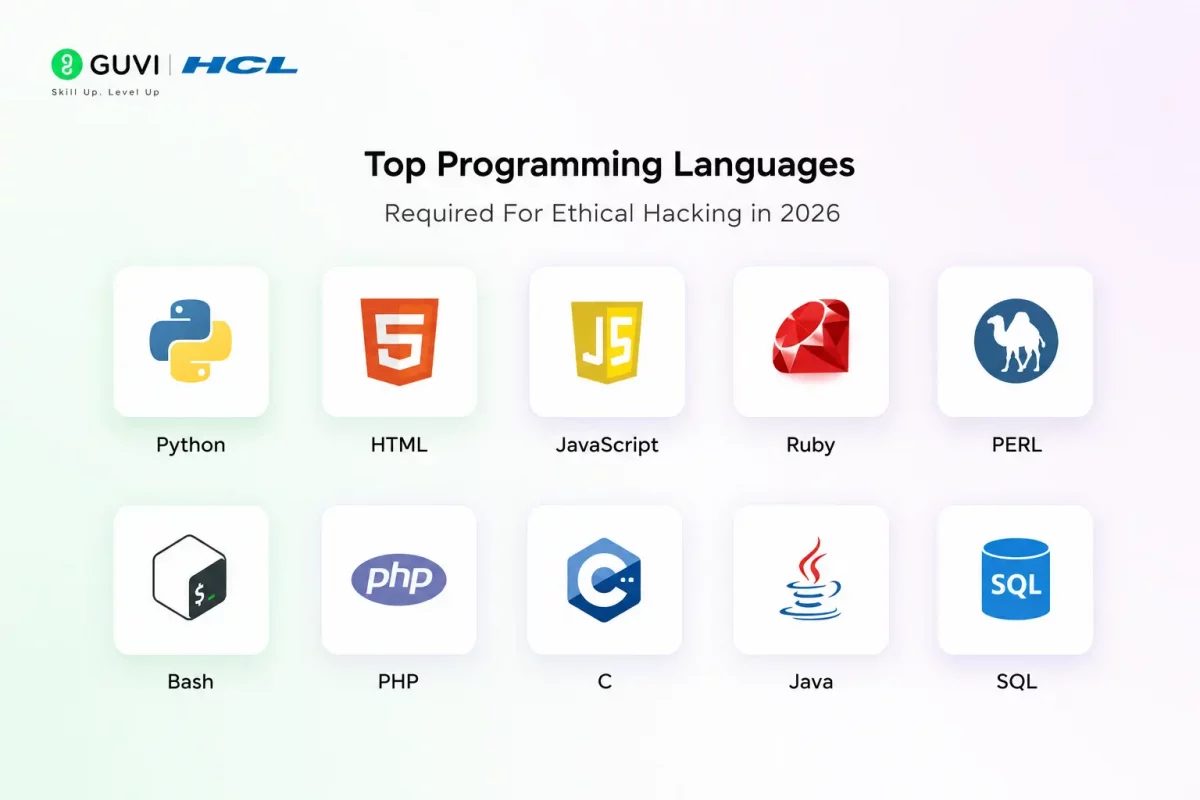
Understanding programming is important in Ethical Hacking because different programming languages support automation, scripting, web security, exploit development, network analysis, and database testing.
Below are some important programming languages used in Ethical Hacking and how they are used in different security tasks:
1. Python
Python is one of the most widely used programming languages in Ethical Hacking because of its simple syntax, flexibility, and powerful libraries. It helps security professionals automate tasks, build scripts, and perform different cybersecurity activities more efficiently.
Uses of Python in Ethical Hacking
• Used for automation of repetitive security tasks and scripts.
• Helps in network scanning, vulnerability assessment, and testing.
• Used for building security tools and penetration testing scripts.
Key Features of Python
• Has easy-to-understand syntax, making it beginner-friendly.
• Offers a large collection of libraries and frameworks for security tasks.
• Supports cross-platform usage, allowing scripts to run on multiple systems.
Why Learn Python for Ethical Hacking?
Learning Python can make Ethical Hacking easier by automating complex tasks and reducing manual work. Since many security tools, scripts, and cybersecurity projects use Python, understanding it can make learning practical hacking concepts much simpler.

2. HTML
HTML is the standard markup language used to create and structure web pages. Since Ethical Hackers often work with websites and web applications, understanding HTML helps them analyze page structures, identify elements, and understand how web content is displayed in browsers.
Uses of HTML in Ethical Hacking
• Helps understand web page structures and elements.
• Useful for analyzing forms, input fields, and page components.
• Supports testing and identifying web-based vulnerabilities.
Key Features of HTML
• Provides the basic structure of websites and web applications.
• Easy to read and understand, even for beginners.
• Works together with other web technologies like CSS and JavaScript.
Why Learn HTML for Ethical Hacking?
Learning HTML is important because many cybersecurity tasks involve websites and browser-based applications. Understanding how web pages are structured makes it easier to inspect websites, identify weaknesses, and understand how attackers may target web applications.
3. JavaScript
Modern websites rely heavily on JavaScript to create interactive features and dynamic content. Because of this, Ethical Hackers often learn JavaScript to understand how websites process data, handle user interactions, and communicate with servers.
Uses of JavaScript in Ethical Hacking
• Helps analyze client-side behavior and interactive web elements.
• Useful for testing web application security and browser-based attacks.
• Supports examining how websites handle data validation and requests.
Key Features of JavaScript
• Enables dynamic and interactive web experiences.
• Runs directly inside web browsers, making testing easier.
• Works closely with front-end and back-end technologies.
Why Learn JavaScript for Ethical Hacking?
Since many attacks target web applications, understanding JavaScript helps security professionals identify security issues more effectively. Learning JavaScript also makes it easier to understand how websites function behind the scenes and how vulnerabilities may appear in real-world applications.
4. Ruby
Ruby is a programming language known for its simple syntax and focus on productivity. In Ethical Hacking, it is commonly associated with scripting, automation, and security tools because it allows users to create functional scripts with relatively less code.
Uses of Ruby in Ethical Hacking
• Used for creating automation scripts for security tasks.
• Helps develop and modify security testing tools.
• Supports scripting for penetration testing activities.
Key Features of Ruby
• Offers clean and readable syntax for faster development.
• Allows quick creation of scripts and automation workflows.
• Supports multiple libraries and frameworks for development tasks.
Why Learn Ruby for Ethical Hacking?
Ruby can be useful for Ethical Hackers because many security professionals use scripting to speed up repetitive tasks. Learning Ruby can also help users understand and customize existing security tools while making automation easier during testing activities.
Whether you start with Python for automation, C for system-level analysis, or SQL for database security, none of it sticks without practice. HCL GUVI’s Code Kata gives you real coding problems across languages, with hints along the way, so you build the practical skills this list only introduces.
5. PERL
PERL is a high-level programming language widely used for text processing, scripting, and system administration tasks. Although newer languages are more common today, PERL remains relevant in cybersecurity for its ability to process large volumes of data and automate tasks efficiently.
Uses of PERL in Ethical Hacking
• Helps process and analyze large text files and logs.
• Used for building custom scripts and security utilities.
• Supports automation for system and network-related tasks.
Key Features of PERL
• Strong capabilities for text manipulation and parsing.
• Supports automation through flexible scripting features.
• Works well across multiple operating systems and environments.
Why Learn PERL for Ethical Hacking?
Learning PERL can be useful when working with system logs, data extraction, and automation tasks. Since cybersecurity often involves processing large volumes of data, understanding PERL can help streamline repetitive tasks and improve efficiency in security operations.
6. Bash
Bash is a command-line shell commonly used in Linux and Unix-based systems. Since many cybersecurity tools and environments run on Linux, Bash becomes important for navigating systems, executing commands, and automating tasks directly from the terminal.
Uses of Bash in Ethical Hacking
• Used for system navigation and managing files or directories.
• Helps automate repetitive tasks through shell scripting.
• Supports executing and combining multiple security-related commands.
Key Features of Bash
• Provides direct access to system-level operations.
• Allows quick automation using simple scripts and commands.
• Integrates easily with many Linux security and networking tools.
Why Learn Bash for Ethical Hacking?
Many cybersecurity tasks happen inside Linux environments, making Bash a practical skill for Ethical Hackers. Learning Bash can help users work faster, automate workflows, and become more comfortable with tools commonly used during security testing and analysis.
7. PHP
PHP is a server-side programming language primarily used to build dynamic websites and web applications. Since many websites rely on PHP to handle user data and server operations, understanding it can help ethical hackers analyse how web applications operate behind the scenes.
Uses of PHP in Ethical Hacking
• Helps understand server-side web application behavior.
• Useful for testing website security and application logic.
• Supports analyzing how websites process user input and data handling.
Key Features of PHP
• Commonly used for developing dynamic web applications.
• Works directly with databases and server-side processes.
• Can be integrated with multiple platforms and content management systems.
Why Learn PHP for Ethical Hacking?
Many websites still use PHP-powered applications, which makes understanding the language valuable for web security testing. Learning PHP can help Ethical Hackers better understand how servers process requests, manage data, and where security weaknesses may exist.
8. C
C is a low-level programming language that provides direct access to memory, hardware resources, and system operations. Because of its close interaction with operating systems, C is often useful for understanding how software behaves at a deeper level.
Uses of C in Ethical Hacking
• Helps analyze system-level operations and software behavior.
• Useful for understanding memory management and vulnerabilities.
• Supports creating high-performance security and networking programs.
Key Features of C
• Provides direct access to hardware and system resources.
• Offers fast execution and efficient performance.
• Gives greater control over memory and program behavior.
Why Learn C for Ethical Hacking?
Learning C can help Ethical Hackers understand how software interacts with operating systems and hardware components. Since many security vulnerabilities are connected to low-level operations, understanding C can make analyzing systems and identifying weaknesses easier.
9. Java
Java is widely used for developing desktop applications, mobile apps, enterprise software, and backend systems. Because Java applications run across multiple platforms, understanding the language can help ethical hackers analyse different environments and application types.
Uses of Java in Ethical Hacking
• Helps understand application behavior across different platforms.
• Useful for analyzing mobile, desktop, and enterprise applications.
• Supports building and testing security-related applications and tools.
Key Features of Java
• Follows a write once, run anywhere approach.
• Provides strong support for object-oriented programming.
• Offers a large ecosystem of libraries and development tools.
Why Learn Java for Ethical Hacking?
Java is worth learning because many applications, enterprise systems, and mobile environments use it extensively. Understanding Java can help Ethical Hackers analyze applications more effectively and work with a wider range of software environments during security assessments.
10. SQL
SQL is a language used to store, retrieve, manage, and manipulate data inside databases. Since websites, applications, and business systems rely heavily on databases, understanding SQL can help Ethical Hackers understand how data is stored and accessed.
Uses of SQL in Ethical Hacking
• Helps analyze database structures and stored information.
• Useful for understanding database security weaknesses.
• Supports testing how applications interact with database systems.
Key Features of SQL
• Designed specifically for managing and querying databases.
• Works with different database management systems.
• Allows quick access and manipulation of structured data.
Why Learn SQL for Ethical Hacking?
Databases store critical business and user information, making them common targets for attackers. Learning SQL can help Ethical Hackers understand how databases work, identify security issues, and better understand how applications handle sensitive information.
If you want to begin learning Ethical Hacking and Cybersecurity through a self-paced approach, HCL GUVI’s Cyber Security and Ethical Hacking Beginner course can help you build foundational knowledge while learning concepts at your own pace. It can be a useful starting point for understanding cybersecurity basics and practical security concepts.
Conclusion
Choosing the right programming languages required for Ethical Hacking is less about learning everything and more about understanding what each language helps you achieve. Building knowledge step by step can make learning automation, web security, scripting, and system analysis much easier over time.
FAQs
1. How long does it take to learn programming for Ethical Hacking?
The learning time depends on consistency, practice, and the number of languages being learned.
2. Which programming language should beginners start with for Ethical Hacking?
Starting with beginner-friendly languages (such as JavaScript or Python) and gradually moving to advanced topics makes learning easier.
3. Should I learn multiple programming languages at the same time?
Learning one language properly before moving to another can make concepts easier to understand.
4. Can I practice Ethical Hacking programming without expensive tools?
Many learners practice using free resources, open-source tools, and personal learning environments.
5. Does learning programming make Ethical Hacking easier?
Programming knowledge can help automate tasks, better understand systems, and improve practical skills.
6. Is Linux knowledge useful while learning Ethical Hacking languages?
Many cybersecurity tools and workflows run in Linux environments, making familiarity helpful.
Success Stories

Did you enjoy this article?
Comments











Tool security