


Artificial Intelligence and Machine Learning Articles
AI/ML Skills Gap 2026: Why Companies Can't Find Job-Ready Talent
20 AI/ML Interview Questions Recruiters Can Use Without a Tech Background - Best Guide
How Industry-Backed AI/ML Bootcamps Are Changing the AI/ML Hiring Pipeline - Best Guide 2026
From IT Support to AI Engineer: A Realistic Career Switch Guide 2026


Get In Touch For Details! Request More Information
Production System in AI: Types, Working, and Examples
Aug 19, 2026 4 Min Read 646 Views
(Last Updated)
Artificial Intelligence systems need a structured way to make decisions, solve problems, and apply logic. One of the oldest and most important approaches used in AI is the production system.
A production system in AI works using rules, memory, and an inference mechanism to process information and generate outputs. From expert systems to automated reasoning engines, production systems form the backbone of many rule-based AI applications.
In this article, you’ll learn what a production system in AI is, how it works, its components, types, advantages, limitations, and real-world examples.
Table of contents
- TL;DR
- What is a Production System in AI?
- Components of a Production System
- Production Rules
- Working Memory
- Inference Engine
- How a Production System Works
- Types of Production Systems
- Monotonic Production System
- Non-Monotonic Production System
- Commutative Production System
- Partially Commutative Production System
- Characteristics of Production Systems
- Rule-Based Logic
- Separation of Knowledge and Control
- Modular Structure
- Goal-Oriented Processing
- Advantages of Production Systems
- Easy to Understand
- Modular Design
- Suitable for Expert Systems
- Explainable AI Behavior
- Disadvantages of Production Systems
- Rule Explosion Problem
- Slower Performance
- Difficult Knowledge Acquisition
- Limited Learning Ability
- Real World Applications
- Expert Systems
- Fraud Detection
- Industrial Automation
- Customer Support Bots
- Cybersecurity
- Example of a Production System
- Rules
- Working Memory
- Execution
- Updated Memory
- Production System vs Expert System
- Future of Production Systems
- Conclusion
- FAQs
- What is a production system in AI?
- What are the main components of a production system?
- What is rule firing in AI?
- What is conflict resolution in production systems?
- Where are production systems used in real life?
TL;DR
- A production system in AI is a rule-based problem-solving approach that uses condition-action rules.
- It consists of production rules, working memory, and an inference engine.
- The system checks conditions, selects matching rules, and executes actions automatically.
- Production systems are widely used in expert systems, decision-making tools, and AI automation.
- Conflict resolution helps the AI choose which rule to execute when multiple rules match.
What is a Production System in AI?
A production system in AI is a rule-based system that solves problems using a set of predefined rules. These rules are generally written in the form:
IF Condition THEN Action
The AI system continuously checks whether a condition is true. If the condition matches the current state of the system, the corresponding action is executed.
Components of a Production System
There are primarily 3 main components to a production system:
1. Production Rules
These are condition action statements used to tell the AI system what to do.
For instance:
IF temperature > 40
THEN turn on cooling system
These are where the knowledge of the AI model resides.
2. Working Memory
These are the current facts of the problem. A few examples:
Temperature = 45
Fan = OFF
The inference engine will constantly evaluate the working memory and see which rules match the facts.
3. Inference Engine
These are the features of the production system. Its role includes:
• Match rules
• Fire rules
• Resolve conflicts
• Update the system state
It determines which rule should be used next.
The inference engine depends heavily on reasoning in AI to evaluate conditions, select matching rules, and generate logical outputs.
Production systems are closely connected to knowledge representation in AI because they store and process information using structured rules and logical relationships.
How a Production System Works
A production system typically follows a cycle to reach a solution:
- Facts are added to working memory.
- All production rules are checked to see which ones match the current facts.
- A rule is selected from the matching rules using a conflict resolution strategy if more than one rule matches.
- The selected rule fires, and its action is executed.
- Working memory is updated, and the cycle repeats until the system goal is met.
The rule execution process in production systems is often powered by techniques like forward chaining and backward chaining in artificial intelligence, which help AI systems reach decisions step by step.
Many modern AI systems do not rely solely on machine learning. Instead, applications such as chatbots, recommendation engines, and fraud detection platforms often combine machine learning models with rule-based production systems. Machine learning excels at recognizing complex patterns in data, while rules provide predictable behavior, business constraints, compliance checks, and safety guardrails. This hybrid approach helps organizations improve both the accuracy and controllability of automated decisions, which is especially important in high-stakes domains such as finance, healthcare, cybersecurity, and customer support.
Types of Production Systems
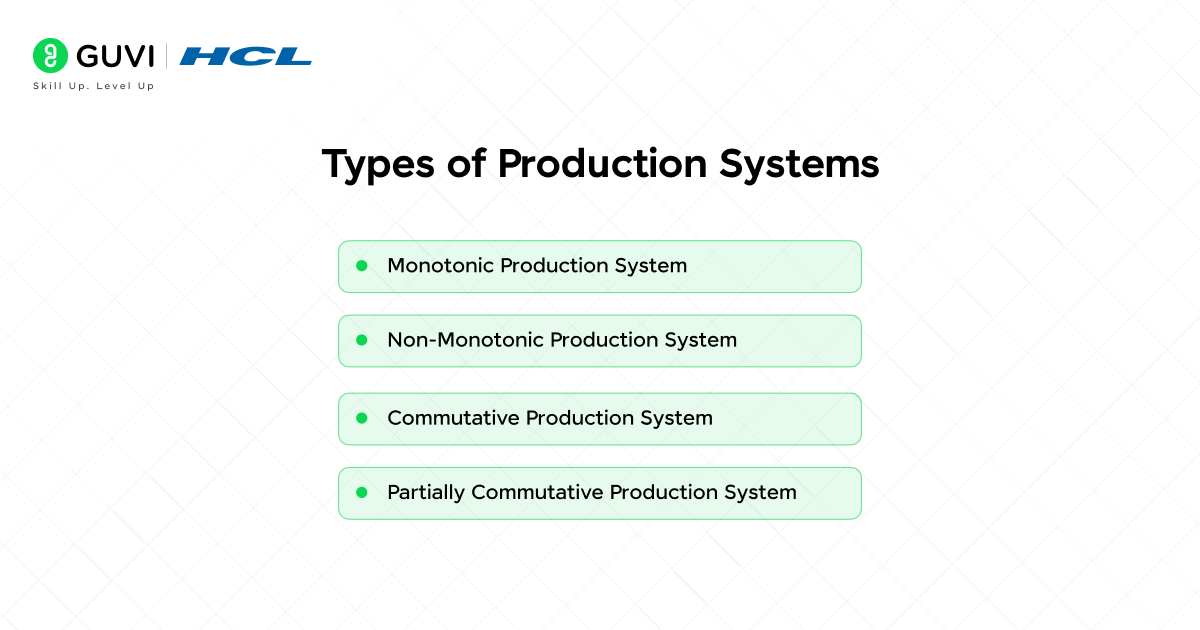
There are four different types of production systems based on how their rules behave:
1. Monotonic Production System
In a monotonic system, the application of any rule can never hinder the subsequent application of any other rule. Problem-solving using this is more stable and predictable.
2. Non-Monotonic Production System
A non-monotonic system makes changes to previously established knowledge bases and rule application. These systems are more flexible and adaptive.
3. Commutative Production System
In a commutative production system, the application order of any set of rules does not affect the end product. It does not matter in what order valid rules are fired; the result is the same.
4. Partially Commutative Production System
In this type, the order of rule application can change intermediate system states, but they do lead to the solution. It is widely used in complex AI search problems.
Characteristics of Production Systems
Rule-Based Logic
The system is entirely dependent on rules that have been coded into the system.
Separation of Knowledge and Control
Rules describe what the system knows, and the inference engine decides how the system is run.
Modular Structure
The rules can be individually added or removed without the need to redesign the whole system.
Goal-Oriented Processing
The system continues until the target objective has been achieved.
Advantages of Production Systems
Easy to Understand
Rules can be written in an English-like structure that is easily understood and debugged by developers.
Modular Design
Rules are independent of each other, allowing for the addition and deletion of rules without affecting other parts of the system.

Suitable for Expert Systems
Production systems are the primary component of many expert systems and are good at modeling domain expertise.
Explainable AI Behavior
Allows a user to know which rule caused the system to make a decision, making this useful in medical, financial, or legal AI.
You can also read HCL GUVI’s ebook resources on Artificial Intelligence fundamentals to strengthen your understanding of AI architectures and intelligent systems.
Disadvantages of Production Systems
Rule Explosion Problem
As a system’s scale increases, it can be extremely difficult to manage its growing list of rules.
Slower Performance
This is often the case in large rule bases due to increased matching and processing times.
Difficult Knowledge Acquisition
Acquiring high-quality, specific rules is often a challenge, especially for complex knowledge domains.
Limited Learning Ability
Production systems are generally not designed to learn from experience the same way a machine learning algorithm would.
Real World Applications
Expert Systems
Used in many industries, including medicine for diagnoses and law to assist with case law, but any industry requiring domain-specific expertise is applicable.
Fraud Detection
Banking and financial institutions will often use rule-based systems to detect anomalous behavior and flag it for further review.
Industrial Automation
In manufacturing and other industrial sectors, AI systems can use rules to control manufacturing processes and monitor equipment.
Customer Support Bots
Rule-based chatbots use programmed conversational flows to answer customer queries.
Cybersecurity
AI systems can be programmed with rules to detect security threats and potential network breaches.
Example of a Production System
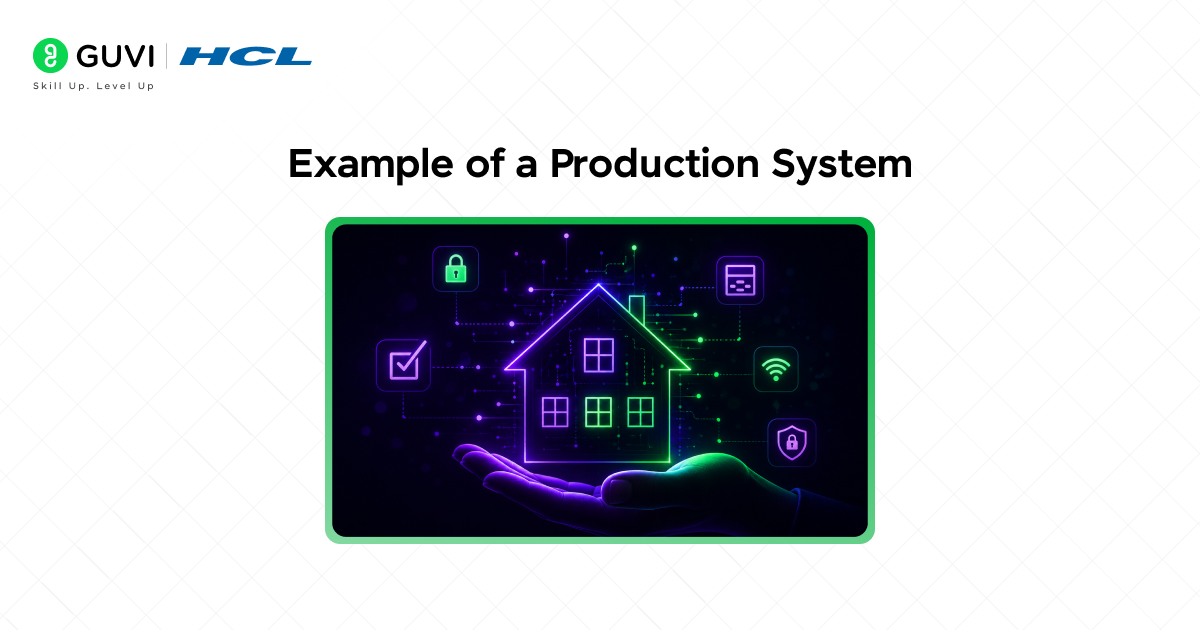
Let’s take the example of an AI system for a smart home.
Rules
Rule 1:
IF room temperature > 30
THEN turn on AC
Rule 2:
IF room temperature < 20
THEN turn off AC
Working Memory
Room temperature = 35
AC = OFF
Execution
The inference engine analyzes the current working memory against the rules. As the room temperature is 35, Rule 1 matches. The system then fires Rule 1.
Updated Memory
AC = ON
The cycle repeats, with the inference engine continuing to check the updated working memory until the desired state is achieved.
Production System vs Expert System
Many people confuse these two systems, but expert systems are a broader category, and production systems are a part of them.
Production systems themselves contain rules and an inference engine, but expert systems incorporate them along with various other techniques and knowledge bases. Thus, it could be said that production systems form the core of expert systems.
Production systems are considered the foundation of many expert systems in AI because they enable machines to make decisions using predefined knowledge and rules.
Future of Production Systems
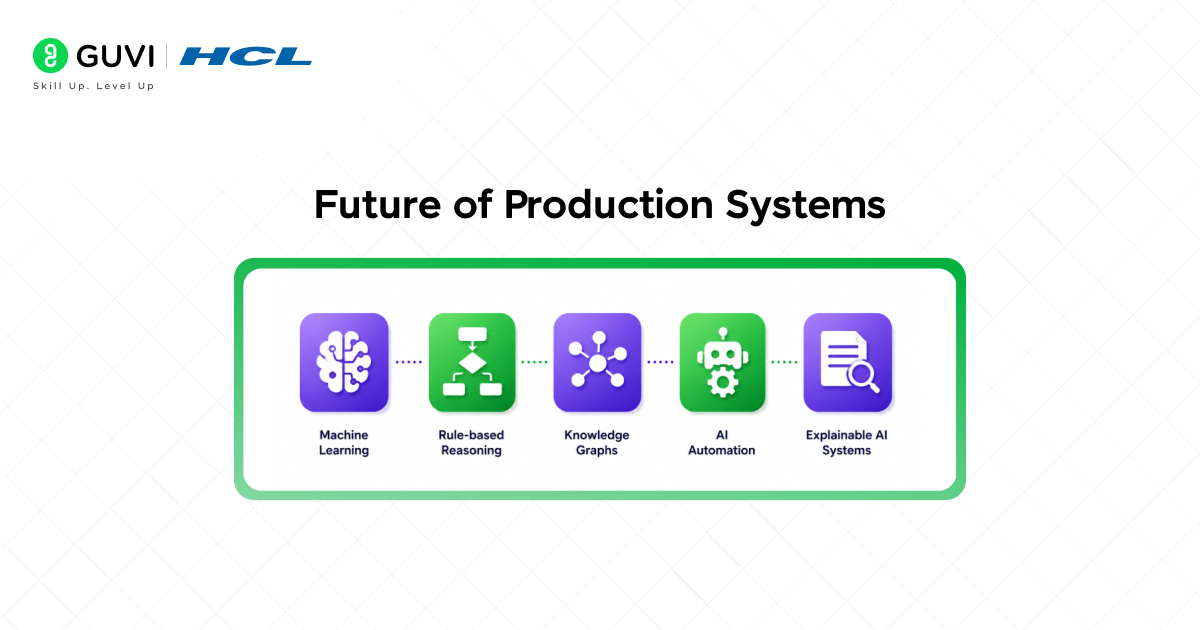
While machine learning is a widely discussed topic in the AI space today, production systems continue to be crucial elements in many intelligent systems. In the current environment, we are seeing increasing integration of:
• Machine learning
• Rule-based reasoning
• Knowledge graphs
• AI automation
• Explainable AI systems
As hybrid models develop and prove their worth in various applications, production systems will become ever more integral parts of complex, intelligent systems.
If you want to learn more about AI concepts and practical implementations, explore HCL GUVI’s AI and Machine Learning programs designed for beginners and professionals.
Conclusion
A production system in AI is one of the foundational approaches used for intelligent decision-making. By combining production rules, working memory, and inference engines, these systems can solve problems logically and efficiently.
Even with the rise of machine learning, production systems continue to remain relevant in expert systems, automation, cybersecurity, and explainable AI applications.
Understanding production systems gives you a strong foundation in how traditional AI reasoning works and how modern intelligent systems still use rule-based architectures today.
FAQs
1. What is a production system in AI?
A production system in AI is a rule-based problem-solving system that uses condition-action rules to make decisions and solve tasks.
2. What are the main components of a production system?
The main components are production rules, working memory, and the inference engine.
3. What is rule firing in AI?
Rule firing refers to executing a production rule when its condition becomes true.
4. What is conflict resolution in production systems?
Conflict resolution is the process of selecting one rule when multiple rules match the current state.
5. Where are production systems used in real life?
Production systems are used in expert systems, fraud detection, automation, robotics, customer support bots, and cybersecurity tools.
Success Stories

About the Author
Vishalini Devarajan
An Aerospace Engineer turned content writer, I focus on making complex concepts easy to understand through well-structured, reader-friendly blogs. Whether it’s a technical topic or a non-technical one, I love creating content that is clear, engaging, and impactful.
View all posts by Vishalini Devarajan
Connect with me @











Did you enjoy this article?