


Artificial Intelligence and Machine Learning Articles
AI/ML Skills Gap 2026: Why Companies Can't Find Job-Ready Talent
20 AI/ML Interview Questions Recruiters Can Use Without a Tech Background - Best Guide
How Industry-Backed AI/ML Bootcamps Are Changing the AI/ML Hiring Pipeline - Best Guide 2026
From IT Support to AI Engineer: A Realistic Career Switch Guide 2026


Get In Touch For Details! Request More Information
The Beginner’s Guide to Reasoning in AI: What You Actually Need to Know (2025)
Sep 22, 2025 7 Min Read 2519 Views
(Last Updated)
Reasoning in AI transforms artificial intelligence from a basic automation tool into a sophisticated decision-making partner. You might encounter AI systems daily without realizing they’re constantly analyzing information, making inferences, and drawing logical conclusions to solve problems. This fundamental process is what enables everything from your virtual assistant’s responses to advanced medical diagnosis systems.
What is reasoning in AI exactly? Essentially, it refers to the mechanism of using available information to generate predictions, make inferences, and draw conclusions.
In this beginner-friendly guide, I’ll walk you through how reasoning works in AI systems, the different reasoning approaches, and their real-world applications. Let’s begin!
Table of contents
- What is Reasoning in AI?
- How reasoning in AI differs from learning and problem-solving
- Why reasoning is essential for intelligent systems
- Types of Reasoning in AI
- 1) Deductive reasoning
- 2) Inductive reasoning
- 3) Abductive reasoning
- 4) Analogical reasoning
- 5) Common sense reasoning
- 6) Fuzzy reasoning
- Monotonic vs Non-Monotonic Reasoning
- What is monotonic reasoning?
- What is non-monotonic reasoning?
- How Reasoning Works in AI Systems
- 1) Knowledge base and inference engine
- 2) Role of logic and rules
- 3) Use of machine learning in reasoning
- 4) Steps in the reasoning process
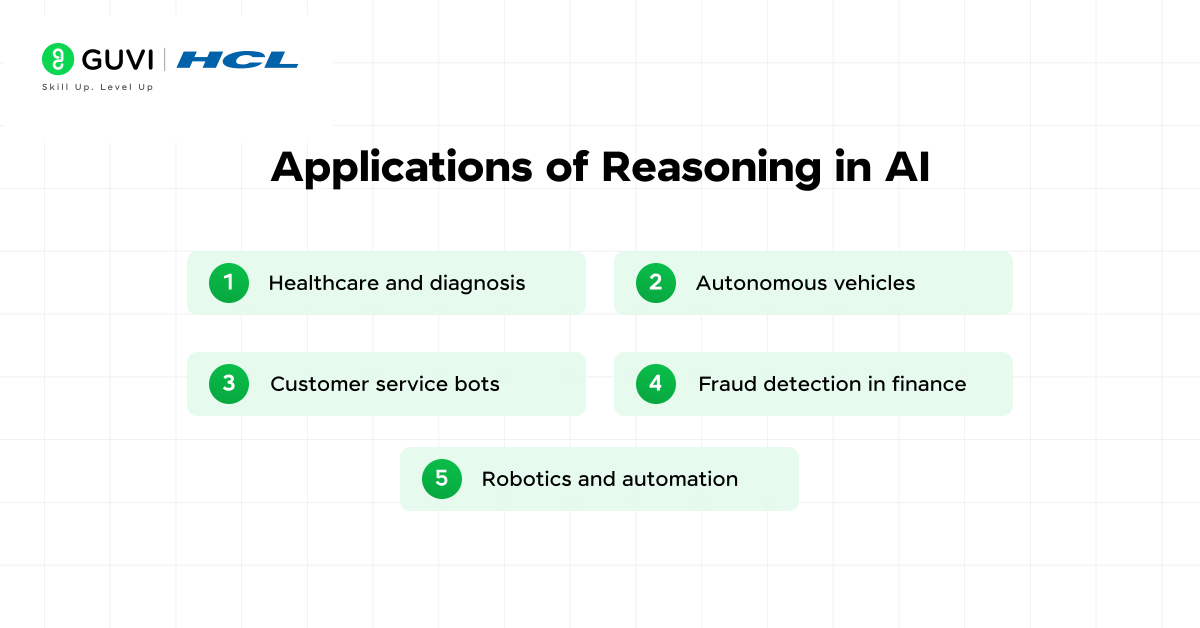
- Applications of Reasoning in AI
- 1) Healthcare and diagnosis
- 2) Autonomous vehicles
- 3) Customer service bots
- 4) Fraud detection in finance
- 5) Robotics and automation
- Concluding Thoughts…
- FAQs
- Q1. What is the difference between reasoning and learning in AI?
- Q2. How does AI reasoning help in real-world applications?
- Q3. What are the main types of reasoning used in AI?
- Q4. How does non-monotonic reasoning differ from monotonic reasoning?
What is Reasoning in AI?
AI reasoning is the mechanism through which machines use available information to generate predictions, make inferences, and draw conclusions. This capability allows AI to go beyond following predefined rules or recognizing patterns – it enables systems to process information in a structured manner, applying logic and contextual understanding to complex scenarios.
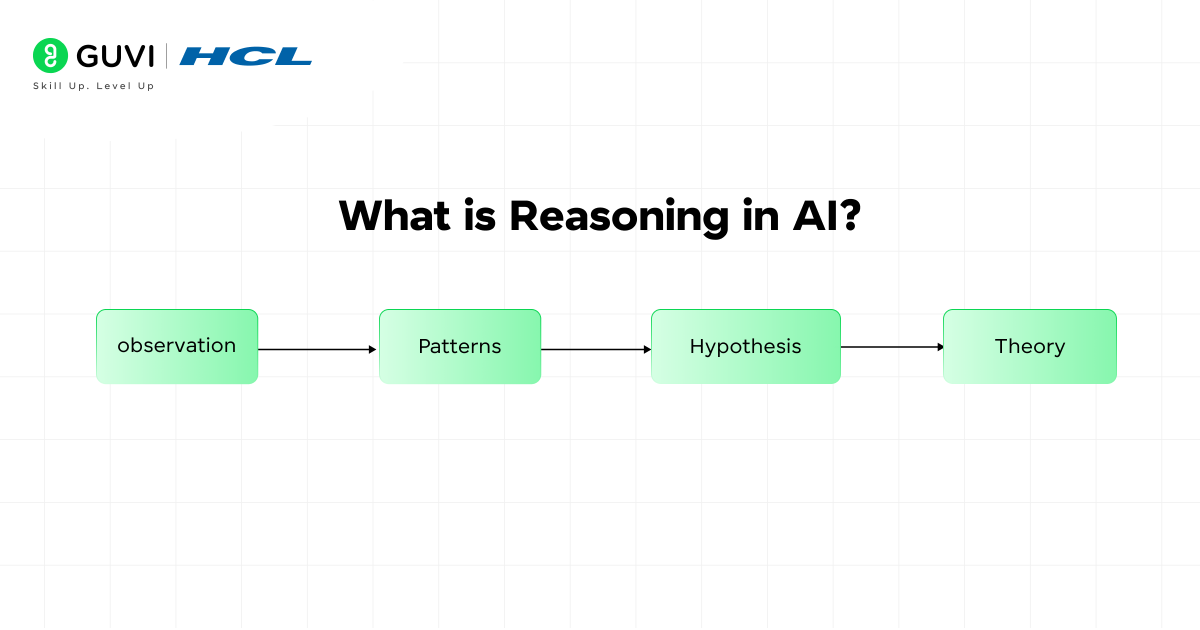
The primary purpose of reasoning in AI is to bridge the gap between pattern recognition and sophisticated decision-making. While traditional AI models excel at generating content based on statistical probabilities, reasoning frameworks enhance these systems by enabling them to:
- Analyze problems logically and systematically
- Break complex tasks into manageable steps
- Evaluate multiple potential outcomes before selecting the best one
- Provide explanations for their decisions and recommendations
Reasoning in AI combines advanced techniques that enhance the logical consistency and decision-making capabilities of generative models. These reasoning capabilities help AI handle dynamic environments, predict outcomes, and optimize processes in ways that simple automation cannot achieve.
How reasoning in AI differs from learning and problem-solving
AI reasoning differs fundamentally from machine learning in both approach and function. Machine learning thrives on data and probabilistic patterns, whereas reasoning in AI relies on logic and structured inference. Consider these key distinctions:
- Machine learning identifies patterns in large datasets to make predictions, while reasoning in ai applies logical structures to conclude. For example, a machine learning system might identify weather patterns to forecast rain, but a reasoning system can analyze the implications of rainfall on traffic and suggest alternative routes.
- AI reasoning also differs from traditional problem-solving in its ability to handle ambiguity and incomplete information. Rather than merely executing algorithms, reasoning systems can assess problems contextually, applying relevant logic even in uncertain scenarios.
- Moreover, reasoning in ai incorporates multiple cognitive processes. To reason is to draw inferences appropriate to the situation, which can be either deductive (drawing specific conclusions from general principles) or inductive (making generalizations based on specific observations).
Why reasoning is essential for intelligent systems
Reasoning transforms AI from basic automation tools into sophisticated decision-making partners. This capability is critical for several reasons:
- First, reasoning enables AI to tackle intricate tasks that require logical consistency, such as coding, scheduling, and long-term planning. Without reasoning capabilities, AI systems would be limited to pattern recognition and simple automation tasks.
- Second, reasoning in ai provides explainability. As AI systems increasingly make important decisions, the ability to explain their reasoning processes becomes crucial. Through reasoning, AI can trace decisions back through logical steps, increasing auditability and user trust.
- Third, reasoning allows AI to handle complex real-world environments that rarely present black-and-white scenarios. By anticipating outcomes, evaluating trade-offs, and adapting strategies based on dynamic inputs, reasoning in AI can deliver more precise, reliable, and context-aware results in enterprise settings.
- Finally, reasoning capabilities enable AI systems to decompose complex requests into manageable steps, improving problem-solving accuracy and efficiency. This makes AI more effective for tasks ranging from medical diagnosis to autonomous vehicle navigation, where step-by-step logical processing is essential for safety and effectiveness.
Types of Reasoning in AI
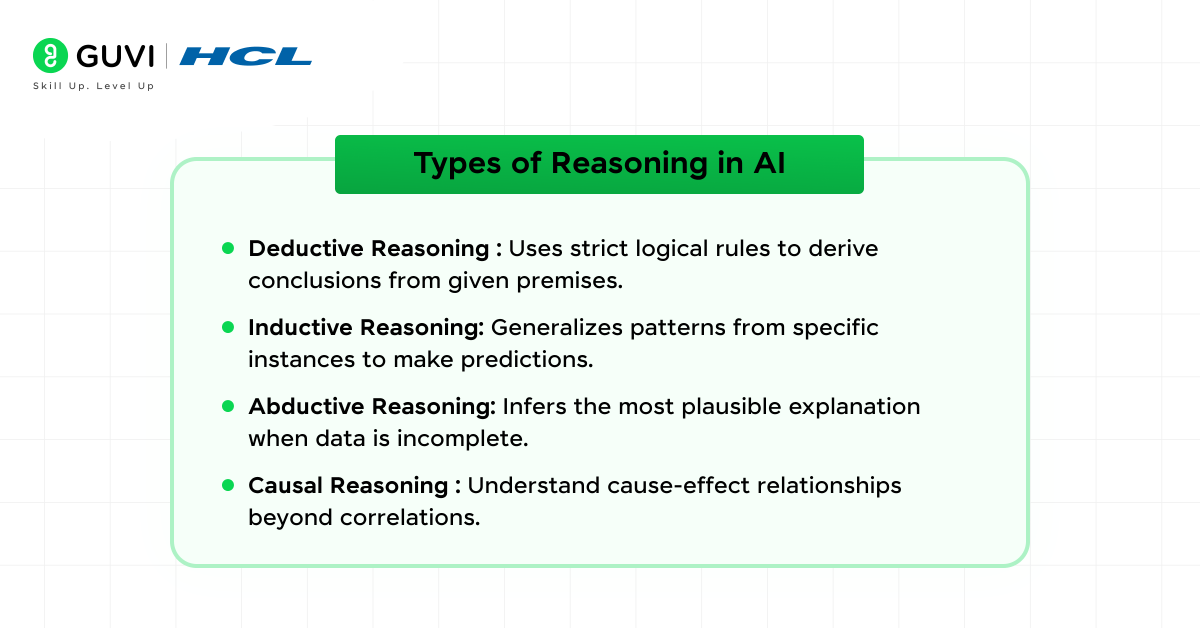
AI systems employ various reasoning techniques to solve problems and make decisions. Each type of reasoning offers unique approaches to handling information and drawing conclusions, enabling AI to tackle different kinds of challenges.
1) Deductive reasoning
Deductive reasoning in AI starts with general principles or rules and applies them to specific cases to reach certain conclusions. If the premises are true, then the conclusion must be true as well. This top-down approach forms the backbone of many rule-based AI systems.
In AI applications, deductive reasoning follows structured logic models to analyze inputs and generate definitive outcomes. Expert systems heavily rely on this approach, applying predefined rules through techniques like Modus Ponens (“If A, then B; A is true; therefore, B is true”) and Modus Tollens (“If A, then B; B is false; therefore, A is false”).
Applications of deductive reasoning in AI include expert systems, automated theorem proving, and rule-based systems for medical diagnosis.
2) Inductive reasoning
Inductive reasoning in AI works in the opposite direction—it draws general conclusions from specific observations. This bottom-up approach allows AI to identify patterns and make predictions based on available data.
When using inductive reasoning, AI systems analyze trends and statistical relationships to infer new knowledge. Unlike deduction, inductive conclusions are probabilistic rather than certain. Machine learning algorithms particularly thrive on this approach, training on labeled data to recognize patterns and make predictions about new scenarios.
Common applications include email spam filtering (analyzing patterns in labeled emails), image classification, and sentiment analysis in text.
3) Abductive reasoning
Abductive reasoning in ai involves finding the most likely explanation for incomplete observations. It’s essentially the process of making educated guesses based on limited information—what Charles Sanders Peirce described as “the process of forming explanatory hypotheses”.
This reasoning type focuses on hypothesis generation and allows AI systems to handle uncertainty by selecting the most promising explanations from numerous possibilities. While deductive and inductive reasoning have dominated AI research historically, abductive reasoning is increasingly recognized as essential for sophisticated AI systems.
Medical diagnosis systems often use abductive reasoning to identify the most probable cause of symptoms, even with incomplete patient data.
4) Analogical reasoning
Analogical reasoning in AI involves comparing similar situations and transferring knowledge from one domain to another. This allows AI to solve new problems by drawing parallels to previously encountered scenarios.
Large pre-trained language models have shown the capability for zero-shot relational reasoning through analogical processes, particularly when information is encoded in language form. This reasoning method helps AI systems handle novel situations by finding similarities with known cases.
Applications include case-based reasoning systems, where AI solves new problems by comparing them to previous cases and adapting earlier solutions.
5) Common sense reasoning
Common sense reasoning involves using everyday knowledge about the world to make decisions—something humans do effortlessly but machines find challenging. This type of reasoning relies on implicit knowledge rather than explicit rules.
Despite significant advances in AI, common sense reasoning remains difficult because it requires understanding a vast collection of unstated facts about how the world works. For instance, knowing that “six-foot-tall person holding a two-foot-tall person” likely means “adult holding child” requires implicit knowledge.
Recent language models have improved at answering common-sense questions, though researchers debate whether this represents true reasoning or pattern matching.
6) Fuzzy reasoning
Fuzzy reasoning handles uncertainty by allowing degrees of truth rather than binary true/false values. It’s especially useful for concepts with vague boundaries or transitional values.
Through fuzzy logic, AI can work with linguistic terms like “very small,” “small,” “big,” and “very big” by assigning membership degrees between 0 and 1. For example, Friday might belong to both “weekday” (0.95) and “weekend” (0.05) categories simultaneously.
A fuzzy logic system typically consists of four components: fuzzification (converting crisp inputs to fuzzy values), knowledge base (storing rules), inference engine (applying human-like reasoning), and defuzzification (converting fuzzy output to crisp values).
This approach is particularly valuable in control systems like air conditioners, washing machines, and medical diagnosis tools, where precise values may not always be available.
Monotonic vs Non-Monotonic Reasoning
Understanding how AI systems update their knowledge is crucial for building intelligent systems. Two fundamental approaches—monotonic and non-monotonic reasoning—represent distinctly different ways machines handle new information.
What is monotonic reasoning?
Monotonic reasoning refers to a form of logical processing where conclusions, once drawn, remain valid regardless of what new information becomes available. The term “monotonic” indicates something that doesn’t vary or change direction. In this reasoning approach:
- Knowledge only expands and never contracts
- Previous conclusions always remain true
- The set of propositions only increases
For instance, the statement “The Sahara is a desert” will always remain true even if you learn more facts about deserts worldwide. Monotonic reasoning deals with specific models that have valid proofs and is based on confirmed facts rather than assumptions.
What is non-monotonic reasoning?
Non-monotonic reasoning (NMR) allows AI systems to revise their conclusions based on new information. Unlike its monotonic counterpart, this approach:
- Changes direction as the knowledge base expands
- Permits the retraction of previous conclusions
- Handles incomplete or uncertain information effectively
Consider how you might initially believe all birds can fly after learning Tweety is a bird. However, upon discovering that Tweety is a penguin, you must revise your conclusion. Non-monotonic reasoning acknowledges that our understanding evolves as we gather more facts.

How Reasoning Works in AI Systems
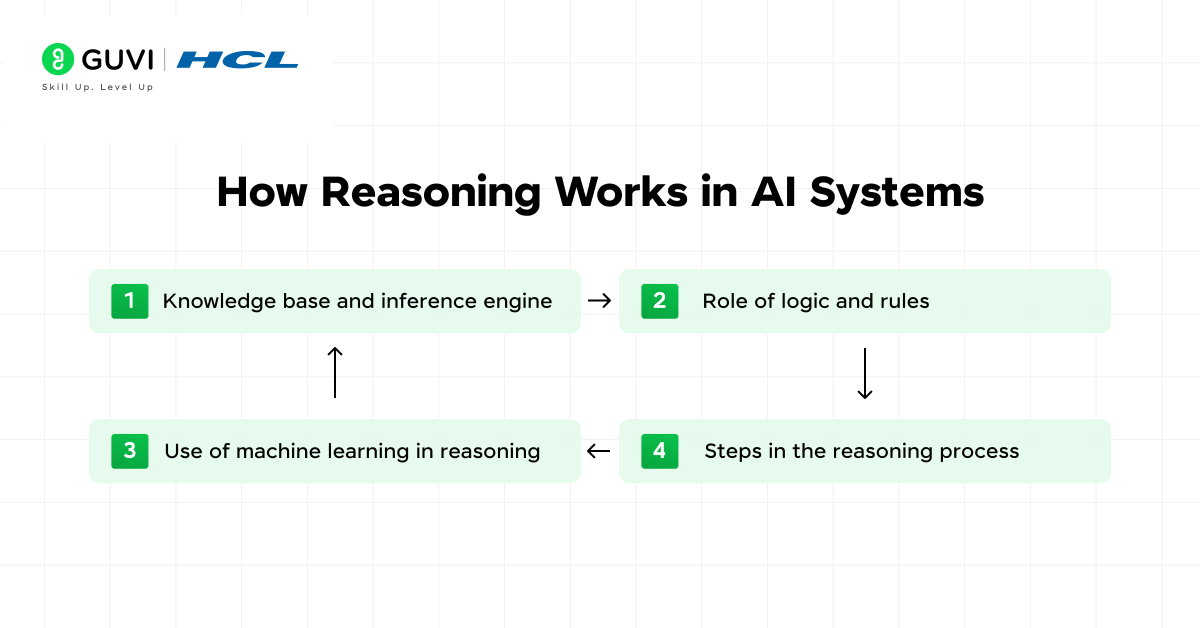
Behind every AI system that demonstrates reasoning capabilities lies a well-structured architecture with specific components working together. The machinery of AI reasoning combines established knowledge with logical processing to generate new insights.
1) Knowledge base and inference engine
AI reasoning systems typically consist of two fundamental components working in tandem. The knowledge base serves as the system’s memory, containing structured information in formats like knowledge graphs, ontologies, and semantic networks. These frameworks map real-world entities, relationships, and domain-specific information that AI can process and understand.
Functioning as the “brain” of the reasoning system, the inference engine processes data from the knowledge base using logical rules to derive new insights and make decisions. It implements necessary logic and applies various reasoning methods to analyze information and reach conclusions. Together, these components form the backbone of AI reasoning capabilities.
2) Role of logic and rules
Logic provides the fundamental framework that enables AI systems to reason effectively. Through formal logical structures, AI can:
- Validate that computations conform to specific standards
- Apply if-then statements systematically to new situations
- Process information according to established rules
Although the connection between logic and computer programs can sometimes be loose, logical theory consistently informs applications while applications challenge and improve logical theory. This cyclical relationship has driven innovations in both fields.
3) Use of machine learning in reasoning
Machine learning enhances reasoning capabilities by allowing systems to:
- Identify patterns in data that might be invisible to rule-based approaches
- Adapt reasoning strategies based on new information
- Refine logical processes over time through experience
Recent approaches like retrieval augmented reasoning (RAR) incorporate sophisticated interaction with information sources, actively reasoning in a human-like manner while engaging with document sources and users. Additionally, integration between Knowledge Representation and Reasoning (KRR) and Machine Learning creates systems that can learn special kinds of rules and leverage background knowledge.
4) Steps in the reasoning process
The AI reasoning process typically follows these sequential steps:
- Data Input: The system receives structured or unstructured data (text, images, sensor data)
- Knowledge Retrieval: Relevant information is extracted from stored knowledge bases
- Logical Processing: The system applies appropriate reasoning methods to analyze data
- Decision-Making: Based on reasoning, the AI generates insights or decisions tailored to the scenario
Consider an autonomous robot floor cleaner that recognizes floor types through its sensors, accesses its knowledge base about cleaning methods, applies logical rules, and selects the appropriate cleaning action for each surface. This practical example illustrates how reasoning empowers AI to make contextual decisions.
To add a little curiosity to your learning journey, here are some surprising tidbits about AI reasoning:
Early AI Reasoning Systems: The very first reasoning-based AI program, called Logic Theorist (1956), could prove mathematical theorems using symbolic logic—earning it the nickname “the first artificial intelligence program.”
Common Sense is Harder Than Chess: While AI mastered chess decades ago, researchers still struggle to give machines everyday common-sense reasoning, like understanding that ice melts in the sun or that people cannot walk through walls.
These facts show how reasoning has always been at the core of AI—from its very beginnings to today’s challenges of making machines think more like humans.
Applications of Reasoning in AI
Reasoning in AI powers real-world applications across diverse industries, solving complex problems through logical processing and inference.
1) Healthcare and diagnosis
AI reasoning systems assist with medical diagnosis by analyzing patient data, medical literature, and treatment protocols to support clinical decisions. IBM Watson uses probabilistic reasoning to suggest potential diagnoses by examining medical records and symptoms.
Consequently, these systems improve diagnostic accuracy and treatment planning while accelerating drug discovery through abductive reasoning. In one study, GPT-4 outperformed human physicians in diagnostic tasks when given identical clinical information.
2) Autonomous vehicles
Self-driving cars utilize reasoning capabilities to interpret sensor data, predict outcomes, and make split-second decisions. MIT researchers developed an autonomous control system that “learns” human steering patterns using only video camera feeds and simple GPS-like maps.
This approach allows vehicles to navigate new environments without extensive pre-mapping. Additionally, non-monotonic reasoning helps autonomous vehicles adapt decisions when faced with conflicting information.
3) Customer service bots
Modern AI chatbots employ reasoning to deliver personalized customer interactions across digital channels. Through natural language processing, these systems handle complex queries, maintain context across multi-turn dialogs, and know when to escalate to human agents. In fact, by 2027, chatbots will become the primary customer service channel for 25% of organizations.
4) Fraud detection in finance
AI reasoning identifies fraudulent patterns in financial transactions by analyzing anomalies and unusual behaviors. Machine learning techniques like graph analysis uncover potential fraud networks by examining relationships between entities. HSBC’s Dynamic Risk Assessment system processes over 1.35 billion transactions monthly, identifying two to four times more financial crimes than previous methods.
5) Robotics and automation
In manufacturing and robotics, reasoning-enabled robots optimize assembly lines by performing tasks like welding and painting with minimal errors. Mars rovers use reasoning systems to navigate rugged terrain and analyze geological samples without human intervention. Furthermore, AI reasoning allows robots to interpret environments and break complex commands into executable tasks using common sense.
Looking to build real-world reasoning skills in AI? HCL GUVI’s Intel & IITM Pravartak–certified Artificial Intelligence and Machine Learning Course delivers hands-on training in Generative AI, Deep Learning, LLM-Ops, and MLOps—backed by live classes, expert mentors, and placement support to make you industry-ready.
Concluding Thoughts…
Wow, AI just never fails to amaze, does it!? It’s so intuitive (and a little scary) how AI reasoning transforms machines from simple pattern-recognition tools into sophisticated decision-making partners. Throughout this guide, you’ve learned how reasoning enables AI systems to process information logically, draw conclusions, and solve complex problems through multiple inference passes.
As AI continues to evolve, reasoning capabilities will play an increasingly crucial role in creating systems that can think rather than simply compute. Reach out to me through the comments section below if you have any doubts. Good Luck!
FAQs
Q1. What is the difference between reasoning and learning in AI?
Reasoning in AI involves using logical structures to conclude, while learning focuses on identifying patterns in data. Reasoning allows AI to tackle complex tasks requiring logical consistency, such as coding and long-term planning, whereas learning enables AI to make predictions based on statistical patterns.
Q2. How does AI reasoning help in real-world applications?
AI reasoning enables sophisticated decision-making in various fields. For example, in healthcare, it assists with medical diagnosis by analyzing patient data and treatment protocols. In autonomous vehicles, reasoning helps interpret sensor data and make split-second decisions. It also enhances customer service bots, fraud detection in finance, and robotics in manufacturing.
Q3. What are the main types of reasoning used in AI?
The main types of reasoning in AI include deductive reasoning (applying general rules to specific cases), inductive reasoning (drawing general conclusions from specific observations), abductive reasoning (finding the most likely explanation for incomplete data), analogical reasoning (comparing similar situations), and fuzzy reasoning (handling uncertainty with degrees of truth).
Q4. How does non-monotonic reasoning differ from monotonic reasoning?
Non-monotonic reasoning allows AI systems to revise their conclusions based on new information, making it suitable for dynamic environments. In contrast, monotonic reasoning maintains that conclusions remain valid regardless of new information. Non-monotonic reasoning is essential for AI systems that need to adapt to changing conditions, such as autonomous vehicles or medical diagnosis systems.
Success Stories

About the Author
Jaishree Tomar
A recent CS Graduate with a quirk for writing and coding, a Data Science and Machine Learning enthusiast trying to pave my own way with tech. I have worked as a freelancer with a UK-based Digital Marketing firm writing various tech blogs, articles, and code snippets. Now, working as a Technical Writer at GUVI writing to my heart’s content!
View all posts by Jaishree Tomar
Connect with me @










Did you enjoy this article?