


Javascript Articles
GraphQL with Strawberry Tutorial: Build Your First Python API
Temporal Workflow Engine Tutorial: Build Reliable Workflows
Tauri 2.0 Desktop App Tutorial: Build Your First App Without the Bloat


Get In Touch For Details! Request More Information
gRPC Tutorial: A Beginner’s Guide to Building Fast, Modern APIs
Aug 13, 2026 4 Min Read 712 Views
(Last Updated)
Table of contents
- TL;DR Summary
- What Is gRPC and Why Should You Care?
- How gRPC Actually Works
- The Four Communication Patterns in gRPC
- Building Your First gRPC Service (Step-by-Step)
- Step 1: Install the Required Packages
- Step 2: Write Your .proto File
- Step 3: Generate the Python Code
- Step 4: Write the Server
- Step 5: Write the Client
- Step 6: Run It
- When to Use gRPC vs REST
- What to Do Next
- Key Takeaways
- FAQs
- What is gRPC used for?
- Is gRPC better than REST?
- What language does gRPC support?
- Do I need to know Protocol Buffers to use gRPC?
- Can gRPC work with browsers?
- How is gRPC different from GraphQL?
- Is gRPC secure?
- What is a .proto file?
TL;DR Summary
- gRPC is a high-performance, open-source framework built by Google for connecting services using Protocol Buffers instead of JSON
- It’s significantly faster than REST for service-to-service communication, especially in microservices architectures
- You define your API once in a .proto file, and gRPC auto-generates client and server code across multiple languages
- gRPC supports four communication patterns: unary, server streaming, client streaming, and bidirectional streaming
- Best suited for internal APIs, real-time systems, and polyglot environments — not ideal for public-facing browser APIs (yet)
gRPC (Google Remote Procedure Call) is an open-source framework that lets services talk to each other using Protocol Buffers — a faster, smaller alternative to JSON over HTTP/2. It’s used by companies like Netflix, Dropbox, and Cloudflare to power high-speed internal APIs. Unlike REST, you define your service once in a .proto file and gRPC handles the rest, including auto-generating client and server code in 10+ languages.
In this gRPC tutorial, you’ll learn what it is, how it works, when to use it, and how to build your very first gRPC service — even if you’ve never touched it before.
What Is gRPC and Why Should You Care?
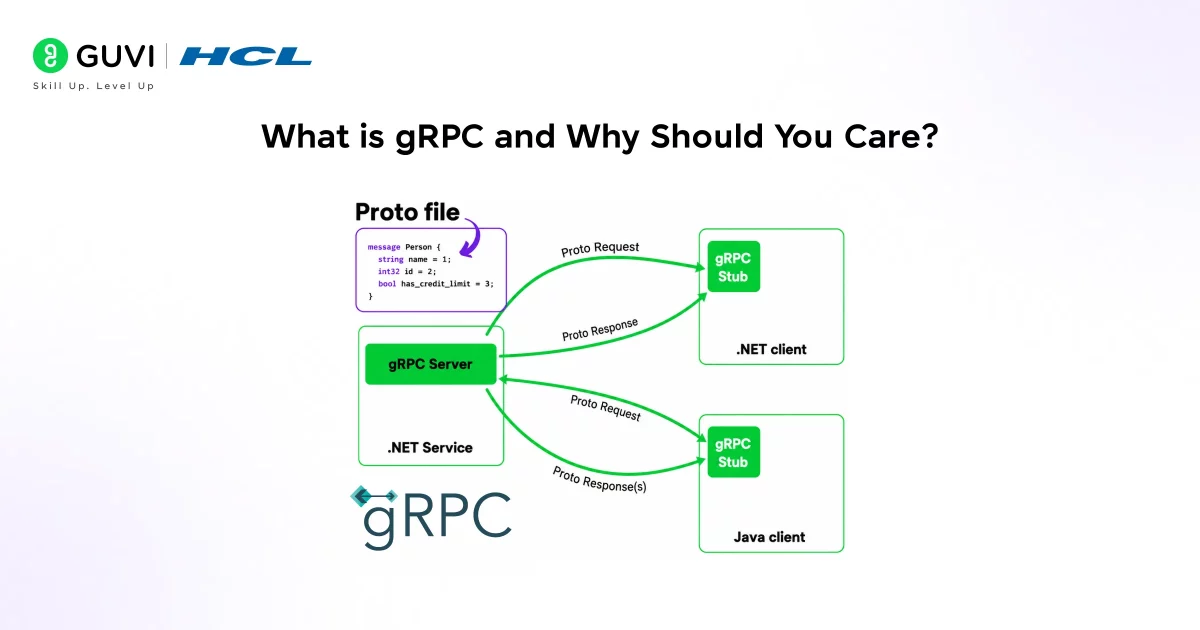
gRPC stands for Google Remote Procedure Call. Google released it as open-source in 2015, and it’s now part of the Cloud Native Computing Foundation (CNCF).
At its core, gRPC lets one program call a function on another program — even if they’re running on completely different machines, written in different languages.
Sound familiar? That’s basically what REST does too. But here’s where gRPC pulls ahead:
| Feature | REST | gRPC |
| Protocol | HTTP/1.1 | HTTP/2 |
| Data Format | JSON (text) | Protocol Buffers (binary) |
| Code Generation | Manual | Auto-generated |
| Streaming Support | Limited | Built-in (4 modes) |
| Speed | Moderate | 5–10x faster in benchmarks |
| Browser Support | Native | Requires gRPC-Web proxy |
📊 Data Point: According to a benchmark published by Ruwan Ranganath (Medium, 2023), gRPC with Protocol Buffers was around 7x faster than REST with JSON for equivalent payloads in a Go-based microservices test. [HUMAN EDITOR: Verify and link to updated 2025 benchmarks if available]
How gRPC Actually Works
Think of gRPC like ordering food at a restaurant with a fixed menu. You pick from defined options — no custom requests, no ambiguity. The kitchen (server) knows exactly what to make.
Here’s the simple version of how it flows:
Step 1 — You write a .proto file
This is your contract. You define your services (what functions exist) and your messages (what data goes in and out). It’s like a blueprint.
Step 2 — gRPC generates the code
Run the Protocol Buffer compiler (protoc) and it spits out ready-to-use client and server code in your language of choice — Python, Go, Java, Node.js, and more.
Step 3 — You implement the server logic
Fill in the actual business logic in your server functions.
Step 4 — The client calls it like a local function
The client calls the remote function as if it were just a regular local method. gRPC handles all the networking underneath.
💡 Pro Tip: The .proto file is the single source of truth for your entire API. If you update it, regenerate the code and both sides stay in sync automatically. This is a huge win over maintaining separate REST docs.
The Four Communication Patterns in gRPC
This is one of the biggest reasons developers fall in love with gRPC. REST is essentially one pattern: you send a request, you get a response. gRPC gives you four:
1. Unary RPC — The REST equivalent. One request, one response. Use this for most standard operations.
2. Server Streaming — Client sends one request, server sends back a stream of responses. Great for real-time dashboards or live logs.
3. Client Streaming — Client sends a stream of data, server replies once. Useful for file uploads or batch operations.
4. Bidirectional Streaming — Both sides send streams simultaneously. Think live chat apps or collaborative document editing.
⚠️ Warning: Bidirectional streaming is powerful but adds complexity. Don’t reach for it unless your use case genuinely needs real-time two-way data flow. Unary is fine for 80% of use cases.
Building Your First gRPC Service (Step-by-Step)
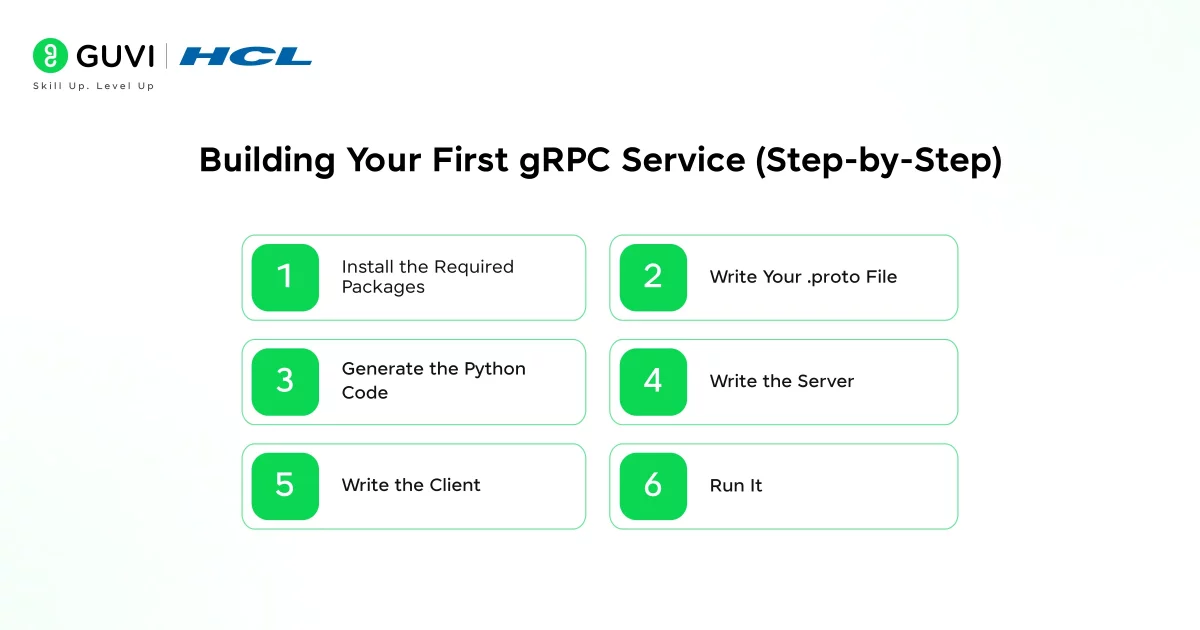
Let’s build a simple Greeter service in Python. This is the “Hello World” of gRPC.
Prerequisites:
- Python 3.8+
- pip installed
Step 1: Install the Required Packages
pip install grpcio grpcio-tools
Step 2: Write Your .proto File
Create a file called greeter.proto:
proto

syntax = "proto3";

package greeter;

service Greeter {

  rpc SayHello (HelloRequest) returns (HelloReply);

}

message HelloRequest {

  string name = 1;

}

message HelloReply {

  string message = 1;

}
This defines one service (Greeter) with one method (SayHello) that takes a name and returns a message. Clean, readable, unambiguous.
Step 3: Generate the Python Code
python -m grpc_tools.protoc -I. --python_out=. --grpc_python_out=. greeter.proto
This creates two files: greeter_pb2.py (message classes) and greeter_pb2_grpc.py (service stubs).
Step 4: Write the Server
Create server.py:
//python

import grpc

from concurrent import futures

import greeter_pb2

import greeter_pb2_grpc

class GreeterServicer(greeter_pb2_grpc.GreeterServicer):

    def SayHello(self, request, context):

        return greeter_pb2.HelloReply(message=f"Hello, {request.name}!")

def serve():

    server = grpc.server(futures.ThreadPoolExecutor(max_workers=10))

    greeter_pb2_grpc.add_GreeterServicer_to_server(GreeterServicer(), server)

    server.add_insecure_port('[::]:50051')

    server.start()

    print("Server running on port 50051")

    server.wait_for_termination()

if __name__ == '__main__':

    serve()
Step 5: Write the Client
Create client.py:
//python

import grpc

import greeter_pb2

import greeter_pb2_grpc

def run():

    with grpc.insecure_channel('localhost:50051') as channel:

        stub = greeter_pb2_grpc.GreeterStub(channel)

        response = stub.SayHello(greeter_pb2.HelloRequest(name='Kiran'))

        print(f"Server said: {response.message}")

if __name__ == '__main__':

    run()
Step 6: Run It
Open two terminals. In the first:
python server.py
In the second:
python client.py
# Output: Server said: Hello, Kiran!
That’s it. You just built and called your first gRPC service.
✅ Best Practice: Always use insecure_channel only in local development. In production, use TLS with grpc.secure_channel() and proper credentials.
When to Use gRPC vs REST
This is the question that trips up most beginners. Here’s a clean way to think about it:
Use gRPC when:
- You’re building internal microservices that need to talk to each other at high speed
- Your team works across multiple languages (gRPC’s code gen handles the polyglot problem)
- You need streaming — real-time data, live feeds, or large file transfers
- Payload size matters and you want to cut bandwidth costs
Stick with REST when:
- You’re building a public API that browsers will consume directly
- Simplicity and wide tooling support matter more than speed
- Your team is already comfortable with REST and the performance difference isn’t a bottleneck
💡 Pro Tip: Many production systems use both. REST for public-facing endpoints, gRPC for internal service-to-service calls. This is exactly what companies like Uber and Netflix do.
What to Do Next
Now that you’ve got the basics down, here’s how to keep building:
- Add error handling — Learn gRPC status codes (they’re like HTTP status codes but more granular)
- Try server streaming — Modify your .proto to return a stream and build a live data feed
- Explore gRPC-Web — This lets browsers call gRPC services directly with a lightweight proxy
- Look into Buf — A modern alternative to protoc that makes managing .proto files much easier
- Learn about Interceptors — gRPC’s equivalent of middleware for logging, auth, and more
If you want a structured, mentor-supported path and learn all these new tools, then HCL GUVI’s IIT-M Pravartak Certified Full Stack Developer Course with AI Integration covers the entire journey, from HTML to deployment, with real projects, live sessions, and placement support. Over 10,000 students have used it to break into product-based companies.
Key Takeaways
- gRPC uses HTTP/2 and Protocol Buffers — that’s why it’s faster and more efficient than REST
- The .proto file is everything — define it once, generate code for any language
- There are four RPC types; unary is the simplest and covers most use cases
- gRPC is not a REST replacement — it’s a better choice for specific scenarios, especially internal services
- You can build a working gRPC service in under 30 minutes with Python
FAQs
What is gRPC used for?
gRPC is used to connect services in microservices architectures. Companies use it for internal APIs where speed and efficiency matter. It’s also popular for real-time applications like chat, live dashboards, and streaming data pipelines.
Is gRPC better than REST?
gRPC is faster and more efficient than REST for internal service communication, but it’s not a full replacement. REST is still better for public APIs and browser-facing applications due to its wider tooling support and native browser compatibility.
What language does gRPC support?
gRPC officially supports Go, Java, Python, C++, Node.js, Ruby, C#, Kotlin, Dart, and PHP. You write your service definition once in a .proto file and generate code for any of these languages automatically.
Do I need to know Protocol Buffers to use gRPC?
Yes, but they’re simpler than they sound. Protocol Buffers (protobuf) is just a way to define structured data using a clean schema language. Most developers get comfortable with basic .proto syntax within an hour.
Can gRPC work with browsers?
Not natively — browsers don’t support HTTP/2 at the level gRPC requires. But gRPC-Web solves this with a browser-compatible transport layer. You’ll need a proxy like Envoy or the official gRPC-Web npm package.
How is gRPC different from GraphQL?
GraphQL is a query language for APIs, mainly for flexible client-driven data fetching. gRPC is a framework for fast, typed service-to-service communication. They solve different problems — GraphQL is great for flexible front-end queries, gRPC is great for efficient back-end connections.
Is gRPC secure?
gRPC supports TLS out of the box and also has built-in support for token-based auth and mutual TLS. In production, always use secure channels with proper certificates.
What is a .proto file?
A .proto file is the contract for your gRPC service. It defines what functions (RPCs) your service offers and what data structures (messages) it accepts and returns. The Protocol Buffer compiler reads this file to generate client and server code.
Success Stories

About the Author
Lukesh S
A professional content writer who has experience in freelancing and now working as a Technical Content Writer at HCL GUVI having sound knowledge in Blog Writing and Creative Writing!
View all posts by Lukesh S
Connect with me @










Did you enjoy this article?