


Artificial Intelligence and Machine Learning Articles
Attention Mechanism Explained: The Building Block of Transformers
Batch Normalization Explained: Why It Speeds Up Training


Get In Touch For Details! Request More Information
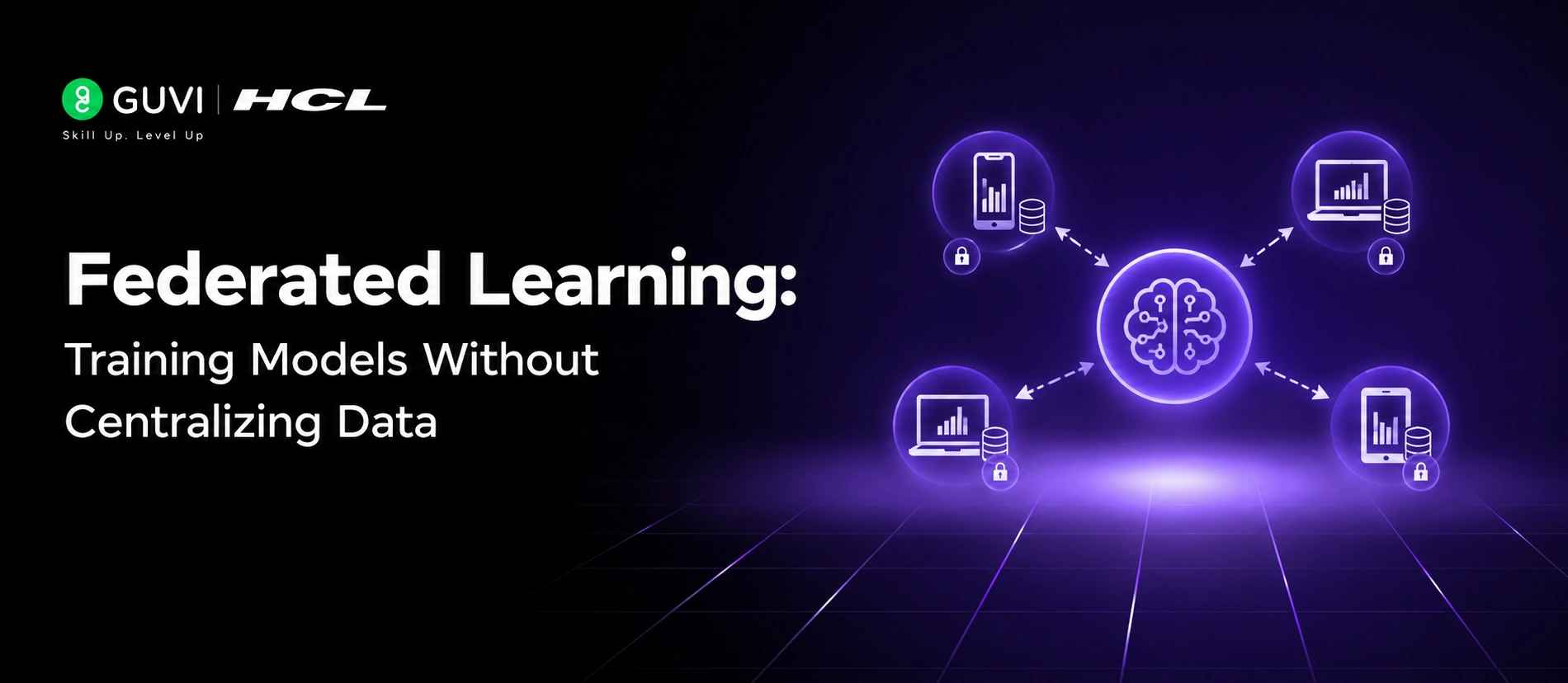
Federated Learning: Training Models Without Centralizing Data
Aug 26, 2026 5 Min Read 17 Views
(Last Updated)
If you care about privacy, compliance, or simply moving less data around, federated learning is one of the most important ideas in modern machine learning. It lets you train powerful models without ever centralizing raw data.
Instead of bringing data to the model, you bring the model to the data. That simple shift unlocks new possibilities for healthcare, finance, mobile apps, and IoT.
Direct Answer
Federated Learning is a decentralized machine learning approach where multiple devices or organizations train a shared model using their local data. Instead of sending raw data to a central server, each participant trains the model locally and sends only model updates (like gradients or weights). A central server aggregates these updates to improve the global model while keeping data on-device.
Table of contents
- TL;DR Summary
- What Is Federated Learning?
- How Federated Learning Works
- The Core Components
- Federated Averaging (FedAvg)
- Types of Federated Learning
- Horizontal Federated Learning
- Vertical Federated Learning
- Federated Transfer Learning
- Why Federated Learning Matters
- Privacy and Security
- Regulatory Compliance
- Reduced Data Movement
- Leveraging Edge Data
- Real-World Applications
- Challenges and Limitations
- A Simple Training Sketch (Conceptual)
- Common Mistakes to Avoid
- What to Do Next
- Conclusion
- FAQs
- What is Federated Learning?
- How does Federated Learning work?
- What is FedAvg?
- Why is Federated Learning important for privacy?
- What are common applications of Federated Learning?
- What are the main challenges in Federated Learning?
- Is Federated Learning the same as distributed training?
TL;DR Summary
- Federated Learning trains models across decentralized devices without moving raw data.
- Only model updates, not data, are shared with a central server.
- It improves privacy, security, and compliance for sensitive datasets.
- Common algorithms include FedAvg for aggregating client updates.
- Challenges include communication costs, heterogeneity, and privacy risks from updates.
What Is Federated Learning?
Federated Learning (FL) is a distributed machine learning technique where multiple clients (devices, servers, or organizations) collaboratively train a shared model while keeping their data local.
In traditional centralized training, all data is collected in one place. In Federated Learning, data stays on each client. Clients train the model on their own data and send only model updates to a central server, which aggregates them.
This approach is especially valuable when:
- Data is sensitive (for example, health records, financial transactions).
- Regulations restrict data movement (for example, GDPR, HIPAA).
- Data is too large or distributed to centralize efficiently.
- You want to leverage edge devices like smartphones and IoT sensors.
Federated learning trains AI models across devices or institutions by sharing only model updates, keeping raw data local and private. Learn AI & ML with HCL GUVI’s Artificial Intelligence and Machine Learning course.
How Federated Learning Works
At a high level, Federated Learning follows an iterative process:
- The central server initializes a global model.
- The server sends the current model to selected clients.
- Each client trains the model locally on its own data.
- Clients send model updates (weights or gradients) back to the server.
- The server aggregates updates (for example, using Federated Averaging).
- The updated global model is sent to clients for the next round.
This cycle repeats until the model converges.
The Core Components
- Central server: Coordinates training, aggregates updates, and maintains the global model.
- Clients: Devices or organizations that hold local data and perform local training.
- Model updates: Parameters, gradients, or weight deltas shared instead of raw data.
Pro Tip: Think of federated learning as collaborative learning where participants contribute to a common model without revealing their private information.
Federated Averaging (FedAvg)
FedAvg is the baseline algorithm for aggregating client updates in Federated Learning.
The basic idea:
- Each client trains the model locally for several epochs.
- Clients send their updated weights to the server.
- The server computes a weighted average of the weights, typically based on the amount of data each client used.
- The averaged weights become the new global model.
FedAvg is simple and effective, but it can struggle when client data is highly heterogeneous (non-IID) or when some clients are unreliable.
Types of Federated Learning
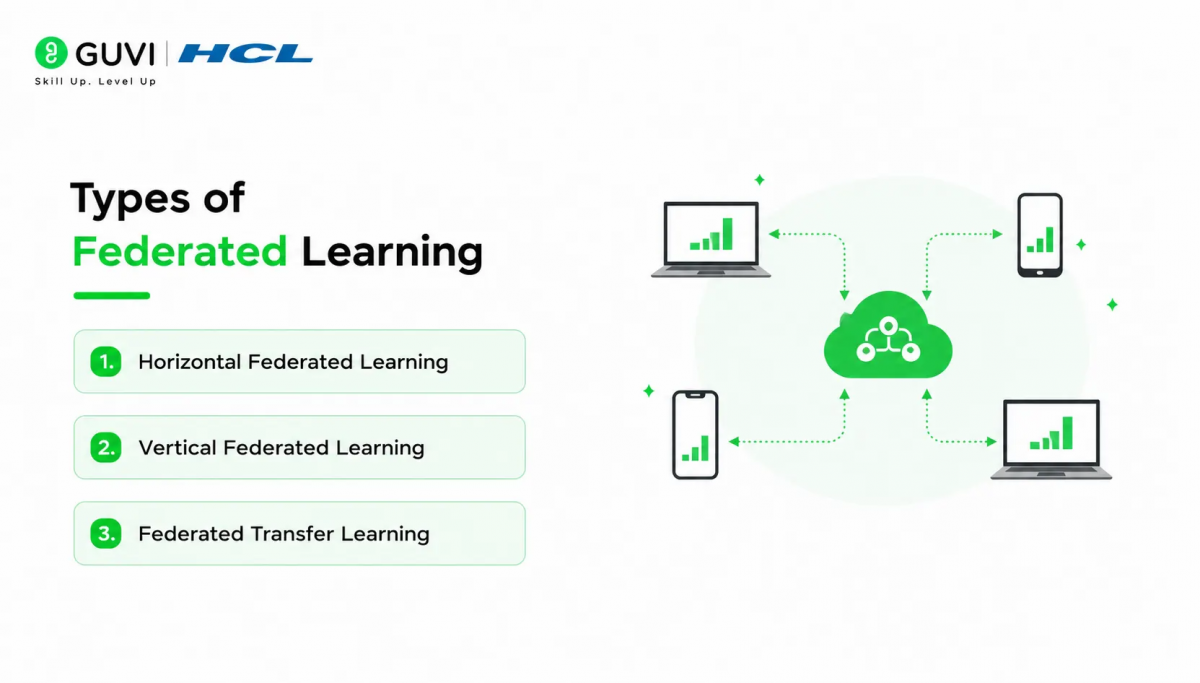
Federated Learning comes in several flavors depending on how data is distributed.
1. Horizontal Federated Learning
Used when clients have similar features but different samples. For example, many smartphones, each with their own user data. The central model is trained across these similar datasets.
2. Vertical Federated Learning
Used when clients have different features about the same entities. For example, a bank and an e-commerce platform might have complementary data about overlapping users. They can jointly train a model without sharing raw records.
3. Federated Transfer Learning
Used when clients have different features and different samples. A pre-trained foundation model is adapted across domains or tasks while keeping data local.
Federated learning trains AI models across devices or institutions by sharing only model updates, keeping raw data local and private. Learn AI & ML with HCL GUVI’s Artificial Intelligence and Machine Learning course.
Why Federated Learning Matters
Federated Learning addresses some of the biggest challenges in modern AI.
1. Privacy and Security
Raw data never leaves the client. Only model updates are shared, reducing exposure of sensitive information. This helps comply with privacy regulations and reduces breach risk.
2. Regulatory Compliance
Organizations can collaborate on AI without violating data-sharing restrictions. This is critical in healthcare, finance, and government sectors.
3. Reduced Data Movement
Moving large datasets to a central location is expensive and slow. Federated Learning moves computation to the data instead, saving bandwidth and storage.
4. Leveraging Edge Data
Billions of devices generate valuable data every day. Federated Learning enables training on this edge data without centralizing it.
Real-World Applications
- Federated Learning is already in use across multiple domains.
- Hospitals and research institutions can jointly train diagnostic models without sharing patient records. This enables larger, more diverse datasets while preserving confidentiality.
- Smartphones can improve keyboard prediction, voice recognition, and recommendations using on-device data. Updates are aggregated without uploading personal usage data.
- Banks can collaborate on fraud detection or credit risk models without exposing customer transaction data. This improves model quality while maintaining compliance.
- Factories and sensors can train predictive maintenance models across sites without centralizing operational data. This is valuable when data is sensitive or voluminous.
Challenges and Limitations
Federated Learning is powerful but not without trade-offs.
- Frequent model updates between clients and server can be expensive, especially over mobile networks. Compression and sparse updates help but add complexity.
- Client data is often non-IID (not independent and identically distributed). This can slow convergence and reduce model quality if not handled carefully.
- Clients vary in compute power, connectivity, and availability. Some may drop out mid-training, requiring robust aggregation strategies.
- Model updates can sometimes leak information about local data through techniques like gradient inversion or membership inference. Additional safeguards like differential privacy or secure aggregation are often needed.
- Inspecting model behavior is harder when data is distributed. Teams need new tools and practices for observability in Federated Learning systems.
Warning: Do not assume Federated Learning automatically guarantees privacy. Model updates can still leak information without additional protections.

A Simple Training Sketch (Conceptual)
Here is a high-level outline of a typical Federated Learning loop:
python
# Conceptual sketch, not runnable as-is

global_model = initialize_model()

for round in range(num_rounds):

    # Select a subset of clients

    clients = select_clients()

    client_updates = []

    for client in clients:

        # Send current global model to client

        client_model = global_model

        # Client trains locally on its own data

        updated_model = client_train(client_model, client_data)

        # Client sends back model update (weights or gradients)

        client_updates.append(updated_model)

    # Server aggregates updates (for example, FedAvg)

    global_model = aggregate(client_updates)

    # Optionally: evaluate global model, log metrics
In practice, frameworks like Flower, TensorFlow Federated, or PySyft provide production-ready tools for building Federated Learning systems.
Best Practice: Start with a small-scale Federated Learning experiment on synthetic or public data. Validate that your aggregation, communication, and privacy mechanisms work before scaling up.
Common Mistakes to Avoid
- Assuming Federated Learning is the same as distributed training on identical nodes.
- Ignoring non-IID data distribution across clients.
- Overlooking communication costs and client availability.
- Forgetting to add privacy safeguards beyond basic Federated Learning.
- Expecting the same convergence speed as centralized training.
- Neglecting monitoring and evaluation of the global model.
What to Do Next
If you want to explore Federated Learning:
- Start with a tutorial using a framework like Flower or TensorFlow Federated.
- Experiment with FedAvg on a simple dataset split across simulated clients.
- Add non-IID splits to understand heterogeneity effects.
- Explore differential privacy or secure aggregation for stronger privacy.
- Read case studies in healthcare, finance, and mobile to see real-world patterns.
Federated Learning is a key enabler for privacy-preserving AI. Understanding its architecture, algorithms, and limitations will help you design systems that respect data boundaries while still learning effectively.
Federated Learning was formally introduced by Google researchers in 2016 as a way to train models on mobile devices without uploading user data. Despite its privacy benefits, raw model updates can still leak information, which is why techniques like differential privacy and secure aggregation are often added on top.
Conclusion
Federated Learning enables collaborative model training across decentralized devices or organizations without centralizing raw data. Clients train locally and share only model updates, which a central server aggregates to improve the global model.
This approach improves privacy, security, and compliance while reducing data movement. It is widely used in healthcare, mobile, finance, and IoT. However, challenges like communication costs, data heterogeneity, and update-level privacy risks require careful design.
When implemented thoughtfully, Federated Learning unlocks the value of distributed data without compromising trust.
FAQs
What is Federated Learning?
Federated Learning is a distributed machine learning approach where multiple clients train a shared model using their local data. Raw data stays on each client, and only model updates are shared with a central server.
How does Federated Learning work?
A central server sends a global model to clients. Each client trains the model locally and sends updates back. The server aggregates these updates (for example, using FedAvg) to create an improved global model.
What is FedAvg?
FedAvg (Federated Averaging) is a baseline algorithm that aggregates client model updates by computing a weighted average of their weights, typically based on local data size.
Why is Federated Learning important for privacy?
Federated Learning keeps raw data on local devices and shares only model updates. This reduces exposure of sensitive information and helps comply with privacy regulations.
What are common applications of Federated Learning?
Common applications include healthcare (collaborative diagnostics), mobile (on-device personalization), finance (fraud detection), and IoT (predictive maintenance).
What are the main challenges in Federated Learning?
Key challenges include communication costs, non-IID data distribution, system heterogeneity, privacy risks from model updates, and debugging distributed systems.
Is Federated Learning the same as distributed training?
No. Distributed training typically moves data to powerful compute nodes, while Federated Learning moves computation to the data and focuses on privacy, heterogeneity, and intermittent connectivity.
Success Stories

About the Author
HCL GUVI
This article was selected and published as part of the HCL GUVI AI Blogathon 2026, an initiative designed to encourage students, AI enthusiasts, and aspiring tech writers to simplify complex AI concepts through impactful technical content. The contest recognized high-quality, original, and insightful AI-focused blogs, with selected authors receiving publication opportunities on the HCL GUVI blog platform along with official author credits and recognition.
View all posts by HCL GUVI
Connect with me @











Did you enjoy this article?