


Artificial Intelligence and Machine Learning Articles
Finance Manager to Data Analytics: Career Growth, Salary and Seniority
How to Evaluate LLM Outputs in Production Deployments
AI/ML Skills Gap 2026: Why Companies Can't Find Job-Ready Talent
20 AI/ML Interview Questions Recruiters Can Use Without a Tech Background - Best Guide


Get In Touch For Details! Request More Information

AI in Fraud Detection: How Banks Use Machine Learning
Aug 26, 2026 4 Min Read 304 Views
(Last Updated)
AI in fraud detection refers to the use of machine learning models to identify fraudulent transactions, account takeovers, and financial crimes in real time by analyzing patterns across transaction data, user behavior, device signals, and historical fraud cases. Banks use AI for fraud detection because rule-based systems cannot adapt to new fraud patterns quickly enough, while ML models learn continuously from new fraud examples and detect anomalies that no predefined rule would catch.
Table of contents
- TL;DR
- Why Rule-Based Systems Fail at Modern Fraud Detection
- Machine Learning Approaches in Bank Fraud Detection
- Handling Class Imbalance in Fraud Detection
- Explainability and Regulatory Requirements
- Conclusion
- FAQ
- How does AI detect fraud in banking?
- What ML models do banks use for fraud detection?
- How do fraud detection models handle class imbalance?
- What latency is required for real-time fraud scoring?
- Why is explainability important for AI fraud detection?
- How often do fraud detection models need to be retrained?
TL;DR
- AI in fraud detection uses machine learning to identify fraudulent financial activity in real time across transactions, account behavior, and identity verification
- Supervised learning models trained on historical fraud labels detect known fraud patterns while unsupervised anomaly detection identifies novel fraud types without labeled examples
- Graph neural networks detect fraud rings and collusion patterns by modeling relationships between accounts, devices, and transactions
- The core challenge is extreme class imbalance: fraud rates of 0.1 to 1 percent require specialized techniques like SMOTE, focal loss, and threshold calibration
Why Rule-Based Systems Fail at Modern Fraud Detection
Traditional fraud detection used expert-designed rules: flag any transaction over 10,000 dollars, decline cards used in two countries within one hour, reject transactions with mismatched billing addresses.
These rules were effective when fraudsters had limited information about bank detection systems and attack patterns were relatively stable. Modern fraud operates differently. Fraud rings study published rules and calibrate transactions to stay below thresholds. Synthetic identity fraud uses combinations of real and fabricated information that no single rule captures. Account takeover through credential stuffing produces behavioral patterns that only deviate subtly from the legitimate account holder’s history.
Rules also cannot adapt without human intervention. When a new fraud pattern emerges, a rule must be designed, tested, approved, and deployed, a process that takes days to weeks during which the fraud pattern continues to succeed. ML models retrained on new fraud examples adapt much faster.
The primary advantage of AI over rules is not that AI is smarter than fraud analysts but that ML models can simultaneously evaluate hundreds of features across transaction context, historical behavior, device signals, and network relationships in ways that no rule set can feasibly enumerate.
Read More: Anomaly Detection With Machine Learning: Techniques and Uses
Want to build practical ML skills covering anomaly detection, classification, and production model deployment for high-stakes applications? Explore HCL GUVI’s Artificial Intelligence & Machine Learning Course, designed to help you develop the practical ML foundations that modern AI roles in finance and beyond demand.
Machine Learning Approaches in Bank Fraud Detection
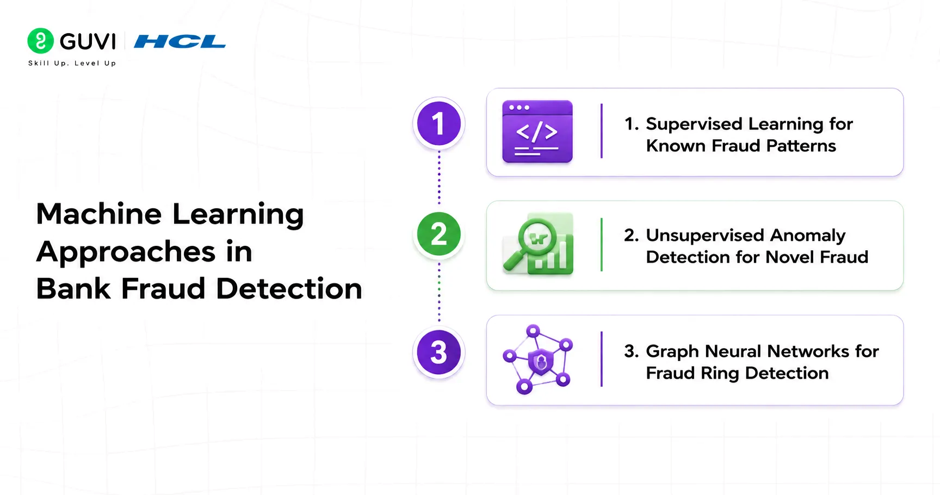
- Supervised Learning for Known Fraud Patterns
Gradient boosting models including XGBoost, LightGBM, and CatBoost are the workhorses of transaction fraud detection. Trained on labeled historical transactions where fraud outcomes are known, these models learn which combinations of features predict fraud with high accuracy.
Features that supervised fraud models typically use include transaction amount relative to historical average, merchant category and geographic location, time since last transaction and transaction velocity, device fingerprint and IP address characteristics, distance between transaction location and home address, and consistency with the account holder’s historical behavioral patterns.
Gradient boosting handles the mixed numerical and categorical feature types common in transaction data efficiently, provides feature importance scores useful for regulatory explainability requirements, and produces well-calibrated probability scores that can be thresholded for different risk tolerance levels.
- Unsupervised Anomaly Detection for Novel Fraud
Supervised models can only detect fraud patterns similar to those in their training data. Novel fraud types, new attack vectors that have not yet generated labeled examples, are invisible to supervised models.
Unsupervised anomaly detection builds a model of normal behavior from unlabeled transaction data and flags significant deviations from that model. Autoencoders trained on normal transaction patterns reconstruct their inputs with low error for normal transactions but high reconstruction error for anomalous ones. Isolation Forest identifies anomalies by measuring how easily a transaction can be isolated from the rest of the data distribution.
One-Class SVM trains exclusively on normal transaction data and learns a boundary around that data, flagging transactions outside the boundary as anomalies without requiring any labeled fraud examples.
These unsupervised methods serve as a first-pass detection layer that surfaces novel patterns for analyst investigation, where they may be confirmed as new fraud types and added to supervised model training data.
- Graph Neural Networks for Fraud Ring Detection
Individual transaction scoring misses coordinated fraud where multiple accounts, devices, and merchants are involved in a scheme. A transaction that looks legitimate in isolation may be part of a fraud ring when the relationships between its participants are analyzed.
Graph Neural Networks model the network of relationships between entities: accounts connected to the same device, devices linked to multiple accounts, merchants appearing in multiple fraud cases, IP addresses shared across suspicious transactions. Each node in the graph is an entity and each edge is a relationship. GNNs propagate fraud signals through the graph, allowing a confirmed fraudulent account to raise the risk score of other accounts sharing its device or IP.
This relational modeling catches fraud patterns that are invisible to transaction-level models, particularly synthetic identity fraud where a single fraudster controls many accounts that individually appear legitimate.
Handling Class Imbalance in Fraud Detection
Fraud rates in consumer banking typically range from 0.1 to 1 percent of transactions. A model that predicts every transaction as legitimate achieves 99 percent accuracy while being completely useless. Class imbalance requires specific techniques throughout the ML pipeline.

Training data resampling using SMOTE creates synthetic minority class examples by interpolating between existing fraud cases, increasing the effective fraud representation in the training set. Undersampling the majority class reduces the imbalance by removing legitimate transaction examples, at the cost of discarding data.
Cost-sensitive learning assigns higher misclassification costs to fraud cases than to legitimate cases during training, pushing the model to minimize missed fraud at the cost of more false positives. Focal loss, originally developed for object detection, applies higher loss weight to hard-to-classify examples, which in fraud detection are typically the rare fraud cases near the decision boundary.
Threshold calibration adjusts the decision threshold applied to the model’s probability scores rather than using the default 0.5. In fraud detection, the optimal threshold is determined by the business’s tolerance for false positives (legitimate transactions declined) versus false negatives (fraud missed), which varies by transaction type and customer segment.
Visa’s AI-powered fraud detection processes over 65,000 transaction messages per second and can reduce fraud by around 30%, showing the importance of continuously updating AI models to detect evolving fraud patterns.
Explainability and Regulatory Requirements
Banks operating in most jurisdictions are required to provide customers with reasons when transactions are declined and regulators with audit trails for fraud detection decisions. This explainability requirement creates a tension with model complexity: the most accurate fraud models are often the least interpretable.
SHAP values are the most widely used explainability method for fraud detection models. For each declined transaction, SHAP identifies the top features that contributed to the fraud score, which are translated into customer-facing reason codes: “this transaction was flagged because it occurred in an unusual location,” “this merchant category has not appeared in your recent transaction history,” or “the transaction amount is significantly higher than your recent average.”
For regulatory audit purposes, SHAP feature importance across populations of fraud decisions demonstrates that models are not using protected characteristics like race or gender as fraud predictors, satisfying fair lending and non-discrimination requirements that apply to automated financial decisions.
Some banks maintain simpler surrogate models alongside their primary fraud detection models specifically for regulatory examination, using decision trees that approximate the gradient boosting model’s decisions in an inspectable form while the more complex model handles actual scoring.
Want to build practical ML skills covering anomaly detection, classification, and production model deployment for high-stakes applications? Explore HCL GUVI’s Artificial Intelligence & Machine Learning Course, designed to help you develop the practical ML foundations that modern AI roles in finance and beyond demand.
Conclusion
AI in fraud detection has moved from an experimental capability to a core banking infrastructure component because the scale, speed, and adaptability requirements of modern fraud prevention exceed what rule-based systems can provide.
Supervised gradient boosting models handle known fraud patterns, unsupervised anomaly detection surfaces novel attack vectors, and graph neural networks identify coordinated fraud that transaction-level models miss.
FAQ
How does AI detect fraud in banking?
AI fraud detection trains machine learning models on historical transaction data with fraud labels, learning patterns that distinguish fraudulent from legitimate transactions across hundreds of features including transaction context, behavioral history, device signals, and relationship networks.
What ML models do banks use for fraud detection?
Gradient boosting models like XGBoost and LightGBM for transaction scoring, autoencoders and Isolation Forest for anomaly detection, and graph neural networks for fraud ring detection are the most common production approaches.
How do fraud detection models handle class imbalance?
Through SMOTE oversampling of fraud examples, cost-sensitive learning that penalizes missed fraud more than false positives, focal loss during training, and threshold calibration to find the optimal precision-recall trade-off for the specific business context.
What latency is required for real-time fraud scoring?
Card transaction fraud detection requires scores returned in under 100 milliseconds before point-of-sale terminal timeout. This requires precomputed features in a feature store and optimized model serving rather than on-demand feature computation.
Why is explainability important for AI fraud detection?
Regulations require banks to provide customers with reasons for declined transactions and regulators with audit trails for automated decisions. SHAP values translate model feature contributions into customer-facing reason codes and regulatory-compliant decision documentation.
How often do fraud detection models need to be retrained?
Fraud patterns evolve continuously as fraudsters adapt to detection systems. Production fraud models require monitoring for performance drift and retraining cycles ranging from weekly to monthly depending on fraud pattern volatility in the specific market.
Success Stories

About the Author
HCL GUVI
This article was selected and published as part of the HCL GUVI AI Blogathon 2026, an initiative designed to encourage students, AI enthusiasts, and aspiring tech writers to simplify complex AI concepts through impactful technical content. The contest recognized high-quality, original, and insightful AI-focused blogs, with selected authors receiving publication opportunities on the HCL GUVI blog platform along with official author credits and recognition.
View all posts by HCL GUVI
Connect with me @


















Did you enjoy this article?