


Project Articles
Automated Resume Screener: NLP-Based Python Project with Source Code
Business Analysis in Digital Transformation Projects - Best Guide
Build No-Code AI Agents with Flowise AI: Step-by-Step Beginner Guide


Get In Touch For Details! Request More Information
Top 7 Important Engineering Project Ideas Using ChatGPT
Jun 24, 2026 5 Min Read 23258 Views
(Last Updated)
Are you searching for creative engineering project ideas that are built using ChatGPT? Well, you came to the right place!
In this blog, we will see how to integrate ChatGPT into traditional engineering projects and how this AI tool can help create groundbreaking solutions. Whether you’re an expert in computer science or from a non-computer science background, you can build fantastic projects using ChatGPT.
This blog will show you the top 7 important engineering project ideas using ChatGPT. Let’s dive into how you can use ChatGPT to take your engineering projects to the next level!
Table of contents
- TL;DR Summary
- How to Integrate ChatGPT in Engineering Projects?
- 7 Engineering Project Ideas Using ChatGPT
- Code Tutor Using ChatGPT
- Resume Guidance Using ChatGPT
- Automated Documentation Generator
- Language Translator Using ChatGPT
- AI in Healthcare Education Using ChatGPT
- Mental Health Support Chatbot using ChatGPT
- Automated Email Assistant using ChatGPT
- Conclusion
- FAQs
- Q1. Is it necessary to be an expert to integrate ChatGPT into my projects?
- Q2. Can ChatGPT be used for non-software engineering projects?
- Q3. What are some challenges of integrating ChatGPT in engineering projects?
- Q4. Can ChatGPT assist in research and development within engineering fields?
- Q5. How can privacy be ensured when using ChatGPT in engineering projects?
TL;DR Summary
- ChatGPT projects use the OpenAI API to add intelligent, language-based features to your engineering builds.
- You don’t need to be a CS expert, beginners across all branches can build these.
- This blog covers 7 ready-to-build ideas: Code Tutor, Resume Guidance, Documentation Generator, Language Translator, AI Healthcare Education, Mental Health Chatbot, and Email Assistant.
- Each project includes key features, tech stack, and real-world use cases.
- Integration involves 4 steps: choose a GPT model → create an API key → implement → test
How to Integrate ChatGPT in Engineering Projects?
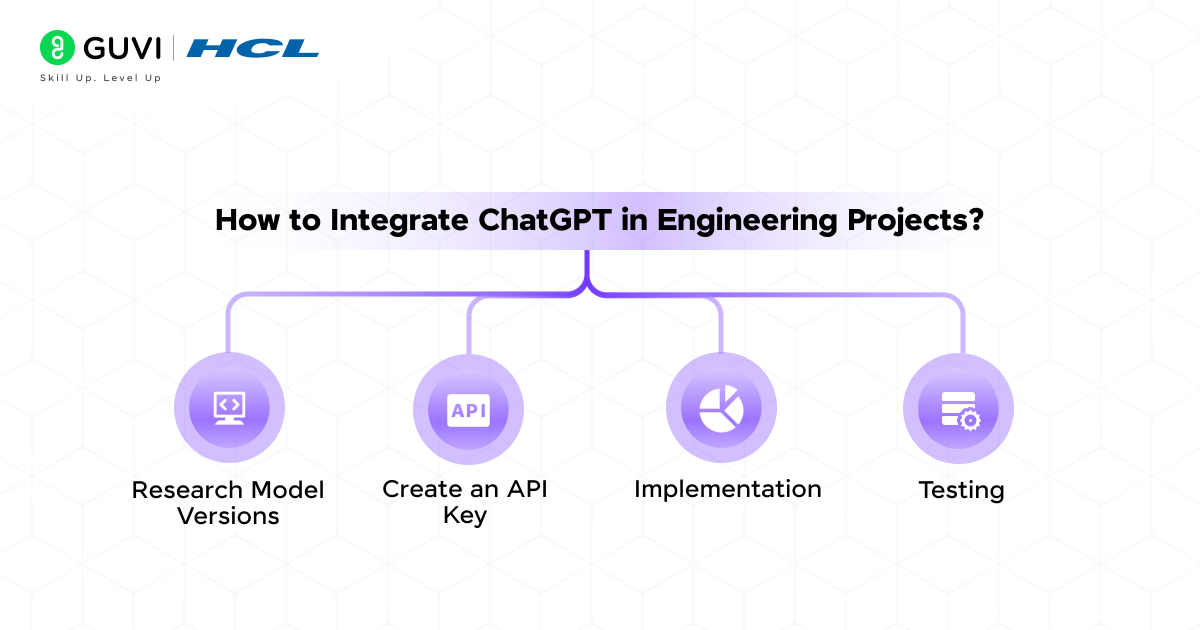
Now, Let’s look into how we can integrate ChatGPT into Engineering Projects. There are a few steps you need to follow before integrating ChatGPT into your projects.
- Research Model Versions
The first step is to research the GPT versions. There are many GPT versions available, according to your project’s size and service you need to choose the version. For example, if you are going to create a chatbot-related project then you should consider using GPT o3-mini. If your project requires a computer vision feature, then consider GPT 4o.
Also, the size of your project matters. If your entire project is solely dependent on GPT then go for larger models that provide a higher context window and larger API calls per second. You can also make use of readymade GPT APIs for chat completion, chat services, assistant APIs and real-time APIs.
- Create an API Key
Once you choose the model and its version, the next step is to create an API key for that model. After the subscription of the specific model, you will be redirected to the page for creating a new API key.
If it didn’t redirect you, then navigate to the OpenAI API page and log in using your credentials. After that go to your personal profile and click the API key section.
Click the create API key button in the right corner of the page and provide the details it requires.
And, that’s all. You’ve created your own API key and you are ready for the next step.
- Implementation
The next step is to integrate the ChatGPT into your project. If you want to use the ChatGPT without any requirements changing, you can simply create an API call in the backend using any server-side programming language such as Node JS, Python or Java. So, when the user inputs the query in the frontend, an API call will trigger in the backend to get the response from the ChatGPT and it will send the response back to the frontend after a successful API call.
Or, if you need the ChatGPT model to generate a response according to some specifications, on your dataset. Then you can fine-tune the model you choose according to your needs and also you can train on your data. This way, the ChatGPT will generate a customized response for your project instead of relying on the globally aware responses.
These are the most effective ways you can integrate ChatGPT into your project.
- Testing
The last step is to test the implementation. Testing is the best way to evaluate a ChatGPT’s performance. After implementing ChatGPT into your project, test the integration using some sample questionnaires and evaluate their performance and response. If it is not responding according to your expectations, there is always a space to fine-tune it further to meet your needs.
If you want to dig deeper into the implementation of the ChatGPT more, you can enroll in HCL GUVI’s Self-Paced course on ChatGPT for Programmers. This course explained the integration of ChatGPT along with the essential theoretical concepts you need to know. It also provides industry-recognized certifications. After taking this course, you can see yourself building projects on your own without any guidance.
7 Engineering Project Ideas Using ChatGPT
Before starting to build projects, make sure you have a decent understanding of full-stack development and ChatGPT integration knowledge. Now, let’s see the top 7 engineering project ideas using ChatGPT.
1. Code Tutor Using ChatGPT

Ever wished you had a patient mentor available at 3 AM when you’re stuck on a bug? That’s exactly what this project builds.
The Code Tutor Using ChatGPT is an interactive learning application that helps students and professionals understand programming concepts, debug code, and learn data structures, all through a conversational AI interface.
This isn’t just a fancy chatbot. It adapts to the user’s skill level, explains code step by step, and suggests learning paths based on the user’s preferred programming language. For any student building a portfolio, this is a project that shows both technical ability and product thinking.
Key Features:
- Step-by-step code explanation in plain language
- Real-time debugging assistance and error explanation
- Personalised learning paths based on skill level and language preference
Tech Stack:
- Content Generation: ChatGPT API
- Frontend: HTML, CSS, JavaScript
- Backend: Python, Node.js
- Cloud: AWS, Azure
2. Resume Guidance Using ChatGPT

Here’s a project that practically sells itself in an interview: you built a tool that helps people get hired.
The Resume Guidance Using ChatGPT project analyses a user’s resume against a specific job description and gives actionable feedback — improving content, format, and ATS (Applicant Tracking System) compatibility. It also helps craft compelling summaries and highlights the right keywords for each role.
This one is especially relevant in 2026, where most companies use automated screening before a human ever reads your resume.
Key Features:
- Automated analysis of resume content and formatting
- Role-specific improvement tips tailored to the job description
- ATS keyword optimisation suggestions
- Guidance on highlighting skills and experiences effectively
Technologies Used
- Content Analysis: ChatGPT API
- Frontend: HTML, CSS, JavaScript
- Backend: Node.js, Python
- Database: MongoDB
3. Automated Documentation Generator
If you’ve ever spent a full afternoon writing documentation for a project you built in two hours, you already understand the pain this project solves.
The Automated Documentation Generator reads your code and project files and automatically produces clear, structured technical documentation — API references, user manuals, system specifications, and more. It saves developers significant time and reduces the chance of documentation being inconsistent or outdated.

For your portfolio, this project demonstrates that you understand the full software development lifecycle, not just writing code, but maintaining it professionally.
Key Features:
- Auto-generation of API docs, user manuals, and system specs
- Clear, plain-language explanation of code functions
- Diagram inclusion for better readability
- Customisable output formats
Tech Stack:
- Content Generation: ChatGPT API
- Frontend: React.js, Angular
- Backend: Python, Node.js
- Deployment: Docker, Kubernetes
4. Language Translator Using ChatGPT
Word-for-word translation has always been the weakness of traditional tools. This project fixes that.
The Language Translator Using ChatGPT goes beyond literal translation to capture idioms, cultural nuance, and contextual meaning, the things that make communication feel natural rather than robotic. Whether it’s a technical document or casual text, the output reads like it was written by a native speaker.
This is one of the most accessible projects on this list. You can build a working prototype in a weekend, and it’s relevant to virtually every industry, making it a strong portfolio piece regardless of your engineering branch.
Key Features:
- Contextual and idiomatic translation across languages
- Automatic source language detection
- Multi-language support in a single interface
- Real-time translation output
Tech Stack:
- Translation: ChatGPT API
- Frontend: HTML, CSS, JavaScript
- Backend: Node.js, Python
5. AI in Healthcare Education Using ChatGPT

This is the most ambitious project on this list, and for good reason. It’s also the one most likely to make someone stop and say “you built what?”
The AI in Healthcare Education project uses ChatGPT to simulate patient interactions and teach complex medical concepts in an interactive, engaging way. It’s designed for medical students and biomedical engineering learners who need more than static textbooks to understand clinical scenarios.
The project makes learning active rather than passive — and demonstrates a deep understanding of both AI and real-world application design.
Key Features:
- Virtual patient simulation for realistic clinical practice
- Interactive learning modules with voice interaction
- Real-time feedback and assessments
- Progress tracking and analytics for learners
Tech Stack:
- Course Content: ChatGPT API
- Voice Recognition: Google Cloud Voice API
- Frontend: React.js, HTML, CSS
- Backend: Python, Node.js
6. Mental Health Support Chatbot using ChatGPT
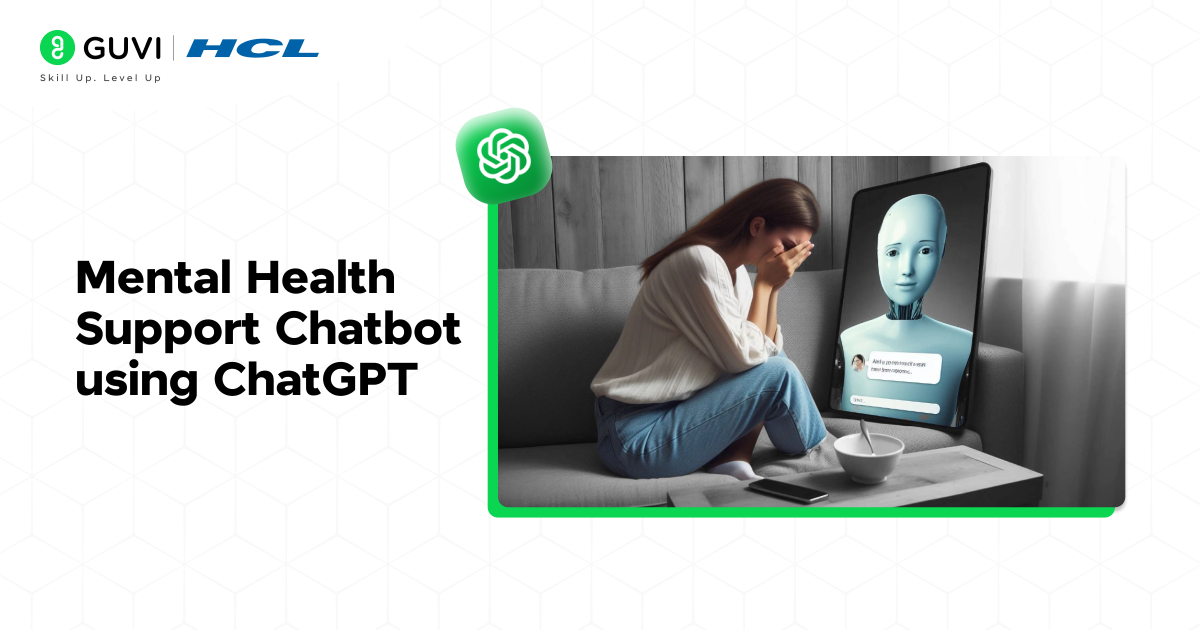
Few projects carry as much genuine impact as this one.
The Mental Health Support Chatbot provides a safe, private space for users to express how they’re feeling and receive empathetic responses, coping strategies, and mental health resources. It’s available 24/7 — which matters enormously when someone needs support at an unusual hour and professional help isn’t immediately accessible.
Building this project shows that you can think beyond technical requirements and design for real human needs. That combination of empathy and engineering is something employers actively look for in 2026.
Key Features:
- Empathetic, context-aware conversational responses
- Mindfulness exercises and stress management tips
- Links to external resources — articles, support groups, therapy platforms
- 24/7 availability with no wait time
Tech Stack:
- Conversation: ChatGPT API
- Frontend: React.js, Vue.js
- Backend: Python, Node.js, Java
- Deployment: AWS, Google Cloud
Over 1 billion people globally are affected by mental health conditions, yet access to support remains severely limited — especially in tier-2 and tier-3 cities across India. AI-powered tools are increasingly being explored as a first point of contact for mental wellness, making this project both timely and impactful.
7. Automated Email Assistant using ChatGPT
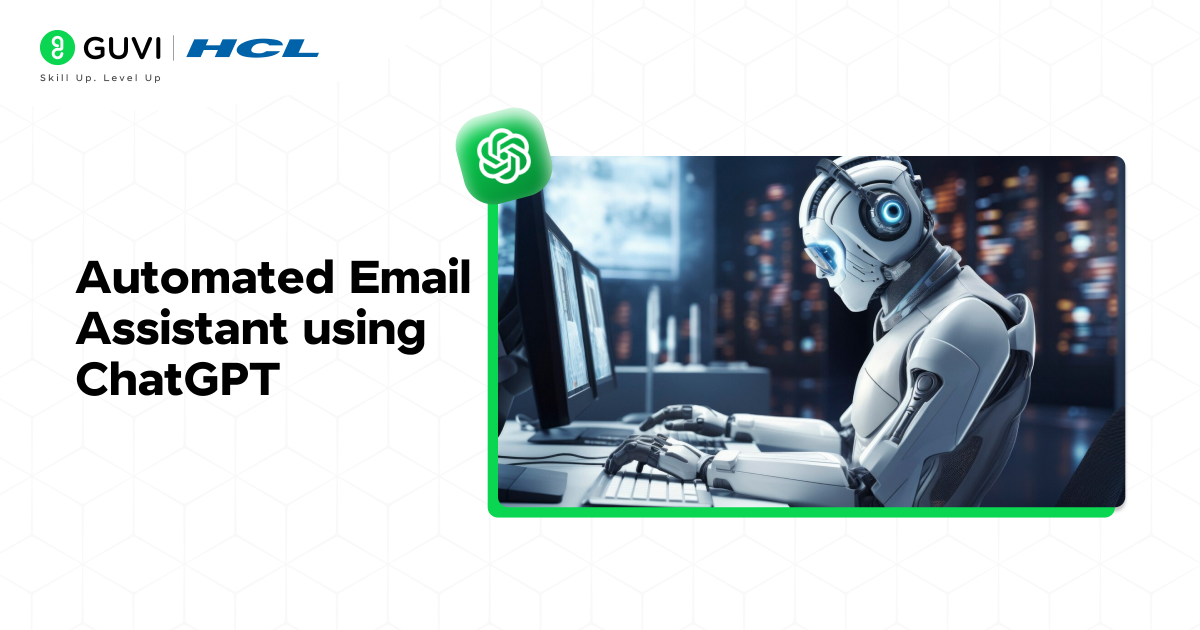
You tell it “write a follow-up email to a recruiter after an interview” — and it gives you a ready-to-send, professional draft in seconds.
The Automated Email Assistant helps users write, rewrite, and auto-respond to emails using a simple natural language input. It can suggest subject lines, improve phrasing, adapt to different tones, and even handle common recurring queries automatically.
This is one of the easiest projects to build and one of the most immediately useful — for yourself and for anyone who uses it.
Key Features:
- Email draft generation from short bullet-point inputs
- Subject line suggestions and tone improvement
- Auto-response for frequent or templated queries
- Customisable tone and response style per user
Tech Stack:
- Content Generation: ChatGPT API
- Frontend: React.js, Angular
- Backend: Python, Node.js
- Email Services: SMTP, SendGrid
Conclusion
In conclusion, all of the engineering project ideas using ChatGPT incorporate the trending technology which offers a transformative potential across various domains, from education and healthcare to customer service and beyond.
As we continue to explore engineering project ideas using ChatGPT, the integration of AI like ChatGPT in engineering projects represents a forward-looking approach that promises to redefine the landscape of technology and its applications.
FAQs
Q1. Is it necessary to be an expert to integrate ChatGPT into my projects?
No, you don’t need to be an expert to integrate ChatGPT into your projects. While having a basic understanding of programming and APIs can be helpful, ChatGPT is designed to be user-friendly and accessible.
Q2. Can ChatGPT be used for non-software engineering projects?
Absolutely! While ChatGPT is commonly used in software engineering, its capabilities extend far beyond that. It can be used in various non-software engineering projects, such as helping with documentation, creating designs or project plans.
Q3. What are some challenges of integrating ChatGPT in engineering projects?
Challenges include managing the API’s response latency, ensuring the responses’ relevance and accuracy, and handling user data’s privacy and security.
Q4. Can ChatGPT assist in research and development within engineering fields?
Yes, ChatGPT can be a great asset in research and development (R&D) within engineering fields. It can help by providing quick answers to technical questions, suggesting innovative solutions, brainstorming ideas, and even reviewing or summarizing research papers.
Q5. How can privacy be ensured when using ChatGPT in engineering projects?
Ensuring privacy when using ChatGPT in engineering projects involves steps like data anonymization to avoid sharing sensitive information, using local models or on-premise setups for sensitive tasks, securing API communications with HTTPS, and ensuring compliance with privacy regulations like GDPR or HIPAA.
Success Stories

About the Author
Roopa Dharshini
I am an open Source contributor & project admin, full stack developer, and technical content writer. A core member of the Guvi's SHECODES community, with expertise in Data Structures, Generative AI, MERN Stack, and Cloud Platforms. Fun Fact: Hates Bootstrap!
View all posts by Roopa Dharshini
Connect with me @









Did you enjoy this article?