


Artificial Intelligence and Machine Learning Articles
LLM Engineer Skills: What You Need to Know in 2026
Text Classification with Scikit-learn: TF-IDF to BERT


Get In Touch For Details! Request More Information

Decision-Time Guidance: Replit’s Reliability Secret
Jun 24, 2026 6 Min Read 312 Views
(Last Updated)
Building reliable AI agents for short tasks is easy; long, multi-step sessions bring compounding failures, loops, and fading instructions. Better prompts won’t fix it. Replit’s January 2026 solution demands a new guidance approach.
Replit Agent now handles complex tasks with longer sessions for max productivity, but risks emerge as failures compound. Their decision-time guidance injects precise nudges exactly when needed, revolutionizing agent control.
In this article, we will walk through why static prompts fail on long agent trajectories, how decision-time guidance works, what the two key techniques are, why the system is both effective and cheap to run, and what it means for how AI agents will be built going forward.
TL;DR
- Static prompts fail long sessions: Primacy/recency bias, overriding priors, and rule overload cause compounding errors.
- Decision-time guidance injects smarts: The classifier analyzes the trajectory to add only relevant micro-instructions at decision points.
- Technique 1: Diagnostic signals: Nudge the agent to check errors (e.g., console logs) without a context dump.
- Technique 2: Consult an external agent: Breaks doom loops with fresh plans from a different model to avoid self-bias.
- Cheap & effective: Ephemeral injections + stable core prompt = 90% cost savings via caching; false positives are harmless.
- Big lesson: Build active scaffolding—observe failures, distill nudges, and inject precisely for reliable AI agents.
Table of contents
- What is Decision-Time Guidance?
- Why Static Prompts Break Down on Long Sessions
- The Problem With Naive Reminders
- How the Decision-Time Guidance System Works
- Selectivity via Lightweight Classifier
- Bank of Reusable Micro-Instructions
- Handbook vs. Tap-on-the-Shoulder
- The Two Key Techniques: Diagnostic Signals and Consult When It Matters
- Pattern 1: Diagnostic Signals
- Pattern 2: Consult External Agent (with Model Switch)
- Why the System Is Both Effective and Cheap
- False Positives Are Cheap
- Guidance Is Ephemeral
- 90% Cost Savings vs. Dynamic Prompts
- What This Means for Building AI Agents
- Final Thoughts
- FAQs
- What is decision-time guidance, and why does it beat static prompts?
- How does the classifier work in this system?
- What are the two key techniques in decision-time guidance?
- Why is this system cheap to run despite adding a classifier?
- How can I apply decision-time guidance to my own AI agents?
What is Decision-Time Guidance?
Decision-time guidance is a control layer that injects short, situational instructions exactly when they matter and only when they matter. A lightweight multi-label classifier analyzes the agent’s current trajectory, user messages, recent tool results, and error patterns and decides which guidance, if any, to inject.
Instead of front-loading every possible rule, the system stays silent until a specific situation arises that warrants a specific intervention, then acts precisely.
Why Static Prompts Break Down on Long Sessions
To understand why decision-time guidance was necessary, you first need to understand what goes wrong with the standard approach.
- The standard approach is to write a detailed system prompt that covers all the rules and constraints the agent should follow, then possibly add reminders in the conversation as needed.
- These approaches work reasonably well for a wide range of use cases, especially when tasks are constrained and interactions are short.
- But as agents operate over longer interactions with humans in the loop, decisions accumulate, and feedback arrives continuously. In this regime, guidance applied uniformly or too early loses leverage, and maintaining reliable behavior becomes progressively harder.
- Three specific failure modes emerge as sessions grow longer. Learned priors can override written rules. Even with explicit instructions, models may fall back to behaviors learned during pre-training or post-training when rules are verbose, ambiguous, or conflicting.
- Instruction-following degrades as context grows due to primacy bias and recency bias. Instructions near the beginning and end of the context tend to carry more weight, while mid-context rules have reduced influence.
- And more rules have diminishing returns, adding constraints, increasing cost, and priority ambiguity, often forcing the model to reason over rules that do not matter for the current decision, leading to partial or inconsistent compliance rather than better control.
The Problem With Naive Reminders
Once you understand that static prompts lose influence over time, the intuitive fix is to inject reminders closer to the decision point.
- Recency bias means that text placed later in the context window carries more weight, so putting guidance at the end of the trace should give it more influence. And it does up to a point.
- A naive implementation creates its own problems. If you append every useful reminder to the bottom of the context, you recreate the same failure mode you were trying to escape: a bloated block of instructions, most of which do not apply to the current decision.
- The model still has to reason over irrelevant rules. Conflicts resurface. Priority becomes ambiguous. Replit observed this directly through experiments.
- Early experiments injecting multiple reminders at decision time showed diminishing returns after the third or fourth, and sometimes negative returns, as competing instructions led to inconsistent behavior.
- Earlier model generations would often mock data to pass a task or perform dangerous deletions without user confirmation.
- When they combined a reminder to avoid mock data with three or more other reminders, compliance dropped. Worse, the reminders competed not just with each other but with user messages, degrading human-in-the-loop performance overall.
- The key insight from this experimentation is that the problem is not where guidance is placed in the context. The problem is relevance.
- A single, well-timed, tightly scoped instruction outperforms five instructions that cover everything but apply to nothing specific happening right now.

How the Decision-Time Guidance System Works
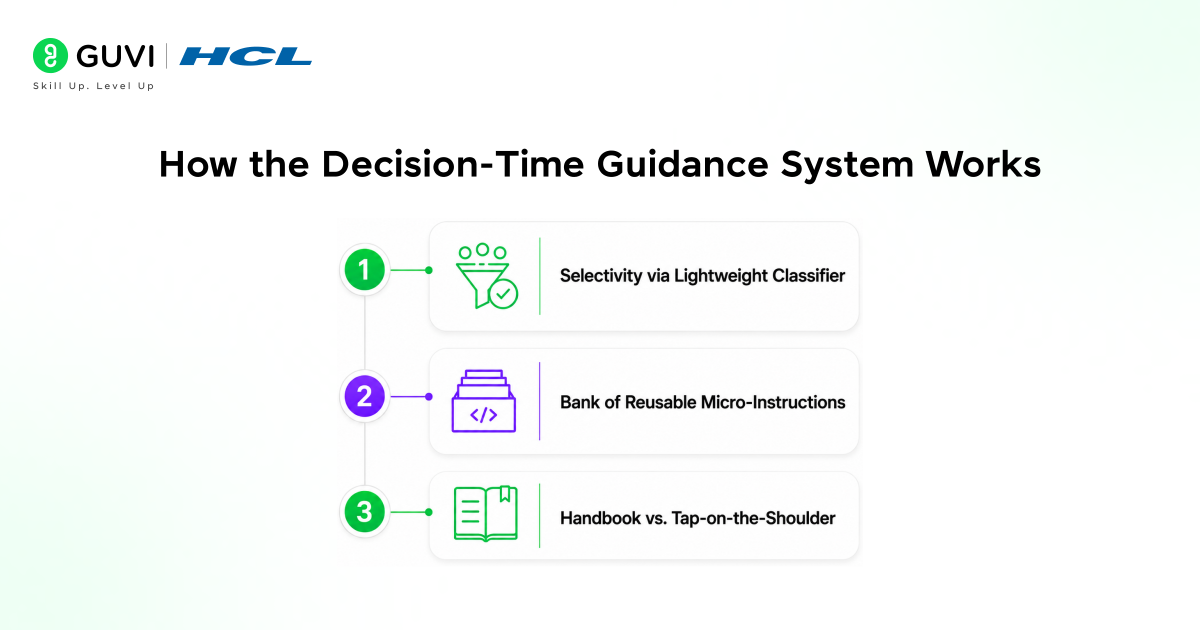
The architecture Replit built around this insight has three components working together: a classifier, a bank of micro-instructions, and a stable core prompt that never changes.
1. Selectivity via Lightweight Classifier
The key is selectivity. A lightweight multi-label classifier analyzes the agent’s current trajectory, user messages, recent tool results, and error patterns and decides which guidance, if any, to inject. The classifier runs on a fast, cheap model, so it can fire on every agent iteration without becoming a bottleneck.
2. Bank of Reusable Micro-Instructions
This moves control out of a monolithic system prompt and into a bank of reusable micro-instructions. They maintain a stable core prompt and dynamically load only what is relevant. Each intervention is short, focused on a single decision, and distilled from failure patterns observed in production.
This allows them to scale from four or five static reminders to hundreds, varying both the number and types of guidance they provide.
3. Handbook vs. Tap-on-the-Shoulder
Think of it as the difference between giving someone a handbook to memorize before a job versus tapping them on the shoulder with a specific piece of advice at exactly the moment they need it. The handbook approach assumes you can anticipate every situation. The tap-on-the-shoulder approach responds to what is actually happening.
Replit’s decision-time guidance system evolved from a handful of static reminders to hundreds of micro-instructions without significantly increasing cost or context size, using a lightweight classifier optimized for recall over precision.
In experiments, adding too many generic reminders (3 or more at once) actually reduced user compliance, as conflicting signals competed with user intent—showing that a single well-timed nudge can outperform an entire checklist.
This approach reportedly reduced prompting costs by up to 90% compared to dynamic prompting systems, while also improving reliability in long-running coding sessions by reducing issues like mock data misuse and unsafe deletions.
The Two Key Techniques: Diagnostic Signals and Consult When It Matters
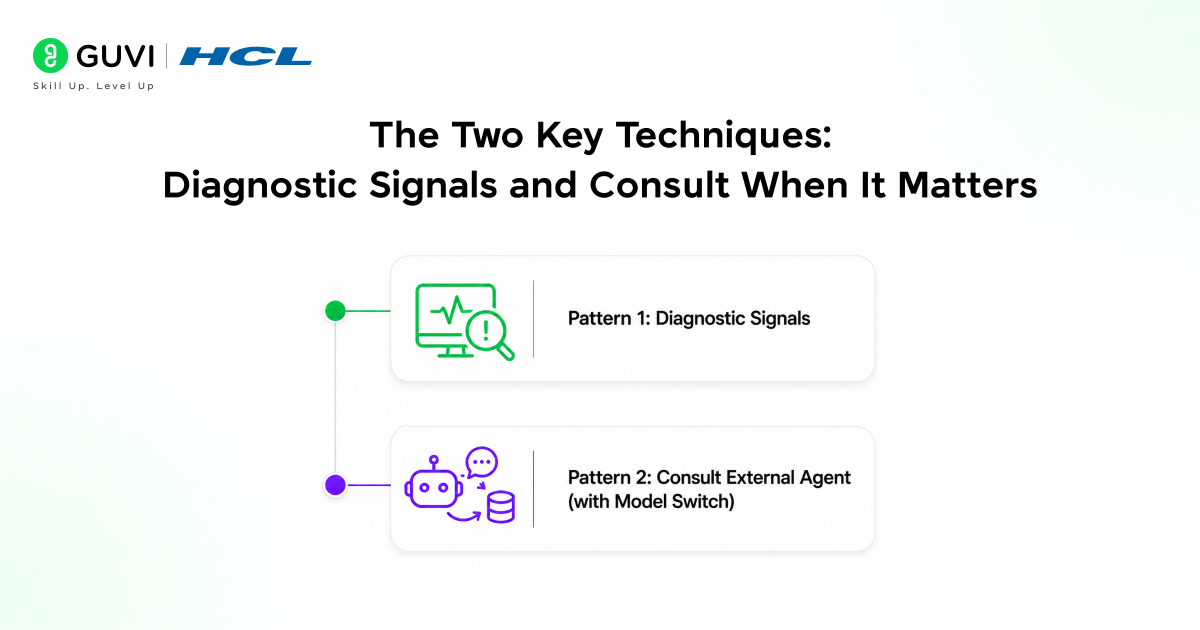
Within the decision-time guidance framework, two patterns have proven especially effective for keeping the agent reliable across long sessions.
Pattern 1: Diagnostic Signals
- The first pattern is diagnostic signals. When repeated errors appear in console output, the system injects a short nudge prompting the agent to address failures before continuing.
- Importantly, this is a notification, not a context dump; the agent is told errors exist and prompted to pull the relevant logs itself.
- This keeps the injection minimal while giving the agent access to diagnostic information only when it chooses to look. A concrete example of what this looks like in practice is a one-line message: “Found 1 new browser console log; use the log tool to view the latest logs. ” That is the entire injection.
- The agent decides whether to investigate, and if it does, it fetches exactly the context it needs. No context bloat, no assumption about what the error is, just a signal that something is worth checking.
Pattern 2: Consult External Agent (with Model Switch)
- The second pattern is consulting an external agent when the classifier detects a doom loop. When the classifier detects signs of a doom loop, repeated failed attempts, circular edits, or high-risk changes, it injects a reminder to consult an external agent.
- The external agent generates a plan from a fresh context, unburdened by the failed attempts polluting the main agent’s trace.
- This exploits the generator-discriminator gap: the stuck agent does not need to generate its way out; it just needs to recognize a good plan when offered one. And recognition is the easier task. There is an additional refinement in the consultation step that addresses a subtle but important problem.
- The consultation is performed by a different model. Switching models at the right moment reduces self-preference bias and improves reliability when the agent has become anchored to a failing trajectory.
- Research has shown that language models tend to evaluate their own outputs more favorably than outputs from other models. When an agent has been stuck on a failing approach, asking it to evaluate its own work will produce biased results.
- Bringing in a different model breaks that bias and makes it much more likely that the agent will recognize a better path forward.
Why the System Is Both Effective and Cheap
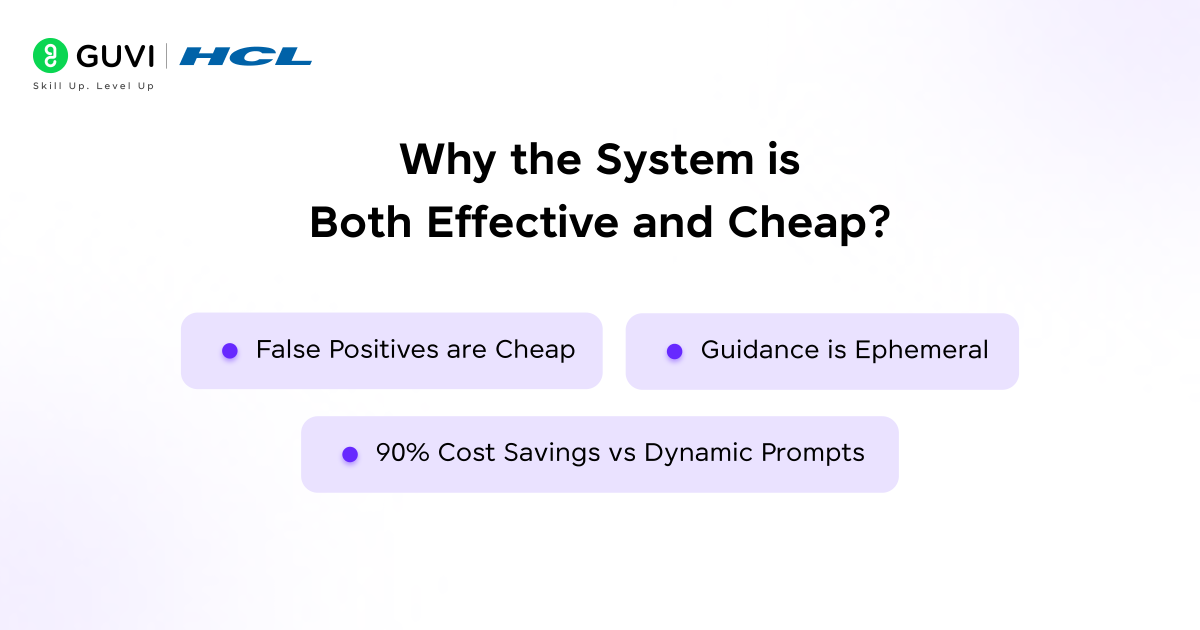
1. False Positives Are Cheap
- The three properties that make decision-time guidance work in production are worth understanding clearly, because they address the objections you might raise about adding a classifier to every agent iteration.
- False positives are cheap. Because reminders are suggestions rather than hard constraints, the model simply ignores guidance that does not apply. This lets the team tune for recall over precision; they would rather catch a failure mode and occasionally misfire than miss it entirely.
2. Guidance Is Ephemeral
- Guidance is ephemeral. Injected reminders do not persist in conversation history. Once the decision is made, they disappear. Context accumulates only what remains relevant. And caching stays intact.
- The core prompt never changes, so they always hit the prompt cache. Behavior shifts from step to step without paying for prompt rewrites, reducing cost by 90% compared to dynamic system prompt modification.
3. 90% Cost Savings vs. Dynamic Prompts
- That 90% cost reduction compared to modifying the system prompt dynamically is significant. The conventional alternative to decision-time injection, rewriting the system prompt with updated rules each time the agent’s situation changes, blows up the prompt cache and forces the model to reprocess everything from scratch.
- Decision-time guidance avoids that entirely. The core prompt is always the same, always cached. Only the small injection at the bottom of the context changes, and it costs almost nothing.
What This Means for Building AI Agents
The principles behind decision-time guidance are not specific to Replit’s architecture. They apply to any system where a language model is making sequential decisions across a long context window with dynamic inputs.
- The execution environment itself can be that guide. The environment already plays a critical role in any agentic system, but rather than just executing, it can provide intelligent feedback that helps the agent course-correct, all while keeping a human in the loop.
- This reframes what the scaffolding around an agent is for. Scaffolding is not just the infrastructure that lets the agent take actions.
- It is an active participant in keeping the agent on track, observing what is happening, recognizing when something needs to change, and providing exactly the right nudge at exactly the right moment.
- The broader lesson is that the right intervention is almost always smaller and more targeted than what builders initially reach for. The instinct when an agent misbehaves is to add more rules to the system prompt.
- The evidence from Replit’s experiments suggests that this instinct makes things worse beyond a certain threshold.
- The better approach is to instrument the environment, observe failure patterns, distill them into specific micro-instructions, and inject those instructions only when the failure pattern is actually occurring.
If you want to master decision-time guidance, build reliable AI agents, and tackle long-session coding challenges, explore HCL GUVI’s AI and ML Course and fast-track your AI engineering career.
Final Thoughts
Decision-time guidance is a practical solution to one of the most persistent challenges in production AI agents, keeping behavior reliable as tasks grow longer and more complex. In conclusion, decision-time guidance has proved to be an effective paradigm for an agent harness designed around the current generation of LLMs, improving both reliability and output quality over long trajectories.
As model intelligence and long-horizon capabilities evolve, the role of external feedback as well as tooling will change. For the next generation of models, they expect stronger self-reflection capabilities, making them less likely to require external feedback, along with improved capacity to attend to multiple instructions in parallel.
But for now, the technique represents one of the most cost-effective and reliable ways to keep an agent on track across the kinds of long, complex sessions that real-world software development demands. If you are building agentic systems and struggling with reliability at scale, this is the architecture worth studying.
FAQs
1. What is decision-time guidance, and why does it beat static prompts?
Decision-time guidance injects short, relevant micro-instructions into an AI agent’s context only when needed, based on its current trajectory (like errors or loops). Static prompts fail on long sessions because rules get buried by primacy/recency bias, learned priors override them, and too many create conflicts, leading to unreliable behavior.
2. How does the classifier work in this system?
A lightweight, fast multi-label classifier scans the agent’s recent history (user messages, tool results, errors) on every iteration. It picks the right micro-instruction from a bank of hundreds, if any, keeping the core prompt stable and cached for efficiency.
3. What are the two key techniques in decision-time guidance?
Diagnostic signals nudge the agent to check errors (e.g., “Found 1 new browser console log—use the log tool”) without bloating context. “Consult when it matters” detects doom loops and prompts consulting a fresh external agent (often a different model) to break bias and generate better plans.
4. Why is this system cheap to run despite adding a classifier?
False positives cost nothing (agent ignores irrelevant nudges), injections are ephemeral (they vanish after the decision), and the core prompt stays unchanged for 90% cost savings via caching versus rewriting dynamic prompts that bust caches and reprocess everything.
5. How can I apply decision-time guidance to my own AI agents?
Instrument your agent’s environment to observe failures, distill them into short micro-instructions, build a simple classifier for relevance, and inject only at decision points. It’s ideal for any long-trajectory LLM system, turning scaffolding into an active reliability layer.
Success Stories

About the Author
Vishalini Devarajan
An Aerospace Engineer turned content writer, I focus on making complex concepts easy to understand through well-structured, reader-friendly blogs. Whether it’s a technical topic or a non-technical one, I love creating content that is clear, engaging, and impactful.
View all posts by Vishalini Devarajan
Connect with me @










Did you enjoy this article?