


Artificial Intelligence and Machine Learning Articles
AI/ML Skills Gap 2026: Why Companies Can't Find Job-Ready Talent
20 AI/ML Interview Questions Recruiters Can Use Without a Tech Background - Best Guide
How Industry-Backed AI/ML Bootcamps Are Changing the AI/ML Hiring Pipeline - Best Guide 2026
From IT Support to AI Engineer: A Realistic Career Switch Guide 2026


Get In Touch For Details! Request More Information
Introducing a Safer Way to Vibe Code with Replit Databases
Jun 24, 2026 5 Min Read 595 Views
(Last Updated)
Vibe coding makes it easy to build applications quickly. You describe what you want, the agent writes the code, and something functional appears in minutes. The problem is that most of what gets built relies on data, and data handled carelessly breaks applications in ways that are hard to recover from.
AI agents working without database guardrails can generate insecure queries, skip validation entirely, expose sensitive records, or write to the wrong tables. The app looks fine during development and fails badly in production when real data is involved.
Replit Databases change this by giving the agent a safe, integrated environment to work with data from the start. The database is part of the project, the agent knows how to use it correctly, and common data mistakes are prevented before they reach your application.
In this article, let us understand what Vibe code with Replit Databases are, how they make vibe coding safer, what problems they solve, and how to build data-backed applications with them reliably.
TL;DR
1. Replit Databases provides built-in, managed database options directly inside Replit projects with no external setup.
2. AI agents working in Replit can read from and write to real databases as part of the vibe coding workflow.
3. The integrated environment prevents common data mistakes such as insecure queries, missing validation, and hardcoded credentials.
4. Replit Databases supports both key-value storage and PostgreSQL depending on the complexity of the project.
5. Using Replit Databases makes vibe-coded applications production-ready rather than demo-ready from the start.
Table of contents
- What Is Replit Databases?
- How Vibe Coding Handles Data Today
- The Real Problem: Data Without Guardrails
- The Shift: Safe Data Handling Built Into the Environment
- How Vibe Coding with Replit Databases Actually Works
- Example: Storing and retrieving user data with Replit DB
- Hidden Architecture: Environment-Aware Database Access
- An Example: A Full Database Workflow with Replit
- Why Database-First Vibe Coding Is More Effective
- Persistent Data as a Crucial Enabler
- Why This Enables More Complete Autonomous Builds
- The Real Innovation: A Complete Environment for Safe Vibe Coding
- Conclusion
- FAQs
- What is Replit Databases?
- What are Potemkin interfaces in the context of vibe coding and data?
- What database types does Replit support?
- How does Replit Databases improve vibe coding reliability?
- Is this better than connecting an external database manually?
- Can Replit Databases fully replace production database services?
What Is Replit Databases?
Replit Databases is a set of built-in, managed database options available directly inside Replit projects. Developers and AI agents can use them without external setup, connection strings, or infrastructure management.
How Vibe Coding Handles Data Today
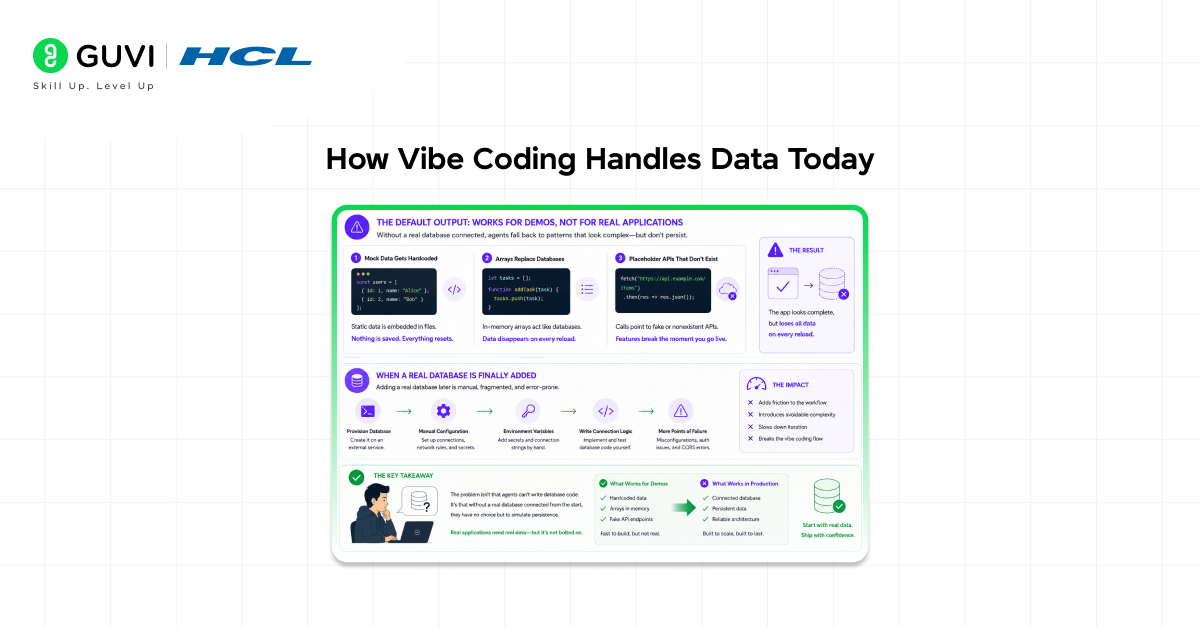
When developers use AI agents to build applications, data handling is often the weakest part of the output. Agents default to patterns that work for demos but fall apart under real conditions. Mock data gets hardcoded. Arrays replace databases. Fetch calls go to placeholder APIs that do not exist.
The issue is not that the agent cannot write database code. It is that without a real database connected to the project, the agent has no choice but to simulate data persistence. The result is an application that appears complete but loses all its data on every reload.
When a real database is eventually added, it is often added as an external service with manual configuration, environment variables set by the developer, and connection logic written from scratch. This adds friction and introduces points of failure that a vibe coding workflow was supposed to avoid.
The Real Problem: Data Without Guardrails
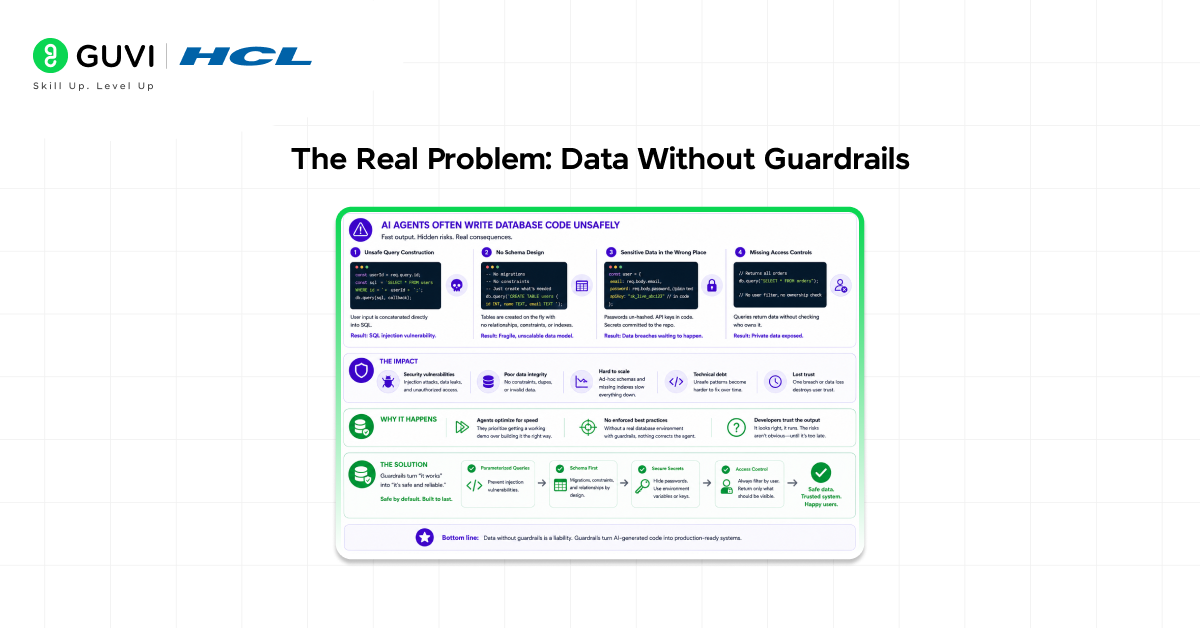
Even when AI agents do write database code, they often do it unsafely. Queries are constructed by concatenating user input directly into SQL strings, which creates injection vulnerabilities. Schema design is skipped because the agent moves fast and focuses on making features work.
Sensitive data ends up in the wrong place. User passwords get stored without hashing. API keys get written into the codebase instead of environment variables. Records that should be private are returned by queries that do not filter by user.
These are not rare mistakes. They are the natural output of an agent optimizing for a working demo rather than a safe production system. Without a database environment that enforces good patterns, the agent will keep producing them.
The Shift: Safe Data Handling Built Into the Environment
The traditional approach separates the application environment from the database. You build the app, then integrate the database, then deal with the security and configuration issues that come from connecting two separate systems.
Replit Databases reverses this. The database is already part of the project environment. The agent knows it is there, knows how to use it, and uses it correctly because the environment is designed to encourage correct patterns from the start.
This is not just a convenience improvement. It is a structural change that makes the output of vibe coding fundamentally more reliable when data is involved.
How Vibe Coding with Replit Databases Actually Works
When a project is created in Replit, the database is available immediately. For simple projects, Replit DB provides a key-value store that requires no schema and no configuration. For more complex applications, PostgreSQL is available with full relational capabilities.
The agent can interact with either database type using the appropriate client libraries, which are pre-installed and pre-configured in the Replit environment. There are no connection strings to manage manually and no authentication tokens to set up before the first query runs.
Example: Storing and retrieving user data with Replit DB
| import Database from ‘@replit/database’;const db = new Database(); // Store a user recordawait db.set(‘user:101’, JSON.stringify({ name: ‘Priya’, email: ‘[email protected]’, role: ‘admin’})); // Retrieve the user recordconst raw = await db.get(‘user:101’);const user = JSON.parse(raw);console.log(user.name); // Priya // List all user keysconst userKeys = await db.list(‘user:’);console.log(userKeys); |
The agent generates this code as part of the normal build process, not as a separate integration step. The database is already connected and the code runs immediately without additional configuration.
Hidden Architecture: Environment-Aware Database Access
Replit Databases works because the database credentials and connection details are injected into the project environment automatically. The agent does not need to ask the developer for a connection string. It does not need to guess which database library to use. The environment provides everything.
This environment-aware approach also means the database used during development is isolated from any production instance. The agent can run tests, seed data, and experiment without risk of affecting real user data.
The boundary between development and production is maintained by the environment itself rather than relying on the developer to configure it correctly every time.
An Example: A Full Database Workflow with Replit
A developer is building a feedback collection tool. They ask the agent to create a form that stores submissions and displays them in an admin view. With Replit Databases available, the agent builds the entire data layer as part of the first pass.
| // Store a feedback submissionawait db.set(`feedback:${Date.now()}`, JSON.stringify({ message: formData.message, email: formData.email, submitted_at: new Date().toISOString()})); // Retrieve all feedback entries for admin viewconst keys = await db.list(‘feedback:’);const entries = await Promise.all( keys.map(async key => JSON.parse(await db.get(key)))); // Return sorted by submission timereturn entries.sort((a, b) => new Date(b.submitted_at) – new Date(a.submitted_at)); |
The agent writes the storage logic, the retrieval logic, and the sorting in a single pass because the database is already available. The developer gets a working, data-backed application without a separate database setup step.
Applications built with an integrated database from the start tend to have fewer data-related bugs at launch. This is because the agent never has to simulate persistence or retrofit database logic onto code that was originally written without it.

Why Database-First Vibe Coding Is More Effective
When the database is an afterthought, the entire data layer gets retrofitted onto code that was not designed with persistence in mind. State that should live in the database lives in memory. Logic that should be a query is a filter on an in-memory array. Fixing this after the fact requires rewriting significant parts of the application.
Database-first vibe coding avoids this entirely. Because the agent starts with a real database available, it writes data access patterns correctly from the beginning. There is no retrofit, no conversion of mock data to real queries, and no discovery of persistence gaps after the first deployment.
Persistent Data as a Crucial Enabler
The most fundamental requirement for a real application is that data survives beyond a single session. Without persistence, nothing the user does is retained. Accounts cannot exist, preferences cannot be saved, and transactions cannot be recorded.
Replit Databases give the agent access to genuine persistence from the first line of data-related code it writes. This means applications built through vibe coding can support real user workflows, not just demonstrations that reset on every reload.
This persistence is what separates a prototype from a product. With Replit Databases integrated into the vibe coding environment, that separation is much smaller than it used to be.
Why This Enables More Complete Autonomous Builds
Without a database, an agent building a data-backed application will eventually hit a wall. It can scaffold the interface, write the logic, and connect the routes, but it cannot complete the data layer without a real database to write against. The build stops being autonomous at exactly the point where data handling begins.
Replit Databases removes that wall. The agent can carry a complete build from the first component to the last data access call without stopping to ask the developer to configure an external service. This is what makes genuinely autonomous, full-stack vibe coding possible.
The Real Innovation: A Complete Environment for Safe Vibe Coding
Replit Databases is not just a convenience feature. It is part of a complete environment designed to make the output of AI-assisted development safe and production-ready. The database, the runtime, the agent, and the deployment target are all part of the same system.
This integration is what makes vibe coding with Replit Databases different from vibe coding with a disconnected AI assistant. The agent is not just writing code. It is writing code inside an environment that enforces safe patterns, provides real infrastructure, and produces applications that actually work with real data.
To effectively build self-testing AI agents using Replit Agent, understanding how execution-based validation, REPL workflows, and iterative feedback loops interact is essential for creating reliable and scalable systems. Programs like HCL GUVI’s Artificial Intelligence and Machine Learning course can help build these skills through hands-on experience.
Conclusion
Replit Databases makes vibe coding safer by putting a real, integrated database inside the same environment where the agent builds the application. Instead of simulated data, disconnected external services, or retrofitted persistence, the data layer is present and correct from the first build.
Through its use of environment-aware database access, built-in provisioning, and support for both simple and relational storage, Replit Databases removes the biggest reliability gap in AI-assisted application development. If an AI agent builds an application without real data infrastructure, it will always produce something that looks finished but cannot handle real users. Reliable vibe coding starts when the database is part of the environment, not an addition to it.
FAQs
1. What is Replit Databases?
It is a set of built-in, managed database options available directly inside Replit projects that allow developers and AI agents to work with real data without external setup or configuration.
2. What are Potemkin interfaces in the context of vibe coding and data?
They are applications that appear to work during development because they use hardcoded or in-memory data, but fail when deployed because there is no real persistence layer underneath.
3. What database types does Replit support?
Replit supports a built-in key-value store called Replit DB for simple projects and PostgreSQL for applications that require relational data and complex queries.
4. How does Replit Databases improve vibe coding reliability?
By giving the agent access to a real database from the start, it eliminates the need to simulate persistence and ensures the data layer is built correctly rather than retrofitted after the fact.
5. Is this better than connecting an external database manually?
For vibe coding workflows it is significantly better because there is no configuration step, no connection string management, and no break in the autonomous build process when data handling begins.
6. Can Replit Databases fully replace production database services?
No. Replit Databases is well suited for development and small to medium applications, but high-throughput or large-scale production workloads will require a dedicated managed database service outside of Replit.
Success Stories

About the Author
Vishalini Devarajan
An Aerospace Engineer turned content writer, I focus on making complex concepts easy to understand through well-structured, reader-friendly blogs. Whether it’s a technical topic or a non-technical one, I love creating content that is clear, engaging, and impactful.
View all posts by Vishalini Devarajan
Connect with me @







Did you enjoy this article?