


Artificial Intelligence and Machine Learning Articles
AI/ML Skills Gap 2026: Why Companies Can't Find Job-Ready Talent
20 AI/ML Interview Questions Recruiters Can Use Without a Tech Background - Best Guide
How Industry-Backed AI/ML Bootcamps Are Changing the AI/ML Hiring Pipeline - Best Guide 2026
From IT Support to AI Engineer: A Realistic Career Switch Guide 2026


Get In Touch For Details! Request More Information

Do You Need a CTO to Launch Your Startup?
Aug 05, 2026 6 Min Read 881 Views
(Last Updated)
There’s a widely accepted belief in the startup world: you must have a CTO to get started. It makes sense – if you have a tech product, Shouldn’t you need a tech co-founder leading the charge?
Not necessarily.
With the rise of no-code tools, AI, cloud computing and plug-and-play APIs, the dependency on a traditional CTO at the earliest stage is no longer absolute.
But the flipside of this is you do not need a CTO in the early stages, but you might need one later.
This blog discusses the truth when a company hires a CTO, when they do it and when they don’t, and how founders are building startups today without a CTO, and their ability to rapidly build scalable and successful products.
Quick answer:
You don’t need a CTO to launch a startup, especially in the early stages. With no-code platforms and AI tools, you can build, test, and validate your idea on your own. However, as your product grows and becomes more complex, a CTO becomes essential for scaling, managing systems, and leading technical decisions. The key is timing start without one, but bring a CTO in when your startup truly needs technical leadership.
Table of contents
- What is the Role of a CTO?
- The Real Question: What Stage Are You At?
- Idea Stage
- Validation Stage
- Early Traction Stage
- Growth Stage
- The Rise of No-Code: Changing the Game
- What Can You Build Without a CTO?
- Real-World Impact
- AI Tools: Your Temporary Technical Co-Founder
- What AI Tools Can Do
- What This Means
- When NOT Having a CTO Can Backfire
- Highly Technical Products
- Scalability Matters Early
- You Don't Know the Technology
- The Hidden Cost of Hiring a CTO Too Early
- Equity Dilution
- Misaligned Vision
- Overengineering
- Alternatives to Hiring a CTO
- Freelance Developers
- Technical Advisors
- Fractional CTO
- Understand the Basics
- Case Study: Building Without a CTO
- When You DEFINITELY Need a CTO
- CTO vs Technical Co-Founder: What's the Difference?
- CTO
- Technical Co-Founder
- The Balanced Approach
- Practical Framework for Founders
- Step 1: Define Your Product Complexity
- Step 2: Evaluate Your Budget
- Step 3: Identify Risk Level
- Step 4: Emphasise Speed vs Stability
- Common Mistakes Founders Make
- Bringing in a CTO Too Soon
- Hiring No Tech
- Over-Reliance on No-Code
- Ignoring Product Validation
- The Future: CTOs in the Age of AI
- Wrapping it up:
- FAQs
- Is it possible for a non-technical founder to start their own company?
- Is it risky to delay hiring a CTO?
- What does "Fractional CTO" mean?
- What is the appropriate equity percentage for a CTO?
What is the Role of a CTO?
To understand if a company needs a CTO, let’s first understand the role of a CTO.
The Chief Technology Officer (CTO) is:
- Setting the technical strategy and architecture
- Making decisions in the tech stack and architecture
- Managing product and engineering teams
- Providing security, performance and infrastructure reliability
- Enabling business through technology
In early-stage startups, the CTO can play many roles:
- Developer
- Architect
- Product thinker
- Sometimes even DevOps engineer
This means firing a CTO too soon is potentially overkill (or underkill, if you’re very early).
The Real Question: What Stage Are You At?
Whether you need a CTO depends on the stage of your startup.

1. Idea Stage
You have:
- A concept
- Maybe some research
- No product yet
Do you need a CTO? →No
At this point you need to:
- Validating the idea
- Understanding your users
- Testing demand
A CTO can’t fix these issues.
2. Validation Stage
You are:
- Testing prototypes
- Talking to users
- Building MVP (Minimum Viable Product)
Do you need a CTO? → Not necessarily
No-code and AI tools to the rescue
3. Early Traction Stage
You have:
- Users
- Feedback
- Some revenue or growth signals
Do you need a CTO? → Maybe
Now things start getting serious:
- Scaling infrastructure
- Improving performance
- Handling real-world usage
4. Growth Stage
You are:
- Scaling rapidly
- Hiring engineers
- Handling complex systems
Do you need a CTO? → Yes
This is where CTO is essential.
Explore: Idea to Product in a Month: Build & Launch Fast with AI
The Rise of No-Code: Changing the Game
Ten years ago, developers wrote thousands of lines of code to build a product. Today, tools like:
make it possible to develop apps without being a tech expert.
What Can You Build Without a CTO?
With no-code, you can:
- Launch SaaS products
- Build marketplaces
- Create internal tools
- Automate workflows
- Build MVPs in days, not months
Real-World Impact
Startups today are:
- Launching faster
- Spending less on development
- Learning by doing
This avoids early hiring of a CTO.
AI Tools: Your Temporary Technical Co-Founder
If no-code tools are your building blocks, AI tools are your accelerators.
Platforms like:
are changing the game for non-tech founders.
What AI Tools Can Do
- Generate code snippets
- Build UI components
- Debug issues
- Suggest architecture ideas
- Automate repetitive tasks
What This Means
You don’t need a CTO to:
- Build your first version
- Experiment with features
- Validate your idea
AI tools can act as a “technical bridge” until your startup matures.
When NOT Having a CTO Can Backfire
Don’t get me wrong, it’s not always best to avoid a CTO.
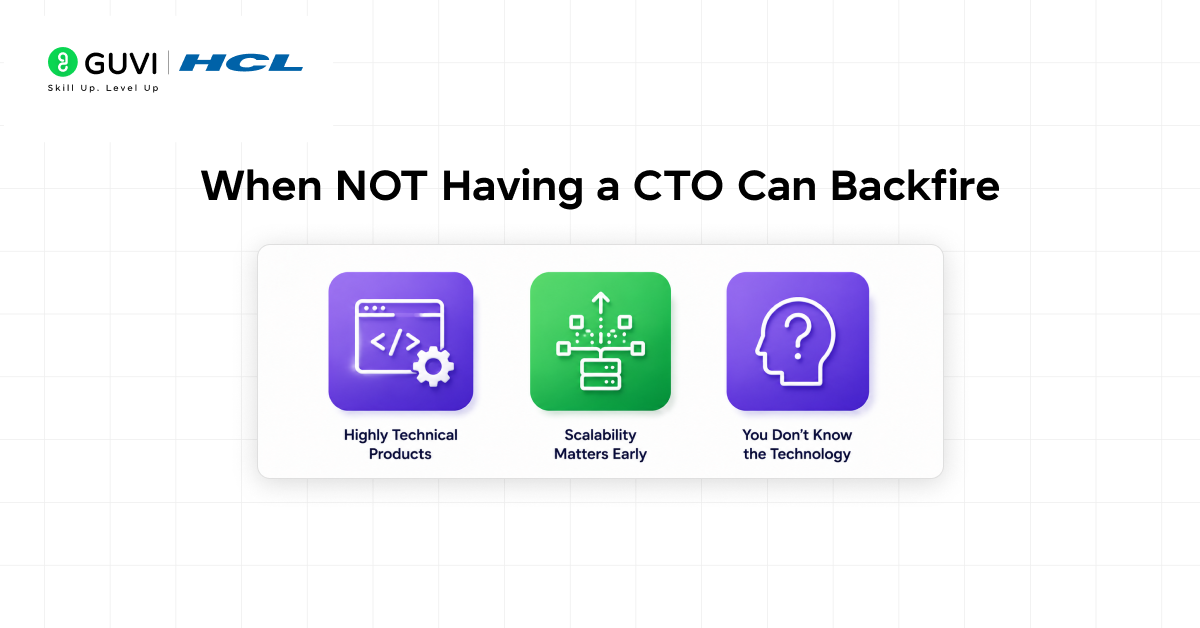
Here’s when it could be a bad move:
1. Highly Technical Products
If your startup involves:
- Custom AI models – Developing AI models requires a solid understanding of data processing, model training and optimisation; without a technical founder, you can end up with a poor-quality model.
- Blockchain systems – Building blockchain solutions requires expertise in cryptography, distributed systems, and security, where errors can create vulnerabilities or cause financial losses.
- Real-time data processing – Processing data in real-time (such as a fintech dashboard or rideshare app) requires a well-designed system or your product could be unstable or slow.
- Hardware integration – Integrating with devices means accuracy and reliability are key, and cannot be achieved without technical leadership.
You do need a technical founder or CTO early because this type of product can’t be developed safely and effectively with “point and click” tools.
2. Scalability Matters Early
If your product:
- Will get a lot of traffic right away – If suddenly more users come to the application, poorly architected systems may crash, causing downtime and reputation damage.
- Deals with critical information (health, finance) – Mishandling user data could lead to legal problems, non-compliance and damage to reputation.
- Requires solid infrastructure – Uptime and reliability are critical for many apps, and they need solid backends, not bandages.
A CTO ensures:
- Proper architecture – Creating systems with scalability in mind.
- Security – Following best practices to keep your users’ data safe and compliant.
- Speed and efficiency – Making your product fast and responsive, even with lots of users.
3. You Don’t Know the Technology
No-code tools does not mean no technology.
Without understanding, you risk:
- Creating unsustainable solutions – What may work for 10 users may not work for 1,000 users.
- Selecting the wrong tools – Building on the wrong platform can slower growth.
- Being locked in poor architectures – Certain tools may be hard to upgrade or migrate, locking your startup into an inflexible structure.
Even non-programmers need to have a technical mindset.
The Hidden Cost of Hiring a CTO Too Early
Some founders are tempted to hire a CTO, believing it’s necessary.
But this is what can happen:
1. Equity Dilution
CTOs usually get:
- 20-40% equity (seed round) – This is a big chunk of your company which is often issued prematurely.
Giving this away too soon can hurt long-term ownership, especially if the startup pivots or the CTO doesn’t stay long-term.
2. Misaligned Vision
A bad CTO can:
- Stall development – If they focus more on making things perfect, rather than fast, you may never release your product.
- Create conflicts – Business and technology misalignment can cause conflicts and suboptimal decisions.
- Cause rebuilds – Bad decisions can result in later rebuilds, which are costly.
When hiring a CTO, it’s not only about capabilities, but if they can fit for your startup.
3. Overengineering
Early-stage startups need:
- Speed – You need to launch quickly and learn from real users.
- Simplicity – Minimum feature set is better than a full-feature set late.
Not:
- Complex systems – Overbuilt architecture slows down iteration and increases costs.
- Perfect architecture – Perfection at an early stage is unnecessary and often counterproductive.
A CTO may be tempted to overbuild rather than validate, particularly if they’re used to big companies.
Alternatives to Hiring a CTO
If you don’t need a CTO, here are some options:
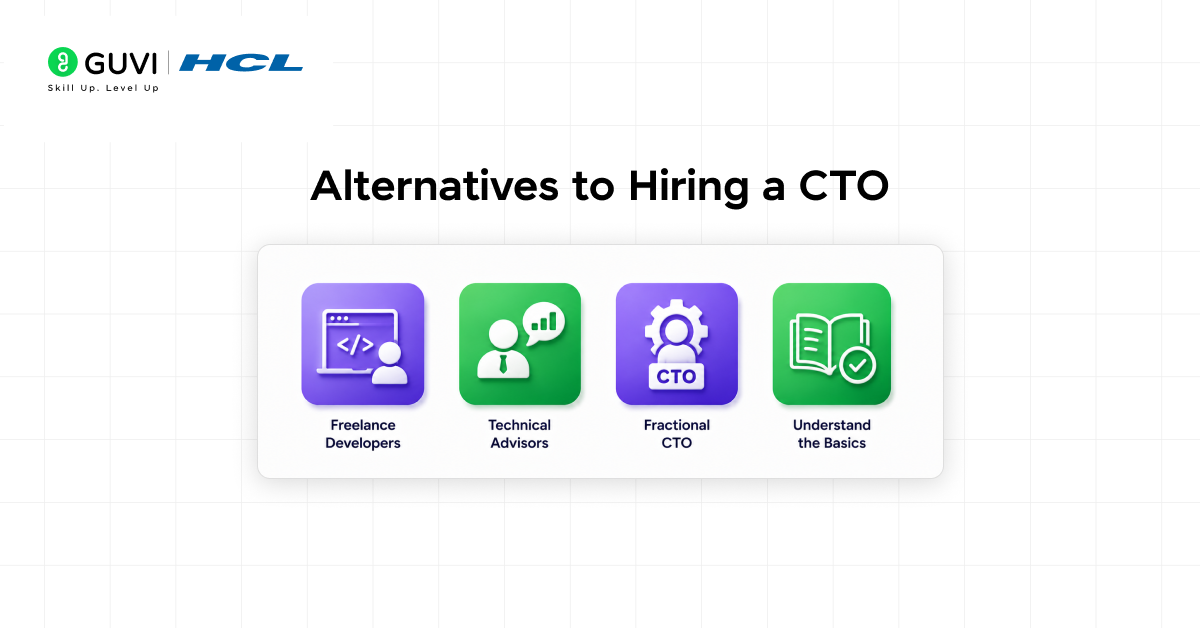
1. Freelance Developers
Websites such as Upwork and Fiverr allow you to hire developers for:
- MVP development – Quickly creating a basic version of your product to test your idea in the market..
- Feature development – Building a particular feature without taking on an full time employee.
This is an economical and agile option for startups.
2. Technical Advisors
You can bring in:
- Part-time experts – Professionals who guide your technical decisions without being involved daily.
- Mentors – People who guide you around the pitfalls and towards the big picture.
They offer guidance without the expense and time commitment of a full-time CTO.

3. Fractional CTO
An emerging practice where:
- You can hire a CTO on a part-time basis – They can spend a number of hours or days per week working for you.
- They work on strategy and architecture – To ensure your product is built right the first time.
This allows you to get high level knowledge at low cost and low risk.
4. Understand the Basics
You don’t need to be an engineer, but you need to know about:
- How web apps work – Understanding the fundamentals helps you plan your product realistically
- APIs – Know how things talk to each other to integrate services.
- Databases – Understanding how data’s stored helps you plan for scalability
- Basic logic – Helps you think about features and processes.
This helps you:
- Make better decisions – You won’t blindly depend on others for critical choices.
- Communicate effectively – You can clearly explain your requirements to developers.
Case Study: Building Without a CTO
Let’s say you want to launch a job-matching platform.
Without a CTO, you can:
- Use Webflow for the UI – Create a professional and responsive user interface without writing code.
- Build backend using Bubble – Manage user information, workflows and app logic visually.
- Integrate tools with Zapier – Link apps and create automation.
- Use AI for matching logic – Use AI APIs to recommend jobs based on user profiles.
In just a few weeks, you can:
- Launch – Launch your product within weeks, not months.
- Get users – Start attracting early adopters and gathering feedback.
- Validate demand – Find out if there’s a market for your idea.
Only after traction do you:
- Bring in engineers – Build a better team.
- Hire a CTO – Scale and architect for the future.
When You DEFINITELY Need a CTO
At some point, a lack of a CTO slows you down.
Signs You Need One:
- Your product can’t handle the volume – Crashes, poor performance mean poor design.
- You have more than one developer – You need someone to lead the team.
- Tech decisions are slowing growth – Lack of clarity leads to delays and confusion.
- Data security and compliance is a priority – You need a leader to ensure security and compliance.
- Investors want a CTO – A CTO inspires investor trust.
A CTO at this point is a must.
Many successful startups launch without a CTO in the early stages.
No-code platforms like Bubble and Webflow can help build full MVPs without traditional coding.
AI tools can act as a temporary technical co-founder, assisting with logic and development decisions.
Hiring a CTO too early can cost up to 40% equity, significantly impacting long-term ownership.
CTO vs Technical Co-Founder: What’s the Difference?
These are often confused.
CTO
- Recruited role – Typically joins after business has been established.
- Not always a founder – May join later on.
- Manages implementation and growth – Helps build and maintain systems.
Technical Co-Founder
- Founding member – Joins early and helps build the company.
- Highly committed – Shares both risk and reward.
- Involved in decision-making – Understands the business.
If you’re building a tech-heavy startup, a technical co-founder is often more valuable than a hired CTO.
The Balanced Approach
Instead of asking:
“Do I need a CTO?”
Ask:
“What tech skills do I need at this stage?
Early Stage
- Use no-code & AI – Build fast, cheap, and experiment.
- Test fast – Focus on learning from users, not systems.
Mid Stage
- Hire advisors or freelancers – Focus on skills as needed.
Growth Stage
- Hire a full-time CTO – Scale processes and people.
Practical Framework for Founders
Here’s a decision framework:
Step 1: Define Your Product Complexity
- Simple → No-code works → You can build and test quickly with minimal technical effort.
- Complex → Need tech skills → Plan for more advanced products and need tech leadership early.
Step 2: Evaluate Your Budget
- Low → No-code + freelancers → Minimize expenses while testing your concept.
- Medium → Fractional CTO → Part-time support.
- High → Full-time CTO → Commit to long-term CTO.
Step 3: Identify Risk Level
- Low risk → Test and experiment freely → Speed and iteration.
- High risk → Hire a CTO → Focus on stability and security.
Step 4: Emphasise Speed vs Stability
- Speed → CTO not needed early → Move quickly and learn.
- Stability → CTO is crucial → Build scalable systems.
Common Mistakes Founders Make
1. Bringing in a CTO Too Soon
Focuses on equity and not execution, when validation is needed.
2. Hiring No Tech
Leads to poor product quality and costly mistakes that are hard to fix later.
3. Over-Reliance on No-Code
Great for getting started but can restrict growth and adaptability over time.
4. Ignoring Product Validation
Even the best technology cannot fix a product that users don’t need.
The Future: CTOs in the Age of AI
As AI progresses, so does the job of CTOs.
The next-gen CTOs will be more focused on:
- Business strategy – Aligning technology with business growth.
- Artificial intelligence (AI) adoption – Using AI technologies to enhance productivity and innovation.
- System design – Designing adaptable systems.
- Innovation leadership – Driving new ideas and competitive advantage.
While AI tools handle:
- Coding – Generating code and automating tasks.
- Debugging – Detecting and resolving problems.
- Automation – Optimising processes.
This means:
- You can delay hiring a CTO → Early-stage development is more accessible than ever.
- But you cannot eliminate the need forever → Long-term growth still requires strong technical leadership.
Take your startup ideas beyond just concepts with HCL GUVI’s AI & ML Course. Learn how to build, automate, and scale real-world solutions using AI tools, no-code platforms, and hands-on projects that prepare you for practical execution.
Wrapping it up:
When starting up today, it’s not about putting together your perfect team at first; it’s about making the right decisions intelligently. A Chief Technology Officer (CTO) will not be where you start from, but rather how you grow. At first, you will create momentum through clarity, speed, and learning; rather than through creating technically perfect solutions. However, as your product grows, so does the cost of weak foundations. Smart founders do not rush to hire a CTO, they have ‘earned’ the need to hire one. If you do this correctly, your CTO will not only create your product; they will also increase the potential for your startup to be successful.
FAQs
1. Is it possible for a non-technical founder to start their own company?
Certainly! Non-technical founders can use no-code and AI solutions to validate their startup without needing to engage a CTO.
2. Is it risky to delay hiring a CTO?
It depends on your product complexity. For simple MVPs, it’s not risky.
3. What does “Fractional CTO” mean?
Fractional CTO refers to a CTO that will be offering their service part-time with no long-term engagement.
4. What is the appropriate equity percentage for a CTO?
Most CTOs receive between 10% and 40% of a company’s equity based on the company’s maturity and their level of engagement.
Success Stories

About the Author
Vishalini Devarajan
An Aerospace Engineer turned content writer, I focus on making complex concepts easy to understand through well-structured, reader-friendly blogs. Whether it’s a technical topic or a non-technical one, I love creating content that is clear, engaging, and impactful.
View all posts by Vishalini Devarajan
Connect with me @












Did you enjoy this article?