


Artificial Intelligence and Machine Learning Articles
AI/ML Skills Gap 2026: Why Companies Can't Find Job-Ready Talent
20 AI/ML Interview Questions Recruiters Can Use Without a Tech Background - Best Guide
How Industry-Backed AI/ML Bootcamps Are Changing the AI/ML Hiring Pipeline - Best Guide 2026
From IT Support to AI Engineer: A Realistic Career Switch Guide 2026

Get In Touch For Details! Request More Information
How Modern Marketing Teams Build on Lovable
Aug 05, 2026 5 Min Read 499 Views
(Last Updated)
A silent transformation is taking place within marketing departments and it has nothing to do with better ads or smarter copy.
It’s about who gets to build.
Not long ago, marketers were dependent operators. The ideas needed to go through designers, developers, and various tools before they were materialized. Action was in another place. Speed was negotiable. Control was limited.
Now, that boundary is disappearing.
Marketing teams in the modern world are not planning campaigns anymore, they are assembling them, refining them and releasing them like products. The line between “idea” and “live campaign” is getting thinner every day..
Platforms such as Lovable are the reason for this transition.
Marketing is no longer about coordination but about creation. Shorter waits, more construction.
That is why such a statement as modern marketing teams build on Lovable is not a trend only, but it is an indicator of a more fundamental change in the way marketing work gets done.
In this blog we will go through what this really means in practice and why it is becoming the new norm.
Quick Answer
Lovable is used by modern marketing teams, which have developed their own campaigns using the no-code, AI-powered platform to build, test, and scale campaigns by not relying heavily on developers. Marketing can be done more efficiently, smarter, and faster by automating data, introducing insights, and user-friendly interfaces to launch landing pages, workflows, and personalized campaigns in hours rather than weeks.
Table of contents
- What Is Lovable?
- Key Characteristics of Lovable
- Why Modern Marketing Teams Build on Lovable
- Speed Is Everything
- Less Reliance on Developers.
- Experimentation Becomes Easy
- Centralized Workflow
- AI-Driven Optimization
- Main Features That Power Marketing on Lovable
- Campaign Builder
- Workflow Automation
- Personalization Engine
- Analytics and Insights
- Integration Capabilities
- How Marketing Teams Actually Build on Lovable
- Step 1: Ideation
- Step 2: Build and Design
- Step 3: Automation Setup
- Step 4: Launch
- Step 5: Analyze and Optimize
- Advantages of Lovable to use in Marketing Teams
- Faster Time-to-Market
- Cost Efficiency
- Better Collaboration
- Increased Productivity
- Improved Campaign Performance
- Challenges and Considerations
- Learning Curve
- Over-Automation Risk
- Dependence on Platform
- The Role of AI Tools in Lovable
- The Future of Marketing with Lovable
- Best Practices for Building on Lovable
- Start Small
- Focus on Data
- Prioritize User Experience
- Test Continuously
- AI + Human Creativity
- Why Lovable Stands Out in the No-Code Era
- Wrapping it up:
- FAQs
- What is Lovable in marketing?
- Why do modern marketing teams build on Lovable?
- Do you need coding skills to use Lovable?
What Is Lovable?
Lovable is an AI-driven application that is a no-code platform allowing teams to create and deploy marketing assets without writing code.
Rather than having to use several tools, Lovable unites:
- Campaign creation
- Workflow automation
- Data insights
- User experience design
into a one united environment.
Key Characteristics of Lovable
- No-code interface: Build without technical skills.
- AI support: Automate routine work and maximise campaigns.
- Quick to deploy: Campaigns in hours.
- Scalability: Grow with campaigns.
Why Modern Marketing Teams Build on Lovable
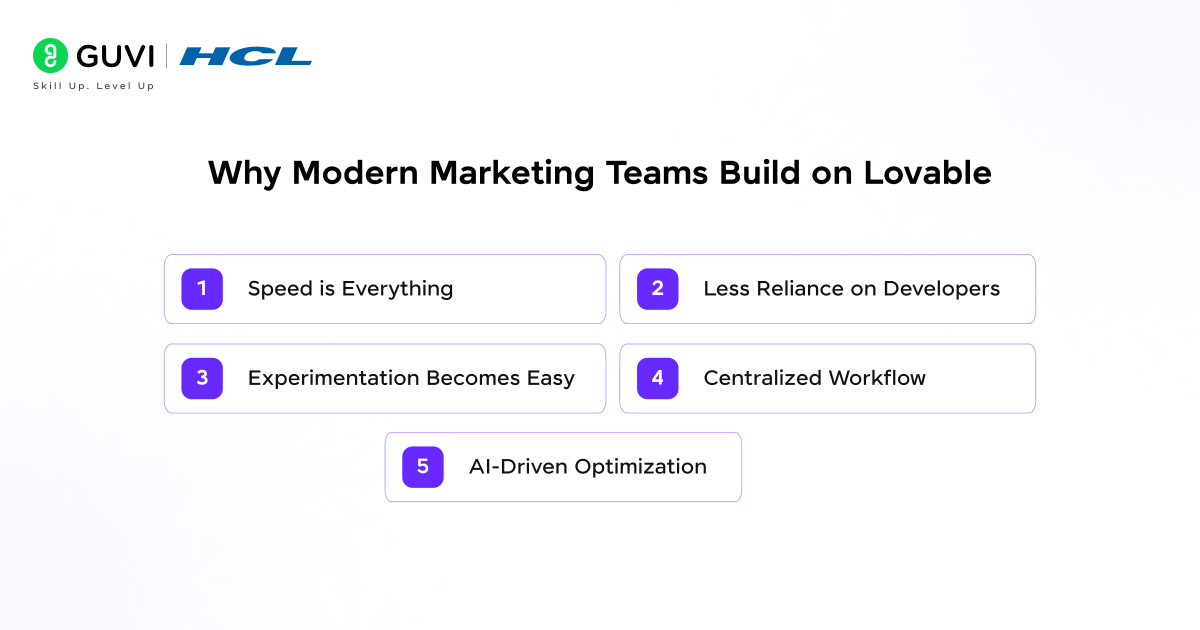
The term “modern marketing teams build on Lovable” reflects a broader change in how work gets done.
1. Speed Is Everything
Success in marketing can be a matter of timing.
With Lovable:
- Campaigns may be initiated immediately.
- Iterations occur dynamically.
- The teams are able to react quickly to trends.
This gets rid of lengthy development cycles and approvals.
2. Less Reliance on Developers.
Waiting to get engineering support is among the largest bottlenecks in marketing.
Lovable eliminates this dependency by permitting:
- Landing page creation
- Workflow automation
- Campaign setup
without coding knowledge.
3. Experimentation Becomes Easy
Modern marketing thrives on testing.
Lovable enables teams to:
- A/B test campaigns quickly
- Modify elements instantly
- Real-time performance tracking.
This promotes a culture of never-ending experimentation.
4. Centralized Workflow
Instead of switching between tools, Lovable provides the following:
- Single platform to manage campaigns.
- Unified data tracks
- Seamless collaboration
This simplifies and enhances efficiency.
5. AI-Driven Optimization
AI add-ons to Lovable assist teams:
- Analyze campaign performance
- Suggest improvements
- Automate repetitive tasks
This will enable marketers to work on strategy and not execution.
Start learning AI today with HCL GUVI’s Free AI & ML Email Course and explore how it’s transforming modern marketing.
Main Features That Power Marketing on Lovable
In order to understand the way the marketing teams can build on Lovable, we will first break down its fundamental capabilities.
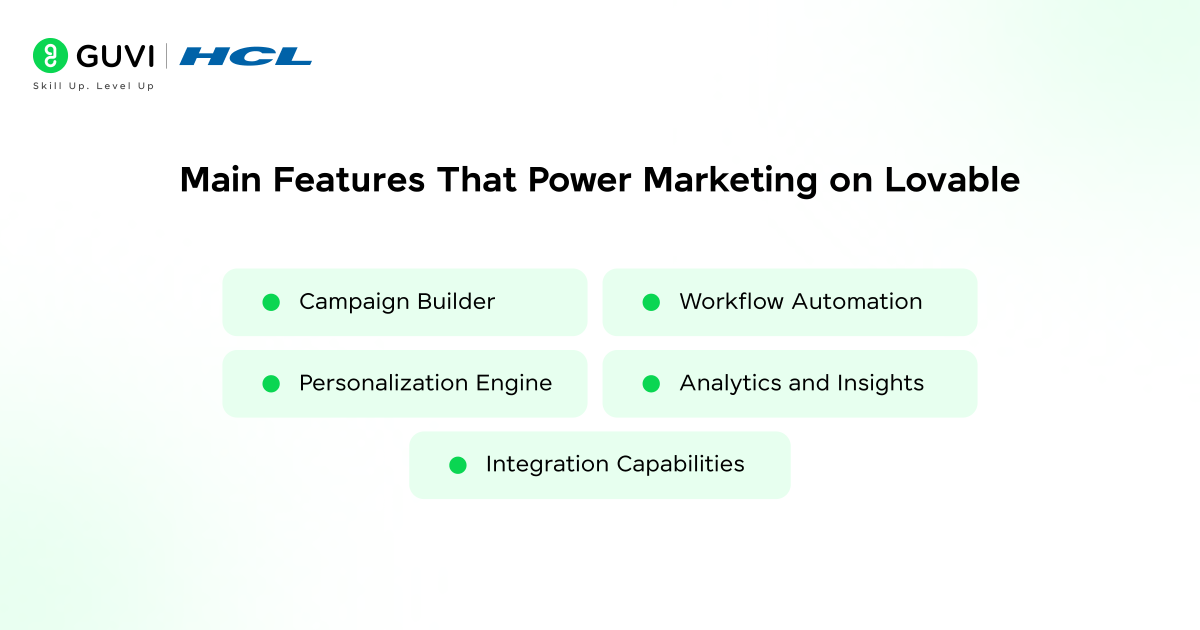
1. Campaign Builder
Lovable is easy to use to make campaigns.
Features include:
- Drag-and-drop design
- Pre-built templates
- Customizable elements
This allows creating campaigns fast without design or code knowledge.
2. Workflow Automation
A fundamental aspect of modern marketing is automation.
Lovable enables:
- Automate email sequences
- Perform actions (triggered by user actions).
- Manage customer journeys
This endures consistent engagement without human intervention.
3. Personalization Engine
Personalization drives engagement.
Lovable helps:
- Customize content to various audiences.
- Deliver targeted messaging
- Improve conversion rates
4. Analytics and Insights
Marketing decisions revolve around data.
Lovable provides:
- Real-time performance tracking
- User behavior insights
- Campaign analytics
This allows teams to optimize strategies effectively.
5. Integration Capabilities
Lovable is compatible with other tools to increase functionality.
This includes:
- CRM systems
- Email marketing platforms
- Analytics tools
Take a look at: How to Use Lovable AI With Demo Project
How Marketing Teams Actually Build on Lovable
To gain a clear insight into how modern marketing teams build on Lovable, it helps to look at how a campaign moves from idea to execution in a real-world scenario. Unlike the old workflow where work is divided among tools and teams, Lovable has an ability to provide an end-to-end process in one platform.
Breaking it down step by step.
Step 1: Ideation
Each campaign begins with an objective – but in modern marketing ideation is no longer brainstorming. It is about rapidly forming an idea into action.
Teams typically begin with use cases like:
- Product launches
- Seasonal or festival promotions
- Lead generation campaigns
- Re-engagement or retention campaigns.
This step is more organized with Lovable. Rather than dropping ideas as rough concept, teams can:
- Map out the campaign flow visually
- Define target audiences early.
- Identify important touchpoints (ads, landing pages, emails).
This makes it less ambiguous and the idea is already execution-ready when it is created in the first place, rather than conceptual.
Step 2: Build and Design
After the idea is understood, teams proceed to the building phase- without having to wait on designers or developers.
With Lovable no-code interface, marketers can:
- Build landing pages using drag-and-drop, conversion-optimized.
- Create campaign materials: forms, CTAs, and interactivity.
- Establish user flows leading users to conversion.
What makes this powerful is the removal of technical friction. Teams don’t need to:
- Write code
- Coordinate among various departments.
- Design and develop with different tools.
All this is done in one place, which significantly speeds up the process and enables instant corrections.
Step 3: Automation Setup
This is where the campaigns are scalable.
Rather than manually managing user interactions, teams specify automated systems that dynamically manage engagement. This involves, in Lovable:
- User triggers – Actions that are behavioral in nature (e.g., registering, clicking a link, leaving a page)
- Email workflows – Pre-programmed messages such as welcome, follow-up, or nurturing campaigns.
- Retargeting tactics – Re-targeting those who did not convert initially.
For example, if a user signs up but doesn’t complete a purchase, Lovable can automatically trigger a follow-up email or offer.
Such automation can guarantee:
- Consistent user engagement
- Reduced manual workload
- Better conversion opportunities
Step 4: Launch
In traditional marketing, the process of launching a campaign can be quite slow, waiting until approvals are received, final testing, or deployment support.

Under Lovable, it is an immediate launch process under the control of the marketing team itself.
- Campaigns are immediately live upon setup.
- Changes can be pushed in real time
- There’s no dependency on external team
Take a look at: How to Create a Portfolio Website Using Lovable AI
This speed enables marketers to:
- Acts on on trends quickly
- Launch time-sensitive campaigns
- Iterate without hesitation
In simple terms, the difference between “live” and “ready” is virtually removed.
Step 5: Analyze and Optimize
Launching a campaign is the beginning. The actual benefit of Lovable lies in the fact that teams can easily analyze and optimize performance.
Using in-built analytics, marketers are able to:
- Measure performance metrics (conversions, click-through rates and engagement).
- Discover user-journey bottlenecks (e.g. drop-offs on landing pages)
- Quickly make adjustments and test and optimize campaigns.
Teams do not need to wait to receive reports as data is available in real time. They can:
- Make instant improvements
- Run continuous A/B tests
- Optimize targeting and message
This turns marketing into an ongoing optimization loop rather than a one-time effort.
Marketing teams can now launch full campaigns in hours instead of weeks using no-code platforms like Lovable.
Over 70% of marketers say speed to execution directly impacts campaign success.
AI-driven personalization can boost conversion rates by up to 20% when used effectively.
Advantages of Lovable to use in Marketing Teams
1. Faster Time-to-Market
Advertisements which used to take weeks to be initiated can now be rolled out in hours. The teams are able to respond to trends fast and update in real-time.
2. Cost Efficiency
Lovable will reduce the total cost of marketing since it eliminates the need to hire developers and various tools to accomplish the same task.
3. Better Collaboration
All this occurs in a single platform, allowing teams to collaborate smoothly using the same data and reduced communication disjointures.
4. Increased Productivity
Automation and AI handle repetitive tasks, allowing marketers to focus more on strategy and creative work.
5. Improved Campaign Performance
Live data can help teams to monitor performance, troubleshoot faster and keep optimizing campaigns to achieve improved results.
Challenges and Considerations
Although Lovable has good strengths, there are some practical limitations that should be considered by teams.
1. Learning Curve
Although Lovable is no-code, it still requires a period of time to learn how to work with it, its automation logic, and functionality. Initial onboarding and experimentation are important to use it effectively.
2. Over-Automation Risk
Automation can improve efficiency, but relying on it too much may make campaigns feel generic. Without thoughtful personalization, user engagement can drop.
3. Dependence on Platform
Building everything on a single platform can create dependency. If business needs change, switching tools or integrating external systems may become challenging.
Take a look at: How to Build a Wedding Website Using No-Code AI Tools (2026 Guide)
The Role of AI Tools in Lovable
AI tools are central to how Lovable operates and improve marketing efficiency.
In Lovable, AI assists teams:
- Predict user behavior by analyzing patterns and engagement
- Make improvements by suggesting better campaigns.
- Automate decision-making for targeting, timing, and workflows.
The Future of Marketing with Lovable
Marketing is taking a turn towards being quicker, smarter, and even more personalized.
Platforms like Lovable are driving this shift by enabling:
- Self-guided processes that operate with minimal human intervention.
- Real-time optimization based on live data
- Touchpoint seamless user experiences.
This means campaigns will increasingly adapt on their own while still aligning with business goals.
Best Practices for Building on Lovable
1. Start Small
It is good to start with simple campaigns to familiarize with the platform and then slowly increase to more complicated workflows.
2. Focus on Data
Use analytics consistently to guide decisions rather than relying on assumptions.
3. Prioritize User Experience
Make campaigns relevant, personal and interactive.
4. Test Continuously
Conduct A/B tests and experiment frequently to enhance performance with time.
5. AI + Human Creativity
AI can optimize and automate, but strong ideas, storytelling, and strategy still come from human insight.
Why Lovable Stands Out in the No-Code Era
The rise of no-code platforms has transformed the process of creating and implementing ideas within teams.
‘Lovable’ is unique in the sense that it:
- Integrates AI and no-code on a single platform.
- Focuses specifically on marketing workflows, not just general building
- Provides end-to-end ideas for optimization campaign management.
Step into the future of marketing with HCL GUVI’s AI & ML Course. Build strong foundations in Python, gain hands-on project experience, and explore how AI tools and no-code platforms like Lovable are helping modern marketing teams create smarter, faster, and more scalable campaigns.
Wrapping it up:
Marketing today isn’t limited by ideas, it’s limited by how fast those ideas can be executed.
Lovable changes that by removing the usual delays and giving teams the ability to build, launch, and improve campaigns on their own. It turns marketing into a continuous process of testing, learning, and evolving.
That’s why modern marketing teams build on Lovable because speed, control, and adaptability are no longer optional, they’re essential.
FAQs
1. What is Lovable in marketing?
Lovable is a no-code, AI-powered platform that helps teams build, automate, and optimize marketing campaigns quickly.
2. Why do modern marketing teams build on Lovable?
Teams choose to work with Lovable because it provides them with the ability to execute faster, have less reliance on developers and provides them with improved overall campaign performance.
3. Do you need coding skills to use Lovable?
No, Lovable is designed for non-technical users with a simple no-code interface.
Success Stories

About the Author
Vishalini Devarajan
An Aerospace Engineer turned content writer, I focus on making complex concepts easy to understand through well-structured, reader-friendly blogs. Whether it’s a technical topic or a non-technical one, I love creating content that is clear, engaging, and impactful.
View all posts by Vishalini Devarajan
Connect with me @









Did you enjoy this article?