


Artificial Intelligence and Machine Learning Articles
AI/ML Skills Gap 2026: Why Companies Can't Find Job-Ready Talent
20 AI/ML Interview Questions Recruiters Can Use Without a Tech Background - Best Guide
How Industry-Backed AI/ML Bootcamps Are Changing the AI/ML Hiring Pipeline - Best Guide 2026
From IT Support to AI Engineer: A Realistic Career Switch Guide 2026


Get In Touch For Details! Request More Information
How to Evaluate Claude for Your Enterprise Use Case
Aug 12, 2026 3 Min Read 217 Views
(Last Updated)
Choosing the right AI solution requires more than testing prompts. Organizations should evaluate how well Claude for your enterprise use case helps in meeting business objectives, integrates with existing workflows, supports security requirements, and delivers measurable value.
Table of contents
- TL;DR
- Direct Answer Box
- Why Evaluate Claude Before Deployment?
- How to Evaluate Claude for Your Enterprise Use Case
- Step 1: Define Business Objectives
- Step 2: Select Real Business Use Cases
- Step 3: Measure Response Quality
- Step 4: Assess Security and Compliance
- Step 5: Test Workflow Integration
- Step 6: Measure Business Impact
- Step 7: Continuously Refine Your Evaluation
- Enterprise Tasks You Can Evaluate with Claude
- Tasks Claude Should Not Replace
- Best Practices for Evaluating Claude
- Conclusion
- FAQs
- How should organizations evaluate Claude?
- Why is a pilot project important?
- What metrics should I use to evaluate Claude?
- Should Claude be evaluated using real business data?
- Can Claude integrate with enterprise systems?
- Can Claude replace enterprise decision-makers?
- What are the best practices for evaluating Claude?
TL;DR
- Evaluate Claude based on your business goals, workflows, and technical requirements.
- Test real-world use cases instead of relying on simple prompt examples.
- Measure response quality, accuracy, productivity, and business impact.
- Assess security, scalability, and integration capabilities before deployment.
- Human evaluation remains essential before enterprise adoption.
📚 Data Point: Many organizations begin enterprise AI adoption with pilot projects that measure productivity, response quality, security, and return on investment before deploying AI across business operations.
Source: Gartner Research
Direct Answer Box
| Evaluating Claude for an enterprise use case involves testing real business scenarios, measuring response quality, assessing security and compliance requirements, validating workflow integration, and analyzing business value. A structured evaluation helps organizations make informed decisions about AI adoption. |
Why Evaluate Claude Before Deployment?
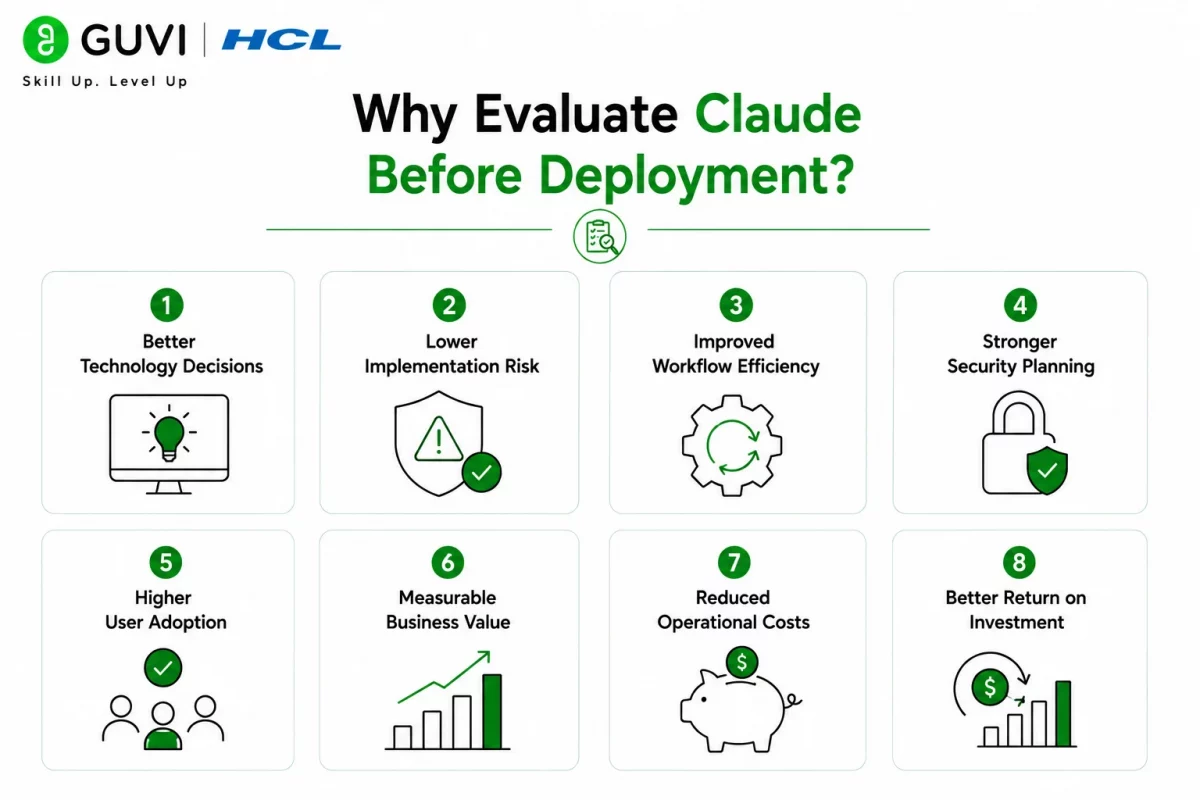
Every organization has different workflows, compliance requirements, and business objectives. Evaluating Claude before deployment helps identify where it delivers value, what limitations exist, and how it fits into existing business processes.
Key benefits include:
- Better technology decisions
- Lower implementation risk
- Improved workflow efficiency
- Stronger security planning
- Higher user adoption
- Measurable business value
- Reduced operational costs
- Better return on investment
How to Evaluate Claude for Your Enterprise Use Case
Step 1: Define Business Objectives
Clearly identify what you want Claude to achieve before starting your evaluation. Well-defined objectives make it easier to measure success.
Define:
- Business goals
- Success metrics
- Expected outcomes
- Target users
- Priority workflows
Step 2: Select Real Business Use Cases
Evaluate Claude with real-world business tasks rather than generic prompts. Real-world testing provides more meaningful insights into performance.
Test scenarios such as:
- Customer support
- Document analysis
- Knowledge management
- Report generation
- Content creation
- Internal automation
Step 3: Measure Response Quality
Assess whether Claude produces accurate, relevant, and consistent responses for your business requirements.
Evaluate:
- Accuracy
- Relevance
- Completeness
- Consistency
- Response speed
- Ease of use
Step 4: Assess Security and Compliance
Review how Claude fits within your organization’s security, privacy, and regulatory requirements before production deployment.
Consider:
- Data privacy
- Access controls
- Compliance requirements
- Information security
- User permissions
- Audit requirements
Step 5: Test Workflow Integration
Evaluate how easily Claude integrates with your existing tools, business applications, and internal processes.
Review integration with:
- CRM platforms
- Knowledge bases
- Document management systems
- Collaboration tools
- Internal applications
- APIs
Step 6: Measure Business Impact
Track business outcomes to determine whether Claude improves productivity, reduces manual effort, and supports organizational goals.
Measure:
- Time savings
- Productivity improvements
- User satisfaction
- Process efficiency
- Cost reduction
- Business value
Step 7: Continuously Refine Your Evaluation
Enterprise AI evaluation is an ongoing process. Review performance regularly, collect user feedback, update evaluation criteria, and refine AI workflows as business needs evolve. Organizations looking to strengthen AI adoption strategies and data-driven decision-making can build these skills through HCL GUVI’s Business Analytics Course.
Many successful enterprise AI deployments begin with a small pilot project. Testing Claude with a limited group of users helps organizations validate performance, identify improvement opportunities, and reduce implementation risk before scaling.
Enterprise Tasks You Can Evaluate with Claude
It can help with:

- Document summarization
- Knowledge base search
- Customer support assistance
- Report generation
- Business content creation
- Meeting summaries
- Workflow documentation
- Data analysis support
- Policy reviews
- Internal communications
- Process documentation
- Research assistance
The HCL GUVI’s Artificial Intelligence eBook is an excellent resource for learning practical Artificial Intelligence concepts, prompt engineering, business automation, and real-world AI applications. It explains how AI can improve productivity across enterprise operations while supporting responsible AI adoption.
Tasks Claude Should Not Replace
Claude is a powerful enterprise assistant, but certain business responsibilities should remain with human experts.
Claude should not replace:
- Executive decision-making
- Legal advice
- Financial approvals
- Regulatory compliance decisions
- Strategic planning
- Security assessments
- Human quality assurance
- Risk management
- Expert judgment
While Claude can improve efficiency and automate routine work, important business decisions should always involve human review.
⚠️ Warning: A successful pilot does not guarantee a successful enterprise deployment. Always validate Claude’s performance across different business scenarios, monitor outputs regularly, and verify AI-generated information before making operational or strategic decisions.
Best Practices for Evaluating Claude
Follow these best practices during evaluation:
- Define clear business objectives.
- Test real business scenarios.
- Measure response quality consistently.
- Review security and compliance requirements.
- Collect user feedback.
- Track productivity improvements.
- Refine evaluation criteria regularly.
- Validate AI-generated outputs.
Conclusion
Evaluating Claude with real business scenarios helps organizations understand its capabilities, identify limitations, and measure business value before deployment. A structured evaluation process, combined with continuous monitoring and human oversight, enables more informed AI adoption and better long-term outcomes.
FAQs
1. How should organizations evaluate Claude?
Organizations should define business goals, test real-world use cases, measure response quality, assess security requirements, evaluate integrations, and monitor business outcomes.
2. Why is a pilot project important?
A pilot project allows organizations to test Claude with real users and workflows before rolling it out across the business, reducing implementation risk.
3. What metrics should I use to evaluate Claude?
Common metrics include accuracy, response quality, productivity improvements, time savings, user satisfaction, cost reduction, and business impact.
4. Should Claude be evaluated using real business data?
Yes. Testing with realistic business scenarios provides a more accurate understanding of Claude’s performance than generic examples, while following your organization’s data governance policies.
5. Can Claude integrate with enterprise systems?
Yes. Claude can be integrated with business applications, knowledge bases, document management systems, APIs, and collaboration tools, depending on your implementation.
6. Can Claude replace enterprise decision-makers?
No. Claude supports analysis, automation, and content generation, but strategic, legal, financial, and compliance decisions should remain with human experts.
7. What are the best practices for evaluating Claude?
Define clear objectives, test real use cases, measure performance consistently, review security requirements, collect user feedback, validate outputs, and use Claude to support not replace business decision-making.
Success Stories

About the Author
HCL GUVI
This article was selected and published as part of the HCL GUVI AI Blogathon 2026, an initiative designed to encourage students, AI enthusiasts, and aspiring tech writers to simplify complex AI concepts through impactful technical content. The contest recognized high-quality, original, and insightful AI-focused blogs, with selected authors receiving publication opportunities on the HCL GUVI blog platform along with official author credits and recognition.
View all posts by HCL GUVI
Connect with me @











Did you enjoy this article?