


Artificial Intelligence and Machine Learning Articles
Finance Manager to Data Analytics: Career Growth, Salary and Seniority
How to Evaluate LLM Outputs in Production Deployments
AI/ML Skills Gap 2026: Why Companies Can't Find Job-Ready Talent
20 AI/ML Interview Questions Recruiters Can Use Without a Tech Background - Best Guide

Get In Touch For Details! Request More Information
Claude’s GDPR Compliance: What Businesses Need to Know
Aug 07, 2026 3 Min Read 588 Views
(Last Updated)
Artificial intelligence is transforming how businesses create content, analyze data, and automate workflows. Many organizations now ask, “Is Claude GDPR compliant?” Claude’s GDPR-related privacy features, enterprise controls, and data handling practices support responsible AI adoption, but compliance also depends on how businesses process, protect, and govern personal data.
Table of contents
- TL;DR Summary
- Understanding Claude's GDPR Compliance
- Key GDPR Support Features
- Claude's GDPR Compliance: What Businesses Need to Know
- Step 1: Identify Personal Data
- Step 2: Choose the Appropriate Claude Product
- Step 3: Review Anthropic's Privacy Documentation
- Step 4: Implement Internal GDPR Policies
- Step 5: Protect Sensitive Information
- Step 6: Monitor Security and Compliance
- Step 7: Stay Updated
- Essential GDPR Features of Claude
- Real-World Applications
- Customer Support
- Business Analytics
- Content Creation
- Legal and Compliance Teams
- Enterprise Knowledge Management
- Software Development
- Research and Decision Support
- Conclusion
- FAQs
- Is Claude GDPR compliant?
- Does Anthropic provide a Data Processing Addendum (DPA)?
- Can businesses use Claude under GDPR?
- Does Claude Enterprise provide additional privacy protections?
- Is using Claude alone enough for GDPR compliance?
- Where can I learn more about Claude's privacy practices?
- What is the best way to use Claude while supporting GDPR compliance?
TL;DR Summary
- Claude’s GDPR compliance depends on how organizations configure and use Anthropic’s products.
- Anthropic provides GDPR-related commitments, privacy controls, and enterprise security features to help businesses meet regulatory requirements.
- Enterprise and API customers receive stronger data governance and administrative controls than consumer users.
- Organizations remain responsible for ensuring their own GDPR compliance when processing personal data with AI.
- Understanding Claude’s GDPR compliance capabilities helps businesses adopt AI more responsibly.
📊 Data Point
Anthropic provides GDPR-related information through its Privacy Policy, Data Processing Addendum (DPA), and enterprise documentation to support customers handling personal data under applicable privacy regulations.
Source: https://www.anthropic.com/legal/privacy
Understanding Claude’s GDPR Compliance
Businesses adopting AI tools must consider more than model performance. Privacy regulations such as GDPR require organizations to process personal data lawfully, protect user information, and maintain appropriate security measures. Anthropic supports these goals by providing privacy documentation, enterprise security features, and administrative controls across its commercial offerings.
Claude’s GDPR compliance capabilities include secure infrastructure, privacy-focused data handling practices, contractual documentation for eligible customers, and enterprise governance features. However, businesses are still responsible for configuring their AI workflows in accordance with GDPR requirements and their own internal compliance policies.
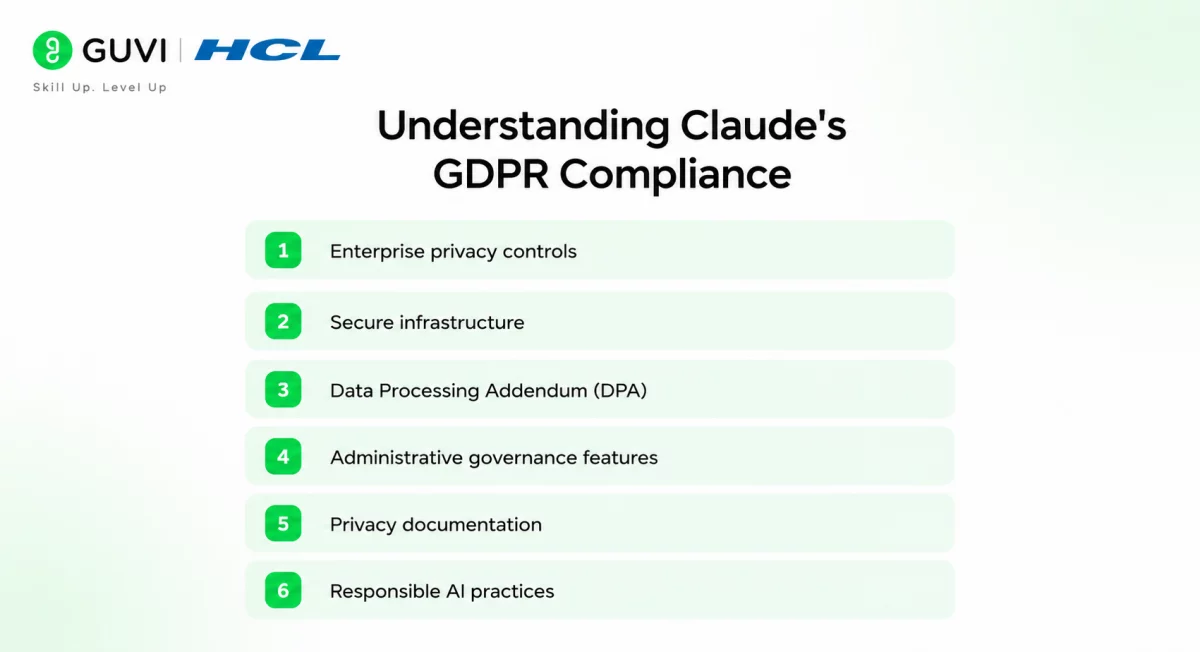
Key GDPR Support Features
- Enterprise privacy controls
- Secure infrastructure
- Data Processing Addendum (DPA)
- Administrative governance features
- Privacy documentation
- Responsible AI practices
To build a solid understanding of AI, data privacy, and machine learning fundamentals, explore HCL GUVI’s AI Ebook. It provides beginner-friendly explanations that complement topics such as Claude’s GDPR compliance and responsible AI use.
Claude’s GDPR Compliance: What Businesses Need to Know
Let’s understand how businesses can use Claude while supporting GDPR compliance.
Step 1: Identify Personal Data
Before using Claude, determine whether the information you plan to process contains personal data covered by GDPR. This may include customer details, employee information, email addresses, or other personally identifiable information (PII).
Step 2: Choose the Appropriate Claude Product
Anthropic offers different products for individual users, teams, enterprises, and API integrations. Businesses handling regulated data should review the privacy features and administrative controls available for each offering before deployment.
Step 3: Review Anthropic’s Privacy Documentation
Read Anthropic’s Privacy Policy, Trust Center, and Data Processing Addendum (DPA), where applicable. These documents explain how customer data is handled, protected, and processed across different Claude services.
Step 4: Implement Internal GDPR Policies
Organizations remain responsible for complying with GDPR. Establish internal policies covering lawful data processing, employee access controls, data retention, user consent where required, and incident response procedures before integrating AI into business workflows.
Step 5: Protect Sensitive Information
Avoid submitting unnecessary confidential or sensitive personal information to AI systems. Where possible, anonymize or pseudonymize personal data before processing it through Claude.
Step 6: Monitor Security and Compliance
Regularly review user permissions, security settings, audit logs, and AI usage policies. Continuous monitoring helps organizations maintain compliance as regulations and business requirements evolve.
Step 7: Stay Updated
Privacy regulations, AI governance standards, and Anthropic’s documentation continue to evolve. Reviewing official updates ensures your organization remains informed about new compliance guidance and platform capabilities.
⚠️ Warning: Using Claude does not automatically make an organization GDPR compliant. Businesses must still implement appropriate legal, technical, and organizational measures to satisfy GDPR requirements, including lawful data processing, security controls, and governance practices.
If you want to understand how AI, analytics, and data governance work together in business environments, HCL GUVI’s Complete Business Analytics Professional Program provides practical learning through real-world business use cases.

Essential GDPR Features of Claude
Claude provides several privacy and security capabilities that help organizations build AI workflows aligned with GDPR principles. While these features support compliance efforts, businesses must also implement their own governance, security, and legal processes to meet regulatory requirements.
| Feature | Primary Purpose |
| Privacy Controls | Help manage user data responsibly |
| Data Processing Addendum (DPA) | Supports contractual GDPR obligations |
| Enterprise Security | Protects organizational data |
| Administrative Controls | Manage users, permissions, and governance |
| Encryption | Protects data during transmission and storage |
| Audit & Compliance Resources | Support security and regulatory reviews |
| Trust Center Documentation | Provides transparency around security and privacy practices |
📊 Data Point
Anthropic offers a Data Processing Addendum (DPA) for eligible commercial customers and provides security documentation through its Trust Center to support organizations with privacy and regulatory requirements.
Under the General Data Protection Regulation (GDPR), using a secure AI platform alone does not guarantee compliance. Organizations are still responsible for establishing a lawful basis for processing, implementing appropriate technical and organizational safeguards, and protecting the personal data they collect, store, and process. Compliance ultimately depends on how an organization uses AI, not just on the security features of the platform itself.
Real-World Applications
Understanding Claude’s GDPR capabilities helps organizations adopt AI responsibly across different business functions.
1. Customer Support
Generate responses and summarize support tickets while following organizational privacy and data protection policies.
2. Business Analytics
Analyze reports and business documents without exposing unnecessary personal information.
3. Content Creation
Create marketing content, reports, and internal documentation while maintaining responsible data handling practices.
4. Legal and Compliance Teams
Review policies, summarize regulations, and assist with documentation while supporting governance workflows.
5. Enterprise Knowledge Management
Organize internal knowledge bases and business information using Claude’s enterprise features.
6. Software Development
Build AI-powered applications through Claude’s API while incorporating privacy and security best practices.
7. Research and Decision Support
Summarize research, compare documents, and generate insights without compromising regulatory compliance.
✅ Best Practice
Before processing personal data with Claude, establish internal GDPR policies, review Anthropic’s privacy documentation, use the appropriate Claude product for your business needs, and regularly assess your AI workflows to ensure they align with applicable regulatory requirements.
Conclusion
Claude provides privacy controls, enterprise security features, and compliance resources that can help organizations support GDPR requirements. However, achieving Claude GDPR compliance depends on how businesses collect, process, protect, and govern personal data within their own AI workflows. By understanding Anthropic’s documentation, implementing appropriate internal controls, and following GDPR best practices, organizations can adopt Claude more responsibly while supporting regulatory compliance.
FAQs
1. Is Claude GDPR compliant?
Claude offers features and documentation that support GDPR compliance, but organizations remain responsible for meeting their own legal obligations.
2. Does Anthropic provide a Data Processing Addendum (DPA)?
Yes. Anthropic offers a DPA for eligible commercial customers to support contractual privacy requirements.
3. Can businesses use Claude under GDPR?
Yes. Businesses can use Claude while implementing appropriate technical, organizational, and legal measures required under GDPR.
4. Does Claude Enterprise provide additional privacy protections?
Yes. Claude Enterprise includes enhanced security, administrative controls, and governance features designed for organizations.
5. Is using Claude alone enough for GDPR compliance?
No. GDPR compliance also depends on an organization’s internal policies, lawful processing practices, security controls, and governance procedures.
6. Where can I learn more about Claude’s privacy practices?
Review Anthropic’s Privacy Policy, Trust Center, and Data Processing Addendum (DPA) for detailed information.
7. What is the best way to use Claude while supporting GDPR compliance?
Review Anthropic’s documentation, minimize the processing of personal data, implement strong internal governance, and regularly assess your AI workflows to ensure they align with GDPR requirements.
Success Stories

About the Author
Vishalini Devarajan
An Aerospace Engineer turned content writer, I focus on making complex concepts easy to understand through well-structured, reader-friendly blogs. Whether it’s a technical topic or a non-technical one, I love creating content that is clear, engaging, and impactful.
View all posts by Vishalini Devarajan
Connect with me @






Did you enjoy this article?