


Artificial Intelligence and Machine Learning Articles
Finance Manager to Data Analytics: Career Growth, Salary and Seniority
How to Evaluate LLM Outputs in Production Deployments
AI/ML Skills Gap 2026: Why Companies Can't Find Job-Ready Talent
20 AI/ML Interview Questions Recruiters Can Use Without a Tech Background - Best Guide


Get In Touch For Details! Request More Information

AI Watermarking: Detecting AI-Generated Content
Sep 04, 2026 4 Min Read 485 Views
(Last Updated)
AI watermarking is the practice of embedding imperceptible signals or patterns into AI-generated content, including text, images, audio, and video, that allow the content to be identified as AI-generated without visibly altering the content itself. For text, watermarking works by subtly biasing token selection during generation. For images, it embeds statistical patterns in pixel values. Watermarks allow platforms, regulators, and consumers to verify whether content was produced by an AI system, supporting authenticity verification, content moderation, and regulatory compliance.
Table of contents
- TL;DR Summary
- How Text Watermarking Works
- How Image Watermarking Works
- Text vs Image Watermarking Compared
- Watermark Robustness and Attacks
- C2PA: Cryptographic Content Provenance
- Conclusion
- FAQs
- What is AI watermarking?
- How does text watermarking work?
- Can AI watermarks be removed?
- What is C2PA and how is it different from watermarking?
- Does the EU AI Act require AI watermarking?
- What are the false positive risks of AI watermark detection?
TL;DR Summary
- AI watermarking embeds imperceptible signals into AI-generated content that allow it to be identified as AI-generated without degrading content quality
- Text watermarking works by biasing the probability distribution over tokens during generation toward a pseudo-random subset, creating a detectable statistical pattern
- Image watermarking embeds patterns in pixel statistics that survive common transformations like resizing, compression, and cropping
- Watermarks can be removed or degraded through paraphrasing, image editing, or adversarial attacks, making them a detection aid rather than a foolproof detection system
How Text Watermarking Works
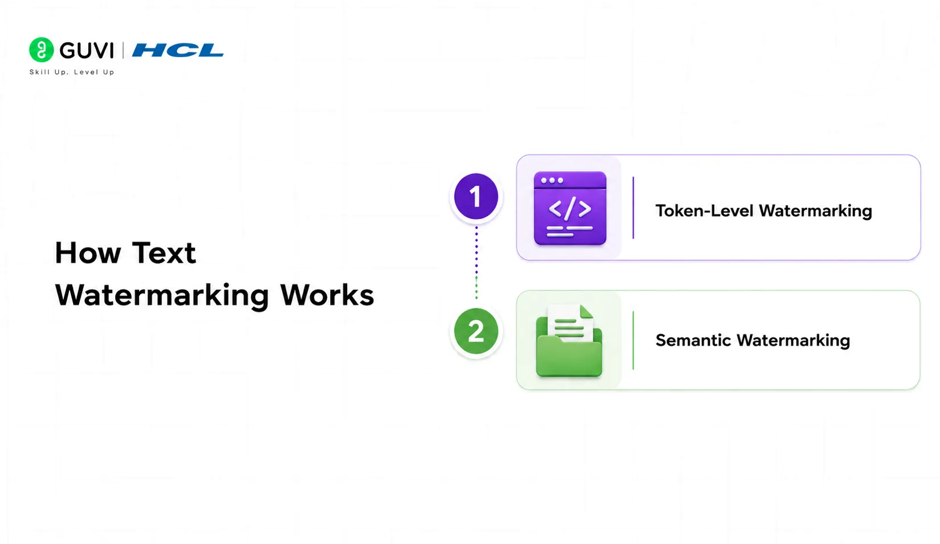
Text watermarking is the most technically active area of AI watermarking research because the output, token sequences, is flexible enough to embed signals without obvious quality degradation.
- Token-Level Watermarking
The most influential approach, introduced by Kirchenbauer and colleagues at the University of Maryland in 2023, works by partitioning the model’s vocabulary into two sets at each generation step: a green list and a red list, determined by a pseudo-random function of the preceding tokens. The model is then biased to select tokens from the green list with higher probability.
The resulting text contains a statistically detectable excess of green list tokens compared to what would appear in unbiased human-written text. A detector with knowledge of the pseudo-random function computes the proportion of green tokens in a piece of text and applies a statistical hypothesis test to determine whether the excess is significant enough to conclude AI generation.
- Semantic Watermarking
A complementary approach embeds the watermark at the semantic level rather than the token level, using paraphrasing models to select among semantically equivalent phrasings in ways that encode a detectable signal. Because the signal is in the choice between meaning-preserving alternatives rather than specific tokens, semantic watermarks are more robust to token-level edits and paraphrasing attacks.
The trade-off is that semantic watermarking requires a separate paraphrasing model running alongside the main generation model, increasing computational cost compared to token-level approaches.
Read More: What is DeepFaceDrawing? Turning Sketches into Real Faces
Want to build strong AI engineering skills covering responsible AI, content safety, and production AI system design? Explore HCL GUVI’s Artificial Intelligence & Machine Learning Course, designed to help you develop the practical AI foundations that modern trustworthy AI roles demand.
How Image Watermarking Works
Image watermarking has a longer history than text watermarking, drawing on decades of digital watermarking research from the copyright protection domain. AI-specific image watermarking adapts these techniques to the generative model context.
- Frequency Domain Watermarking
Traditional image watermarking embeds signals in the frequency domain representation of an image rather than its pixel values. The image is transformed using a discrete cosine transform or discrete wavelet transform, a small signal is added to specific frequency coefficients, and the image is transformed back to pixel space.
The embedded signal is invisible in the spatial domain because it is distributed across many pixels at low amplitude. But it is detectable in the frequency domain because it creates a specific pattern that is statistically unlikely to appear in unwatermarked images.
Frequency domain watermarks survive common transformations including JPEG compression, resizing, and moderate cropping because the signal is distributed across many coefficients rather than concentrated in specific pixels. They are degraded by significant geometric transformations or aggressive filtering.
- Deep Neural Network Watermarking
More recent approaches use neural networks to embed and detect watermarks, training an encoder network that modifies generated images to embed a signal and a decoder network that detects the signal in potentially transformed images.
This approach achieves better robustness to common image transformations than traditional frequency domain methods because the encoder learns to embed the signal in features that are preserved through typical image processing operations. Stable Diffusion’s watermarking implementation uses a variant of this approach.
Google DeepMind introduced SynthID in 2023 to watermark AI-generated content during generation. It is integrated with Gemini and Vertex AI, with text watermarking designed to remain robust against paraphrasing.
Text vs Image Watermarking Compared
| Dimension | Text Watermarking | Image Watermarking |
| Primary method | Token probability biasing | Frequency domain or DNN encoding |
| Visibility to humans | Invisible in normal reading | Invisible to naked eye |
| Robustness to paraphrasing | Low to moderate | Not applicable |
| Robustness to compression | High, token sequence preserved | Moderate, depends on method |
| Robustness to cropping | Not applicable | Moderate |
| Robustness to editing | Low, editing changes tokens | Moderate, distributed signal |
| Minimum content length | 200+ tokens for reliable detection | No minimum, full image used |
| Computational overhead | Low, biasing during generation | Low to moderate |
| False positive rate | Less than 1% for 200+ tokens | Less than 1% for typical images |
Watermark Robustness and Attacks
Watermarks are not permanent and cannot be made completely robust to all removal attempts. Understanding the attack landscape is essential for calibrating how much confidence to place in watermark-based detection.
- Text Watermark Attacks
Paraphrasing attacks are the most effective attack against token-level watermarks. Running watermarked text through a paraphrasing model that selects different tokens while preserving meaning destroys the green token excess that the watermark depends on. Research has shown that a single pass through a capable paraphrasing model can reduce watermark detection accuracy significantly.

Span replacement manually or automatically rewrites portions of watermarked text, reducing the proportion of green tokens in the remaining text. Replacing 30 to 40 percent of tokens can degrade watermark signal below detection thresholds.
Translation attacks translate watermarked text to another language and back. The resulting text conveys the same meaning but the token sequence is generated by a different model with no watermark bias, removing the original watermark.
- Image Watermark Attacks
JPEG recompression at high compression ratios removes frequency domain watermarks by discarding the coefficients where the signal was embedded. Very high compression removes the watermark at the cost of visible image quality degradation.
Adversarial perturbation adds carefully computed pixel-level noise that disrupts the watermark signal without visibly altering the image. These attacks are computationally intensive to generate but highly effective.
Inpainting and editing replacing significant portions of a watermarked image with AI-generated or manually edited content reduces the proportion of the image containing the original watermark signal.
A 2023 University of Maryland paper introduced the green-red token approach for text watermarking, influencing implementations at major AI labs and accelerating the adoption of AI watermarking
C2PA: Cryptographic Content Provenance
Statistical watermarking embeds detectable signals in content. C2PA (Coalition for Content Provenance and Authenticity) takes a fundamentally different approach: cryptographic signing of content at the point of creation.
When an AI system generates an image, it can attach a cryptographically signed manifest to the image file that records the generation tool, timestamp, and optionally a hash of the generation parameters. The signature is issued by a trusted authority and can be verified by any downstream system with access to the public key.
C2PA is supported by Adobe, Microsoft, Google, Sony, Nikon, and others as an open standard. Adobe’s Content Credentials feature and Microsoft’s implementation in Bing Image Creator use C2PA to attach provenance metadata to AI-generated images.
Want to build strong AI engineering skills covering responsible AI, content safety, and production AI system design? Explore HCL GUVI’s Artificial Intelligence & Machine Learning Course, designed to help you develop the practical AI foundations that modern trustworthy AI roles demand.
Conclusion
AI watermarking is a critical and rapidly evolving component of the AI content authenticity ecosystem, but it should be understood as one layer of a multi-layer detection and attribution system rather than a complete solution.
Statistical watermarking provides probabilistic detection that is robust to casual removal but vulnerable to motivated attacks. C2PA cryptographic provenance provides strong attribution when the chain of custody is maintained but fails when metadata is stripped. Classifier-based detection provides coverage for non-watermarked content but produces false positives that affect human creators.
FAQs
What is AI watermarking?
AI watermarking embeds imperceptible signals into AI-generated content that allow it to be identified as AI-generated, without visibly altering content quality. Methods include token probability biasing for text and frequency domain embedding for images.
How does text watermarking work?
Text watermarking biases token selection during generation toward a pseudo-random green list subset. Detectors measure the statistical excess of green tokens in text to determine whether it was AI-generated with above-chance confidence.
Can AI watermarks be removed?
Yes. Paraphrasing attacks remove text watermarks by selecting different tokens while preserving meaning. Image watermarks can be degraded through recompression, cropping, and adversarial perturbation. Watermarks are detection aids rather than permanent, unforgeable marks.
What is C2PA and how is it different from watermarking?
C2PA is a cryptographic content provenance standard that attaches a verifiable signed manifest to content at creation, recording the generation tool and timestamp. Unlike statistical watermarks embedded in content, C2PA provenance lives in metadata that is removed when content is screenshot or re-saved.
Does the EU AI Act require AI watermarking?
The EU AI Act requires machine-readable marking of AI-generated content but does not mandate a specific technical implementation. Watermarking and C2PA provenance are both compliant approaches depending on the content type and distribution channel.
What are the false positive risks of AI watermark detection?
Statistical watermark detectors have non-zero false positive rates where human-created content triggers AI detection. In high-stakes contexts like academic integrity or employment, false positives carry real costs and human review of flagged content is essential before taking consequential action.
Success Stories

About the Author
HCL GUVI
This article was selected and published as part of the HCL GUVI AI Blogathon 2026, an initiative designed to encourage students, AI enthusiasts, and aspiring tech writers to simplify complex AI concepts through impactful technical content. The contest recognized high-quality, original, and insightful AI-focused blogs, with selected authors receiving publication opportunities on the HCL GUVI blog platform along with official author credits and recognition.
View all posts by HCL GUVI
Connect with me @

















Did you enjoy this article?