


Artificial Intelligence and Machine Learning Articles
What is Statistical Power Analysis Explained
TinyML: Machine Learning on Microcontrollers


Get In Touch For Details! Request More Information

AI Model Compression Techniques: Pruning and Beyond
Sep 04, 2026 4 Min Read 9 Views
(Last Updated)
Modern AI models can contain millions or even billions of parameters, making them powerful but also expensive to train, store, and deploy. AI Model Compression reduces the size and computational requirements of these models while attempting to preserve their useful performance.
Compression is particularly important when deploying AI applications on smartphones, edge devices, embedded systems, or environments with limited computing resources. Techniques such as pruning, quantization, knowledge distillation, and low-rank factorization provide different ways to make models more efficient.
Table of contents
- TL;DR Summary
- What Is AI Model Compression?
- Why Is Model Compression Important?
- Pruning: Removing Unnecessary Parameters
- Types of Pruning
- Quantization
- Knowledge Distillation
- Low-Rank Factorization
- Weight Sharing
- Combining Compression Techniques
- AI Model Compression for Edge AI
- How to Choose a Compression Technique
- Key Takeaways
- Conclusion
- FAQs
- What is AI Model Compression?
- What is pruning in AI?
- How does quantization reduce model size?
- What is knowledge distillation?
- Which AI Model Compression technique is best?
TL;DR Summary
- AI Model Compression reduces model size, memory usage, and computational requirements.
- Pruning removes unnecessary parameters or connections.
- Quantization represents model values using lower numerical precision.
- Knowledge distillation transfers knowledge from a large model to a smaller one.
- Low-rank factorization approximates large weight matrices with smaller matrices.
- Compression should always be evaluated against the resulting accuracy and deployment requirements.
What Is AI Model Compression?
AI Model Compression is the process of reducing the computational, memory, or storage requirements of a trained machine learning model.
A compressed model may:
- Occupy less storage.
- Require less memory.
- Perform inference faster.
- Consume less energy.
- Be easier to deploy on resource-constrained devices.
The goal is not simply to make a model smaller. The goal is to achieve a useful balance between model efficiency and predictive performance.
Read More: Types of Generative AI: The Complete Beginner Guide
Optimize AI models with HCL GUVI’s Artificial Intelligence & Machine Learning Course. Learn model optimization, deep learning, and AI deployment through hands-on projects.
Why Is Model Compression Important?
Large models can create practical deployment challenges.
For example, a model that works efficiently on a high-end GPU may be difficult to run on:
- Smartphones
- IoT devices
- Edge computers
- Embedded systems
- Low-memory servers
Reducing the model’s resource requirements can make deployment more practical and can also lower inference costs in cloud environments.
Pro Tip: Define your deployment target before choosing a compression technique. A model optimized for a mobile CPU may require different compression strategies from one intended for a GPU-based inference server.
Pruning: Removing Unnecessary Parameters
Pruning removes parameters, connections, neurons, channels, or other model components considered less important.
The basic idea is:
Large Model → Identify Less Important Components → Remove Them → Fine-Tune → Smaller ModelFor example, a neural network may contain weights that contribute very little to its predictions. Pruning can remove some of these weights while attempting to preserve accuracy.
Compression can be applied at different stages of an AI workflow. Some techniques modify an existing trained model, while others involve training a smaller model specifically to reproduce the behavior of a larger model.
Types of Pruning
Unstructured pruning removes individual weights.
Structured pruning removes larger structures such as neurons, filters, or channels.
Structured pruning can be particularly useful for practical hardware acceleration because standard hardware can often process the resulting smaller structures more efficiently.
Best Practice: Do not assume that removing parameters automatically produces faster inference. The actual speed improvement depends on the hardware, software framework, and type of sparsity created.
Quantization
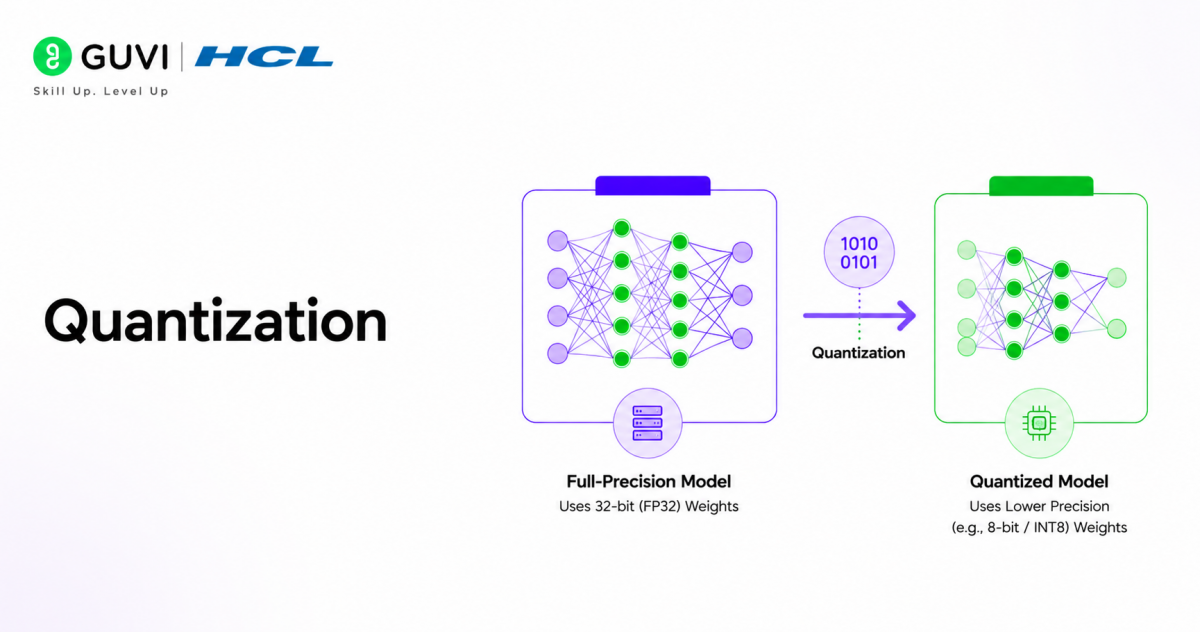
Quantization reduces the numerical precision used to represent model parameters and, in some cases, activations.
For example, a model might use:
- 32-bit floating-point values
- 16-bit floating-point values
- 8-bit integer values
Moving from higher to lower precision can significantly reduce memory usage and potentially improve inference efficiency.
A simplified example is:
FP32 → INT8The model uses fewer bits to represent numerical values, reducing the amount of memory required.
Quantization approaches include:
- Post-training quantization
- Quantization-aware training
- Dynamic quantization
Warning: Aggressive quantization can reduce model accuracy, particularly when the model is sensitive to numerical precision. Always validate the compressed model on representative data.
Knowledge Distillation
Knowledge distillation takes a different approach.
Instead of directly modifying a large model, a smaller student model learns from a larger teacher model.
The teacher produces predictions or probability distributions that provide additional information to the student.
The general process is:
Teacher Model → Soft Predictions → Student Model → Compact ModelThe student learns to approximate the teacher’s behavior while having fewer parameters.
Knowledge distillation can be useful when you want a model specifically designed for efficient deployment rather than simply shrinking an existing architecture.
Low-Rank Factorization
Large neural network layers often contain weight matrices with significant redundancy.
Low-rank factorization approximates a large matrix using smaller matrices.

Instead of representing:
Wdirectly, the model can approximate it as:
W ≈ A × Bwhere A and B require fewer parameters than the original matrix under suitable conditions.
This can reduce storage and computation for certain model architectures.
The effectiveness depends on the structure of the original weights and the selected rank.
Weight Sharing
Weight sharing reduces the number of unique parameter values in a model.
Instead of storing a separate numerical value for every parameter, multiple parameters can use the same representative value.
For example:
Original weights → Cluster similar values → Replace with shared valuesThis can reduce storage requirements and may work particularly well when many parameters have similar values.
Combining Compression Techniques
Compression techniques do not have to be used independently.
A model could use:
Pruning + Quantizationor:
Knowledge Distillation + QuantizationFor example, a large model could first be pruned to remove unnecessary structures and then quantized to reduce numerical precision.
Combining methods can provide greater efficiency, but each additional transformation should be tested for its effect on model quality.
Data Point: Compression is often a trade-off rather than a free optimization. Greater reductions in model size or computation can introduce increasing risks of accuracy degradation.
AI Model Compression for Edge AI
Model compression is particularly important for edge AI.
An edge device may have:
- Limited RAM
- Limited storage
- Low-power processors
- Restricted thermal capacity
- No continuous cloud connection
A compressed model can make local inference more practical.
For example, an image classification model used on a smartphone may benefit from quantization and architecture optimization to reduce latency and energy consumption.
How to Choose a Compression Technique
The best approach depends on your objective.
| Technique | Main Benefit | Potential Challenge |
| Pruning | Reduces parameters | May require fine-tuning |
| Quantization | Reduces memory and computation | Possible accuracy loss |
| Knowledge Distillation | Creates smaller models | Requires teacher-student training |
| Low-Rank Factorization | Reduces matrix complexity | Approximation error |
| Weight Sharing | Reduces storage | May affect model quality |
Consider these factors before choosing a method:
- Target hardware
- Latency requirements
- Memory limits
- Model accuracy
- Energy consumption
- Available training resources
Key Takeaways
- AI Model Compression makes models smaller and more efficient.
- Pruning removes unnecessary parameters or structures.
- Quantization reduces numerical precision.
- Knowledge distillation trains a smaller student model using a larger teacher.
- Low-rank factorization reduces the complexity of large weight matrices.
- Multiple compression techniques can be combined.
- Real-world hardware benchmarking is essential.
Optimize AI models with HCL GUVI’s Artificial Intelligence & Machine Learning Course. Learn model optimization, deep learning, and AI deployment through hands-on projects.
Conclusion
AI Model Compression is an important technique for making modern machine learning models practical to deploy. Pruning, quantization, knowledge distillation, low-rank factorization, and weight sharing each approach model efficiency differently.
The right technique depends on the model architecture, target hardware, accuracy requirements, and deployment constraints. Rather than focusing solely on reducing parameter count, data scientists and ML engineers should evaluate the complete trade-off between accuracy, latency, memory, storage, and energy consumption.
When carefully applied and validated, model compression can help bring capable AI systems to devices and environments where large models would otherwise be impractical.
FAQs
What is AI Model Compression?
AI Model Compression is the process of reducing a machine learning model’s size, memory requirements, computational cost, or energy consumption while maintaining acceptable performance.
What is pruning in AI?
Pruning removes less important parameters, connections, neurons, filters, or other model structures to reduce model complexity.
How does quantization reduce model size?
Quantization represents model parameters and sometimes activations using fewer bits, such as converting FP32 values to INT8 representations.
What is knowledge distillation?
Knowledge distillation trains a smaller student model to learn from the predictions or representations of a larger teacher model.
Which AI Model Compression technique is best?
There is no universally best technique. The appropriate choice depends on accuracy requirements, model architecture, target hardware, memory constraints, and inference goals.
Success Stories

About the Author
HCL GUVI
This article was selected and published as part of the HCL GUVI AI Blogathon 2026, an initiative designed to encourage students, AI enthusiasts, and aspiring tech writers to simplify complex AI concepts through impactful technical content. The contest recognized high-quality, original, and insightful AI-focused blogs, with selected authors receiving publication opportunities on the HCL GUVI blog platform along with official author credits and recognition.
View all posts by HCL GUVI
Connect with me @









Did you enjoy this article?