


Artificial Intelligence and Machine Learning Articles
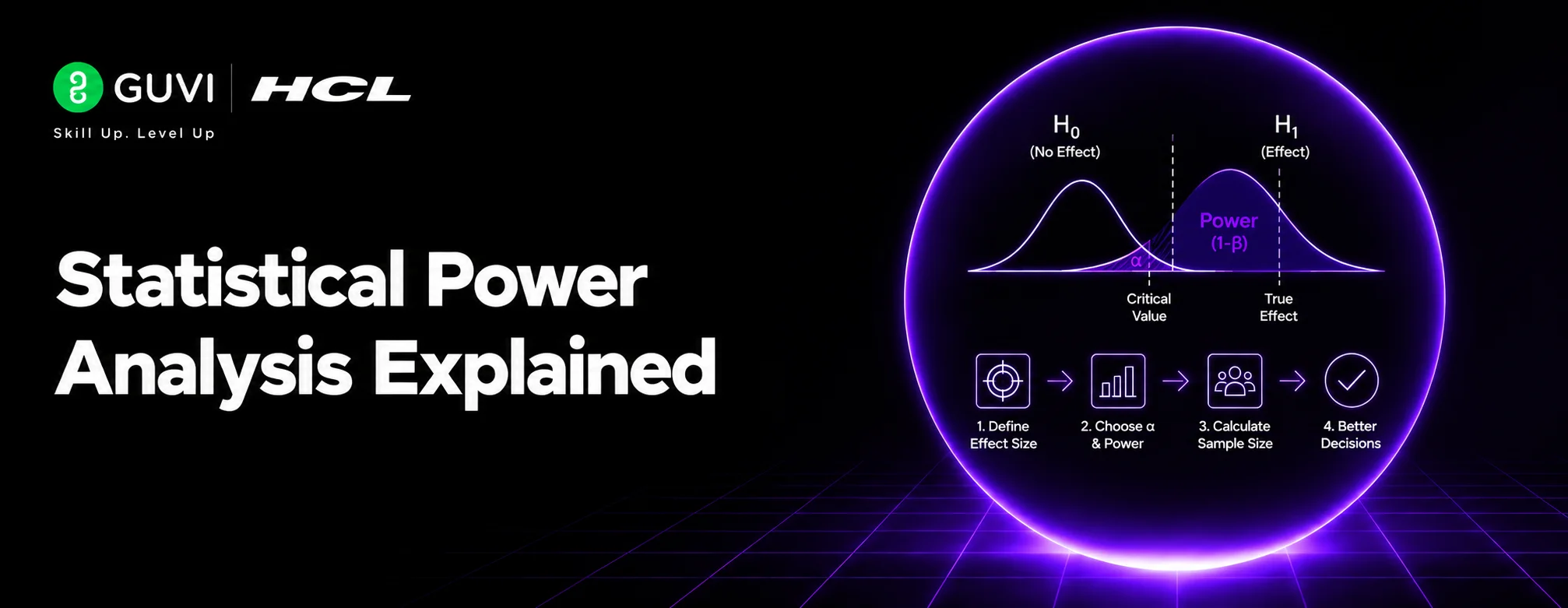
What is Statistical Power Analysis Explained
AI Model Compression Techniques: Pruning and Beyond


Get In Touch For Details! Request More Information
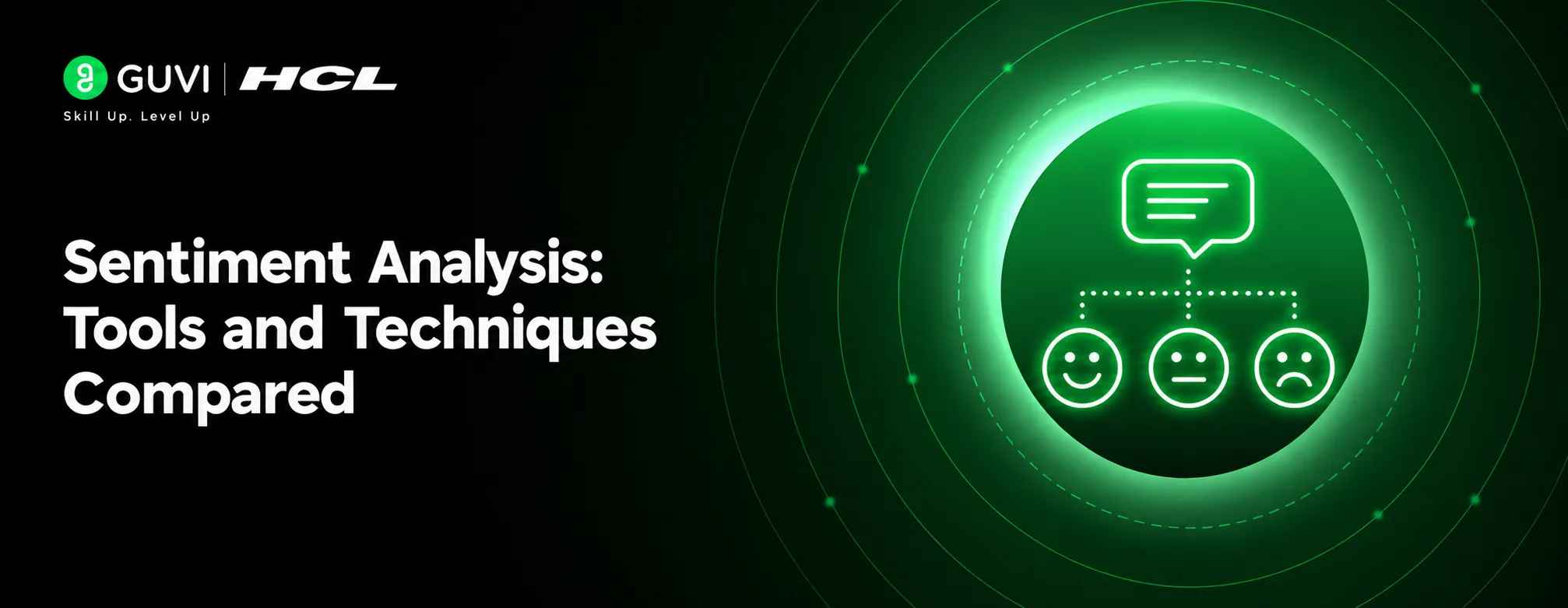
Sentiment Analysis: Tools and Techniques Compared
Sep 04, 2026 3 Min Read 9 Views
(Last Updated)
Businesses receive enormous amounts of text through customer reviews, surveys, social media posts, support tickets, and feedback forms. Manually analyzing all this information can be difficult and time-consuming. Sentiment Analysis uses natural language processing (NLP) to automatically identify the emotional tone or opinion expressed in text.
Depending on the approach, a sentiment analysis system can classify text as positive, negative, or neutral, or identify more detailed emotions. Different tools and techniques offer different levels of accuracy, complexity, scalability, and contextual understanding.
Table of contents
- TL;DR Summary
- What Is Sentiment Analysis?
- How Does Sentiment Analysis Work?
- Major Sentiment Analysis Techniques
- Lexicon-Based Sentiment Analysis
- VADER
- TextBlob
- Machine Learning-Based Sentiment Analysis
- Deep Learning for Sentiment Analysis
- Transformer-Based Sentiment Analysis
- Aspect-Based Sentiment Analysis
- Sentiment Analysis Tools Compared
- How to Evaluate a Sentiment Model
- Key Takeaways
- Conclusion
- FAQs
- What is Sentiment Analysis?
- Which Sentiment Analysis tool is best for beginners?
- Is machine learning better than lexicon-based sentiment analysis?
- What is aspect-based sentiment analysis?
- Why can Sentiment Analysis produce incorrect results?
TL;DR Summary
- Sentiment Analysis identifies opinions, attitudes, or emotional polarity in text.
- Lexicon-based methods are simple and require little training data.
- Traditional machine learning can provide efficient classification with labeled data.
- Transformer models generally provide stronger contextual understanding.
- Tools such as VADER, TextBlob, and transformer-based libraries serve different use cases.
- Sarcasm, context, slang, and domain-specific language remain challenging.
What Is Sentiment Analysis?
Sentiment Analysis is an NLP technique that analyzes text to determine the sentiment expressed by the author.
A basic system may classify text into three categories:
- Positive
- Negative
- Neutral
For example:
"The product is excellent and easy to use." → Positive

"The application keeps crashing." → Negative

"The package arrived yesterday." → Neutral
More advanced systems can identify emotions such as happiness, anger, disappointment, or excitement.
Read More: Creating a Sentiment Analysis App with Hugging Face and Streamlit
Build practical NLP skills with HCL GUVI’s Artificial Intelligence & Machine Learning Course. Learn sentiment analysis, machine learning, and AI techniques through real-world projects.
How Does Sentiment Analysis Work?
A typical sentiment analysis pipeline includes:
Text → Preprocessing → Feature Extraction or Embeddings → Sentiment Model → Classification → ResultThe exact process depends on the selected technique.
A traditional machine learning system might convert text into numerical features using TF-IDF, while modern transformer models generate contextual representations of the text.
The output can be a sentiment label, probability score, or both.
Sentiment analysis can operate at different levels, including document-level, sentence-level, and aspect-level analysis.
Major Sentiment Analysis Techniques
Lexicon-Based Sentiment Analysis
Lexicon-based methods use dictionaries containing words associated with sentiment.
For example:
| Word | Sentiment |
| Excellent | Positive |
| Helpful | Positive |
| Terrible | Negative |
| Broken | Negative |
The system calculates sentiment based on the words present in the text.
Advantages:
- Simple to implement.
- Does not require labeled training data.
- Fast for large volumes of text.
Limitations:
- Can struggle with context.
- May not understand sarcasm.
- Domain-specific terminology can cause errors.
Pro Tip: Lexicon-based approaches work well as a lightweight baseline before investing in more complex machine learning models.
VADER
VADER (Valence Aware Dictionary and sEntiment Reasoner) is a rule- and lexicon-based sentiment analysis tool designed particularly for social media-style text.
It considers factors such as:
- Word sentiment
- Punctuation
- Capitalization
- Intensifiers
- Negation
For example, emphasis in a sentence can influence its sentiment score.
VADER is especially useful for short, informal text such as social media posts.
TextBlob
TextBlob provides a simple Python interface for common NLP tasks, including sentiment analysis.
It can return measures such as:
- Polarity
- Subjectivity
Polarity generally represents the direction of sentiment, while subjectivity indicates whether the text is more opinion-oriented.
TextBlob is easy to use and can be useful for prototypes and educational projects.
Machine Learning-Based Sentiment Analysis
Traditional machine learning models can classify sentiment using labeled training data.
Common algorithms include:
- Logistic Regression
- Naive Bayes
- Support Vector Machines
- Decision Trees
- Random Forests
Text is typically converted into numerical features using techniques such as:
- Bag of Words
- TF-IDF
- N-grams
For example:
Text → TF-IDF Features → Logistic Regression → SentimentThese approaches can perform well when sufficient domain-specific training data is available.
Best Practice: Establish a simple machine learning baseline before adopting a more complex model. This provides a useful reference for measuring whether the additional complexity improves performance.
Deep Learning for Sentiment Analysis
Deep learning models can learn complex patterns directly from text representations.
Earlier approaches included:
- Recurrent Neural Networks (RNNs)
- Long Short-Term Memory (LSTM)
- Convolutional Neural Networks (CNNs)
These models can capture more complex relationships than simple bag-of-words approaches.
However, transformer-based models have become particularly important for modern NLP applications.
Transformer-Based Sentiment Analysis
Transformers use attention mechanisms to understand relationships between words in context.

Models such as BERT and its variants can be fine-tuned for sentiment classification.
For example:
“The camera is small but surprisingly powerful.”
A context-aware model can recognize that “small” is not necessarily negative in this sentence.
Transformer models can also be adapted to specialized domains using appropriate training or fine-tuning data.
Data Point: Transformer-based approaches generally require more computational resources than simple lexicon-based methods, but they can provide substantially better contextual understanding on many NLP tasks.
Aspect-Based Sentiment Analysis
Basic sentiment analysis might classify an entire review as positive or negative.
Aspect-based sentiment analysis goes further by identifying sentiment toward specific aspects.
Consider:
“The phone has an excellent camera, but the battery life is disappointing.”
The system can identify:
| Aspect | Sentiment |
| Camera | Positive |
| Battery life | Negative |
This is particularly useful for product analysis because a single review can contain both positive and negative opinions.
Sentiment Analysis Tools Compared
| Tool/Approach | Best For | Strength | Limitation |
| VADER | Social media | Fast and simple | Limited deep context |
| TextBlob | Beginners/prototypes | Easy Python API | Less sophisticated |
| Scikit-learn ML | Custom classifiers | Flexible | Requires labeled data |
| Transformer models | Advanced NLP | Strong contextual understanding | Higher resource requirements |
| Cloud NLP APIs | Enterprise applications | Managed infrastructure | Usage costs and provider dependency |
The right tool depends on the application’s accuracy requirements, available data, budget, and deployment environment.
How to Evaluate a Sentiment Model
Common classification metrics include:
- Accuracy
- Precision
- Recall
- F1-score
- Confusion matrix
For imbalanced datasets, accuracy alone can be misleading.
For example, if 90% of reviews are positive, a model that always predicts “positive” could achieve 90% accuracy while being practically useless.
Consider the distribution of sentiment classes when selecting evaluation metrics.
Key Takeaways
- Sentiment Analysis identifies opinions and emotional polarity in text.
- Lexicon-based approaches are simple and fast.
- VADER works particularly well for informal social text.
- TextBlob provides an accessible approach for beginners.
- Traditional machine learning offers customizable classification.
- Transformer models provide stronger contextual understanding.
- Aspect-based analysis identifies sentiment toward specific features.
- Real-world evaluation is essential because language can be highly contextual.
Build practical NLP skills with HCL GUVI’s Artificial Intelligence & Machine Learning Course. Learn sentiment analysis, machine learning, and AI techniques through real-world projects.
Conclusion
Sentiment Analysis has evolved from simple word-based scoring to sophisticated transformer-based systems capable of understanding complex linguistic patterns. The right approach depends on the application’s requirements.
Lexicon-based tools can be effective for lightweight applications, while traditional machine learning provides greater customization when labeled data is available. Transformer models are suitable when contextual understanding and advanced performance are priorities.
Regardless of the technique, testing against real-world data is essential. Sarcasm, negation, mixed opinions, domain-specific language, and multilingual content can all affect results. A thoughtful combination of the right model, evaluation strategy, and domain-specific testing can make sentiment analysis a valuable tool for extracting insights from unstructured text.
FAQs
What is Sentiment Analysis?
Sentiment Analysis is an NLP technique that identifies the emotional tone, opinion, or polarity expressed in text.
Which Sentiment Analysis tool is best for beginners?
VADER and TextBlob are accessible options for beginners because they require relatively little setup and can be used directly from Python.
Is machine learning better than lexicon-based sentiment analysis?
Not always. Machine learning can provide better domain-specific performance when trained appropriately, while lexicon-based approaches are simpler and require less data.
What is aspect-based sentiment analysis?
Aspect-based sentiment analysis identifies sentiment toward specific aspects of a product, service, or topic rather than assigning one sentiment to the entire text.
Why can Sentiment Analysis produce incorrect results?
It can struggle with sarcasm, negation, context, mixed sentiment, slang, ambiguous language, and domain-specific terminology.
Success Stories

About the Author
HCL GUVI
This article was selected and published as part of the HCL GUVI AI Blogathon 2026, an initiative designed to encourage students, AI enthusiasts, and aspiring tech writers to simplify complex AI concepts through impactful technical content. The contest recognized high-quality, original, and insightful AI-focused blogs, with selected authors receiving publication opportunities on the HCL GUVI blog platform along with official author credits and recognition.
View all posts by HCL GUVI
Connect with me @




Did you enjoy this article?