


Artificial Intelligence and Machine Learning Articles
Finance Manager to Data Analytics: Career Growth, Salary and Seniority
How to Evaluate LLM Outputs in Production Deployments
AI/ML Skills Gap 2026: Why Companies Can't Find Job-Ready Talent
20 AI/ML Interview Questions Recruiters Can Use Without a Tech Background - Best Guide

Get In Touch For Details! Request More Information
AI in Retail: Demand Forecasting and Personalization
Sep 04, 2026 5 Min Read 340 Views
(Last Updated)
AI in retail is transforming how merchants predict demand, manage inventory, and personalize every customer interaction.
Retailers using AI-driven demand forecasting and personalization are unlocking $240–390 billion in value while reducing overstock and stockouts simultaneously.
This guide explains how AI in retail works for forecasting and personalization, the measurable benefits, and practical implementation steps.
Table of contents
- TL;DR Summary
- What Is AI in Retail?
- Why AI Matters for Retail Now
- AI in Retail Demand Forecasting
- How AI Demand Forecasting Works
- Data Requirements for AI Forecasting
- Measurable Benefits of AI Forecasting
- How AI Personalization Works
- Personalization Use Cases
- Personalization Benefits
- Implementation Roadmap for AI in Retail
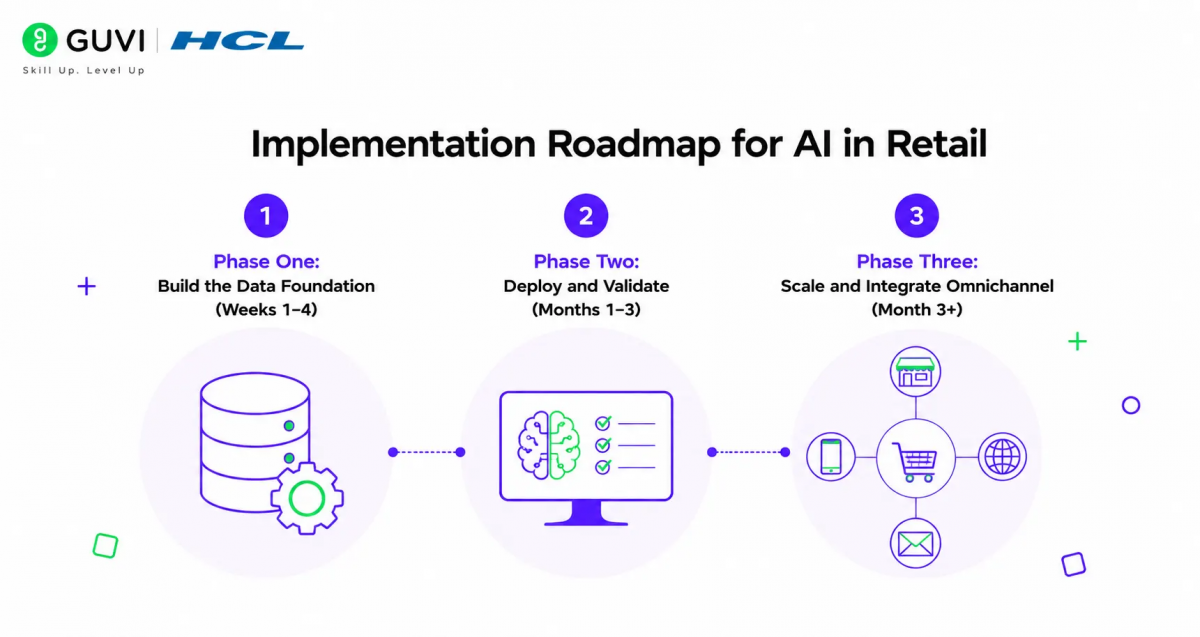
- Phase One: Build the Data Foundation (Weeks 1–4)
- Phase Two: Deploy and Validate (Months 1–3)
- Phase Three: Scale and Integrate Omnichannel (Month 3+)
- Prioritization by ROI and Risk
- Common Mistakes to Avoid
- Did You Know?
- Conclusion
- FAQs
- What is AI in retail demand forecasting?
- How does AI personalization work in retail?
- What data do I need for AI demand forecasting?
- What are the benefits of AI in retail?
- How long does it take to see ROI from AI in retail?
- Should I start with forecasting or personalization?
- Can small retailers benefit from AI in retail?
- What is the biggest mistake retailers make with AI?
TL;DR Summary
- AI in retail predicts SKU-level demand 12 weeks ahead with higher accuracy than statistical baselines.
- Personalization engines deliver individualized recommendations, pricing, and content across channels.
- AI demand forecasting reduces stockouts by 60–75% and lowers inventory carrying costs by 25–40%.
- Personalization alone is linked to a 10–15% revenue uplift according to McKinsey.
- Start with demand forecasting for fastest ROI, then expand to personalization and pricing optimization.
Direct Answer
AI in Retail for demand forecasting and personalization uses machine learning, predictive analytics, and real-time behavioral data to predict SKU-level sales up to 12 weeks ahead and deliver individualized product recommendations, pricing, and content. AI improves merchandise forecasting by reading demand signals that spreadsheets cannot weather, local events, price moves, promotions, and live search trends—while personalization engines tailor offers to each shopper based on purchase history and basket composition. Together, these applications reduce overstock write-downs, prevent stockouts, and drive 10–15% revenue uplift from personalization alone.
What Is AI in Retail?
“AI in retail” refers to the application of machine learning, generative AI, and predictive analytics across the retail value chain including demand forecasting, personalization engines, smart checkout, and agentic merchandising.
Artificial intelligence in retail is the use of machine learning, predictive analytics, computer vision, and natural language processing to forecast demand, automate operational decisions, and personalize the commercial experience across every channel.
AI in retail is unlocking $240–390B in value through proven use cases in personalization, inventory optimization, and customer experience transformation.
AI in retail uses ML models on POS, inventory, and external signals to forecast SKU-level demand and power real-time personalization engines that tailor recommendations, offers, and pricing per shopper. Master AI & ML at HCL GUVI: Artificial Intelligence and Machine Learning.
Why AI Matters for Retail Now
Retail operates on thin margins where small improvements in forecasting accuracy or conversion rates create outsized financial impact. AI enables this shift by automating inventory and pricing decisions, generating real-time personalization across channels, and predicting demand using historical and live transaction data.
Two cost categories, overstock write-downs and out-of-stock events represent over $1 trillion in annual losses for global retailers. AI demand forecasting models address both simultaneously by predicting SKU-level sales with significantly higher accuracy than traditional statistical methods.
AI in Retail Demand Forecasting
How AI Demand Forecasting Works
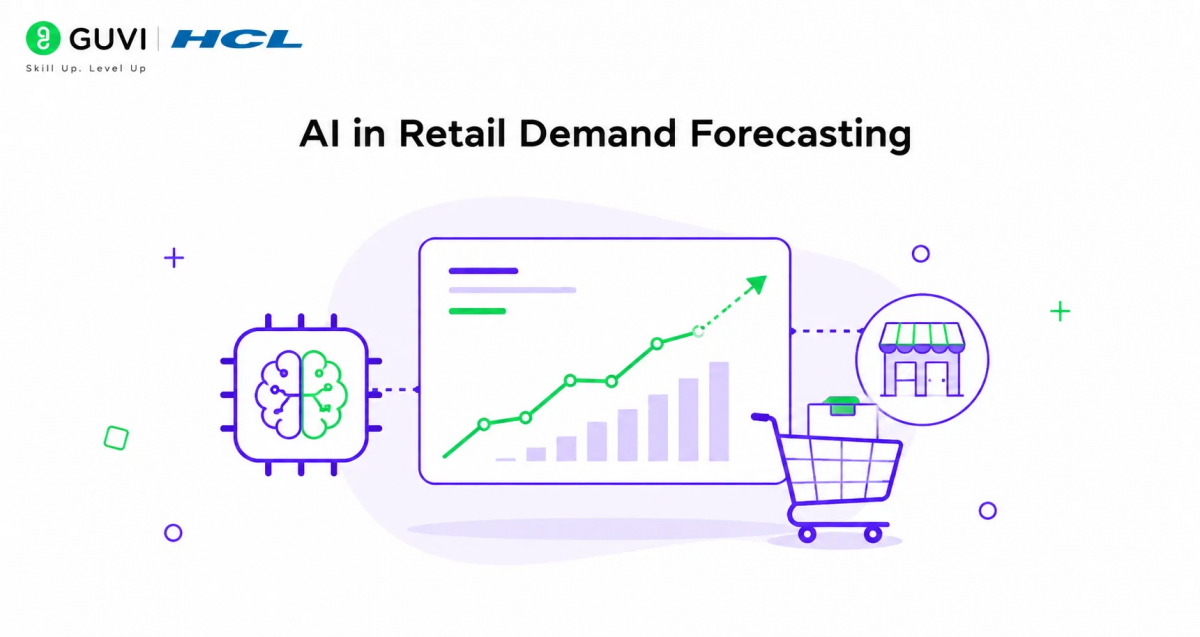
AI-powered demand forecasting transforms inventory management from reactive to predictive by analyzing multiple data streams simultaneously.
Forecasting Models:
- Time Series: ARIMA, Prophet, LSTM networks for trend and seasonality
- External Factors: Weather, holidays, promotions, social media trends
- New Product Forecasting: Transfer learning and cohort analysis
- Hierarchical Forecasting: Category → Brand → SKU-level forecasts with reconciliation.
AI improves merchandise forecasting by reading demand signals that spreadsheets cannot weather: local events, price moves, promotions, and live search trends, and resolving them down to the SKU and store.
Data Requirements for AI Forecasting
The minimum viable dataset for production demand forecasting is 18 months of daily, SKU-level POS data with fewer than 5% gaps.
Retail demand forecasting is not a single model. It is a hierarchical architecture where national category models feed into regional cluster models that feed into store-SKU level predictions.
Models are trained on historical sell-through and continuously corrected against actuals, so accuracy compounds over time.
Measurable Benefits of AI Forecasting
AI-powered demand forecasting can reduce stockouts by 60 to 75 percent and lower inventory carrying costs by 25 to 40 percent.
| Metric | Improvement |
| Stockout Reduction | 60–75% |
| Inventory Carrying Costs | 25–40% reduction |
| Forecast Accuracy | Significantly higher than statistical baselines |
| Payback Period | 6–9 months |
| Gross Margin Impact | Reduced overstock write-downs |
AI demand forecasting models predict SKU-level sales up to 12 weeks ahead with significantly higher accuracy than statistical baselines, reducing overstock write-downs and out-of-stock events.
How AI Personalization Works
AI retail personalization uses real-time behavioral data and machine learning models to deliver individualized product recommendations, pricing, and content increasing conversion rates and average order value across both digital and physical channels.
AI tailors offers, schemes, and pricing to each outlet or shopper based on purchase history, basket composition, and responsiveness, rather than applying one blanket promotion. Product recommendation models predict what a given retailer or customer is most likely to accept next, then trigger the offer at the right moment.
Personalization Use Cases
For online and increasingly in-store:
- Recommendation engines (related products, complementary products, “customers who bought”)
- Personalized search ranking
- Email and push targeting
- Personalized promotions and pricing
- Personalized content (homepage, search results)
The mature stack uses tabular ML on user-item-context features, neural retrieval for candidate generation, and LLMs for explanation and re-ranking in some cases.
Personalization Benefits
Personalization and recommendation engines are the most common applications of AI in retail, followed closely by demand forecasting and inventory optimization. Most retailers begin here because the data is readily available and the return is well-evidenced—personalization alone is linked to a 10–15% revenue uplift (McKinsey).
Instead of stocking stores based on broad category assumptions, retailers can forecast demand at the SKU and customer level—knowing which size will sell fastest, which color resonates locally, which styles are emerging trends, and which products will convert tomorrow.
Implementation Roadmap for AI in Retail
Phase One: Build the Data Foundation (Weeks 1–4)
Start with a single application. The NVIDIA survey confirms: successful retailers begin with demand forecasting or inventory optimization before moving to more complex applications.
Start with the 100 highest-revenue items and compare AI forecasts after four weeks with previous planning values.
Phase Two: Deploy and Validate (Months 1–3)
Activate ML models on selected categories or channels. Validate predictions against actual sales and adjust models accordingly. First proof of value matters more than perfection at this stage.

Phase Three: Scale and Integrate Omnichannel (Month 3+)
Expand the AI application to the full assortment. Connect inventory optimization with personalization: campaigns are specifically aligned with available merchandise. Integrate click-and-collect, real-time inventory display, and cross-channel customer profiles.
Prioritization by ROI and Risk
Here is how to prioritize based on ROI and implementation risk:
- Year One: Demand Forecasting for categories where overstock is a meaningful problem. ROI is fastest, change management is manageable, and the infrastructure investment is proportionate.
- Year One-Two: Email Personalization using collaborative filtering on historical purchase data. Quick to implement, easy to measure, drives immediate lift on email revenue per customer.
- Year Two: Markdown Optimization for seasonal categories where inventory aging is a measurable problem. Integration with pricing systems is complex but the ROI justifies the effort.
- Year Two-Three: Shelf Analytics in high-shrink categories or categories where out-of-stock is a measured business problem. Edge hardware investment is moderate and accuracy is proven.
- Year Three and Beyond: Real-Time Web Personalization once you have cleaned your SKU master data and integrated your transaction history across channels. This is the most complex use case and it is worth doing right once rather than doing it wrong early
Common Mistakes to Avoid
- AI-powered demand forecasting that has zero integration with your customer data, loyalty systems, or inventory positions, producing predictions that cannot account for the events that actually drive demand.
- Starting with real-time web personalization before cleaning SKU master data and integrating transaction history.
- Treating AI forecasting as a single model instead of a hierarchical architecture.
- Expecting immediate results without 18+ months of quality POS data.
- Implementing personalization without connecting to inventory positions and availability.
- Scaling too quickly before validating results on a focused category or channel.
- Ignoring change management and training for merchandising and planning teams.
- Not measuring baseline metrics before AI implementation.
- Overlooking the importance of data quality and gap-filling in historical data.
- Failing to integrate AI predictions into existing planning and replenishment workflows.
AI in retail uses ML models on POS, inventory, and external signals to forecast SKU-level demand and power real-time personalization engines that tailor recommendations, offers, and pricing per shopper. Master AI & ML at HCL GUVI: Artificial Intelligence and Machine Learning.
Did You Know?
Retail used to react to last quarter’s sales. Now AI predicts demand, personalizes experiences, and adjusts pricing in real time, turning shopping from reactive to proactive.
Building an AI-driven retail organization follows a strategic path: Start with visibility by gaining clarity into store conditions, product availability, shopper behavior, and operational execution. Advance to prediction by forecasting demand, predicting out-of-stocks, and identifying emerging trends. Finally, mature into fully automated, hyper-personalized actions through adaptive assortments, automated replenishment, and real-time guidance for teams.
Conclusion
AI in Retail for demand forecasting and personalization represents a fundamental shift from reactive to predictive operations. By using machine learning to predict SKU-level demand 12 weeks ahead and deliver individualized experiences across channels, retailers can reduce stockouts by 60–75%, lower inventory costs by 25–40%, and drive 10–15% revenue uplift from personalization alone.
Implementation requires a phased approach: start with demand forecasting for fastest ROI, validate results, then expand to personalization and pricing optimization. The $240–390 billion in unlocked value makes AI in retail not just a competitive advantage but increasingly a necessity for modern retail operations.
FAQs
What is AI in retail demand forecasting?
AI in retail demand forecasting uses machine learning models to predict SKU-level sales up to 12 weeks ahead by analyzing historical data, weather, promotions, and live demand signals that traditional methods cannot process.fieldassist+1
How does AI personalization work in retail?
AI retail personalization uses real-time behavioral data and machine learning to deliver individualized product recommendations, pricing, and content based on purchase history, basket composition, and customer responsiveness.
What data do I need for AI demand forecasting?
The minimum viable dataset is 18 months of daily, SKU-level POS data with fewer than 5% gaps, integrated with customer data, loyalty systems, and inventory positions.alicelabs+1
What are the benefits of AI in retail?
AI-powered demand forecasting reduces stockouts by 60–75% and lowers inventory carrying costs by 25–40%, while personalization drives 10–15% revenue uplift.alicelabs+1
How long does it take to see ROI from AI in retail?
Demand forecasting typically shows ROI in 6–9 months, while email personalization can drive immediate lift on email revenue per customer.alicelabs+1
Should I start with forecasting or personalization?
Start with demand forecasting for categories where overstock is a meaningful problem. ROI is fastest, change management is manageable, and results justify investment in personalization.aiadvisorypractice
Can small retailers benefit from AI in retail?
Yes. Start with the 100 highest-revenue items, compare AI forecasts with previous planning values, and scale gradually. The ROI of AI makes it accessible even for smaller operations when implemented strategically.
What is the biggest mistake retailers make with AI?
Implementing AI-powered demand forecasting without integration with customer data, loyalty systems, or inventory positions, resulting in predictions that cannot account for events that actually drive demand.
Success Stories

About the Author
HCL GUVI
This article was selected and published as part of the HCL GUVI AI Blogathon 2026, an initiative designed to encourage students, AI enthusiasts, and aspiring tech writers to simplify complex AI concepts through impactful technical content. The contest recognized high-quality, original, and insightful AI-focused blogs, with selected authors receiving publication opportunities on the HCL GUVI blog platform along with official author credits and recognition.
View all posts by HCL GUVI
Connect with me @






Did you enjoy this article?