


Artificial Intelligence and Machine Learning Articles
AI/ML Skills Gap 2026: Why Companies Can't Find Job-Ready Talent
20 AI/ML Interview Questions Recruiters Can Use Without a Tech Background - Best Guide
How Industry-Backed AI/ML Bootcamps Are Changing the AI/ML Hiring Pipeline - Best Guide 2026
From IT Support to AI Engineer: A Realistic Career Switch Guide 2026

Get In Touch For Details! Request More Information
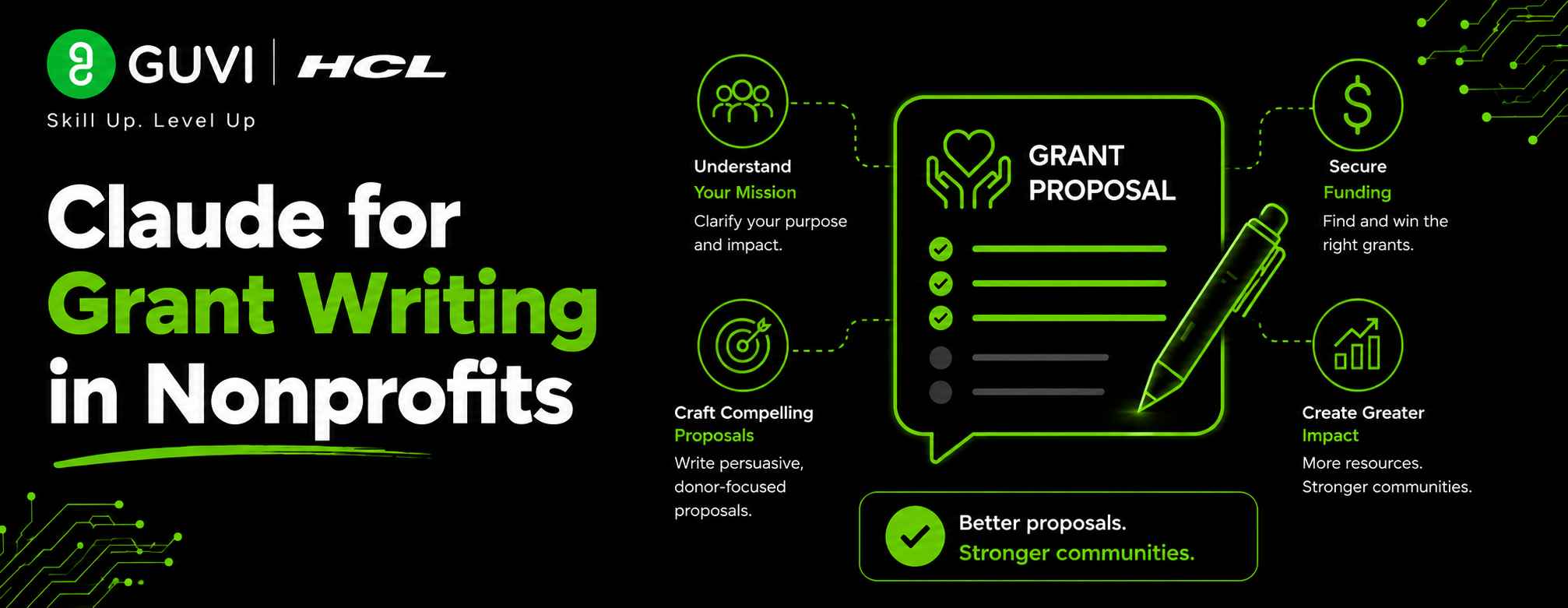
Claude for Grant Writing in Nonprofits
Aug 05, 2026 4 Min Read 331 Views
(Last Updated)
Whether you’re a grant writer, fundraising professional, nonprofit leader, or volunteer, learning how to use Claude effectively can improve your proposal development process and boost productivity.
Table of contents
- TL;DR
- 📊 Data Point
- Why Use Claude for Grant Writing in Nonprofits?
- How to Use Claude for Grant Writing in Nonprofits
- Step 1: Research Grant Opportunities
- Step 2: Summarize Grant Guidelines
- Step 3: Create a Structured Proposal Outline
- Step 4: Draft Individual Proposal Sections
- Step 5: Strengthen Your Proposal Narrative
- Step 6: Organize Supporting Documents
- Step 7: Prepare Budget Narratives
- Step 8: Review and Finalize Your Proposal
- Grant Writing Tasks Claude Can Assist With
- Grant Writing Tasks Claude Cannot Replace
- ⚠️ Warning
- Best Practice
- Conclusion
- FAQs
- What is the Claude grant writing course?
- Can Claude write grant proposals for nonprofits?
- How does Claude improve nonprofit grant writing?
- Can Claude guarantee grant approval?
- Is Claude suitable for small nonprofits?
- Should AI-generated grant proposals be reviewed before submission?
- What are the best practices for using Claude in nonprofit grant writing?
TL;DR
- Claude helps nonprofit organizations research funding opportunities, draft grant proposals, and organize grant documentation more efficiently.
- It assists with proposal outlines, impact statements, budget narratives, and grant application summaries while reducing repetitive writing tasks.
- Nonprofit professionals can use Claude as an AI-powered grant writing assistant without compromising control over strategy or final submissions.
- AI enhances productivity throughout the grant writing process but should always complement human expertise, fact-checking, and compliance.
- Every grant application should be reviewed, customized, and verified to align with the funding organization’s requirements.
HCL GUVI’s Business Analytics Course equips learners with analytical, reporting, and AI-powered decision-making skills that help organizations evaluate program outcomes, measure impact, and strengthen evidence-based funding strategies.
📊 Data Point
According to Giving USA, charitable giving in the United States surpassed $590 billion, making grant funding increasingly competitive and emphasizing the need for well-researched, persuasive, and data-driven grant proposals.
Preparing a competitive grant proposal can take dozens of hours, especially for complex funding applications. Using Claude for grant writing can summarize lengthy guidelines, organize proposal sections, refine narratives, and identify missing information, helping nonprofit teams spend more time demonstrating their mission and measurable community impact.
Why Use Claude for Grant Writing in Nonprofits?
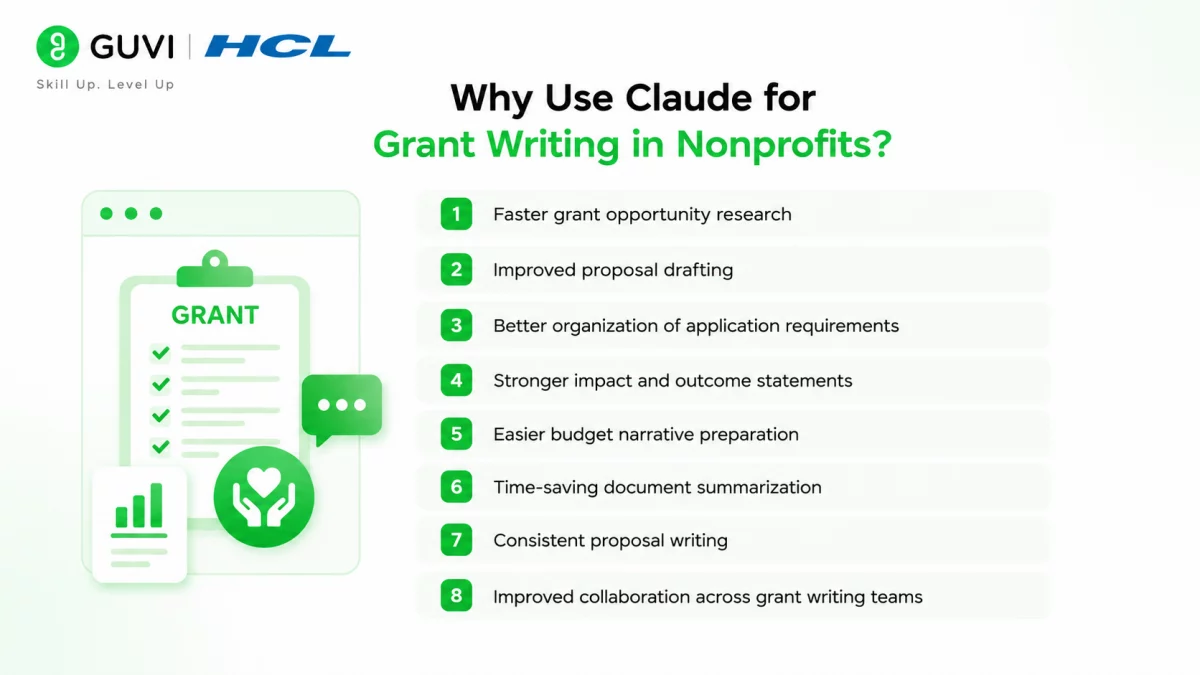
Grant writing involves much more than producing well-written proposals. Nonprofit professionals must research funding opportunities, interpret application requirements, gather supporting evidence, prepare budgets, and clearly communicate their organization’s impact. Claude simplifies many of these responsibilities by helping teams organize information, draft content, and improve proposal quality throughout the application process.
Some major advantages include:
- Faster grant opportunity research
- Improved proposal drafting
- Better organization of application requirements
- Stronger impact and outcome statements
- Easier budget narrative preparation
- Time-saving document summarization
- Consistent proposal writing
- Improved collaboration across grant writing teams
By automating repetitive writing and research tasks, Claude enables nonprofit organizations to focus more on developing impactful programs and creating compelling funding proposals.
How to Use Claude for Grant Writing in Nonprofits
Step 1: Research Grant Opportunities
Identify grant providers whose funding priorities align with your nonprofit’s mission. Gather information about eligibility criteria, deadlines, funding amounts, required documents, and evaluation guidelines before beginning the proposal.
Step 2: Summarize Grant Guidelines
Paste lengthy funding guidelines into Claude and ask it to summarize important details such as eligibility requirements, submission instructions, evaluation criteria, required attachments, and deadlines.
Step 3: Create a Structured Proposal Outline
Use Claude to generate a logical proposal framework covering the executive summary, organizational background, problem statement, project objectives, implementation strategy, evaluation plan, sustainability approach, and budget overview.
Step 4: Draft Individual Proposal Sections
Claude can help create first drafts for needs assessments, project descriptions, organizational capacity statements, expected outcomes, community impact sections, and sustainability plans using information provided by your nonprofit.
Step 5: Strengthen Your Proposal Narrative
Ask Claude to improve readability, clarity, and persuasiveness while ensuring your proposal aligns with the funding organization’s priorities and review criteria.
Step 6: Organize Supporting Documents
Claude can help organize project timelines, evaluation frameworks, partnership letters, budget explanations, and other supporting materials required during the grant application process.
Step 7: Prepare Budget Narratives
Provide your financial data and ask Claude to draft a clear budget narrative explaining how the requested funds will be allocated and how each expense supports the project’s goals.
Step 8: Review and Finalize Your Proposal
Before submission, carefully verify every AI-generated section, confirm factual accuracy, ensure compliance with grant guidelines, and customize the proposal to reflect your organization’s unique strengths and objectives.
Grant Writing Tasks Claude Can Assist With
Claude supports nonprofit organizations throughout every stage of the grant writing lifecycle.
It can help with:
- Grant opportunity research
- Funding guideline summarization
- Proposal outlines
- Executive summaries
- Needs assessments
- Impact statement drafting
- Budget narrative preparation
- Editing and proofreading
- Document organization
- Proposal refinement and language improvement
The HCL GUVI AI eBook also introduces practical AI concepts, prompt engineering techniques, and real-world AI applications that help nonprofit professionals streamline grant research, improve proposal writing, organize documentation, and use AI more effectively across fundraising and nonprofit operations.

Grant Writing Tasks Claude Cannot Replace
While Claude is a powerful AI assistant for nonprofit grant writing, certain responsibilities require human expertise, organizational knowledge, and strategic decision-making. AI can improve efficiency, but it cannot replace the experience, credibility, and judgment needed to develop successful grant proposals.
Claude should not replace:
- Building relationships with funding organizations
- Defining your nonprofit’s mission and long-term strategy
- Collecting accurate organizational and financial data
- Creating realistic project budgets and financial plans
- Verifying compliance with grant requirements
- Making strategic funding decisions
- Demonstrating authentic community impact
- Reviewing and approving final grant submissions
Using Claude alongside experienced grant writers allows nonprofit organizations to streamline repetitive tasks while maintaining proposal quality, credibility, compliance, and alignment with each funder’s expectations.
Professionals looking to strengthen their analytical and decision-making skills can also explore the HCL GUVI Business Analytics Course, which covers data analysis, business intelligence, dashboards, and visualization techniques that help nonprofit organizations track impact, improve reporting, and create stronger data-driven grant applications.
⚠️ Warning
Claude should enhance your grant writing process not replace professional judgment. Always verify organizational information, budget figures, supporting evidence, and AI-generated content before submitting any proposal. Every funding organization has unique requirements, so ensure your application complies with all eligibility criteria, formatting guidelines, and submission instructions.
Best Practice
To maximize the benefits of the Claude Grant Writing Course:
- Research funding organizations before drafting proposals.
- Carefully review every AI-generated response.
- Tailor each proposal to the specific funding opportunity.
- Support claims with accurate organizational data and measurable outcomes.
- Verify budgets, timelines, and supporting documents.
- Follow every grant provider’s submission guidelines.
- Combine AI assistance with strategic planning and human expertise.
Conclusion
Claude is transforming how nonprofit organizations approach grant writing by simplifying research, proposal drafting, document organization, and content refinement. Instead of spending countless hours managing repetitive writing tasks, nonprofit professionals can use Claude to prepare stronger proposals more efficiently while focusing on creating meaningful community impact.
However, successful grant applications still depend on strategic planning, accurate organizational data, persuasive storytelling, and compliance with funder requirements. When combined with thoughtful human review and responsible AI usage, the Claude Grant Writing Course can help nonprofit teams improve productivity, strengthen proposal quality, and increase confidence throughout the grant writing process.
FAQs
1. What is the Claude grant writing course?
The Claude Grant Writing Course teaches nonprofit professionals how to use Claude to research funding opportunities, summarize grant requirements, draft persuasive proposals, organize supporting documents, and streamline the grant writing process.
2. Can Claude write grant proposals for nonprofits?
Yes. Claude can help create proposal outlines, executive summaries, needs assessments, impact statements, budget narratives, and other proposal sections. However, every proposal should be reviewed and customized before submission.
3. How does Claude improve nonprofit grant writing?
Claude accelerates grant writing by summarizing funding guidelines, organizing proposal content, refining language, generating structured drafts, and reducing repetitive research and writing tasks.
4. Can Claude guarantee grant approval?
No. Claude helps improve the proposal preparation process, but funding decisions depend on proposal quality, organizational impact, eligibility, competition, and the grant provider’s evaluation criteria.
5. Is Claude suitable for small nonprofits?
Yes. Small nonprofits, charities, community organizations, and foundations can use Claude to improve efficiency, reduce administrative workload, and prepare higher-quality grant applications.
6. Should AI-generated grant proposals be reviewed before submission?
Absolutely. Every AI-generated proposal should be verified for factual accuracy, funding compliance, organizational alignment, and overall quality before it is submitted.
7. What are the best practices for using Claude in nonprofit grant writing?
Research funding opportunities thoroughly, verify AI-generated information, customize every proposal, review budgets and supporting documents carefully, follow grant guidelines, and combine AI assistance with human expertise to create stronger funding applications.
Success Stories

About the Author
Vishalini Devarajan
An Aerospace Engineer turned content writer, I focus on making complex concepts easy to understand through well-structured, reader-friendly blogs. Whether it’s a technical topic or a non-technical one, I love creating content that is clear, engaging, and impactful.
View all posts by Vishalini Devarajan
Connect with me @







Did you enjoy this article?