


Data Science Articles
How Long Does It Take to Move From BPO to Data Analytics?
Can an Operations Assistant Manager Switch to Data Analytics or Data Science?
BPO to Data Analyst : Is It Time to Switch? | Skills, Roadmap & Career Path
Excel to Data Analytics: Is Excel Enough for Finance Professionals?

Get In Touch For Details! Request More Information

How Can a BPO Professional With 5–10 Years of Experience Get a Data Analyst Job?
Oct 12, 2026 3 Min Read 25 Views
(Last Updated)
After spending 5–10 years in a BPO, moving into Data Analytics can feel like starting your career again. However, your experience with performance metrics, customer trends, quality reports, and process improvement can provide a useful foundation. The challenge is translating that experience into demonstrable analytical skills that employers recognise when hiring for Data Analyst positions.
Table of contents
- TL;DR
- Quick Answer
- Does 5–10 Years of BPO Experience Help You Become a Data Analyst?
- How Should Senior BPO Professionals Prepare for the Transition?
- Identify Your Existing Analytical Exposure
- Learn Tools in a Practical Order
- Which Projects Can Make Your BPO Experience Relevant?
- Customer Complaint Analysis
- Quality Performance Dashboard
- Service-Level Analysis
- Attrition Trend Analysis
- How Can You Apply for Data Analyst Jobs Without Starting From Zero?
- How Should You Present Your Experience on Your Resume?
- Conclusion
- FAQs
- Can someone with 10 years of BPO experience become a Data Analyst?
- Is BPO experience useful for Data Analyst jobs?
- Can a non-IT professional become a Data Analyst?
- Which skills should I learn first?
- Do I need a Data Analyst certification?
- Will I have to accept a lower-level position?
- How can I prove my analytical skills without work experience?
TL;DR
- Experienced BPO professionals can transition into Data Analytics without discarding their existing work experience.
- The key is demonstrating analytical ability rather than relying on years of service alone.
- SQL, Excel, Power BI, and basic statistics are important skills to develop.
- Projects based on familiar BPO problems can strengthen your portfolio.
- Your first analytics role may differ in seniority from your current position.
Quick Answer
| A BPO professional with 5–10 years of experience can pursue a Data Analyst job by learning essential analytical tools, building practical projects, and presenting relevant work experience effectively. Start by identifying the reports and performance metrics you already understand, then learn to analyse the underlying data independently. |
Does 5–10 Years of BPO Experience Help You Become a Data Analyst?
Yes, but the value of BPO experience depends on your responsibilities. Experience with quality scores, customer metrics, productivity, and service-level reports provides useful business context.
The key difference is moving from simply monitoring reports to analysing why performance changes. Your BPO experience helps you ask relevant questions, while data skills help you find the answers.
How Should Senior BPO Professionals Prepare for the Transition?
1. Identify Your Existing Analytical Exposure
Start by reviewing your current and previous responsibilities. Have you prepared Excel reports, monitored team performance, tracked quality scores, investigated recurring errors, or compared monthly results?
These activities can help you identify where your experience overlaps with analytics.
Create a list of the metrics you have worked with and the decisions they supported. This exercise will help you choose relevant portfolio projects and explain your background during interviews.
Do not claim formal data analysis experience unless you have performed that work. Instead, identify your existing exposure and build the missing capabilities.
2. Learn Tools in a Practical Order
Focus on tools that help you complete common Data Analyst tasks.
- Excel: Practise formulas, pivot tables, data cleaning, and trend analysis.
- SQL: Learn to retrieve records, join tables, filter information, and calculate metrics.
- Power BI: Build dashboards that communicate patterns and performance changes.
- Statistics: Understand averages, percentages, distributions, and correlation.
- Python: Learn it after establishing the fundamentals, especially if your target roles require automation or more advanced analysis.
You do not need to master every tool before applying. However, you should be able to demonstrate the skills listed in the job descriptions you target.
Which Projects Can Make Your BPO Experience Relevant?
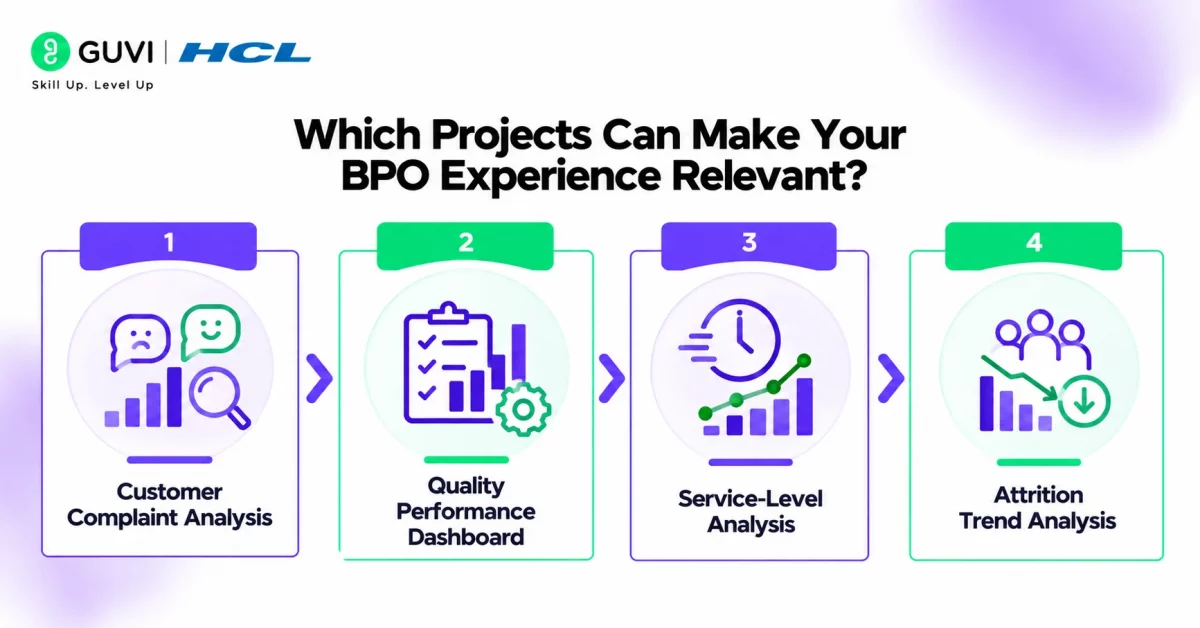
Generic dashboards may demonstrate tool knowledge, but projects connected to your professional background can also show that you understand business problems.
Consider these examples:
1. Customer Complaint Analysis
Use sample data to categorise complaints, compare monthly trends, and identify categories with increasing volumes.
2. Quality Performance Dashboard
Analyse sample quality scores across teams, time periods, or evaluation categories. Use Power BI to highlight patterns that deserve further investigation.
3. Service-Level Analysis
Examine synthetic data on response times, workload, and missed service-level targets. Identify periods when performance deteriorates and possible contributing factors.
4. Attrition Trend Analysis
Use publicly available or synthetic workforce data to explore patterns in employee turnover. Clearly distinguish observed relationships from proven causes.
For every project, explain the business question, data preparation, analytical method, findings, and recommendations. Publish the work in a portfolio and include relevant project links on your resume.
Never use confidential customer or employer data.
The same business metric can tell different stories depending on its context. For example, a lower average handling time may indicate improved efficiency, but it could also coincide with declining quality scores. Comparing related metrics helps analysts investigate performance more accurately.

How Can You Apply for Data Analyst Jobs Without Starting From Zero?
- A career transition does not automatically mean you must accept the same level as a fresher. However, your previous experience does not guarantee a senior analytics position either.
- Target roles based on your demonstrated analytical skills, not solely on your years in BPO.
- Read job descriptions carefully. Some positions prioritise reporting and dashboards, while others require advanced SQL, Python, or statistical analysis.
- During applications, highlight transferable business knowledge and separate it from your newly acquired technical capabilities. Be prepared to complete practical assessments that test data cleaning, querying, visualisation, and interpretation.
How Should You Present Your Experience on Your Resume?
Your resume should make the connection between your BPO background and analytics clear.
Instead of writing only that you monitored team performance, describe the metrics you tracked and the business purpose of the reporting.
For example:
- Before: Responsible for daily performance reporting.
- Stronger: Monitored daily productivity and quality metrics, prepared performance summaries, and highlighted recurring deviations for management review.
Use the stronger version only if it accurately reflects your responsibilities.
Create a separate technical skills section for Excel, SQL, Power BI, and other tools you can use confidently. Include portfolio projects that demonstrate your ability to analyse data independently.
During interviews, explain how your understanding of customer operations or service delivery helps you interpret findings. Avoid presenting management experience as a substitute for technical proficiency.
Conclusion
A BPO professional with 5–10 years of experience can pursue a Data Analyst job by combining existing business knowledge with demonstrable technical skills. The most important step is moving beyond monitoring reports to independently analysing data and explaining findings.
Start with Excel, SQL, and Power BI, then build projects around customer complaints, quality performance, or service-level trends. Update your resume to highlight relevant experience without overstating your analytical responsibilities.
Your years in BPO can provide valuable context, but your ability to work with data will determine how effectively you make the transition.
FAQs
1. Can someone with 10 years of BPO experience become a Data Analyst?
Yes. They can transition by developing relevant technical skills and demonstrating analytical ability through practical projects.
2. Is BPO experience useful for Data Analyst jobs?
It can be useful when the experience includes reporting, performance metrics, quality monitoring, or process improvement.
3. Can a non-IT professional become a Data Analyst?
Yes. A non-IT background does not automatically prevent the transition, although employer requirements vary.
4. Which skills should I learn first?
Start with Excel and SQL, then learn Power BI and basic statistics. Add Python based on your target roles.
5. Do I need a Data Analyst certification?
Not always. Certifications can structure learning, but practical skills and projects are also important when applying for jobs.
6. Will I have to accept a lower-level position?
Possibly. Your first analytics role depends on your technical skills and the employer’s requirements, not just your total work experience.
7. How can I prove my analytical skills without work experience?
Build independent projects using public or synthetic datasets, document your methods, and explain your findings and recommendations clearly.
Success Stories

About the Author
HCL GUVI
This article was selected and published as part of the HCL GUVI AI Blogathon 2026, an initiative designed to encourage students, AI enthusiasts, and aspiring tech writers to simplify complex AI concepts through impactful technical content. The contest recognized high-quality, original, and insightful AI-focused blogs, with selected authors receiving publication opportunities on the HCL GUVI blog platform along with official author credits and recognition.
View all posts by HCL GUVI
Connect with me @









Did you enjoy this article?