


Career Articles
Do Managers Need Coding to Move Into Data Analytics or Data Science?
Finance Career Growth After 5+ Years: Should You Add Data Skills?
What BPO Skills for Data Analytics Transfer to a Data Analyst Career? - Best Guide
Which Data Roles Suit a BPO Team Lead With People-Management Experience?


Get In Touch For Details! Request More Information
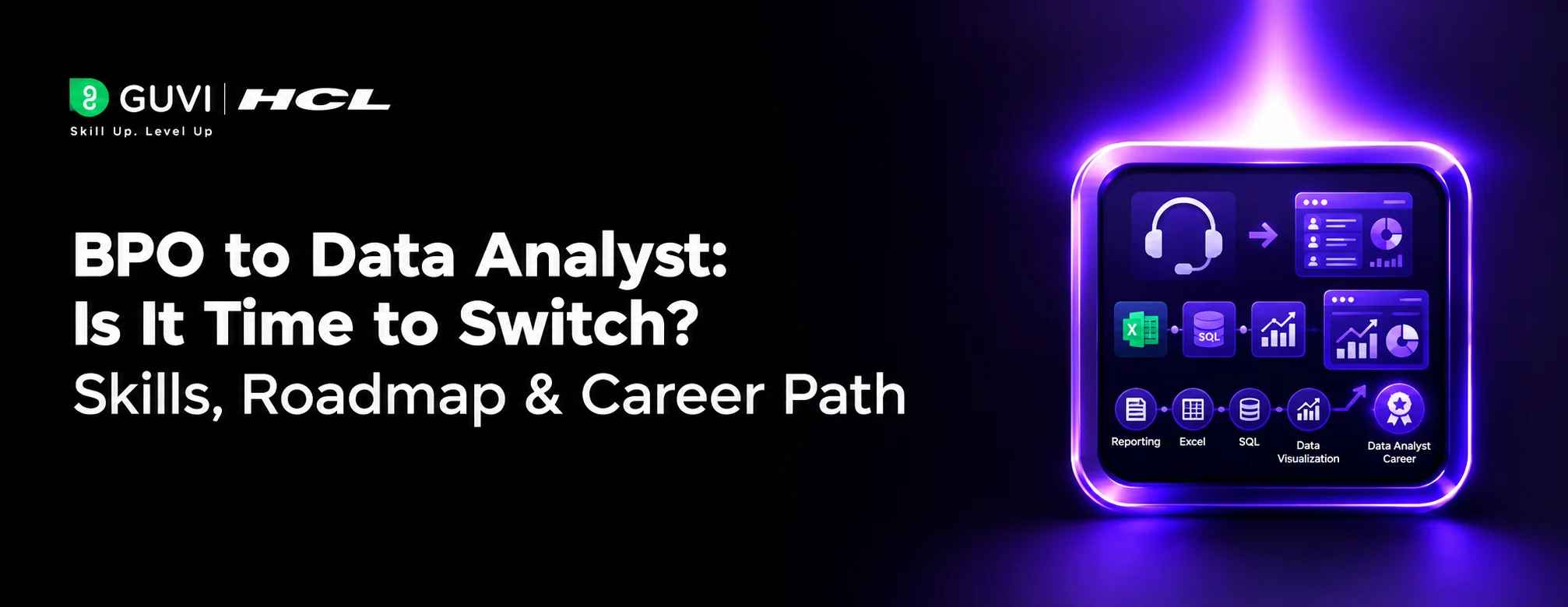
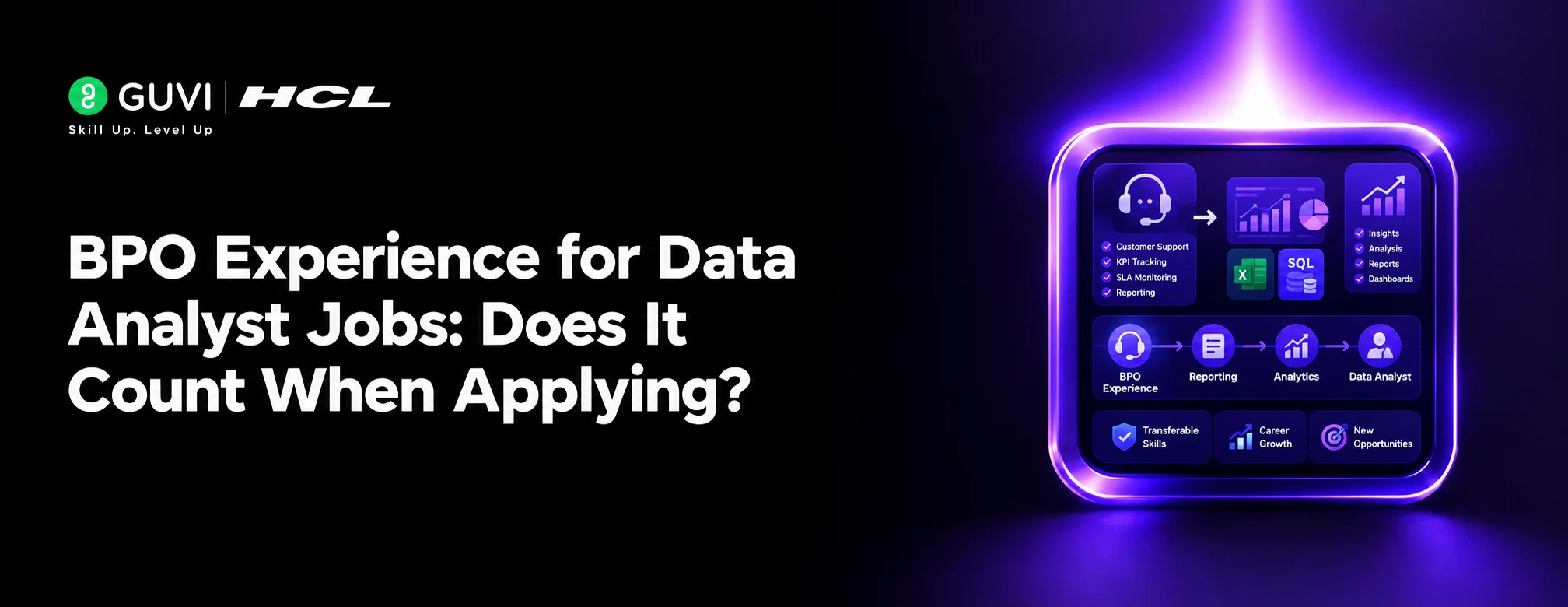
BPO to Data Analyst : Is It Time to Switch? | Skills, Roadmap & Career Path
Oct 09, 2026 5 Min Read 26 Views
(Last Updated)
What if the customer data, performance reports, and business metrics you work with in a BPO could open doors to an entirely different career? One with opportunities beyond traditional customer support and operations roles?
India’s Data Analytics market is projected to reach $47.5 billion by 2033, according to Grand View Research. And if you’ve been thinking about your next career move, a BPO to Data Analyst transition might be more realistic than you think.
Of course, knowing your way around BPO operations isn’t enough. You’ll need technical skills, practical projects, and a clear plan to make the switch.
So, where should you begin, especially if you’re already a few years into your career? Let’s explore the skills, roadmap, and career opportunities that can help you get there.
Table of contents
- TL;DR
- Can a BPO Employee Become a Data Analyst Without an IT Degree?
- How Is Data Analytics Used in the BPO Industry?
- A Practical Example
- What Skills Do BPO Employees Need to Become Data Analysts?
- Which Skills Should You Learn First?
- How Can You Prepare for a Data Analyst Role in 6 Months?
- Which Data Analytics Projects Should BPO Professionals Build?
- Call Centre Performance Dashboard
- Customer Satisfaction Analysis
- Workforce Planning and Call Volume Analysis
- How Can You Get Your First Data Analyst Job After BPO?
- 1) Explore internal opportunities
- 2) Target related job roles
- 3) Update your resume
- 4) Prepare for practical interviews
- What Challenges Should You Expect When Switching From BPO to Data Analytics?
- 1) Salary adjustments
- 2) Competition for jobs
- 3) Finding time to learn
- 4) Technical interview challenges
- Wrapping Up
- Frequently Asked Questions
- Can I make a BPO to Data Analyst career switch while working night shifts?
- Is coding compulsory for a Data Analyst job?
- Can I become a freelance Data Analyst after working in a BPO?
- Is 30 or 35 too late for a career transition into Data Analytics?
- Is a non-IT to Data Analytics transition harder than switching from a technical role?
TL;DR
- A BPO to Data Analyst career switch is possible, even without an IT degree.
- Skills like Excel, SQL, Power BI, and basic statistics can help you prepare for analytics roles.
- Your experience with customer data, performance metrics, and business operations can be an advantage.
- A focused 6-month learning plan, supported by practical projects, can help you build job-ready skills.
- Early-career and experienced BPO professionals can explore opportunities in reporting, business operations, and Data Analytics, depending on their skills and experience.
Can a BPO Employee Become a Data Analyst Without an IT Degree?
Yes, you can become a Data Analyst after working in a BPO, even without an IT degree. Employers often look for practical skills, analytical thinking, and the ability to work with data, although some companies may have specific educational requirements.
Your starting point will depend on your current role and experience.
- Early-career BPO professionals: If you’ve spent a few years in customer support or operations, you can start learning Excel, SQL, and data visualisation while building projects that demonstrate your skills.
- Experienced BPO professionals: If you’ve worked in quality assurance, reporting, workforce management, or operations, you may already have experience analysing performance and identifying process improvements.
You don’t necessarily need another degree, but you should understand the roles and responsibilities of a Data Analyst and be able to demonstrate relevant skills. Your first opportunity could even be within the BPO industry itself.
How Is Data Analytics Used in the BPO Industry?
BPO companies handle huge amounts of data every day, including customer interactions, call durations, service ratings, and employee performance. Data Analysts use this information to identify problems, improve efficiency, and help teams make better decisions.
Here are some common applications:
| Area | How Data Analytics Helps |
| Call Centre Performance | Analyses call volumes, average handling time (AHT), and resolution rates to identify performance gaps. |
| Customer Satisfaction | Studies CSAT scores, complaints, and feedback to understand why customers are unhappy. |
| Workforce Management | Examines call patterns and staffing requirements to improve shift planning. |
| Quality Assurance | Identifies recurring service issues and areas where agents may need additional training. |
| Operational Reporting | Creates dashboards that help managers track KPIs and monitor team performance. |
A Practical Example
Imagine a BPO receives 10,000 customer calls every month, but its customer satisfaction scores have started dropping.
A Data Analyst might compare call durations, repeat complaints, resolution rates, and customer feedback to identify possible reasons. Using data visualisation techniques, they could then create a dashboard showing which issues need attention.
This is one reason a BPO to Data Analytics transition can make sense. You may already understand the business problems. The next step is learning how to investigate them using data.
What Skills Do BPO Employees Need to Become Data Analysts?
If you’re planning a BPO to Data Analyst career switch, you may already have some useful workplace skills. The main challenge is learning the technical tools that help you analyse data rather than simply record or report it.
Here’s how your existing experience can support the transition:
| Skills You May Already Have | Skills You Need to Develop |
| Reporting: Tracking daily targets, KPIs, and team performance | Advanced Excel: Pivot tables, XLOOKUP, formulas, and data cleaning |
| Problem-solving: Identifying customer issues and recurring complaints | SQL: Extracting, filtering, and analysing data from databases |
| Process knowledge: Understanding workflows and operational bottlenecks | Power BI or Tableau: Building interactive dashboards |
| Communication: Explaining issues and updates to customers or managers | Statistics: Understanding averages, trends, distributions, and correlations |
| Attention to detail: Maintaining accurate records and checking reports | Python (optional initially): Automating tasks and analysing larger datasets |
Which Skills Should You Learn First?
For beginners, we suggest prioritising:
- Excel: Get comfortable cleaning data, using formulas, and creating reports.
- SQL: Learn to retrieve and combine data using queries.
- Power BI: Practise building dashboards that communicate useful insights.
- Basic Statistics: Understand patterns, comparisons, and relationships in data.
You can add Python once you’re comfortable with these fundamentals. The exact tools required will depend on the role you’re targeting.
In 1858, Florence Nightingale used a striking circular diagram to show that more soldiers were dying from preventable diseases than battlefield injuries. Data visualisation was influencing major decisions long before Power BI existed!
How Can You Prepare for a Data Analyst Role in 6 Months?
You can start preparing for a Data Analyst role while continuing your BPO job. A structured six-month plan or a solid roadmap can help you build your skills gradually, even if you’re starting without a technical background.
Here’s how you can organise your learning:
| Timeline | What to Learn | Practical Goal |
| Month 1 | Advanced Excel, Pivot Tables, formulas, and data cleaning | Analyse a customer support report |
| Month 2 | SQL queries, JOINs, GROUP BY, and aggregations | Write queries to analyse customer and sales data |
| Month 3 | Power BI, Power Query, DAX basics, and dashboards | Create a call centre performance dashboard |
| Month 4 | Basic statistics, distributions, correlation, and trends | Examine customer satisfaction data trends |
| Month 5 | Apply your skills through real-world datasets and projects | Complete 2–3 portfolio projects |
| Month 6 | Resume preparation, SQL practice, and interview questions | Begin applying for relevant roles |
How much time should you dedicate? Around 7–10 hours a week is a reasonable starting point for working professionals. You could spend 45–60 minutes on weekdays and reserve a few hours over the weekend for projects.
This is a suggested timeline, not a guarantee of job readiness. You may need more time depending on your starting point and the roles you’re targeting.
Which Data Analytics Projects Should BPO Professionals Build?
Learning Excel, SQL, and Power BI is one thing. But can you actually use them to solve a business problem? That’s what your portfolio should demonstrate.

Since you’re familiar with BPO operations, you can start with projects that reflect situations you’ve encountered at work.
1. Call Centre Performance Dashboard
- What to do: Analyse call volumes, average handling time (AHT), first-call resolution, and agent performance.
- Tools: Excel, SQL, and Power BI.
- Final output: An interactive dashboard highlighting performance trends and areas needing improvement.
2. Customer Satisfaction Analysis
- What to do: Study customer ratings, complaint categories, repeat calls, and resolution times to identify possible reasons for low satisfaction scores.
- Tools: Excel, SQL, and basic statistics.
- Final output: A short report with charts, findings, and recommendations for improving customer experience.
3. Workforce Planning and Call Volume Analysis
- What to do: Examine hourly call volumes, peak periods, and staffing levels to understand when additional support may be needed.
- Tools: Excel and Power BI.
- Final output: A dashboard comparing call demand with staffing patterns, along with suggested scheduling improvements.
You can use public or simulated datasets for these projects. Avoid uploading confidential customer or company information to your portfolio.
Even two well-executed projects can be more useful than several unfinished ones. Focus on explaining the problem, your analysis, and what the findings mean for the business.
How Can You Get Your First Data Analyst Job After BPO?
Once you’ve developed the required skills and completed a few projects, the next challenge is finding the right opportunity. Your first Data Analyst role doesn’t necessarily have to be outside the BPO industry.
Here are some practical ways to approach your job search:
1) Explore internal opportunities
Many BPO companies have MIS, reporting, workforce analytics, and business intelligence teams. An internal move could help you gain analytics experience while staying in a familiar industry.
2) Target related job roles
Along with Data Analyst positions, consider MIS Analyst, Reporting Analyst, Operations Analyst, and Workforce Analyst roles. Check the actual responsibilities, since job titles can vary between companies.
3) Update your resume
Highlight your experience with KPIs, reporting, process improvements, and data-driven decisions. Add your technical skills and portfolio projects, but don’t claim tools you haven’t used professionally.
4) Prepare for practical interviews
Practice SQL queries, Excel exercises, dashboard explanations, and questions about your projects. Be ready to explain how your analysis could solve a business problem.
What Challenges Should You Expect When Switching From BPO to Data Analytics?
A career switch can open up new opportunities, but it may not be as straightforward as completing a course and applying for jobs. Here are a few challenges worth preparing for:
1) Salary adjustments
Your first analytics offer may not match your current salary, particularly if you have 5+ years of BPO experience but limited technical experience.
2) Competition for jobs
You’ll compete with graduates and other career switchers. Targeting reporting, workforce analytics, or operations-focused roles could give you a more relevant starting point.
3) Finding time to learn
Rotational shifts and work commitments can make studying difficult. A manageable weekly schedule can help you stay consistent.
4) Technical interview challenges
Be prepared to solve SQL queries, interpret datasets, and explain your dashboards rather than simply listing tools on your resume.
Wrapping Up
Data Analytics is gaining ground across industries, and staying limited to traditional BPO roles could mean missing out on opportunities that your existing experience might help you pursue. A BPO to Data Analyst transition won’t happen overnight, but with the right skills, practical projects, and consistent effort, you can start preparing for a career with broader growth possibilities. Why wait until you feel stuck to explore your next move?
HCL GUVI’s Advanced Data Science and Generative AI Program offers mentor-led training, expert guidance, hands-on projects, placement support, and access to a network of 1,000+ hiring partners. If you’re just beginning to explore the field, the self-paced Data Science and Analytics course can help you build foundational skills in Data Analytics at your own pace.
So, in summary, the opportunities are growing. The question is, are you preparing for them?
Frequently Asked Questions
1. Can I make a BPO to Data Analyst career switch while working night shifts?
Yes! You can prepare alongside your current job and apply for analytics roles with schedules that suit you. Just remember that some analytics teams also work rotational shifts.
2. Is coding compulsory for a Data Analyst job?
Not always. Many entry-level roles focus on Excel, SQL, and Power BI. SQL is important, but you don’t necessarily need advanced Python programming skills to get started.
3. Can I become a freelance Data Analyst after working in a BPO?
Yes, although finding clients without a portfolio can be challenging. You could begin with smaller projects involving Excel reporting, dashboard creation, or data cleaning to build credibility.
4. Is 30 or 35 too late for a career transition into Data Analytics?
Not at all! There’s no universal age limit for becoming a Data Analyst. Your skills, projects, and relevant work experience generally matter more, although employers may have specific hiring criteria.
5. Is a non-IT to Data Analytics transition harder than switching from a technical role?
It can take more preparation initially, especially if you’re unfamiliar with databases or analytical tools. However, your industry experience can be an advantage, and practical skills matter more than simply having a technical background.
Success Stories











Did you enjoy this article?