


Software Development Articles
How to Read and Understand System Design Diagrams?
System Engineer Roles and Responsibilities: 12 Proven Duties for Growth
SAP Consultant Roles and Responsibilities: 12 Proven Duties for Growth and Success
Network Engineer Roles and Responsibilities: 12 Essential Duties for Success


Get In Touch For Details! Request More Information

10 Best System Design Courses in 2026 (Free + Paid)
Jun 29, 2026 7 Min Read 3064 Views
(Last Updated)
If you’ve ever wondered how Instagram handles hundreds of millions of photos a day without crashing, or how WhatsApp delivers messages to billions of users in milliseconds, that’s system design at work behind the scenes.
For a long time, system design was considered an advanced topic that only senior engineers needed to worry about. That’s no longer the case. In 2026, it’s a core competency tested across all mid-to-senior engineering roles, and it’s increasingly separating developers who write code from engineers who build systems that scale.
The challenge? Most developers don’t know where to start. There’s no shortage of resources, but finding a course that’s genuinely focused on system design, not padded with unrelated content, is harder than it sounds. This article does that work for you. Every course on this list is strictly about system design: scalability, distributed systems, HLD, LLD, architecture trade-offs, and real-world design problems. Nothing else.
Table of contents
- TL;DR Summary
- What is System Design and Why Does It Matter in 2026?
- 10 Best System Design Courses in 2026
- HCL GUVI’s System Design Course
- Mastering the System Design Interview — Frank Kane (Udemy)
- Grokking the System Design Interview — DesignGurus.io
- Grokking the Modern System Design Interview — Educative.io
- ByteByteGo — System Design Interview Course
- System Design Masterclass — Arpit Bhayani
- Mastering System Design: From Basics to Cracking Interviews — Udemy
- Novice to Ninja: System Design (High Level Design) 2026 — Udemy
- System Design for Beginners — Arpit Bhayani
- System Design Interview Questions — 350+ Questions (2026) — Udemy
- How to Choose the Right Course for You
- Conclusion
- FAQs
- What is system design?
- What is the difference between HLD and LLD?
- Do I need to know coding before learning system design?
- How long does it take to get interview-ready in system design?
- Which system design course is best for FAANG preparation?
TL;DR Summary
System design is one of the most in-demand skills for software engineers in 2026, and choosing the right course can make a significant difference in your career. Here’s what this guide covers:
- This guide breaks down the 10 best system design courses in 2026 — strictly focused on system design, covering scalability, distributed systems, HLD, LLD, and architecture.
- Each course is listed with duration, price, features, learning outcomes, and a verified direct link to the course page.
- The guide covers platforms like HCL GUVI, Udemy, ByteByteGo, DesignGurus.io, Educative, and more.
- Whether you’re a beginner or preparing for FAANG-level interviews, there’s a course here that fits your goals and budget.
- It also answers common questions around prerequisites, interview prep, and how long system design takes to learn.
- GUVI’s System Design Course leads the list as the top pick for structured, certification-backed learning with hands-on practice.
What is System Design and Why Does It Matter in 2026?
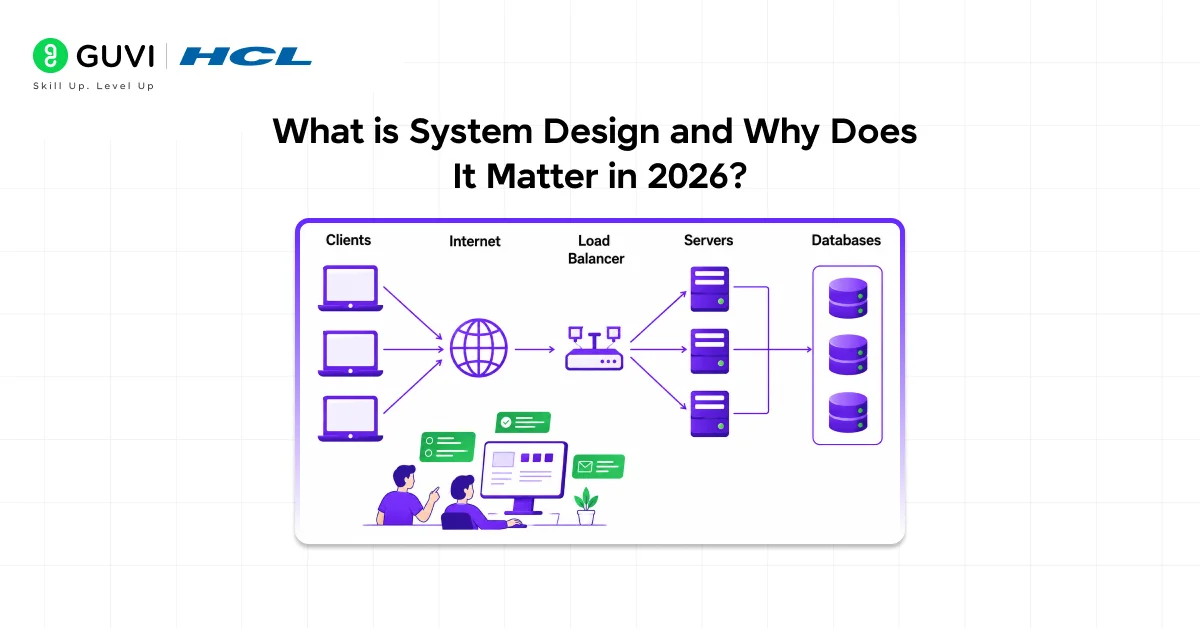
System design is the process of defining the architecture, components, and data flow of a software system to meet specific requirements, things like handling millions of concurrent users, maintaining 99.99% uptime, or recovering from failures without data loss.
It covers concepts like:
- High-Level Design (HLD) — system architecture, major components, and data flow
- Low-Level Design (LLD) — class design, API structure, and database schema
- Scalability — horizontal vs vertical scaling, load balancing
- Database design — SQL vs NoSQL, replication, and sharding
- Caching strategies — Redis, Memcached, cache eviction policies
- Fault tolerance — redundancy, failover, and disaster recovery
- Message queues and event-driven architecture
According to Uptime Institute’s 2025 outage analysis, more than half of serious system outages cost over $100,000, and one in five cost over $1 million. That’s exactly why companies value engineers who can design resilient systems from the ground up.
10 Best System Design Courses in 2026
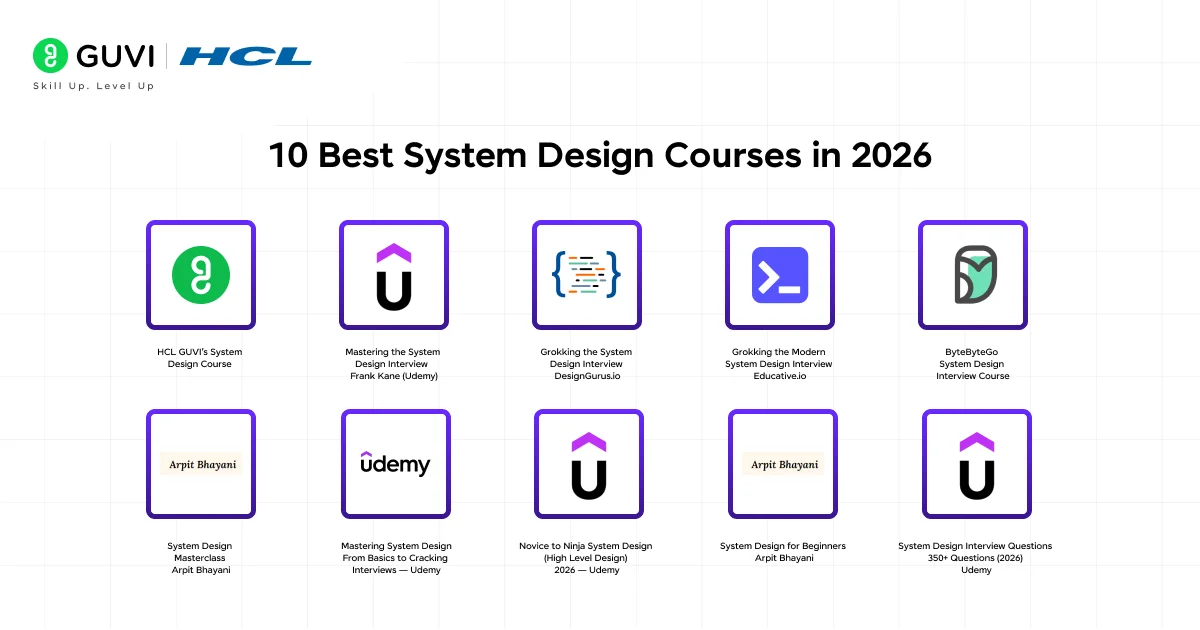
Here are 10 courses that are strictly focused on system design, verified, with direct links to their course pages.
1. HCL GUVI’s System Design Course
System design can feel overwhelming without a structured starting point. HCL GUVI’s System Design Course is built to solve exactly that problem, taking you from foundational concepts all the way through to advanced architectural patterns, in a self-paced format that fits around your schedule.
Course Duration: Self-paced
Free/Paid: Paid – 2499 INR
Course Features:
- Covers both HLD and LLD in depth
- Globally recognised certification upon completion
- Access to CodeKata, 1500+ coding problems for interview practice
- Multilingual support: Hindi, Tamil, Telugu, Malayalam, and English
- Industry-aligned curriculum backed by HCL
Learning Outcomes:
- Design scalable, fault-tolerant systems from scratch
- Apply HLD to define architecture and LLD to define class design and APIs
- Build confidence for system design rounds in technical interviews
- Understand performance optimisation, caching, and distributed system fundamentals
Rating: 4.2/5 — Check ratings here
Link: HCL GUVI System Design Course
2. Mastering the System Design Interview — Frank Kane (Udemy)
What gives this course an edge over most system design resources is who’s teaching it. Frank Kane spent nine years at Amazon and IMDb as a developer and Bar Raiser, someone with veto authority over hiring decisions across the company.
He’s interviewed over 1,000 candidates, which means the course isn’t just teaching you system design theory. It’s teaching you exactly what interviewers are looking for, and what most candidates get wrong.
Course Duration: ~5 hours 13 minutes
Free/Paid: Paid – 470 INR
Course Features:
- Taught by Frank Kane, ex-Amazon Bar Raiser and hiring manager
- 6 full mock system design interviews with real-world questions
- Covers scalability, caching, NoSQL databases, distributed systems, and generative AI system design
- 73 lectures across 9 sections
- Lifetime access with certificate of completion
Learning Outcomes:
- Apply horizontal and vertical scaling techniques to real systems
- Design for resiliency, handling failures and distributed load
- Structure interview responses clearly and confidently
- Understand what interviewers are actually evaluating beyond technical answers
Rating: 4.6/5 (14,781 ratings, 108,372 students) — Check on Udemy
Link: Mastering the System Design Interview — Udemy
3. Grokking the System Design Interview — DesignGurus.io
This is the original Grokking course, the one that started the system design interview prep category. Grokking the System Design Interview is the original, best-selling system design prep resource that has guided over 140,000 learners.
It’s crafted for anyone preparing for system design interviews, from junior developers with no design experience to seasoned engineers who want to refine their skills.
Course Duration: Self-paced (~15–25 hours)
Free/Paid: Paid – ~2400 INR
Course Features:
- Pattern-based framework for approaching any open-ended design question
- Covers real systems: URL shorteners, social networks, WhatsApp, Dropbox, and more
- Video lessons + interactive architecture diagrams
- Includes OOP design problems alongside system design
- Mock interview prompts with model answers
Learning Outcomes:
- Apply the RESHADED framework to any system design problem
- Design distributed systems covering load balancing, caching, sharding, and replication
- Understand capacity estimation and reliability planning for production systems
Rating: 4.7/5 — Check on DesignGurus.io
Link: Grokking the System Design Interview
4. Grokking the Modern System Design Interview — Educative.io
While the name sounds similar to the DesignGurus version, this is a separate course hosted on Educative, an interactive, browser-based learning platform. Once you’ve mastered the basics, this course dives deep into complex, large-scale systems, think designing YouTube-scale platforms, AI pipelines, and multi-region deployments.
Course Duration: Self-paced (~20–30 hours)
Free/Paid: Paid – Educative subscription ~$14.99/month (includes access to 1,200+ courses); standalone course ~$53 (discounted from $79)
Course Features:
- Built by FAANG engineers with real hiring experience
- Browser-based interactive learning, no setup required
- Covers distributed systems, API gateways, CDNs, consistency models, and CAP theorem
- Mock interview prompts with rubrics for self-assessment
- Regularly updated for 2026 interview formats
Learning Outcomes:
- Master distributed system fundamentals with hands-on problem sets
- Design large-scale systems like YouTube, Uber, and WhatsApp from scratch
- Reason through architecture trade-offs under real interview conditions
Rating: 4.7/5 — Check on Educative
Link: Grokking the Modern System Design Interview — Educative
5. ByteByteGo — System Design Interview Course
ByteByteGo was created by Alex Xu, the author of the bestselling System Design Interview book series. ByteByteGo teaches you to think in systems, not just components, and after testing 40+ courses, it’s considered the most complete resource available for system design preparation.
Course Duration: Self-paced (text-based with illustrations; ongoing updates)
Free/Paid: Paid – Course bundles available on the platform; lifetime plan with discounts periodically offered; check bytebytego.com for current pricing
Course Features:
- Visual-first learning with detailed illustrated diagrams for every concept
- Content drawn from the bestselling System Design Interview book series (Volumes 1 & 2)
- Covers system design problems like URL shorteners, notification systems, rate limiters, chat systems, and more
- Regularly updated to include modern topics like AI system design and multi-region deployments
- Free preview chapters available before purchase
Learning Outcomes:
- Think in full systems and understand the “why” behind every architectural decision
- Design real-world, production-grade systems step by step
- Prepare for system design interview rounds at any company level
Rating: 4.8/5 — Check on ByteByteGo
Link: ByteByteGo System Design Interview Course
6. System Design Masterclass — Arpit Bhayani
This is a live, cohort-based course for engineers who already have some grounding in system design and want to go deeper, specifically SDE-2 and above. What’s different here is the format: sessions run for a minimum of three hours and don’t end until every question is answered.
Course Duration: Cohort-based (8 weeks, live); recordings available for lifetime access
Free/Paid: Paid – 39,999 INR (Masterclass — live cohort); 19,999 INR (Beginner course — self-paced recorded)
Course Features:
- Live cohort sessions of 3+ hours each, taught entirely by Arpit Bhayani
- Every system is brainstormed, prototyped, and implemented, not just diagrammed
- Covers distributed systems, social networks, storage engines, message queues, and high-throughput systems
- 1:1 doubt-clearing sessions with the instructor
- Lifetime access to all recordings
Learning Outcomes:
- Design and prototype scalable, fault-tolerant systems from first principles
- Understand trade-offs at a deep architectural level, not just surface-level frameworks
- Build systems that are production-ready, not just interview-ready
Rating: 4.8/5 — Check on arpitbhayani.me
Link: System Design Masterclass — Arpit Bhayani
7. Mastering System Design: From Basics to Cracking Interviews — Udemy
This is one of Udemy’s best-reviewed beginner-to-intermediate system design courses, built around a structured journey from fundamentals to advanced architectural patterns.
The course is designed to take you on a step-by-step journey through scalability, availability, reliability, and fault tolerance, reinforced with real-world case studies showing how major tech companies design systems like URL shorteners, messaging platforms, and e-commerce applications.

Course Duration: Self-paced
Free/Paid: Paid – 480 INR
Course Features:
- Starts from absolute basics and builds up to advanced architectural patterns
- Covers monolithic vs microservices, distributed systems, caching, load balancing, and database scaling
- Real-world case studies from major tech companies
- Hands-on interview preparation with a structured problem-solving approach
- Certificate of completion included
Learning Outcomes:
- Understand core system design principles: scalability, availability, reliability, and performance
- Design systems using microservices, APIs, caching, and load balancing
- Apply industry best practices to build robust, maintainable systems
- Crack system design interview rounds with a structured approach
Rating: 4.4/5 (2,198 ratings, 24,138 students) — Check on Udemy
Link: Mastering System Design: From Basics to Cracking Interviews
8. Novice to Ninja: System Design (High Level Design) 2026 — Udemy
If you’re looking for a course that takes you from zero knowledge to a strong command of HLD, this is one of the most comprehensive options available on Udemy right now. It uses a proven framework for approaching any system design problem and covers real systems like Netflix, Uber, and Instagram, walking you through the architectural decisions at each stage.
Course Duration: Self-paced (growing content library)
Free/Paid: Paid – 460 INR
Course Features:
- Step-by-step framework for approaching any system design challenge
- Covers microservices, APIs, caching, load balancing, and database partitioning
- Builds resilient systems with replication, failover, and monitoring
- Designed for beginners through to aspiring senior/principal engineers
- Content updated and expanded regularly
Learning Outcomes:
- Think like a senior engineer and make design trade-offs confidently
- Design architectures for real-world systems like Netflix, Uber, and Instagram
- Evaluate trade-offs between different architectural choices
- Gain the skills to crack system design interviews at FAANG-level companies
Rating: 4.8/5 — Check on Udemy
Link: Novice to Ninja: System Design (High Level Design) 2026
9. System Design for Beginners — Arpit Bhayani
For engineers who are starting from scratch and want to learn system design the right way, not through shortcuts or surface-level frameworks, Arpit Bhayani’s Beginner Course is one of the most thorough self-paced options available.
Course Duration: Self-paced with bi-weekly live doubt-solving sessions
Free/Paid: Paid – 19,999 INR
Course Features:
- Self-paced pre-recorded course taught entirely by Arpit Bhayani
- Starts from an absolute scratch, no prior system design knowledge required
- Bi-weekly live doubt-solving sessions with the instructor
- Covers scalability, distributed systems, databases, caching, and fault tolerance
- 3-day refund window available
Learning Outcomes:
- Build a strong foundation in system design from first principles
- Understand how to approach and break down complex design problems
- Prepare for system design rounds as a fresher or early-career engineer
- Develop the thinking patterns needed before progressing to advanced concepts
Rating: 4.7/5 — Check on arpitbhayani.me
Link: System Design for Beginners — Arpit Bhayani
10. System Design Interview Questions — 350+ Questions (2026) — Udemy
Sometimes you’ve already done the theory and what you actually need is to test yourself. That’s exactly what this course is designed for. Rather than teaching concepts from scratch, it puts you through 350+ scenario-based practice questions across six full-length mock tests, all structured around the way real system design interviews are actually conducted.
Course Duration: Self-paced (6 full-length practice tests)
Free/Paid: Paid – 480 INR
Course Features:
- 350+ scenario-based system design questions across 6 full-length mock tests
- Covers scalability bottlenecks, caching strategies, database design, consistency models, and API design
- Questions follow a deliberate difficulty curve, fundamentals to senior-level edge cases
- Focuses on reasoning and trade-off analysis, not definition memorisation
- Structured to mirror real mid-to-senior interview formats
Learning Outcomes:
- Identify scalability bottlenecks and failure points in distributed systems
- Choose between caching, database, and API designs based on real constraints
- Reason through edge cases like retries, timeouts, idempotency, and partial failures
- Validate your system design readiness before actual interviews
Rating: 4.6/5 — Check on Udemy
Link: System Design Interview Questions — 350+ Questions (2026)
How to Choose the Right Course for You
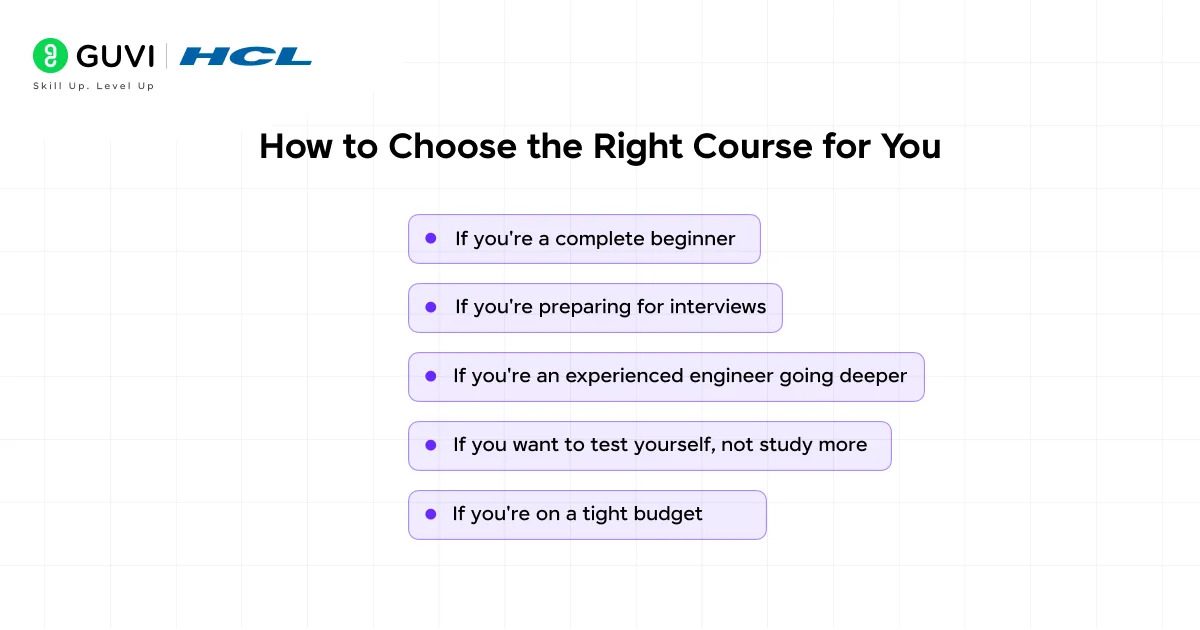
- If you’re a complete beginner: HCL GUVI’s System Design Course or Arpit Bhayani’s System Design for Beginners
- If you’re preparing for interviews: The Grokking courses (DesignGurus.io or Educative), ByteByteGo, or Frank Kane’s Udemy course
- If you’re an experienced engineer going deeper: Arpit Bhayani’s Masterclass
- If you want to test yourself, not study more: The 350+ Questions course on Udemy
- If you’re on a tight budget: Udemy courses
Depict these pointers in the image.]
With ten strong options in front of you, the decision still comes down to where you are and what you need right now.
If you’re a complete beginner: Start with HCL GUVI’s System Design Course or Arpit Bhayani’s System Design for Beginners. Both are built to take you from zero knowledge to a solid foundation without assuming anything.
If you’re preparing for interviews: The Grokking courses (DesignGurus.io or Educative), ByteByteGo, or Frank Kane’s Udemy course are your strongest bets. They’re built around real interview formats and teach you how to communicate your decisions under pressure.
If you’re an experienced engineer going deeper: Arpit Bhayani’s Masterclass is the most rigorous option on this list. It’s not interview prep — it’s engineering depth for SDE-2 and above who want to understand systems at a production level.
If you want to test yourself, not study more: The 350+ Questions course on Udemy gives you structured mock tests that simulate actual interviews. Use it after completing any of the content-heavy courses above.
If you’re on a tight budget: Udemy courses go on sale frequently, often dropping to under ₹500 or $10. HCL GUVI also offers competitive pricing for Indian learners with the added benefit of a certificate.
Even if you never work on AI systems, every modern backend today is distributed, scalable, and event-driven, which is exactly why system design has become a core engineering skill, not just an interview topic. The engineers who understand how systems fail, and how to design them so they don’t. These are the ones companies compete to hire.
Conclusion
In conclusion, system design is no longer something you can put off until you’re a senior engineer. In 2026, it’s a skill that shapes how you’re evaluated in interviews, how you grow within your team, and how you approach every architectural decision you make in production.
Every course on this list is strictly focused on system design, no padding, no off-topic modules. Pick the one that matches your current level, commit to it fully, and follow it up with consistent practice. That combination will take you further than any amount of passive resource-collecting.
If you’re starting out and want a structured, certification-backed foundation, HCL GUVI’s System Design Course is where we’d point you first. For experienced engineers wanting real depth, Arpit Bhayani’s Masterclass is hard to beat.
The right course won’t make you a great system designer overnight, but it gives you the framework to get there faster.
FAQs
What is system design?
System design is the process of defining the architecture, components, and data flow of a software system to meet specific functional and non-functional requirements like scalability, reliability, and performance.
What is the difference between HLD and LLD?
High-Level Design (HLD) covers the overall system architecture, the major components, and how they interact. Low-Level Design (LLD) goes deeper into implementation details like class design, API endpoints, and database schema.
Do I need to know coding before learning system design?
Not deeply. A basic understanding of how software works and familiarity with any programming language is enough to get started with most beginner-level system design courses.
How long does it take to get interview-ready in system design?
With consistent effort, most learners become interview-ready in 2–4 months. Deeper architectural understanding typically comes with 6–12 months of focused practice.
Which system design course is best for FAANG preparation?
For FAANG-specific prep, the Grokking course on DesignGurus.io, ByteByteGo, and Frank Kane’s Udemy course are the most targeted options. All three are built around real interview formats at top companies.
Success Stories

About the Author
Lukesh S
A professional content writer who has experience in freelancing and now working as a Technical Content Writer at HCL GUVI having sound knowledge in Blog Writing and Creative Writing!
View all posts by Lukesh S
Connect with me @











Did you enjoy this article?