


Software Development Articles
How to Read and Understand System Design Diagrams?
System Engineer Roles and Responsibilities: 12 Proven Duties for Growth
SAP Consultant Roles and Responsibilities: 12 Proven Duties for Growth and Success
Network Engineer Roles and Responsibilities: 12 Essential Duties for Success


Get In Touch For Details! Request More Information
Producer-Consumer Problem Using Semaphores in OS
Aug 05, 2026 3 Min Read 804 Views
(Last Updated)
The Producer-Consumer Problem is a fundamental and exciting concept in Operating Systems (OSs). It addresses cooperation among multiple processes that access common resources and provides an insightful view of the “under-the-cover” activity occurring within a computer system.
Although the topic may appear challenging at the very beginning, as soon as you start seeing all the different logical connections and pieces, the process of learning semaphores via the producer-consumer problem becomes interesting.
Table of contents
- TL;DR Summary
- Producer-Consumer Problem: Meaning
- Example:
- Important Terms:
- What Is Semaphore
- How Semaphore Solves the Producer-Consumer Problem
- Conclusion
- FAQs
- What happens if both producer and consumer access the buffer at the same time?
- Why is the buffer size important in the Producer-Consumer Problem?
- Why does the producer sometimes need to wait?
- Why does the consumer stop at certain times?
- Why are semaphores important in synchronisation?
- Where is the Producer-Consumer concept used in real systems?
TL;DR Summary
- This blog helps you understand how producers, consumers, and buffers work together in an Operating System.
- Makes the concepts of semaphores and process synchronisation easier to visualise with simple examples and a flow diagram.
- Explains how systems prevent buffer full and buffer empty problems while keeping processes synchronised smoothly.
The concept of Semaphores was introduced by computer scientist Edsger W. Dijkstra in the 1960s.
Producer-Consumer Problem: Meaning
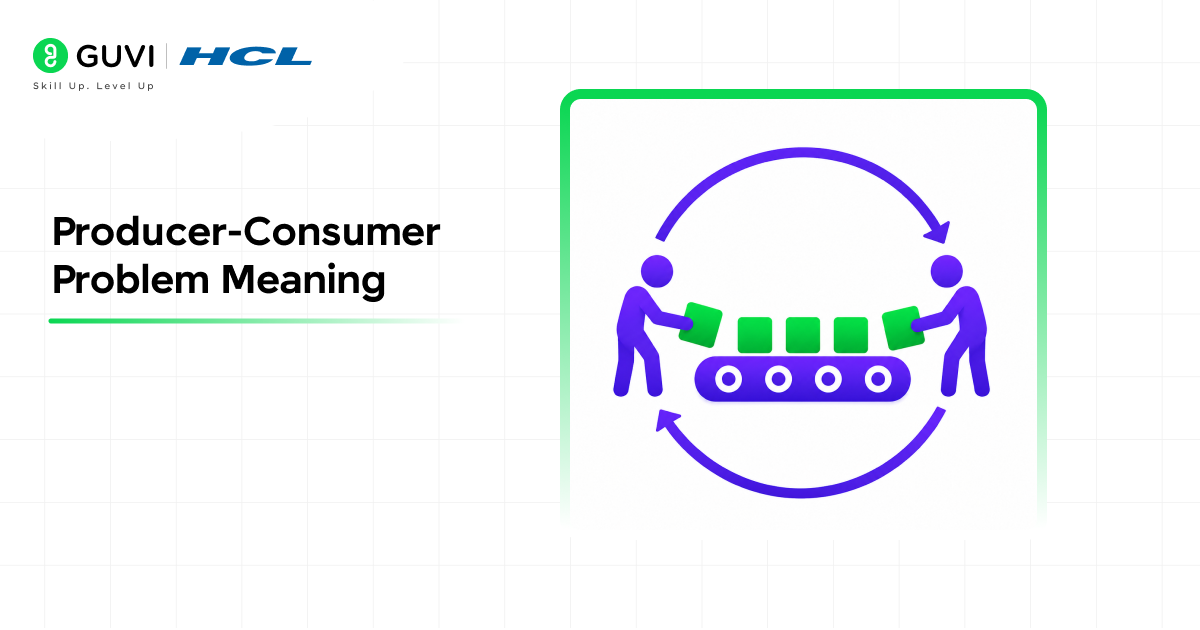
The Producer-Consumer Problem occurs when one process (the producer) produces a resource and another process (the consumer) consumes it. Both processes access the same storage area, the Buffer.
The producer is a process that produces data, and the consumer is a process that consumes data.
The problem arises when the buffer is either full or empty, so the Operating System (OS) must coordinate these two processes to prevent errors.
Explore HCL GUVI’s free learning resource on Operating Systems, where you will learn the core concepts like process scheduling, memory management, multithreading, and file systems through simple explanations and real-world examples: OS Handbook
Example:
When letters are entered via the keyboard, the keyboard driver sends characters to the buffer, which temporarily stores them. Here, the keyboard process is the producer, because it produces data.
The other application (e.g., Notepad) is the consumer, as it reads characters from the buffer and displays them on the screen.
In simple terms, the issue arises mainly for 2 reasons:
- The first is when you type very fast: the keyboard keeps adding letters, so the buffer is highly likely to be full, since the application has not read them yet.
- On the other hand, if the application tries to read the letters before you typed anything, the buffer will most probably become empty because there is no data available.
Due to this problem, the following repercussions occur:
- If the buffer becomes full, fresh data can’t be added until some of the old data is removed.
- If the buffer area becomes empty, the consumer process has nothing to consume, which can increase waiting time.
As a result, this system can become sluggish and experience synchronisation issues.
Important Terms:
1. Buffer:
A temporary storage area where data is kept before the consumer uses it.
2. Producer:
A process that creates or adds data to the buffer.
Example:
- Typed letters forwarded by the Keyboard
- Camera capturing photos
- Music app downloading songs
3. Consumer:
A process that receives or uses data from the buffer.
Example:
- Notepad reading typed letters
- Gallery app showing photos
- A Music Player playing downloaded songs
What Is Semaphore

A Semaphore is a signalling tool used in an operating system (OS) that controls how many processes can access a shared resource.
It is similar to a traffic light: a green light means it is okay to continue the process, and a red light means to wait.

In the Producer-Consumer problem, Semaphores can be used to synchronise access to the buffer, preventing the producer from placing an item in the buffer when it is full and preventing the consumer from consuming data from an empty buffer.
How Semaphore Solves the Producer-Consumer Problem
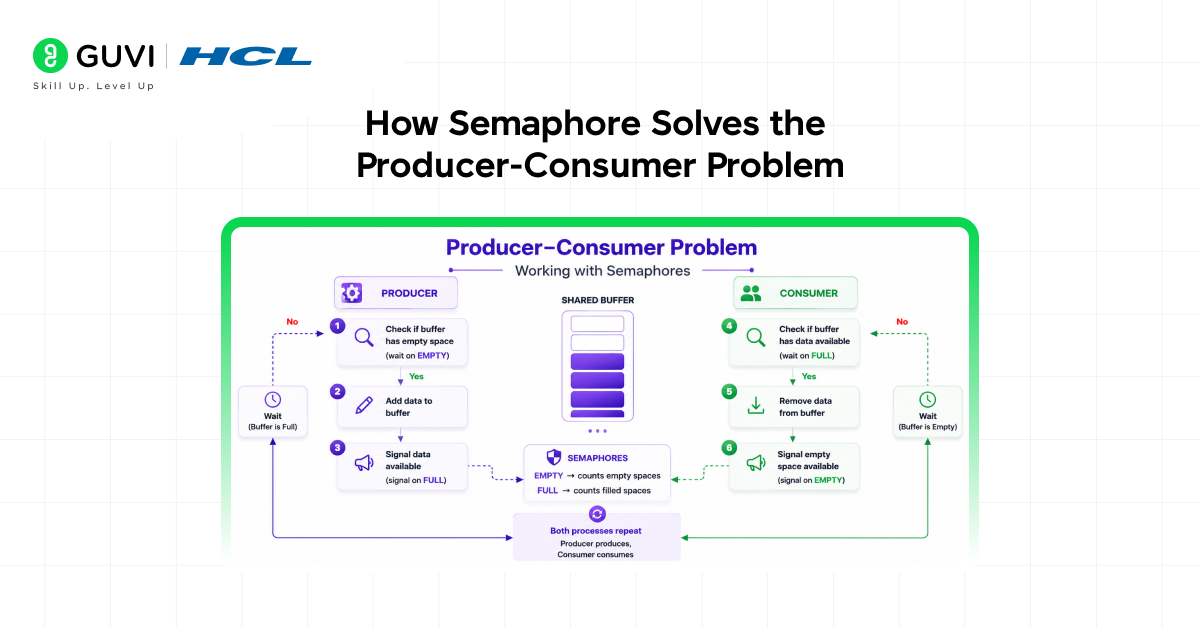
In the Producer-Consumer Problem, the producer first checks whether the buffer is empty. If space is available, it adds the data to the buffer and then signals the consumer that the data is ready to use.
- After that, the consumer checks whether data is present in the buffer. If data is available, it removes the data and processes it.
- If the buffer becomes full, the semaphore blocks the producer; if the buffer becomes empty, the semaphore blocks the consumer.
- In this way, semaphores keep both processes synchronised and prevent conflicts.
Let’s understand this process more clearly with the help of an illustration:
- Here, the producer first checks whether the buffer has empty space available to store new data.
- If space is available, the producer adds data to the shared buffer and sends a signal that new data is ready.
- The consumer then checks whether the buffer contains usable data.
- If data is present, the consumer removes the data from the buffer and starts processing it.
- If the buffer becomes full, the producer must wait; if it becomes empty, the consumer must wait. The semaphore manages this entire flow and keeps both processes synchronised.
Every great software starts with understanding what users actually need, and that’s exactly what you’ll master in HCL GUVI’s Software Requirement Engineering Course. From gathering requirements to planning smarter systems, this course helps you think like a real software engineer from the very beginning.
Conclusion
At first glance, the Producer-Consumer Problem may seem complex, but understanding it helps clarify how the system manages multiple processes. By grasping the flow of this problem, you will gain a solid foundation in operational concepts. Additionally, learning how semaphores achieve synchronisation will provide a strong basis for studying operating systems and pave the way for understanding other complex topics.
FAQs
What happens if both producer and consumer access the buffer at the same time?
The data inside the buffer can become inconsistent or corrupted.
Why is the buffer size important in the Producer-Consumer Problem?
A limited buffer size helps control how much data can be stored at once.
Why does the producer sometimes need to wait?
The producer waits when the buffer has no empty space left.
Why does the consumer stop at certain times?
The consumer waits when no data is available in the buffer.
Why are semaphores important in synchronisation?
Semaphores help processes work in the correct order without conflicts.
Where is the Producer-Consumer concept used in real systems?
It is used in keyboards, printers, networking, streaming, and many background system tasks.
Success Stories












Did you enjoy this article?