


Software Development Articles
How to Read and Understand System Design Diagrams?
System Engineer Roles and Responsibilities: 12 Proven Duties for Growth
SAP Consultant Roles and Responsibilities: 12 Proven Duties for Growth and Success
Network Engineer Roles and Responsibilities: 12 Essential Duties for Success


Get In Touch For Details! Request More Information
Inter Process Communication (IPC): A Complete Beginner’s Guide
Sep 02, 2026 5 Min Read 964 Views
(Last Updated)
Modern applications rarely run as isolated processes. Web browsers, messaging platforms, and operating systems continuously manage multiple independent processes that must exchange information and coordinate tasks efficiently. Without a structured communication mechanism, process coordination becomes complex and resource management becomes inefficient. This is where Inter Process Communication (IPC) becomes essential.
Read this blog to understand Inter Process Communication (IPC), its mechanisms, types, working models, benefits, challenges, and real-world applications.
Quick Answer:
Inter Process Communication (IPC) enables isolated processes to exchange data, synchronize execution, and coordinate tasks efficiently through mechanisms like pipes, shared memory, message queues, semaphores, signals, and sockets, helping modern systems achieve secure communication, multitasking efficiency, scalability, and reliable performance across distributed applications.
Table of contents
- What Is Inter Process Communication (IPC)?
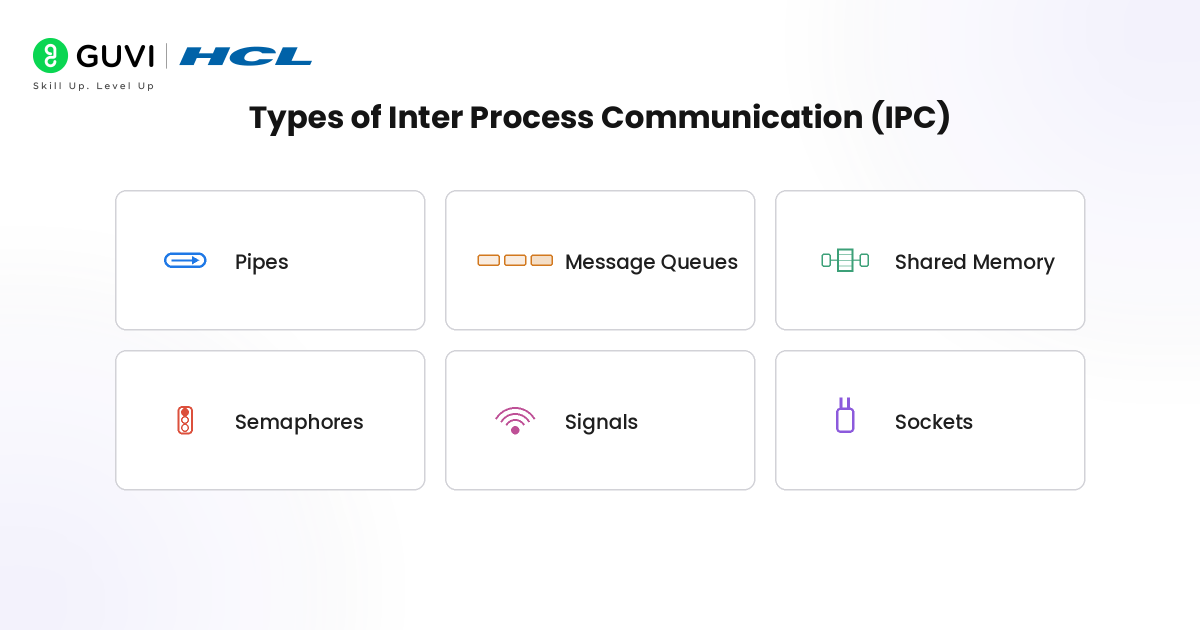
- Types of Inter Process Communication (IPC)
- Pipes
- Message Queues
- Shared Memory
- Semaphores
- Signals
- Sockets
- How Does Inter Process Communication Work?
- Process Initialization and Address Space Isolation
- Communication Channel Creation
- Kernel Resource Allocation
- Data Transfer Operation
- Synchronization and Process Coordination
- Context Switching During Communication
- IPC Flow Example
- Internal Technical Workflow Summary
- Benefits of Inter Process Communication (IPC)
- Real-World Applications of Inter Process Communication (IPC)
- Best Practices for Implementing Inter-Process Communication (IPC)
- Conclusion
- FAQs
- Is IPC only used inside operating systems?
- Which IPC mechanism is fastest?
- Why are semaphores used in IPC?
- Can IPC work across networks?
What Is Inter Process Communication (IPC)?
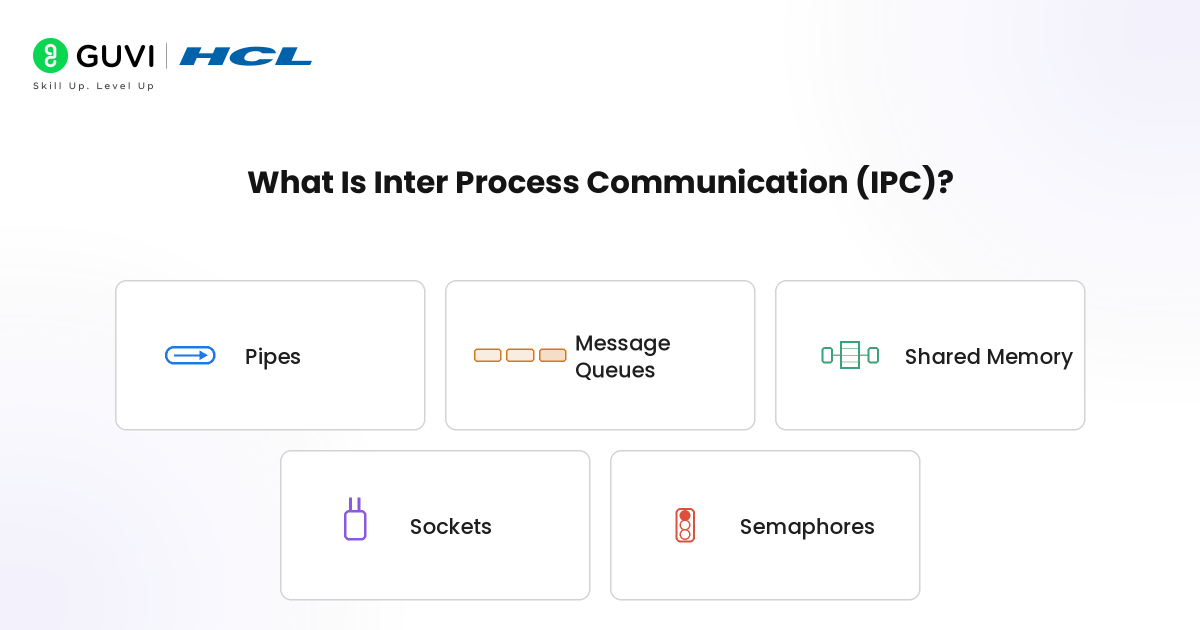
Inter Process Communication (IPC) is a set of techniques used by operating systems to enable communication between independent processes.
A process is an executing instance of a program. Since processes usually operate in isolated memory spaces, IPC mechanisms help them exchange information securely and efficiently.
IPC allows processes to:
- Share data
- Synchronize execution
- Coordinate tasks
- Exchange messages
- Access shared resources
- Improve multitasking efficiency
Types of Inter Process Communication (IPC)
1. Pipes
Pipes provide a unidirectional communication channel between processes. One process writes data into the pipe while another process reads from it.
Characteristics of Pipes
- Simple communication mechanism
- Mostly used between parent-child processes
- Temporary communication
- Sequential data flow
Real-World Example
Linux terminal commands commonly use pipes:
ls | grep txt
Here, the output of ls becomes the input for grep.
Advantages of Pipes
- Easy to implement
- Lightweight communication
- Efficient for small data transfers
Limitations of Pipes
- Usually unidirectional
- Limited scalability
- Restricted process relationships
2. Message Queues
Message queues allow processes to exchange structured messages asynchronously. Processes communicate by placing messages into queues managed by the operating system.
Characteristics of Message Queues
- Asynchronous communication
- Message prioritization possible
- Processes do not need direct interaction
Real-World Example
Enterprise microservices often use message queue systems such as:
- Apache Kafka
- RabbitMQ
- ActiveMQ
Advantages of Message Queues
- Decoupled communication
- Better scalability
- Reliable message handling
Limitations of Message Queues
- Queue management overhead
- Potential latency increase
3. Shared Memory
Shared memory allows multiple processes to access the same memory region directly. This is one of the fastest IPC mechanisms because processes avoid repeated data copying.
Characteristics of Shared Memory
- High-speed communication
- Shared data access
- Requires synchronization mechanisms
Real-World Example
High-performance databases and multimedia applications commonly use shared memory for faster data exchange.
Advantages of Shared Memory
- Extremely fast
- Efficient large data transfer
- Reduced CPU overhead
Limitations of Shared Memory
- Complex synchronization
- Risk of race conditions
- Higher implementation difficulty
4. Semaphores
Semaphores are synchronization tools used to control access to shared resources. They prevent multiple processes from modifying shared data simultaneously.
Types of Semaphores
Binary Semaphore
Acts like a lock with only two states:
- Locked
- Unlocked
Counting Semaphore
Allows limited multiple access based on resource count.
Real-World Example
Banking systems use semaphores to manage transaction synchronization and prevent data inconsistency.
Advantages of Semaphores
- Prevents race conditions
- Improves process coordination
- Enables safe concurrency
Limitations of Semaphores
- Deadlock risks
- Complex debugging
5. Signals
Signals are software interrupts used to notify processes about events.
Common Uses of Signals
- Process termination
- Error handling
- Event notifications
Real-World Example
Pressing:
Ctrl + C
sends a termination signal to a running process.
Advantages of Signals
- Lightweight notifications
- Fast event handling
Limitations of Signals
- Limited data transfer capability
- Complex signal handling
6. Sockets
Sockets enable communication between processes over networks. They are heavily used in distributed systems and internet applications.
Characteristics of Sockets
- Supports local and remote communication
- Works across multiple systems
- Client-server communication model
Real-World Example
Web applications use sockets for:
- APIs
- Chat systems
- Multiplayer games
- Real-time notifications
Advantages of Sockets
- Highly scalable
- Network-wide communication
- Supports distributed computing
Limitations of Sockets
- Higher overhead
- Network latency
Go beyond understanding operating system concepts and build industry-ready software expertise with HCL GUVI’s AI-Powered Software Development Course. Designed for graduates and working professionals to master software development and Generative AI, the program helps you become SDE-ready for top product-based companies. Earn 4 certifications from MongoDB, IITM Pravartak, NSDC, and HCL GUVI while learning through a structured, industry-focused curriculum.
How Does Inter Process Communication Work?
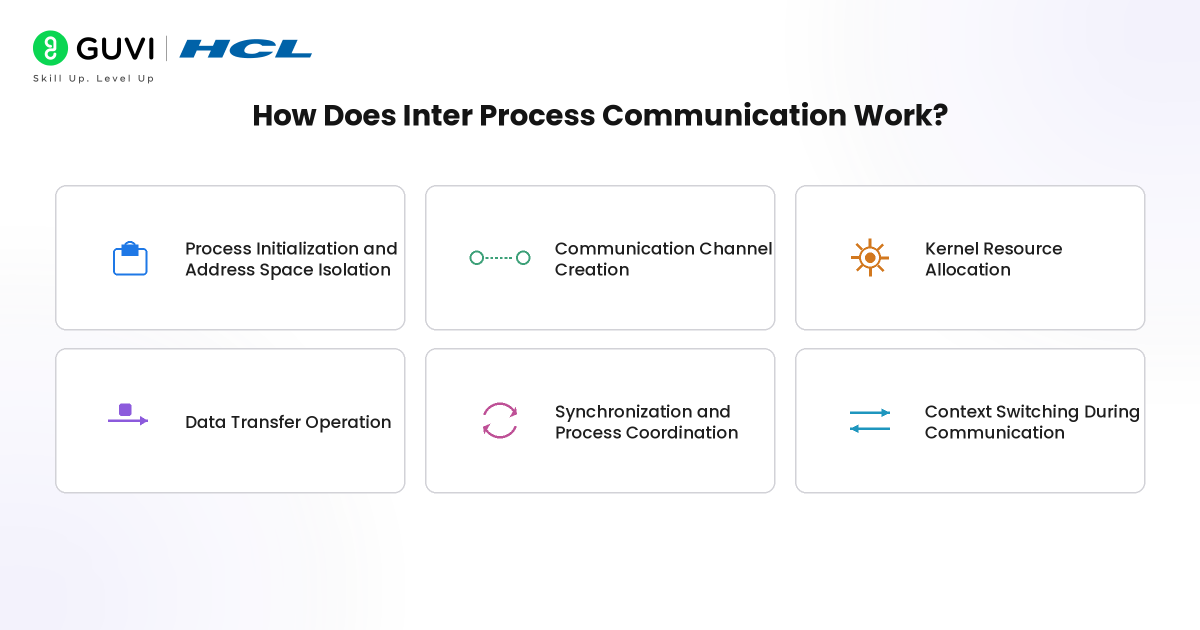
The IPC workflow generally follows multiple stages:
1. Process Initialization and Address Space Isolation
When a process is created, the operating system allocates a separate virtual address space, process control block (PCB), registers, file descriptors, and execution context. Since one process cannot directly access another process’s memory, IPC mechanisms create structured pathways for interaction.
For example:
- Process A → Memory Space A
- Process B → Memory Space B
- Direct access blocked by OS protection mechanisms
This isolation prevents accidental memory corruption and unauthorized access.
2. Communication Channel Creation
The operating system establishes a communication medium through which data can be exchanged. The communication method depends on performance requirements, process location, synchronization needs, and data volume.
Common IPC channels include:
- Pipes
- Named pipes (FIFOs)
- Shared memory segments
- Message queues
- Sockets
- Signals
- Semaphores
- Memory-mapped files
Each mechanism uses different kernel-level structures and APIs.
3. Kernel Resource Allocation
The operating system allocates internal resources required for communication. These resources may include:
- Kernel buffers
- Shared memory regions
- Message queue tables
- Socket descriptors
- Synchronization objects
- Semaphore counters
For example, when a pipe is created:
- Kernel creates a pipe object
- Buffer memory is allocated
- Read and write file descriptors are assigned
- Processes receive communication endpoints
The kernel manages access permissions and lifecycle control.
4. Data Transfer Operation
After communication channels are established, data exchange begins.
In message-based communication:
- Sender process generates data
- Data enters kernel buffer
- Kernel validates permissions
- Receiver retrieves information
Workflow:
Process A → System Call → Kernel Buffer → Process B
Examples of system calls:
- pipe()
- fork()
- msgsnd()
- msgrcv()
- shmget()
- socket()
- send()
- recv()
The kernel handles context switching and scheduling during communication.

5. Synchronization and Process Coordination
Multiple processes may attempt to access shared resources simultaneously. IPC therefore integrates synchronization mechanisms to prevent race conditions and maintain consistency.
Common synchronization techniques include:
- Semaphores
Maintain counters controlling resource access.
- Mutex Locks
Allow exclusive access to critical sections.
- Signals
Notify processes about events.
- Condition Variables
Pause execution until conditions become true.
Example:
Process A writes shared memory → Semaphore unlocks → Process B reads data
Without synchronization, concurrent updates can cause inconsistent system states.
6. Context Switching During Communication
When IPC operations require kernel intervention, the CPU may perform context switching:
- Save current process state
- Suspend execution
- Load target process state
- Resume execution
This operation introduces overhead because CPU registers, program counters, stack information, and memory mappings require updates.
Frequent IPC interactions can therefore increase:
- CPU utilization
- Scheduling overhead
- Latency
Shared memory often reduces this overhead because data does not repeatedly pass through kernel buffers.
IPC Flow Example
Consider a media streaming application:
Video Decoder Process
↓
Places decoded frames into shared memory
Semaphore
↓
Signals frame availability
Rendering Process
↓
Reads frame and displays output
In this workflow:
- Shared memory provides fast data access
- Semaphores maintain synchronization
- Kernel manages permissions and scheduling
This architecture supports high-throughput communication with minimal latency.
Internal Technical Workflow Summary
Process Creation
↓
Memory Isolation
↓
IPC Channel Creation
↓
Kernel Resource Allocation
↓
Data Transfer
↓
Synchronization Control
↓
Context Switching
↓
Coordinated Process Execution
Benefits of Inter Process Communication (IPC)
- Enables Controlled Data Exchange Across Isolated Memory Spaces: IPC allows independent processes with separate virtual address spaces to exchange data safely through kernel-managed channels without violating process isolation or memory protection mechanisms.
- Supports High-Performance Parallel Processing: Multiple processes can execute concurrently and communicate efficiently, enabling workload distribution across CPU cores for compute-intensive applications such as database engines, media processing systems, and distributed workloads.
- Improves Resource Sharing Efficiency: Shared memory IPC allows multiple processes to access common datasets, buffers, and resources without creating duplicate copies, reducing memory consumption and improving system efficiency.
- Provides Synchronization for Concurrent Execution: IPC integrates synchronization primitives such as semaphores, mutexes, signals, and condition variables to coordinate process execution and maintain consistency across shared resources.
- Reduces Tight Coupling in System Architecture: IPC allows system components to communicate through standardized interfaces and communication channels, enabling modular design and easier maintenance of large-scale software systems.
Real-World Applications of Inter Process Communication (IPC)
- Multi-Process Web Browser Architecture:
Modern browsers use isolated processes for tabs, rendering, GPU tasks, and extensions. IPC mechanisms coordinate rendering, JavaScript execution, and crash isolation securely.
- Database Query Processing Engines:
Database systems use worker processes for query execution, caching, logging, and transactions. Shared memory and semaphores synchronize concurrent requests while maintaining ACID consistency.
- High-Frequency Trading (HFT) Platforms:
Trading platforms use low-latency IPC and shared memory to transfer real-time market data between analytics, risk engines, and order execution systems.
- Video Streaming and Media Processing Pipelines:
Streaming systems separate decoding, rendering, and audio processing into multiple processes. IPC synchronizes frame buffers and maintains smooth media playback.
- Container and Microservice Orchestration Systems:
Cloud platforms use sockets, RPC channels, and message queues to coordinate container scheduling, health monitoring, and service discovery operations.
Best Practices for Implementing Inter-Process Communication (IPC)
- Select IPC Mechanisms Based on Communication Patterns: Use shared memory for large, high-throughput data transfer, message queues for asynchronous task exchange, pipes for parent-child communication, and sockets for distributed or network-based interactions. Matching IPC mechanisms to workload characteristics reduces latency and unnecessary overhead.
- Minimize Kernel Transitions During Data Exchange: Frequent system calls increase context switching overhead. Prefer shared memory or memory-mapped files for high-frequency communication because they reduce repeated user-to-kernel mode transitions and data copying operations.
- Use Synchronization Primitives Carefully: Protect shared resources with semaphores, mutexes, reader-writer locks, or condition variables to prevent race conditions and maintain data consistency across concurrent processes.
- Design Lock Acquisition Order to Prevent Deadlocks: Establish a fixed resource acquisition sequence across processes and avoid circular wait conditions. Timeouts and deadlock detection mechanisms further reduce execution stalls.
- Reduce Shared Memory Critical Sections: Keep lock duration small and isolate only essential code inside critical sections. Shorter lock holding periods reduce contention and improve process throughput.
Conclusion
Inter Process Communication (IPC) powers much of the coordination happening behind modern applications, from browser tabs and database engines to cloud platforms and real-time systems. As software architectures become increasingly distributed and process-driven, efficient communication becomes critical for performance and reliability. Understanding IPC mechanisms, synchronization strategies, and implementation practices helps developers build scalable systems that support seamless data exchange, efficient multitasking, and stable application behaviour.
FAQs
Is IPC only used inside operating systems?
No. IPC principles are used in distributed systems, client-server applications, and cloud platforms.
Which IPC mechanism is fastest?
Shared memory is often fastest because it avoids repeated kernel data transfer.
Why are semaphores used in IPC?
Semaphores synchronize access to shared resources.
Can IPC work across networks?
Yes. Sockets support communication between systems over networks.
Success Stories

About the Author
Vaishali
I'm a seasoned writer with four years of experience across technical, non-technical, and just about every genre or niche you can imagine. Adaptable and curious, I enjoy exploring new topics and making information engaging and easy to understand. Fueled by a steady stream of tea, I approach each project with creativity, reliability, and genuine enthusiasm for storytelling.
View all posts by Vaishali
Connect with me @















Did you enjoy this article?