


Software Development Articles
How to Read and Understand System Design Diagrams?
System Engineer Roles and Responsibilities: 12 Proven Duties for Growth
SAP Consultant Roles and Responsibilities: 12 Proven Duties for Growth and Success
Network Engineer Roles and Responsibilities: 12 Essential Duties for Success


Get In Touch For Details! Request More Information

Introduction to High-Level Design: A Beginner’s Guide
Jun 29, 2026 6 Min Read 850 Views
(Last Updated)
If you are a CS student or fresher preparing for placements, you’ve likely heard the term “system design” thrown around in interview prep conversations. And at the heart of system design sits one concept you simply cannot skip, High Level Design, or HLD.
HLD is where you stop thinking like a coder and start thinking like an architect. Instead of asking “how do I write this function?”, you ask “how do I design an entire system that can serve millions of users without breaking down?”
That shift in perspective is exactly what this guide will help you make. Whether you’re preparing for product-based company interviews or just trying to understand how large-scale applications are actually built, this introduction to High-Level Design will walk you through everything you need to know, from the basics all the way to practical application.
TL;DR Summary
- High-Level Design (HLD) is the process of defining the overall architecture of a software system, mapping out major components, how they interact, and how data flows between them.
- It focuses on the big picture: system structure, technology stack, and scalability decisions, not implementation-level code.
- HLD is distinct from Low Level Design (LLD), which handles the internal logic of individual components.
- Key elements of HLD include system architecture, data flow diagrams, module breakdown, interface design, and deployment planning.
- Understanding HLD is essential for CS students and freshers, as it is a heavily tested concept in technical interviews at top companies.
- Real-world systems like Netflix, Uber, and Twitter all rely on HLD principles to support millions of users at scale.
Table of contents
- What is High-Level Design?
- Why Does HLD Matter?
- Key Components of High-Level Design
- System Architecture
- Modules and Components
- Data Flow Diagrams (DFDs)
- Interface Design
- Technology Stack
- Deployment Architecture
- Core Concepts You Need to Know
- Scalability
- Load Balancing
- Caching
- Databases: SQL vs NoSQL
- APIs and Communication
- CAP Theorem
- Common Mistakes Beginners Make in HLD
- How to Start Learning High-Level Design?
- Conclusion
- FAQs
- What is High Level Design in simple terms?
- What is the difference between HLD and LLD?
- Is HLD important for freshers?
- What are the key components of a High-Level Design document?
- What is the CAP theorem and why does it matter in HLD?
What is High-Level Design?
High-Level Design, commonly abbreviated as HLD, is the initial stage of system design where you define the overall architecture of a software system. It is sometimes referred to as macro-level design because it looks at the system from a bird’s-eye view.
At this stage, you are not worried about writing code or choosing specific algorithms. Instead, you are answering questions like:
- What are the major components of this system?
- How do these components communicate with each other?
- What database will be used, and why?
- How will the system handle a large number of users?
- Where will it be deployed?
Think of it this way. If you were designing a house, HLD would be the architectural blueprint, the number of rooms, the placement of doors, and the overall layout. You wouldn’t worry about the specific type of hinges used on the door or the brand of tiles yet. That comes later.
HLD gives everyone involved in a project, developers, architects, product managers, and stakeholders, a shared understanding of what is being built and how it will work at a structural level.
Why Does HLD Matter?
You might wonder, why not just start coding and figure things out along the way? Here’s why that approach fails more often than it succeeds.
Building software without a high-level design is like starting a road trip without a map. You might eventually reach your destination, but you’ll waste a lot of time, fuel, and effort on wrong turns.
HLD matters for several practical reasons:
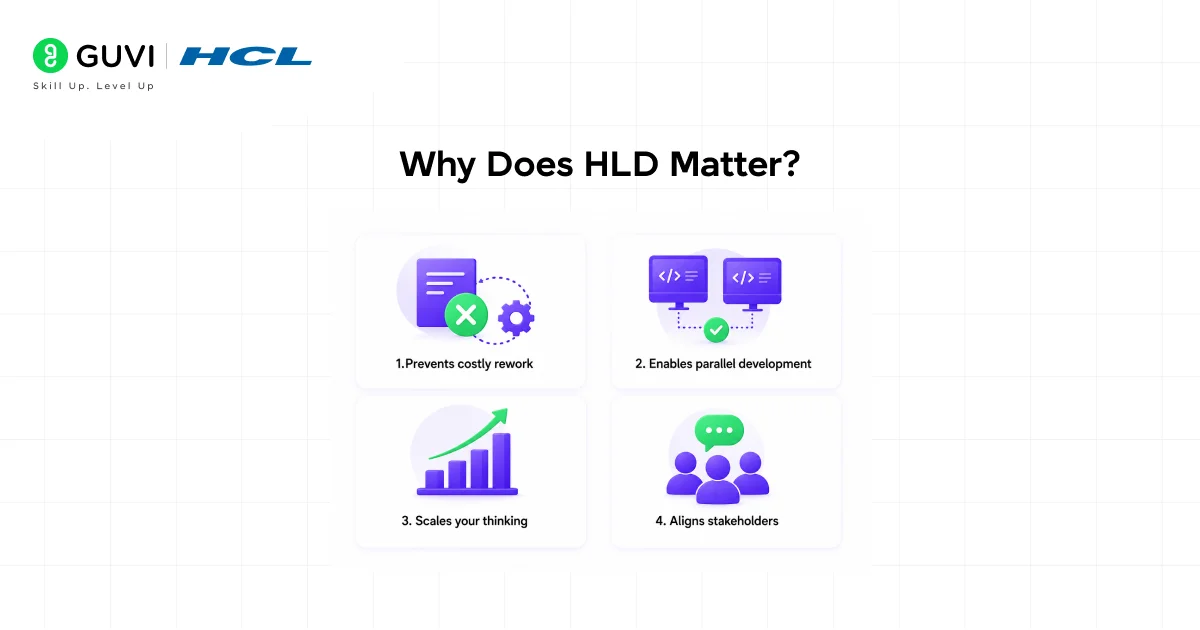
- Prevents costly rework: Design decisions made early, like choosing a relational vs non-relational database, are extremely expensive to change later. HLD forces you to think through these choices before a single line of code is written.
- Enables parallel development: When teams clearly understand the boundaries between modules, different developers can work on separate components simultaneously without stepping on each other’s work.
- Scales your thinking: HLD asks you to think about how a system behaves under load, with thousands or millions of users. This kind of architectural thinking is a critical skill for any software engineer.
- Aligns stakeholders: Not everyone on a project understands code. HLD communicates through diagrams and component descriptions, making it accessible to non-technical stakeholders like product managers and business leads.
Netflix transitioned its entire backend from a monolithic architecture to microservices starting around 2008. This was essentially an HLD-level decision, one that allowed them to scale independently across hundreds of services and handle the massive surge in streaming demand we see today. Without that architectural pivot, their infrastructure would have collapsed under the load.
Key Components of High-Level Design
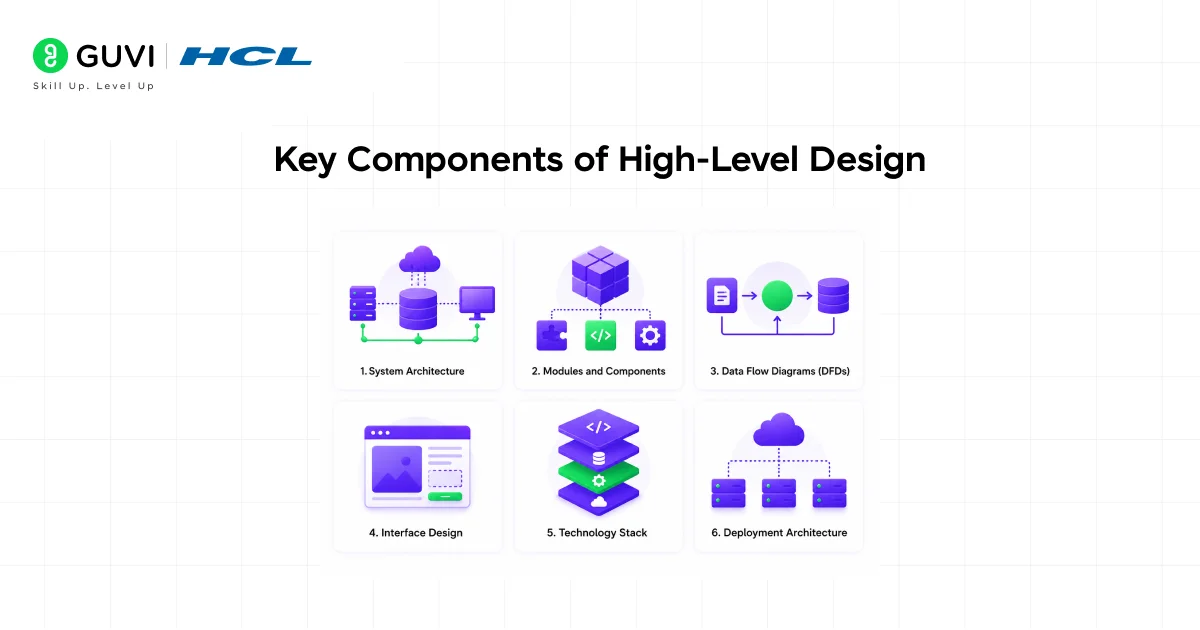
Now let’s get into what HLD actually consists of. A well-documented HLD typically covers the following areas:
System Architecture
This is the structural foundation of your design. It defines which major components exist in the system and how they relate to each other. Common architectural patterns include monolithic architecture, microservices, event-driven architecture, and client-server architecture.
For example, in a monolithic system, all features live in one codebase. In a microservices system, each feature, user management, payments, notifications, is its own independent service.
Also Read: Microservices vs. Monolithic Architecture: Key Differences
Modules and Components
HLD breaks the system down into logical modules. Each module has a specific responsibility. For instance, in an e-commerce application, you might have:
- User Service: Handles registration, login, and authentication
- Product Catalog Service: Manages product listings and search
- Order Service: Handles order creation and tracking
- Payment Service: Processes payments securely
- Notification Service: Sends emails and push notifications
Defining these modules clearly means every developer knows exactly which part of the system they own.
Data Flow Diagrams (DFDs)
Data Flow Diagrams show how data moves through your system, from the moment a user makes a request to the moment they receive a response. These are visual tools that help you and your team understand the journey data takes across different components.
For example, when a user places an order:
User → API Gateway → Order Service → Payment Service → Database → Confirmation Response
This flow makes it easy to spot potential bottlenecks or failure points early.
Interface Design
This covers how different modules talk to each other. In modern systems, this usually means defining REST APIs or GraphQL endpoints. It also includes the design of the user-facing interface at a structural level, what screens exist, and how data flows between the frontend and backend.
Technology Stack
HLD is where major technology decisions are made. This includes:
- Database type: SQL (PostgreSQL, MySQL) vs NoSQL (MongoDB, Cassandra)
- Caching layer: Redis or Memcached for frequently accessed data
- Message queues: Kafka or RabbitMQ for async communication
- Cloud infrastructure: AWS, GCP, or Azure for hosting and scaling
These are high-stakes decisions. Choosing the wrong database type for your use case can create serious performance problems as your system grows.
Deployment Architecture
Finally, HLD covers how the system will be hosted and accessed. This includes server configuration, cloud setup, load balancers, CDN usage, and whether the system will be deployed across multiple geographic regions.
Core Concepts You Need to Know
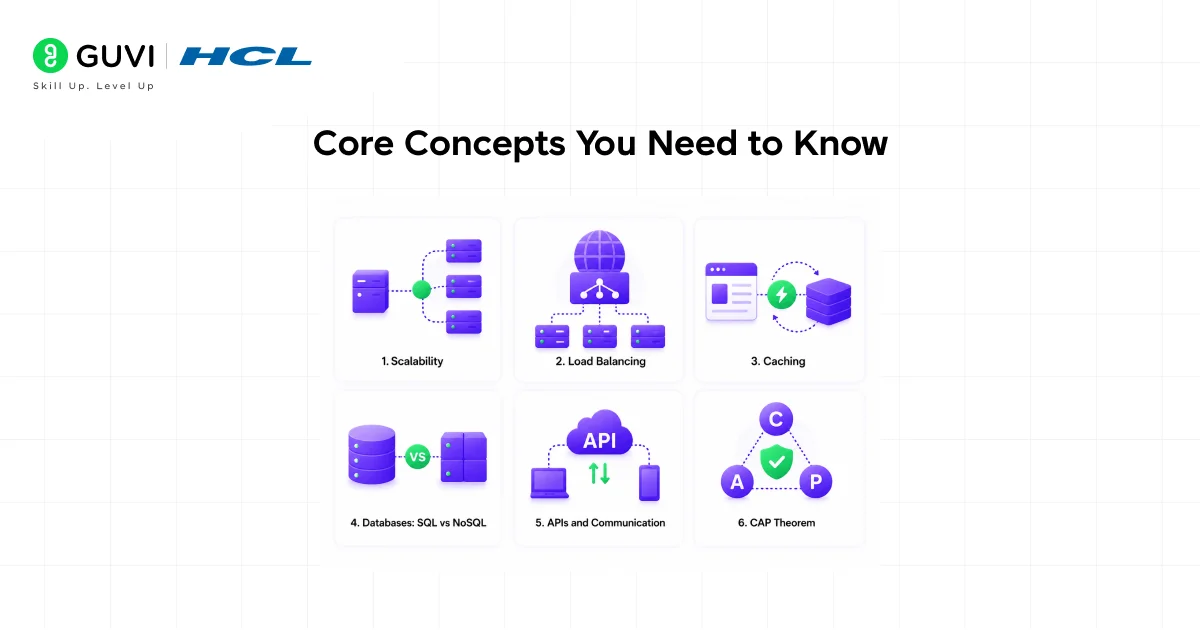
Before you can practice HLD effectively, there are a few foundational concepts that come up repeatedly in system design discussions. Here is a quick primer on each.
Scalability
Scalability is the ability of a system to handle increasing load without degrading in performance. There are two types:
- Vertical scaling: Adding more power to an existing server (more CPU, more RAM)
- Horizontal scaling: Adding more servers to distribute the load
Most modern large-scale systems prefer horizontal scaling because it’s more cost-effective and resilient.
Load Balancing
A load balancer distributes incoming requests across multiple servers so that no single server gets overwhelmed. Think of it like a traffic controller at a busy intersection, directing cars to whichever lane is moving fastest.

Popular load balancers include NGINX and AWS Elastic Load Balancer.
Caching
Caching stores frequently accessed data in fast, temporary storage so it doesn’t have to be fetched from the database every time. This dramatically reduces latency and database load. Redis is one of the most widely used caching solutions in production systems.
Databases: SQL vs NoSQL
Choosing the right database type is one of the most important HLD decisions you’ll make.
- SQL databases (like MySQL, PostgreSQL) are great for structured data and complex relationships. They offer strong consistency.
- NoSQL databases (like MongoDB, Cassandra) are better for unstructured or rapidly changing data at a very large scale. They offer high availability and flexible schemas.
There’s no universally correct answer; the choice always depends on the use case.
APIs and Communication
In distributed systems, components need to talk to each other. The two most common approaches are:
- REST APIs: Simple, stateless, widely understood
- Message queues (Kafka, RabbitMQ): Used for asynchronous communication when you don’t need an immediate response
CAP Theorem
This is a foundational concept in distributed systems. The CAP theorem states that a distributed system can only guarantee two out of the following three properties at the same time:
- Consistency: Every read receives the most recent write
- Availability: Every request receives a response
- Partition Tolerance: The system keeps working even if network failures occur between nodes
Understanding this trade-off helps you make better decisions when choosing databases and designing distributed components.
WhatsApp serves over 2 billion users globally with a surprisingly lean engineering team. Much of this efficiency comes from smart architectural decisions made at the HLD level, including Erlang-based messaging infrastructure designed for extreme concurrency and reliability.
Common Mistakes Beginners Make in HLD
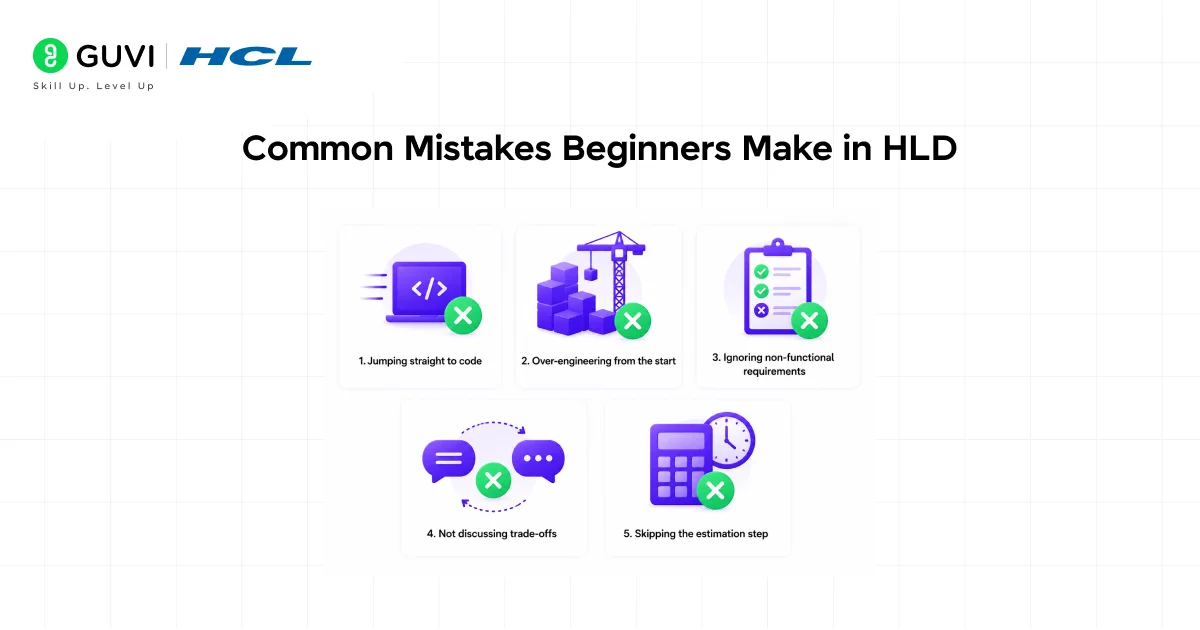
As you start practicing HLD, here are some pitfalls to watch out for:
- Jumping straight to code. HLD is not about implementation. Resist the urge to start writing functions. Think in components and flows first.
- Over-engineering from the start. Not every system needs microservices, Kafka, and a multi-region deployment. Start simple. Add complexity only when the requirements demand it.
- Ignoring non-functional requirements. Scalability, availability, fault tolerance, and security are just as important as features. A system that works for 100 users but crashes at 10,000 is poorly designed.
- Not discussing trade-offs. Every design choice has pros and cons. Interviewers and senior engineers expect you to acknowledge these. Saying “I chose NoSQL because it scales horizontally, but this means I’ll sacrifice strong consistency” shows real understanding.
- Skipping the estimation step. Scale estimates guide your entire design. If you don’t know how many users or requests per second you’re designing for, your architecture might be completely wrong for the use case.
How to Start Learning High-Level Design?
If you’re a fresher just getting started, here’s a practical path to build your HLD skills:
- Start with the fundamentals: Before you can design systems, you need a working understanding of databases, networking basics (HTTP, DNS, TCP/UDP), APIs, and data structures. These form the vocabulary of HLD.
- Study real-world systems: Look at how companies like Netflix, Uber, Twitter, and WhatsApp are architected. GeeksforGeeks, Grokking the System Design Interview, and engineering blogs from major tech companies are excellent resources.
- Practice with common problems: URL shorteners, messaging apps, ride-sharing platforms, and social media feeds are classic HLD practice problems. Try designing each one from scratch before looking at solutions.
- Draw diagrams regularly: Tools like Draw.io and Excalidraw are free and beginner-friendly. The habit of visualizing architecture, rather than just writing about it, is a crucial skill.
- Think through trade-offs: For every design choice, ask yourself: what does this give me, and what does it cost? That habit of thinking is what separates a good HLD response from a great one.
If you’re serious about mastering software development and want to apply it in real-world scenarios, don’t miss the chance to enroll in HCL GUVI’s IITM Pravartak and MongoDB Certified Online AI Software Development Course. Endorsed with NSDC certification, this course adds a globally recognized credential to your resume, a powerful edge that sets you apart in the competitive job market.
Conclusion
In conclusion, High-Level Design is one of the most important skills you can develop as a software engineer, and the earlier you start building it, the better. It shifts your thinking from writing code to architecting systems, from individual functions to interconnected components, from today’s requirements to tomorrow’s scale.
Whether you’re preparing for your first placement interview or simply trying to understand how the apps you use every day are actually built, HLD gives you the mental framework to think at that level. The systems you’ll design in interviews and on the job are complex, but with a solid understanding of HLD principles, you’ll have the tools to break them down into manageable, well-reasoned architectures.
Start practicing. Draw your first system diagram today.
FAQs
1. What is High Level Design in simple terms?
High-Level Design (HLD) is the process of planning a software system’s overall structure, defining its major components, how they interact, and how data flows between them, without going into the internal code-level details.
2. What is the difference between HLD and LLD?
HLD focuses on the big picture, system architecture, component relationships, and technology choices. LLD goes into the implementation details, class structures, method definitions, database schemas, and algorithms. HLD comes first; LLD builds on top of it.
3. Is HLD important for freshers?
Yes, very much so. Product-based companies like Amazon, Google, and Flipkart test system design, including HLD, in their technical interviews. Even for campus placements, having a working understanding of HLD sets you apart from other candidates.
4. What are the key components of a High-Level Design document?
A typical HLD document includes system architecture, module and component descriptions, data flow diagrams, interface design, technology stack decisions, and deployment architecture.
5. What is the CAP theorem and why does it matter in HLD?
CAP theorem states that a distributed system can guarantee only two of three properties: Consistency, Availability, and Partition Tolerance. Understanding it helps you make informed database and infrastructure choices during HLD.
Success Stories

About the Author
Lukesh S
A professional content writer who has experience in freelancing and now working as a Technical Content Writer at HCL GUVI having sound knowledge in Blog Writing and Creative Writing!
View all posts by Lukesh S
Connect with me @












Did you enjoy this article?