


Software Development Articles
How to Read and Understand System Design Diagrams?
System Engineer Roles and Responsibilities: 12 Proven Duties for Growth
SAP Consultant Roles and Responsibilities: 12 Proven Duties for Growth and Success
Network Engineer Roles and Responsibilities: 12 Essential Duties for Success


Get In Touch For Details! Request More Information
Strategy Method Design Pattern: Build Cleaner and More Maintainable Applications
Sep 11, 2026 6 Min Read 731 Views
(Last Updated)
When developing software, coding is only half of what you’ll be doing. The real challenge comes when your application starts growing, requiring developers to constantly add features and keep the code clean.
Many software projects may start out simple, but quickly develop large if/else statements, duplicate logic, and tightly linked code that is harder to change over time. This is one of the most important reasons that modern developers now use design patterns to build scalable and adaptable applications.
The Strategy Method Design Pattern is a powerful behavioural design pattern that allows developers to manage many different algorithms and/or behaviours in an organised, clean manner. Rather than managing all of the logic in a single class, the Strategy Pattern manages the behaviour across many different separate strategy classes, and behaves differently depending on which class is used at runtime.
In this blog, we’ll explore how the Strategy Method Design Pattern works, its components, real-world applications, advantages, disadvantages, and implementation with practical coding examples.
Quick Answer
The Strategy Method Design Pattern is a behavioral design pattern that allows developers to define multiple algorithms separately and switch between them dynamically during runtime. Instead of using large if-else conditions, it organizes behaviors into independent strategy classes, making applications more flexible, scalable, and easier to maintain. It is commonly used in systems like payment gateways, navigation apps, authentication services, and recommendation engines.
Table of contents
- What is the Strategy Method Design Pattern?
- Why This Pattern Is So Popular in Modern Software Development
- Real-World Analogy: Google Maps
- Strategy Design Pattern Architecture
- Components of Strategy Method Design Pattern
- Context
- Strategy Interface
- Concrete Strategies
- Client
- Understanding the Strategy Pattern With a Complete Java Example
- Step 1: Create the Strategy Interface
- Step 2: Create Concrete Strategies
- Step 3: Create the Context Class
- Step 4: Use the Pattern
- Key Benefits of the Strategy Pattern
- Open/Closed Principle
- Easy to Read Code
- Easier Unit Testing
- Runtime Flexibility
- Better Team Collaboration
- Disadvantages of the Strategy Pattern
- Increased Number of Classes
- Can Be Overkill for Small Projects
- Client Must Choose the Correct Strategy
- When Should You Use the Strategy Pattern?
- When Should You Avoid It?
- Wrapping it up:
- FAQs:
- What is the Strategy Method Design Pattern?
- Why is the Strategy Pattern used?
- What are some real-world examples of the Strategy Pattern?
- Which SOLID principle does the Strategy Pattern follow?
What is the Strategy Method Design Pattern?
Strategy Method Design Pattern is a behavioural design pattern that helps to define various algorithms or behaviours independently and switch between them dynamically at runtime.
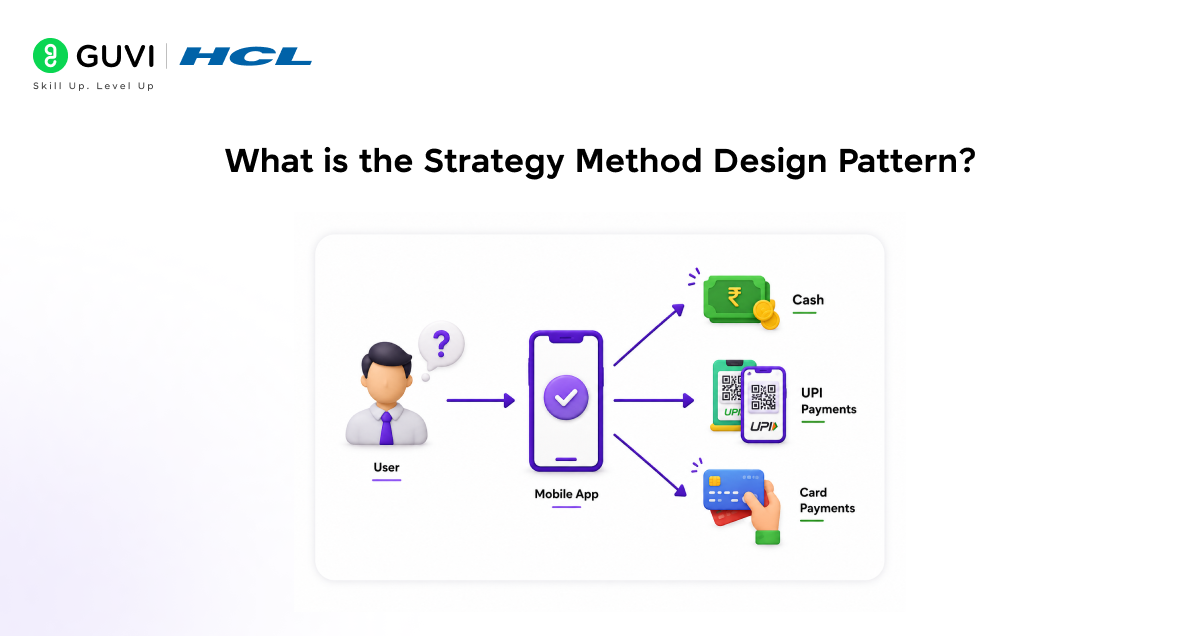
Instead of placing all logic inside one massive class, you:
- Create separate strategy classes
- Encapsulate each behavior independently
- Have the main class decide on the strategy to use
It’s similar to changing your driving settings in the car.
A modern car might be capable of doing the following:
- Eco Mode
- Sports Mode
- Comfort Mode
The car’s behavior varies according to the strategy chosen, but the car itself is unchanged.
Why This Pattern Is So Popular in Modern Software Development
The Strategy Pattern is well suited for modern software architecture as applications are constantly changing today. Features are added to business applications often and systems must adapt without compromising the existing functionality.
That’s why this pattern is widely used in:
- Applications across FinTech where payment transactions, security protocols, and rules are constantly evolving based on customer needs and security requirements.
- Cloud platforms that can re-allocate resources, change caching policies, or deploy resources in any way to meet traffic and performance requirements.
- Game engines where enemy behavior, movement systems, and AI decision-making need to change dynamically during gameplay.
- Systems that test numerous algorithms and models without rewriting the application architecture, such as AI and Machine Learning systems.
Real-World Analogy: Google Maps
A great real-world example is Google Maps.
When you choose a destination, the app can provide:
- Fastest Route
- Shortest Route
- Toll-Free Route
- Fuel-Efficient Route
There is no change to the app itself.
The only thing that changes is the routing algorithm.
Each route calculation method is a stand-alone strategy.
Strategy Design Pattern Architecture
The Strategy Pattern mainly works by separating behaviors from the main application logic.
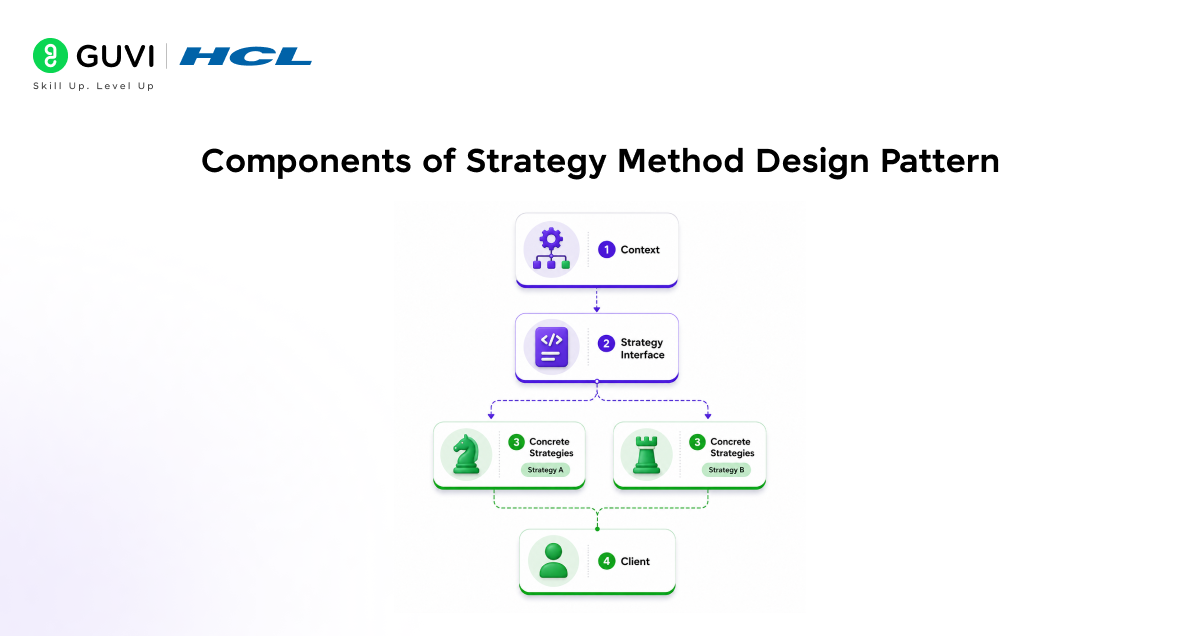
In this architecture:
- The client decides which strategy should be used depending on the situation or user input.
- The Context acts as the main class that uses the selected strategy but does not implement the algorithm itself.
- The Strategy Interface defines a common contract that every strategy must follow.
- The Concrete Strategies contain different implementations of the same behavior.
The Strategy Pattern consists of several important components that work together to provide flexibility and modularity.
Components of Strategy Method Design Pattern
The Strategy Pattern consists of several important components that work together to provide flexibility and modularity.
1. Context
The Context is the main class that interacts with the strategy object.
Instead of implementing algorithms directly, the context delegates the task to the selected strategy. This ensures that this context class has a single responsibility , context management and doesn’t implement more than one business logic.
A well written context class:
- Stores a reference to the current strategy
- Allows strategies to change dynamically
- Delegates tasks without depending on implementation details
For Example:
In a payment application the payment methods would be the strategies, and the shopping cart would be the context.
2. Strategy Interface
The Strategy Interface defines a common contract that all concrete strategies must follow.
This interface ensures consistency across all strategies because every implementation provides the same method structure.
An advantage of a strategy interface is:
- Better code standardization
- Swappable strategies between different players.
- Reduced coupling between components
If there were no common interface it would be hard and messy to switch behaviors dynamically.
3. Concrete Strategies
Concrete strategies include the actual processes (algorithms, behaviors, etc.).
Each strategy is served by a single task.
For example:
- CreditCardPaymentStrategy
- UPIPaymentStrategy
- PayPalPaymentStrategy
Other strategies are unaffected by the different processing logic in each class.
This separation makes things more maintainable as the developer can change one strategy without making changes to the rest of the application.
4. Client
The Client is in charge of deciding which is the best strategy and providing it to the context.
The client decides which strategy should be used based on:
- User input
- Business rules
- Runtime conditions
- System requirements
For example, when a customer selects UPI during checkout, the client passes the UPI payment strategy to the payment context.
Understanding the Strategy Pattern With a Complete Java Example
Let’s build a proper example.
Step 1: Create the Strategy Interface
interface PaymentStrategy {
void pay(int amount);
}
This interface defines the contract every payment method must follow.
Step 2: Create Concrete Strategies
Credit Card Payment
class CreditCardPayment implements PaymentStrategy {
public void pay(int amount) {
System.out.println(amount + ” paid using Credit Card”);
}
}
UPI Payment
class UPIPayment implements PaymentStrategy {
public void pay(int amount) {
System.out.println(amount + ” paid using UPI”);
}
}
PayPal Payment
class PaypalPayment implements PaymentStrategy {
public void pay(int amount) {
System.out.println(amount + ” paid using PayPal”);
}
}
Step 3: Create the Context Class
class ShoppingCart {
private PaymentStrategy strategy;
public ShoppingCart(PaymentStrategy strategy) {
this.strategy = strategy;
}
public void checkout(int amount) {
strategy.pay(amount);
}
}
Notice something important here.
The ShoppingCart class does not know:
- How cards work
- How UPI works
- How PayPal works
It simply delegates the task.
That creates loose coupling.
Step 4: Use the Pattern
public class Main {
public static void main(String[] args) {
PaymentStrategy upi =
new UPIPayment();
ShoppingCart cart =
new ShoppingCart(upi);
cart.checkout(5000);

}
}
Output:
5000 paid using UPI
Now imagine adding:
- Apple Pay
- Crypto Wallet
- EMI Payment
You can do it without touching existing code.
That is a huge advantage in enterprise applications.
Large-scale systems like Google Maps and Amazon often rely on the idea behind the Strategy Pattern to dynamically switch between different behaviors without changing core application logic—for example, selecting between multiple routing strategies (fastest, shortest, or traffic-aware routes) or swapping payment methods at checkout. While not always explicitly labeled in production code, this design principle helps systems stay flexible, modular, and easier to extend as new behaviors are added.
Key Benefits of the Strategy Pattern
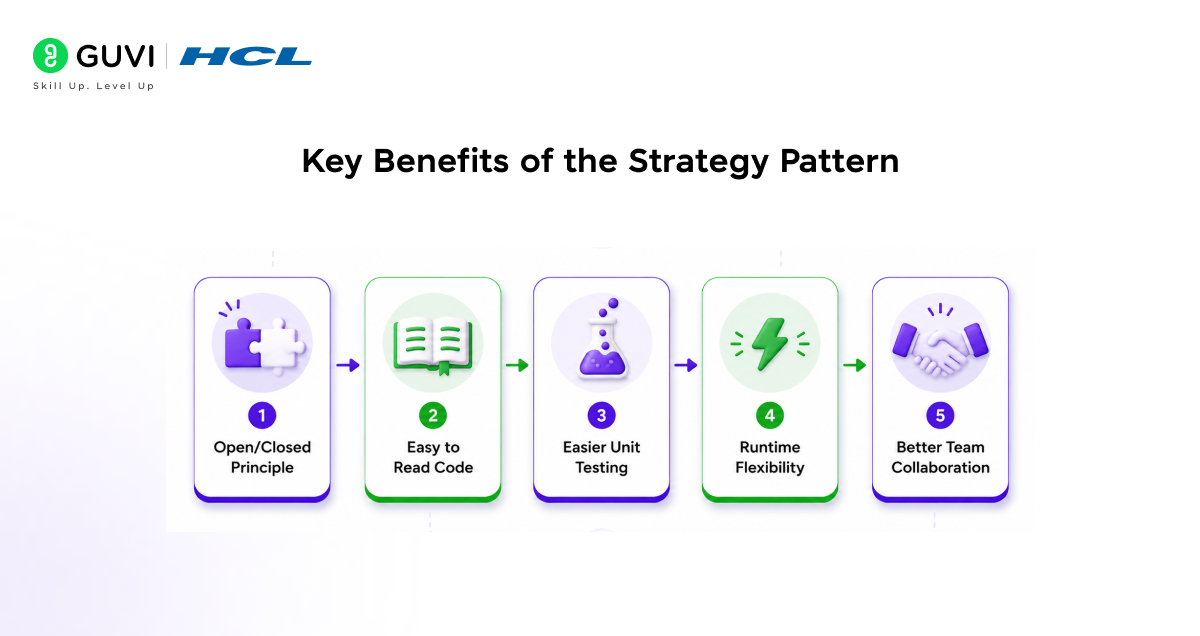
1. Open/Closed Principle
One of the most important feature of Strategy Pattern is it is based on the Open/Closed Principle of SOLID design principles.
This means that your application turns into:
- Open to extension, developers can add new behaviours or algorithms easily.
- Closed for mod, existing code is not modified, thus reducing the risk of introducing bugs into stable features.
This is very useful in large projects when it is necessary to change already written code and affect various systems.
2. Easy to Read Code
The Strategy Pattern breaks up behaviors into individual classes, rather than having all of the business logic in a single large class.
Your code is:
- More accessible to entry-level developers to the project
- Easy to update when adding features
- More readable as everyone has one clear responsibility in each class.
This separation over time helps to avoid having projects become unmanageable “spaghetti code.”
3. Easier Unit Testing
Testing is much easier as each strategy operates in isolation.
You can test, for instance:
- separate payment logic in UPI.
- Credit card validation separately
- PayPal integration separately
This isolation helps in decreasing debugging time and increasing software reliability particularly for enterprise systems.
4. Runtime Flexibility
One of the best aspects of the Strategy Pattern is the ability to dynamically switch behaviors at run time.
Depending on the application decision can be made based on:
- User preference
- Device type
- Business rules
- System performance
- External APIs
This flexibility allows developers to build highly adaptive applications without changing core logic.
5. Better Team Collaboration
In large development teams, multiple developers often work on the same feature simultaneously.
With the Strategy Pattern:
- UPI payment logic can be built by one developer
- The second one can work on integration with Paypal.
- A different one can process payments through the wallet.
Strategies are independent modules, so developers can work without constantly having to create merge conflicts.
Disadvantages of the Strategy Pattern
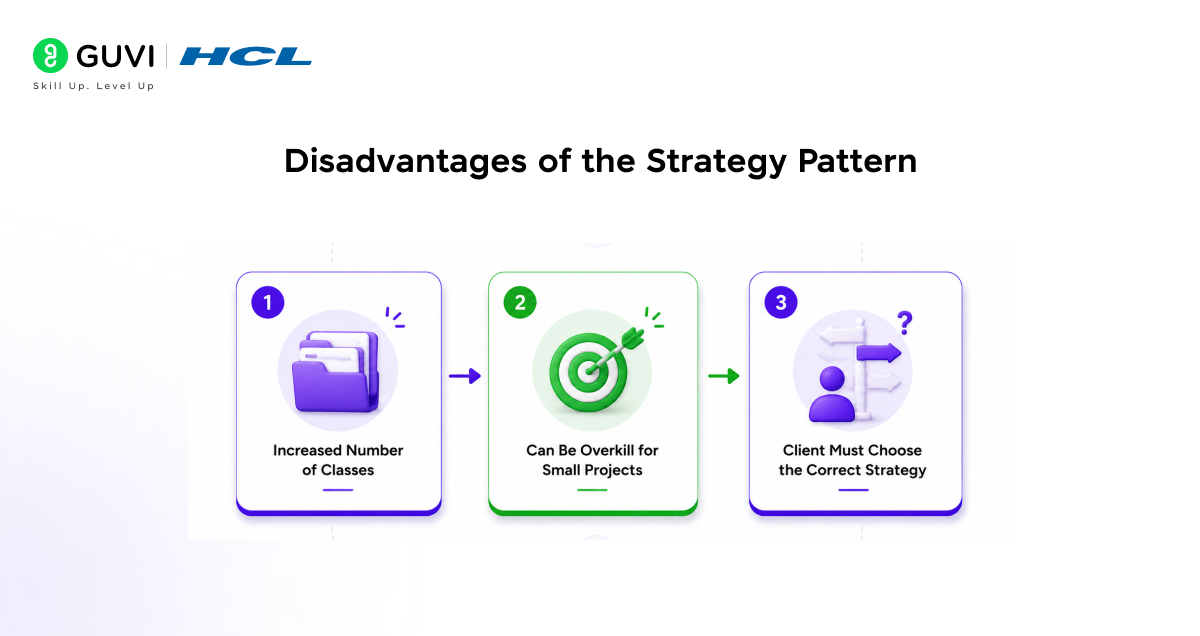
1. Increased Number of Classes
The Strategy Pattern creates separate classes for each behavior or algorithm.
This can lead to:
- Many small files
- More project structure complexity
- Further setup for beginners to understand
It’s great that it’s modular, but it can seem like too much work for the beginning developer.
2. Can Be Overkill for Small Projects
All projects do not require a design pattern.
If you are using only:
- Two simple conditions
- Rarely changing behavior
- Minimal business logic
then using the Strategy Pattern may unnecessarily complicate the codebase.
Sometimes a simple conditional statement is completely acceptable.
3. Client Must Choose the Correct Strategy
The application or client code usually needs to decide which strategy should be used.
This implies that higher-level logic needs to:
- Understand available strategies
- Select the appropriate one
- Handle invalid selections properly
The selection of a strategy can be a messy process if not carefully designed.
When Should You Use the Strategy Pattern?
- When your application has multiple alternative ways of completing a function or task, such as payment methods (credit cards vs PayPal) or sorting methods (sorting by name vs sorting by price).
- When the business logic involved in completing a task has the potential to change often and you expect additional behaviors will be required in the future.
- When your codebase contains large conditional statements that are difficult to maintain.
- When you want the ability to change the behavior of an object dynamically at run time without modifying the class or code.
- When your projects require a scalable, maintainable, and clean architecture.
When Should You Avoid It?
While the Strategy Pattern is a powerful design pattern, it may not be the best fit for your project. Before using the Strategy Pattern, consider the following factors:
- You have a very small project that is not expected to grow.
- You have 1-2 simple conditions that rarely change.
- Adding abstraction will make your application more difficult to comprehend than it currently is.
- Your priorities are on speedy development and simplicity rather than future growth potential.
The goal of software engineering is to maintain a balance. In many cases, the most simple solution is the best solution.
Want to build real-world software projects and master concepts like Design Patterns, System Design, AI, and Full Stack Development?
Check out the Professional Certificate in AI Software Development Course by HCL GUVI in collaboration with IITM Pravartak & MongoDB. The program helps you gain hands-on experience with industry-level tools, live projects, and practical development skills that companies actually look for.
Wrapping it up:
The Strategy Method Design Pattern is more than just a design pattern, it helps create an easier means of managing the changing behavior of software applications. This pattern allows developers to structure their algorithms into independent and flexible strategies instead of cluttering their applications with large conditional statements and tightly coupled logic.
For students, it strengthens problem-solving and object-oriented programming skills. For professionals, it provides a cleaner approach to designing systems that can grow without becoming difficult to manage.
Thank you for reading this blog, and I hope it helped you to understand better how the Strategy Design Method Pattern works in real-world examples.
FAQs:
1. What is the Strategy Method Design Pattern?
The Strategy Pattern is a behavioral design pattern that enables a developer to implement multiple algorithms separately, as well as switch between them at runtime.
2. Why is the Strategy Pattern used?
It is used to reduce complex conditional logic, improve flexibility, and make applications easier to maintain and scale.
3. What are some real-world examples of the Strategy Pattern?
Common real-world examples include payment gateways, navigation systems, authentication methods, recommendation engines, and game AI behaviors.
4. Which SOLID principle does the Strategy Pattern follow?
The Strategy Pattern is most closely aligned with the Open/Closed principle. This is because you may add new strategies without changing any existing code.
Success Stories

About the Author
Vishalini Devarajan
An Aerospace Engineer turned content writer, I focus on making complex concepts easy to understand through well-structured, reader-friendly blogs. Whether it’s a technical topic or a non-technical one, I love creating content that is clear, engaging, and impactful.
View all posts by Vishalini Devarajan
Connect with me @
















Did you enjoy this article?