


Career Articles
Imposter Syndrome in Tech: Recognizing and Overcoming It
Business Development Executive Roles and Responsibilities: 12 Powerful Duties for Growth
Moonlighting in India: Is It Legal? How to Do It Safely
Work-from-Home vs Office Salary: What Companies Actually Pay


Get In Touch For Details! Request More Information
Average CTC vs In-Hand Salary: Complete Breakdown for IT Jobs
Jul 08, 2026 4 Min Read 30 Views
(Last Updated)
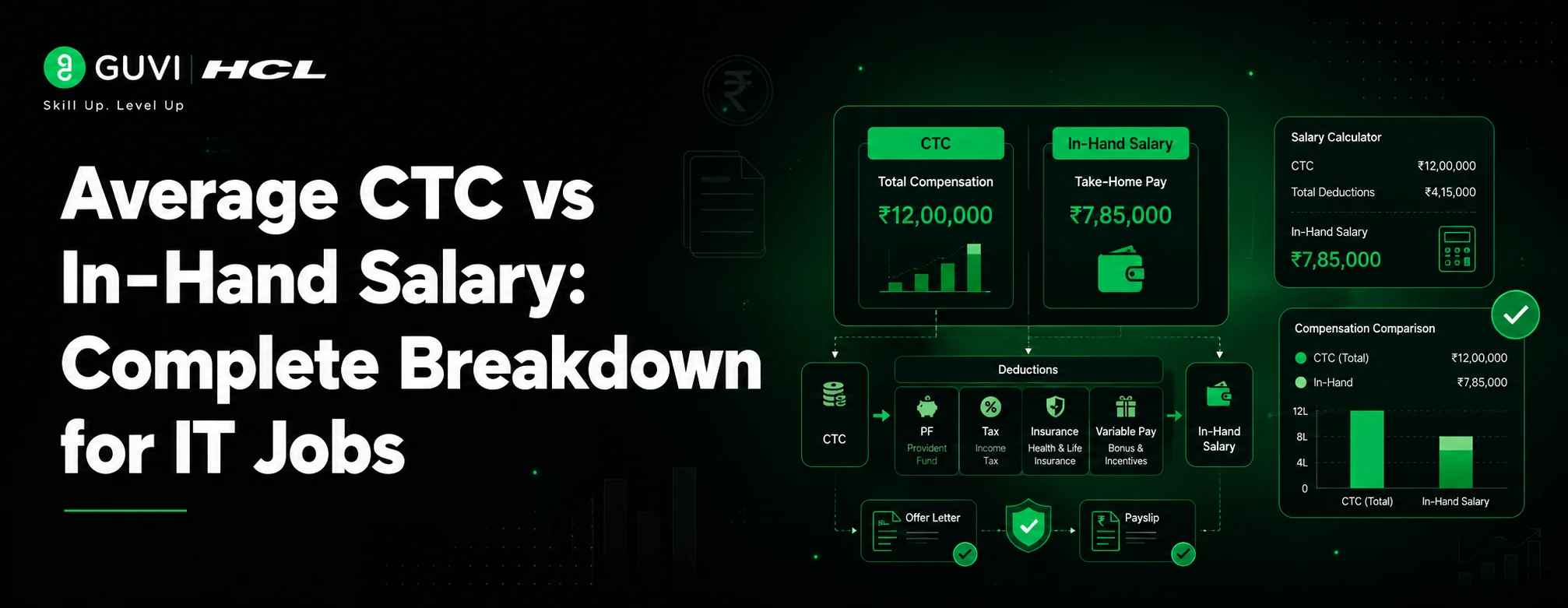
You get an offer letter that says ₹12 LPA. You tell your family. Everyone is excited. Then your first salary arrives and it is ₹72,000 instead of the ₹1,00,000 you expected. What happened? Understanding average CTC vs in-hand salary is one of the most important financial literacy topics for anyone entering or growing in the Indian IT industry. This guide breaks down exactly what CTC includes, what gets deducted, and what you will actually see in your account each month.
Table of contents
- TL;DR Summary
- What is CTC?
- What is In-Hand Salary?
- Average CTC vs In-Hand Salary: What Gets Deducted?
- Real Breakdown Examples by CTC Slab
- Variable Pay and Joining Bonus: The Hidden Traps
- How to Calculate Your In-Hand Salary from CTC
- 💡 Did You Know?
- Common Mistakes to Avoid
- Conclusion
- FAQs
- What is the difference between average CTC vs in-hand salary?
- How much of my CTC will I actually receive in hand?
- Is variable pay included in CTC?
- How do I calculate my monthly in-hand salary from CTC?
- Why does the average CTC vs in-hand salary gap get bigger at higher salaries?
- Should I ask for the CTC breakup before joining a company?
TL;DR Summary
- Average CTC vs in-hand salary is one of the most misunderstood gaps in Indian IT hiring. Your take-home is almost always 60 to 75 percent of your CTC.
- CTC includes basic salary, HRA, PF contributions, gratuity, bonuses, ESIC, and perks. Many of these never reach your bank account directly.
- A ₹10 LPA CTC typically translates to ₹65,000 to ₹72,000 per month in-hand after deductions.
- Variable pay and joining bonuses inflate CTC on paper without guaranteeing that money in your first year.
- Always ask for a detailed CTC breakup before accepting any IT job offer.
What is CTC?
CTC stands for Cost to Company. It is the total annual amount a company spends on employing you, including components that never directly reach your bank account.
CTC typically includes:
- Basic salary (usually 40 to 50 percent of CTC)
- House Rent Allowance (HRA)
- Special allowance
- Employer’s PF contribution (12 percent of basic)
- Gratuity (4.81 percent of basic, paid only after 5 years)
- Medical allowance
- Telephone or internet reimbursement
- Variable pay or performance bonus
- ESIC (if applicable, for salaries under ₹21,000 per month)
- Company-paid perks like food coupons, cab facilities, or insurance premiums
The key word is “cost to company.” Everything on this list costs the company money, but most of it either goes to the government, gets paid conditionally, or is reimbursed against receipts rather than deposited as cash.
What is In-Hand Salary?
In-hand salary is the amount actually credited to your bank account each month after all deductions. It is also called take-home salary.
In-hand salary equals:
Gross Salary minus TDS (income tax) minus Employee PF contribution minus Professional Tax (in some states) minus ESIC (if applicable)
Gross salary itself is CTC minus employer contributions like the employer’s PF share and gratuity provision, which are cost items that never flow through your payslip as income.
Average CTC vs In-Hand Salary: What Gets Deducted?
Here is exactly where your money goes between your CTC number and your bank account.
| Deduction | Rate or Amount | Notes |
| Employee PF | 12% of basic | Goes to your EPF account, not lost |
| Employer PF | 12% of basic | Part of CTC, never hits your payslip |
| Gratuity provision | 4.81% of basic | Part of CTC, paid only after 5 years |
| Income Tax (TDS) | Slab rate | Depends on your declarations, HRA, 80C |
| Professional Tax | ₹200/month | Maharashtra, Karnataka, AP, WB |
| ESIC | 0.75% of gross | Only for salaries under ₹21,000 gross/month |
The average CTC vs in-hand salary gap typically ranges from 25 to 40 percent of the CTC figure, depending on the tax slab you fall in.
Real Breakdown Examples by CTC Slab
Here is how average CTC vs in-hand salary plays out across common IT salary levels.
| Annual CTC | Monthly Gross | Approx. In-Hand/Month | Take-Home % |
| ₹4 LPA | ₹33,333 | ₹27,000 to ₹29,000 | ~85% |
| ₹6 LPA | ₹50,000 | ₹40,000 to ₹43,000 | ~82% |
| ₹10 LPA | ₹83,333 | ₹65,000 to ₹72,000 | ~76% |
| ₹15 LPA | ₹1,25,000 | ₹92,000 to ₹1,00,000 | ~74% |
| ₹20 LPA | ₹1,66,667 | ₹1,15,000 to ₹1,28,000 | ~70% |
| ₹30 LPA | ₹2,50,000 | ₹1,60,000 to ₹1,80,000 | ~67% |
Note: These are approximate figures assuming standard deductions, HRA exemption claimed, and ₹1.5 lakh invested under 80C. The higher the CTC, the wider the average CTC vs in-hand salary gap because of the higher income tax slab.

Variable Pay and Joining Bonus: The Hidden Traps
Variable pay is performance-linked pay that appears in your CTC but is only paid if you or your team hits certain targets. It is typically 10 to 20 percent of CTC at service companies and can be higher at product companies.
Common traps in the average CTC vs in-hand salary discussion:
- A ₹12 LPA offer with 20 percent variable means ₹9.6 LPA fixed plus ₹2.4 LPA variable. If you receive only 80 percent of your variable target, your effective CTC drops to ₹11.52 LPA.
- A joining bonus is often repayable if you leave within 12 to 18 months. It inflates your year-one CTC without changing your monthly in-hand.
- Retention bonuses appear in CTC but are paid only after a specific tenure, sometimes two to three years into the role.
Always ask: what is the fixed component of my CTC? That number divided by 12 and then reduced by standard deductions is what you will actually receive monthly.
How to Calculate Your In-Hand Salary from CTC
A simple three-step method:
Step 1: Find your fixed monthly gross. Subtract employer PF (12 percent of basic), gratuity provision (4.81 percent of basic), and any other non-cash benefits from your monthly CTC.
Step 2: Subtract employee deductions. Remove employee PF (12 percent of basic), professional tax if in an applicable state, and TDS based on your income slab and declared savings.
Step 3: What remains is your monthly in-hand.
For a quick estimate, multiply your annual fixed CTC by 0.70 to 0.75 and divide by 12. This is a reliable rough cut for most IT salaries between ₹6 LPA and ₹20 LPA.
Understanding average CTC vs in-hand salary helps you negotiate better offers. Getting those offers requires the right skills. HCL GUVI’s Full Stack Development Course and AI Software Development Course are both IITM Pravartak certified and designed to build the skill sets that product companies and service firms are hiring for in 2026.
💡 Did You Know?
Many IT candidates compare job offers using CTC numbers alone, but two offers with the same CTC can differ by ₹10,000 to ₹20,000 per month in actual take-home depending on how the salary is structured between basic, HRA, special allowance, and variable pay. The CTC number is a starting point, not a take-home guarantee.
Common Mistakes to Avoid
- Accepting an offer based on CTC without asking for the breakup. Companies are required to share a detailed CTC breakup before you sign the offer letter. Ask for it, review the fixed vs variable split, and calculate your actual monthly in-hand before deciding.
- Forgetting to account for tax deductions. Many freshers in the ₹5 LPA to ₹8 LPA range pay negligible tax if they declare HRA, invest ₹1.5 lakh under 80C, and claim the standard deduction. Not declaring these means paying unnecessary TDS every month.
- Treating the joining bonus as part of your salary. A joining bonus is a one-time payment, often with a clawback clause. Do not use it to set your lifestyle expectations for monthly spending.
Conclusion
The average CTC vs in-hand salary gap in Indian IT is real, consistent, and predictable once you understand how CTC is structured. Your take-home will generally be 65 to 80 percent of your fixed CTC depending on your tax slab, salary structure, and savings declarations. Always ask for the full CTC breakup, separate the fixed from the variable, and calculate your actual monthly in-hand before comparing or accepting any offer.
FAQs
1. What is the difference between average CTC vs in-hand salary?
CTC is the total cost a company incurs to employ you annually, including components like employer PF, gratuity, and perks. In-hand salary is what actually reaches your bank account each month after deductions.
2. How much of my CTC will I actually receive in hand?
For most Indian IT roles, you will take home 65 to 80 percent of your annual fixed CTC divided by 12, depending on your income tax slab, salary structure, and investment declarations.
3. Is variable pay included in CTC?
Yes, variable pay is typically included in the CTC figure. It is only paid out if performance targets are met and is not guaranteed. Always find out the fixed-to-variable split before accepting an offer.
4. How do I calculate my monthly in-hand salary from CTC?
Multiply your annual fixed CTC by 0.70 to 0.75 and divide by 12 for a rough estimate. For an accurate figure, get the detailed breakup and subtract employee PF, professional tax, and TDS individually.
5. Why does the average CTC vs in-hand salary gap get bigger at higher salaries?
Higher CTC means a higher income tax slab, which increases the percentage of deductions. A ₹4 LPA employee may keep 85 percent of their CTC while a ₹30 LPA employee keeps closer to 65 percent.
6. Should I ask for the CTC breakup before joining a company?
Yes, always. A detailed CTC breakup shows your basic salary, HRA, allowances, variable pay, and benefits. It is the only way to accurately compare two offers and calculate your actual average CTC vs in-hand salary for each role.
Success Stories

About the Author
Jebasta
I translate the language of data into stories that anyone can understand. As a writer with a data science background, I simplify analytics, AI, and decision-making so beginners and enthusiasts can confidently explore the world of data.
View all posts by Jebasta
Connect with me @














Did you enjoy this article?