


Career Articles
Imposter Syndrome in Tech: Recognizing and Overcoming It
Business Development Executive Roles and Responsibilities: 12 Powerful Duties for Growth
Moonlighting in India: Is It Legal? How to Do It Safely
Average CTC vs In-Hand Salary: Complete Breakdown for IT Jobs


Get In Touch For Details! Request More Information
Work-from-Home vs Office Salary: What Companies Actually Pay
Jul 08, 2026 4 Min Read 33 Views
(Last Updated)
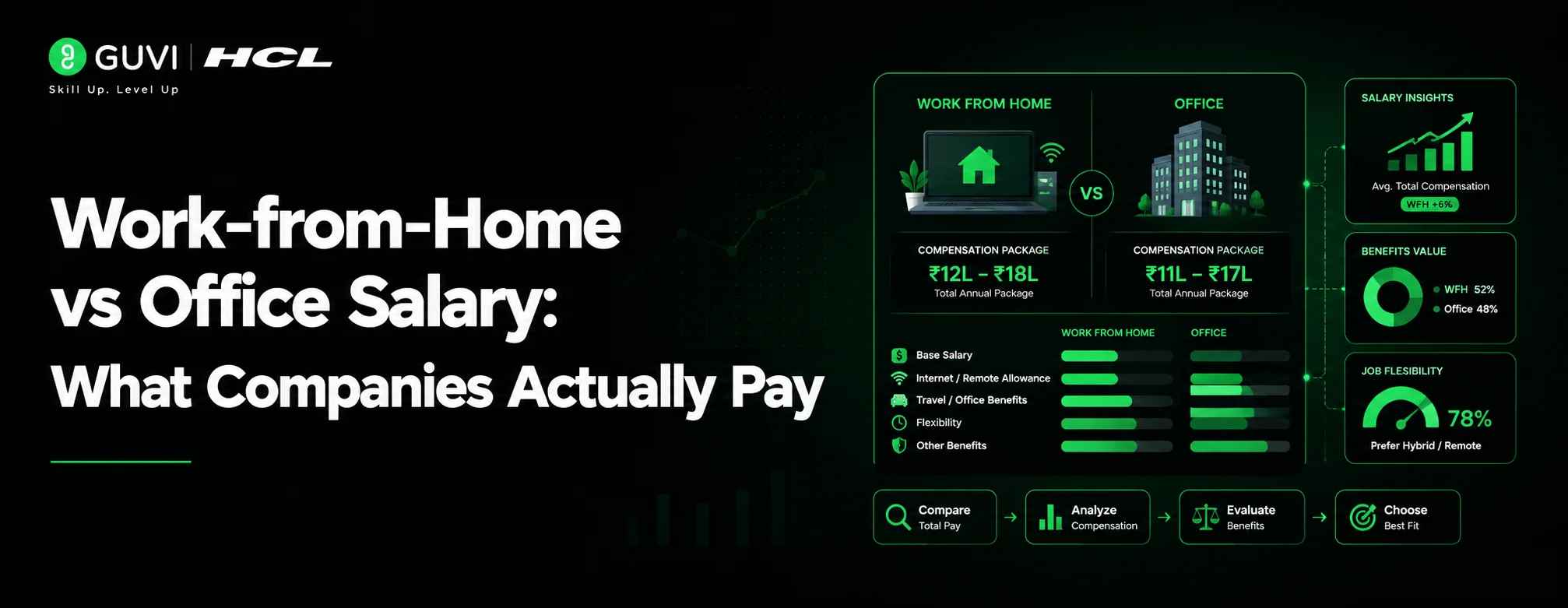
When you compare two job offers today, one fully remote and one requiring daily office attendance, the headline salary numbers do not tell the full story. The work-from-home vs office salary comparison depends on who is offering the role, where the company is headquartered, what your commute costs, and whether the role comes with meal, transport, or equipment allowances. This guide breaks down what Indian IT companies and international firms actually pay in 2026 for remote versus in-office roles so you can make an informed comparison before accepting anything.
Table of contents
- TL;DR Summary
- Work-from-Home vs Office Salary: The Real Numbers
- Why Companies Pay Differently for Remote vs Office Roles
- Product Companies vs Service Companies: The Salary Split
- International Remote Roles: Where WFH Wins Completely
- Hidden Costs That Change the Work-from-Home vs Office Salary Calculation
- Work-from-Home vs Office Salary by Role Type
- 💡 Did You Know?
- Common Mistakes to Avoid
- Conclusion
- FAQs
- Do work-from-home roles pay less than office roles in India?
- Which pays more in India: work from home or office?
- How much can I earn in a remote role for a US company from India?
- Do Indian companies pay a WFH allowance?
- Should I accept a lower CTC for a work-from-home role?
TL;DR Summary
- The work-from-home vs office salary gap is real but varies significantly by company type, role, and location.
- Fully remote roles at Indian product companies often pay 5 to 15 percent less than equivalent in-office roles.
- Remote roles at US or European companies paying in dollars or euros are where the real income gap reverses dramatically in favour of WFH.
- Hybrid roles are now paying at or above full office rates at most service companies as a retention strategy.
- The work-from-home vs office salary equation changes entirely when you factor in commute costs, meal allowances, and petrol savings.
Work-from-Home vs Office Salary: The Real Numbers
Here is how the work-from-home vs office salary gap plays out across the most common scenarios in the Indian IT market.
| Scenario | WFH Salary | Office Salary | Net Advantage |
| Indian product company, same role | 5 to 10% lower | Baseline | Office wins on paper |
| Indian service company, hybrid | Equal to baseline | Baseline | Parity, WFH wins on savings |
| US remote role, Indian developer | ₹30 to ₹90 LPA | ₹10 to ₹25 LPA local | WFH wins significantly |
| European remote role | ₹20 to ₹60 LPA | ₹10 to ₹20 LPA local | WFH wins significantly |
| Indian startup, fully remote | 10 to 20% lower | Baseline | Office wins slightly |
The work-from-home vs office salary gap inverts completely depending on whether you are comparing domestic versus international employers.
Why Companies Pay Differently for Remote vs Office Roles
Companies adjust pay for remote roles for a mix of legitimate and self-serving reasons.
Legitimate reasons:
- Office roles come with real costs: transport allowance, food subsidies, equipment, electricity, and maintained office space. These are stripped from the total package in remote roles, reducing effective CTC even if the stated salary looks equal.
- Location-based pay adjustments mean a company headquartered in Bangalore may pay a Tier-2 city remote hire less because their cost of living is lower.
Self-serving reasons:
- Many companies use “we don’t offer remote” as a negotiation posture rather than a genuine constraint, particularly for mid-level roles where the work is entirely digital.
- Some companies maintain in-office requirements specifically to limit salary demands, because candidates in large cities with high commute burdens tend to negotiate higher salaries.
Product Companies vs Service Companies: The Salary Split
The work-from-home vs office salary dynamic plays out very differently depending on company type.
Product companies in India (CRED, Razorpay, Zerodha, Freshworks) shifted to hybrid models post-2022 and generally pay the same CTC regardless of in-office or hybrid attendance. Fully remote roles at these companies are rarer and sometimes carry a 5 to 10 percent discount.
Service companies (TCS, Infosys, Wipro, HCL, Accenture India) now predominantly offer hybrid models paying the same baseline salary whether you are in office three days a week or five. Some have added remote-work allowances of ₹5,000 to ₹15,000 per month for stable internet and ergonomic equipment, shifting the work-from-home vs office salary calculation in WFH’s favour.
International Remote Roles: Where WFH Wins Completely
This is where the work-from-home vs office salary conversation changes entirely for Indian developers in 2026.
A mid-level full stack developer in India earning ₹12 LPA at a Bangalore office is earning roughly $14,400 per year. The same developer, working remotely for a US startup paying $50,000 to $80,000 per year, takes home ₹41 to ₹66 LPA while living in India. There is no office role in India at the same experience level that competes with that number.
This is why the fastest-growing segment of the Indian freelance and contract developer market is remote work for international employers. The work-from-home vs office salary gap is not a disadvantage in this context. It is a 3x to 5x income multiplier.
Whether you are targeting a remote role with an international employer or a high-paying product company in India, the underlying requirement is the same: a genuinely strong, demonstrable skill set. HCL GUVI’s Full Stack Development Course and AI Software Development Course are both IITM Pravartak certified and designed to build that foundation with real projects and placement support.

Hidden Costs That Change the Work-from-Home vs Office Salary Calculation
When you compare the work-from-home vs office salary for any role, these costs need to be part of the calculation.
| Item | Office Cost (Monthly) | WFH Cost (Monthly) |
| Commute (Bangalore, train + auto) | ₹2,000 to ₹6,000 | ₹0 |
| Lunch and tea at office | ₹3,000 to ₹6,000 | ₹1,500 to ₹2,500 |
| Work clothes and grooming | ₹1,500 to ₹3,000 | ₹300 to ₹500 |
| Internet and power at home | ₹0 to ₹500 | ₹1,000 to ₹2,000 |
| Effective monthly saving from WFH | ₹4,000 to ₹11,000 |
A role that pays ₹5,000 per month less for WFH still comes out ahead once you factor in what you stop spending on commute, food, and work clothes. The work-from-home vs office salary is never just the number on the offer letter.
Work-from-Home vs Office Salary by Role Type
| Role | WFH Premium or Discount | Notes |
| Full Stack Developer | Neutral to 10% discount | High WFH demand, small pay gap |
| DevOps Engineer | Neutral | Cloud-native roles are fully remote-compatible |
| Data Scientist | Neutral to 5% premium | Scarce skill, WFH negotiating power is high |
| QA Engineer | 5 to 10% discount | More WFH roles, supply exceeds demand |
| UI/UX Designer | Neutral | Portfolio drives pay more than location |
| Project Manager | 10 to 15% discount | Stakeholder visibility valued in office |
💡 Did You Know?
- A Mercer India 2025 talent survey found that 68% of IT professionals would accept a 10–15% lower salary in exchange for a fully remote role. However, only 22% of Indian IT companies offered fully remote roles in mid-2025, showing that demand for WFH far exceeds supply.
Common Mistakes to Avoid
- Comparing only the CTC number when evaluating work-from-home vs office salary. Two offers with the same CTC land differently in your bank account once you factor in commute costs, meal allowances, equipment stipends, and location-based cost of living. Always calculate the effective take-home after living costs, not just after taxes.
- Assuming all international remote roles pay in dollars. Some global companies with Indian offices pay in rupees on Indian payroll even for remote positions, giving you neither the salary of a domestic market role nor the dollar premium of a genuine international remote role. Confirm the currency and payroll structure before negotiating.
- Not negotiating the WFH allowance separately. Many Indian IT companies now offer a one-time remote setup allowance of ₹15,000 to ₹50,000 and a monthly internet stipend. These are often not mentioned in the initial offer and are almost always available if you ask. Not asking leaves real money on the table in every work-from-home vs office salary negotiation.
Conclusion
The work-from-home vs office salary comparison in 2026 has no single winner. For domestic Indian roles, the gap is small and often reversed by commute and meal savings. For international remote roles, WFH wins by a factor of three to five in total compensation. The most important move any developer can make is to treat the work-from-home vs office salary comparison as a total compensation calculation, not a headline number comparison, and to negotiate every component of the offer including the remote allowance, not just the base salary.
FAQs
1. Do work-from-home roles pay less than office roles in India?
In domestic Indian IT roles, WFH roles often pay 5 to 15 percent less than equivalent office roles at product companies. At service companies with hybrid models, pay is now largely equivalent. The work-from-home vs office salary gap is almost entirely reversed for international remote roles.
2. Which pays more in India: work from home or office?
Office roles at Indian product companies pay slightly more on paper. However, the effective work-from-home vs office salary after deducting commute, food, and clothing costs often makes WFH competitive or superior, particularly at service companies and for international remote roles.
3. How much can I earn in a remote role for a US company from India?
Mid-level developers in India working remotely for US companies typically earn $40,000 to $80,000 per year, which translates to ₹33 to ₹66 LPA at current exchange rates, significantly above domestic market rates.
4. Do Indian companies pay a WFH allowance?
Many larger IT companies and product startups now offer a one-time remote setup allowance (₹15,000 to ₹50,000) and a monthly internet stipend (₹1,000 to ₹2,000). These are often negotiable even when not included in the initial offer letter.
5. Should I accept a lower CTC for a work-from-home role?
It depends on how much lower and what your commute costs look like. A role paying ₹5,000 less per month but saving you ₹6,000 in commute and food costs is effectively higher paying. Always calculate effective take-home in any work-from-home vs office salary comparison.
Success Stories

About the Author
Jebasta
I translate the language of data into stories that anyone can understand. As a writer with a data science background, I simplify analytics, AI, and decision-making so beginners and enthusiasts can confidently explore the world of data.
View all posts by Jebasta
Connect with me @














Did you enjoy this article?