


Artificial Intelligence and Machine Learning Articles
AI/ML Skills Gap 2026: Why Companies Can't Find Job-Ready Talent
20 AI/ML Interview Questions Recruiters Can Use Without a Tech Background - Best Guide
How Industry-Backed AI/ML Bootcamps Are Changing the AI/ML Hiring Pipeline - Best Guide 2026
From IT Support to AI Engineer: A Realistic Career Switch Guide 2026

Get In Touch For Details! Request More Information
AI Fluency Index: Guide to Smarter AI Conversations
Sep 08, 2026 7 Min Read 722 Views
(Last Updated)
Artificial intelligence is no longer something you just hear about in the news. It is sitting inside the tools you use at work right now, and the question is no longer whether you use it but how well you use it.
That is exactly what the AI Fluency Index measures. It is a framework that goes beyond whether you have tried AI tools and looks at whether you can use them with real skill, consistency, and intention in your everyday work.
This guide breaks down what AI fluency means, why it is quickly becoming one of the most valuable professional skills of this decade, and how you can start building it in a practical, no-jargon way starting today.
Quick TL;DR Summary
- This guide explains what the AI Fluency Index is and why it has become one of the most important measures of professional capability in 2025.
- You will learn the core areas that AI fluency covers, from giving good instructions to evaluating AI output critically.
- The guide covers when fluency genuinely changes your results and when people overestimate how much they know.
- A step-by-step breakdown shows you how to assess and grow your own fluency level.
- Real-world examples show how professionals across different fields are closing the fluency gap.
- Practical strategies help you build real fluency, not just surface-level familiarity.
Table of contents
- What Is the AI Fluency Index?
- The Problem with Assuming Fluency
- Why the Index Changes the Conversation
- When AI Fluency Genuinely Matters
- The Core Areas the AI Fluency Index Measures
- Types of Fluency You Can Build Right Now
- Step-by-Step: Assessing and Building Your AI Fluency
- Step 1: Honest Self-Assessment
- Step 2: Identify Your Most Common AI Tasks
- Step 3: Study One Task Deeply
- Step 4: Learn the Principles of Good Instruction
- Step 5: Rebuild Your Approach to That Task
- Step 6: Test Across Different Variations
- Step 7: Expand to Other Tasks Gradually
- Real-World Examples of AI Fluency in Action
- Pros and Cons of Focusing on AI Fluency
- Pros
- Cons
- Top Strategies to Build Real AI Fluency
- Common Mistakes to Avoid
- Conclusion
- FAQs
- How long does it take to build genuine AI fluency?
- Is AI fluency the same thing as knowing how to code?
- Can organizations measure AI fluency across teams?
- What is the most important fluency skill to build first?
- How do I know if my AI fluency is actually improving?
- What is the difference between an AI course and an AI & ML course?
- What should I look for before enrolling in an AI & ML course?
- How should I evaluate AI & ML certifications before enrolling?
What Is the AI Fluency Index?

The AI Fluency Index is a framework that measures how effectively a person or organization understands and applies artificial intelligence in real work situations. It goes far beyond knowing that AI tools exist. It looks at whether people can use those tools with intention, skill, and consistency.
Think of fluency the way you think about language. Someone who is fluent in a second language does not just know vocabulary words. They understand grammar, context, tone, and nuance. They can hold a real conversation without stopping to translate everything in their head. AI fluency works the same way.
A fluent AI user does not just know what tools are available. They know how to communicate with those tools clearly, how to evaluate what comes back, when to trust the output and when to question it, and how to build AI into their workflow so it actually saves time instead of creating more work.
The Problem with Assuming Fluency
Most people who use AI regularly believe they are using it well. The reality is more complicated.
People get generic results and assume that is the best AI can do. They give vague instructions and blame the tool when outputs are vague.
They use AI for the wrong tasks and miss opportunities to use it for the right ones. They accept AI output without reviewing it critically and create problems downstream.
Why the Index Changes the Conversation
The AI Fluency Index gives individuals and organizations a clear, honest picture of where fluency is strong and where it is weak.
This makes it possible to train deliberately, improve specifically, and measure progress over time instead of just hoping things get better.
A 2024 study by Microsoft and LinkedIn found that 66% of business leaders would not hire candidates without AI skills, yet only 39% of workers have received formal AI training from their employers. This growing gap highlights why building your own AI fluency is becoming essential.
When AI Fluency Genuinely Matters
AI fluency is not equally important in every situation. Being clear about where it makes a real difference helps you invest your learning time wisely.
- Repetitive Professional Tasks
Any work you do regularly that follows a consistent pattern benefits enormously from higher fluency. The fluent user gets consistent, high-quality results every time. The less fluent user gets inconsistent outputs that require heavy editing.
- High-Stakes Outputs
When the work matters, like client reports, executive summaries, or important communications, fluency determines whether AI helps you or creates extra work. A fluent user produces polished outputs. A less fluent user produces drafts that need complete rewrites.
- Specialized or Domain-Specific Work
In fields like law, medicine, finance, or education, AI outputs need to meet specific standards. Fluent users know how to guide AI toward those standards. Less fluent users get generic results that miss critical requirements.
Read More: How AI Works? A Comprehensive Guide
The Core Areas the AI Fluency Index Measures
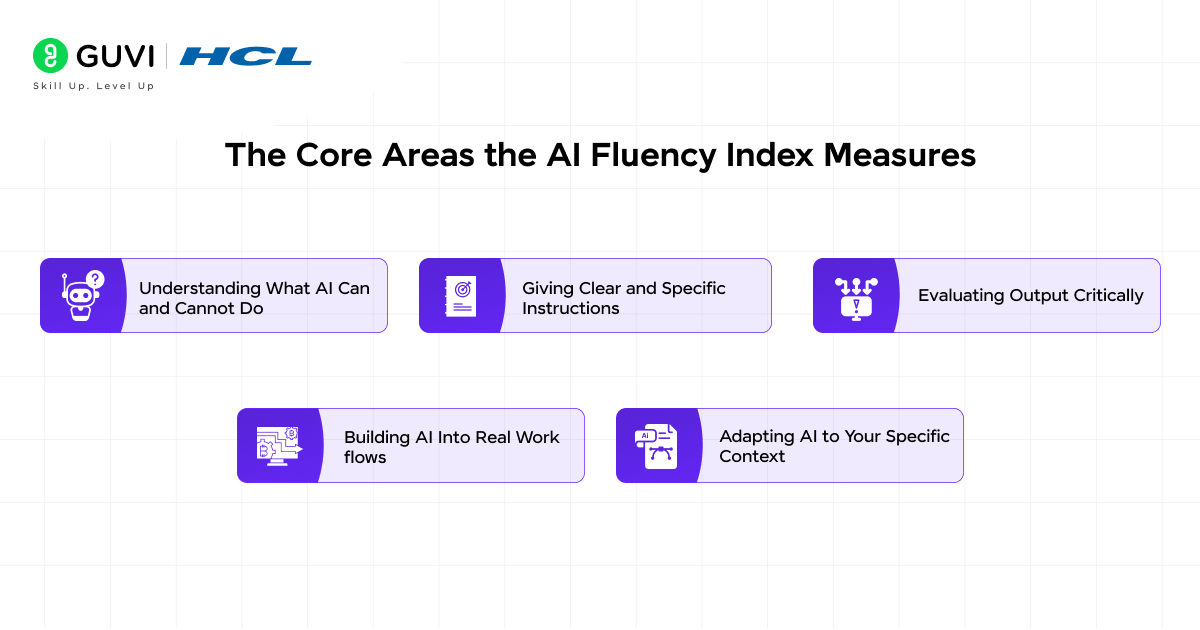
- Understanding What AI Can and Cannot Do
Fluent users know the limits. They do not expect AI to have perfect knowledge of recent events, to make deeply personal decisions, or to be accurate about highly specialized facts without verification. They know when to trust and when to check.
- Giving Clear and Specific Instructions
This is often called prompting. Clear, detailed, well-structured instructions produce dramatically better results than vague ones. Fluency in this area alone can transform the quality of everything AI produces for you.
- Evaluating Output Critically
Fluent users do not accept AI output at face value. They review it, question it, and refine it. They treat AI output as a capable first draft that still needs their professional judgment applied to it.
- Building AI Into Real Workflows
It is one thing to experiment with AI occasionally. It is another to build it into how you actually work every day. Real fluency shows up in practice, in consistent habits and processes, not just in occasional experiments.
- Adapting AI to Your Specific Context
Generic use of AI produces generic results. Fluent users know how to make AI work for their specific needs, their industry, their standards, and their personal style. This is where fluency creates the biggest gap between good results and great ones.
Types of Fluency You Can Build Right Now
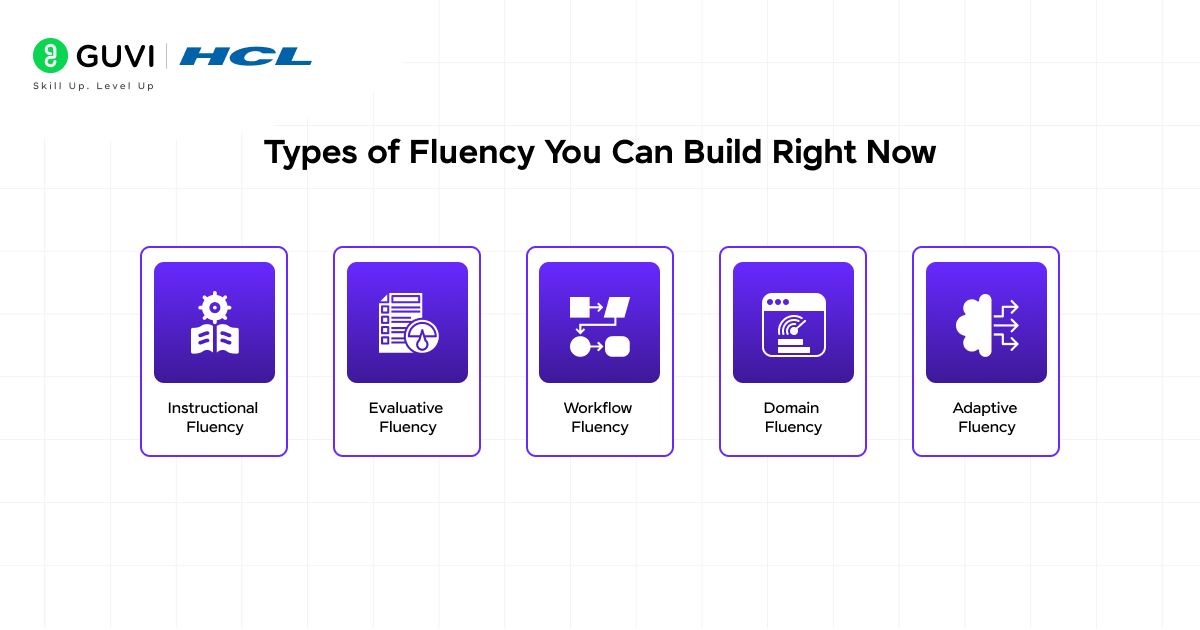
- Instructional Fluency
The ability to communicate clearly with AI tools. Knowing how to structure requests, provide context, specify formats, and guide the output toward what you actually need.
- Evaluative Fluency
The ability to assess AI output critically. Knowing what good looks like in your field, identifying where AI has gone wrong, and refining outputs to meet your standards.
- Workflow Fluency
The ability to integrate AI into your daily processes consistently. Knowing which tasks benefit from AI, when to use it, and how to build habits that make AI a reliable part of how you work.
- Domain Fluency
The ability to apply AI effectively within your specific professional field. Understanding how your industry’s standards, terminology, and requirements should shape how you use AI tools.
- Adaptive Fluency
The ability to keep up as AI tools evolve. Staying curious, continuing to learn, and updating your understanding as capabilities change. This is what separates people who stay ahead from those who fall behind.
Step-by-Step: Assessing and Building Your AI Fluency
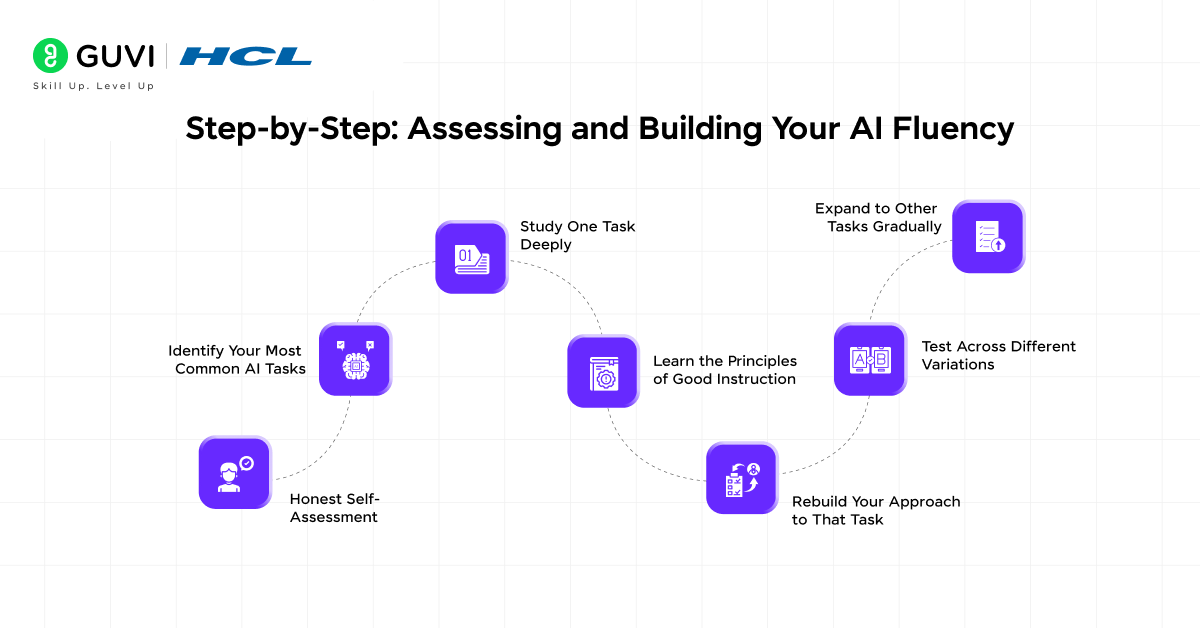
Step 1: Honest Self-Assessment
Before you can improve, you need an honest picture of where you are. Think about the last ten times you used an AI tool. Were the results genuinely useful or did they need heavy editing? Were you satisfied or frustrated? Honest answers here are the starting point.
Step 2: Identify Your Most Common AI Tasks
Write down the three to five things you use AI for most often. These are the highest-value areas for building fluency. Improving here will have the biggest impact on your daily work.
Step 3: Study One Task Deeply
Pick your most frequent AI task and study how you are currently approaching it. Look at the instructions you give, the outputs you get, and the gap between them. This analysis will show you exactly where your fluency needs work.
Step 4: Learn the Principles of Good Instruction
Spend time learning how to give better instructions. Specificity, context, format guidance, and examples all make a significant difference. This single skill improvement lifts the quality of everything you produce with AI.
Step 5: Rebuild Your Approach to That Task
Using what you have learned, rebuild how you approach your most common task. Write clearer instructions. Provide better context. Specify the format you want. Compare the results to what you were getting before.
Step 6: Test Across Different Variations
Do not just test the obvious version of your task. Try different variations, edge cases, and unusual requests. This is how you discover where your approach works and where it breaks down.
Step 7: Expand to Other Tasks Gradually
Once you have genuinely improved your fluency on one task, apply the same process to the next one. Build fluency systematically rather than trying to improve everything at once.
Real-World Examples of AI Fluency in Action
- The Marketing Manager Who Stopped Rewriting Everything
A marketing manager had been using AI to draft social media content but was spending almost as much time editing the outputs as she would have spent writing from scratch. After working on her instructional fluency, she learned to specify her brand voice, target audience, tone, and format in her requests. Her editing time dropped by more than half and the outputs started feeling genuinely on-brand.
- The Teacher Who Cut Planning Time in Half
A secondary school teacher was using AI to create lesson plans but getting generic results that did not fit his curriculum or teaching style. By learning to specify grade level, learning objectives, assessment methods, and curriculum standards in his requests, he started getting plans he could actually use. Planning time dropped from over an hour per lesson to under thirty minutes.

- The Analyst Who Made Reports Consistent
A financial analyst was getting inconsistent results when using AI to help structure monthly reports. Some outputs were close to what she needed. Others were completely off. By building clearer, more detailed instructions and providing examples of what good reports looked like, she achieved consistent, high-quality outputs every time. Report generation time fell significantly.
- The Project Manager Who Fixed Meeting Notes
A project manager tried using AI for meeting notes and found the outputs were too generic to be useful. After working on his workflow fluency and building a clear, repeatable process for briefing AI on meeting context, decisions, and action items, his notes became faster to produce and more thorough than what he had been doing manually.
Pros and Cons of Focusing on AI Fluency
Pros
- Higher fluency produces dramatically better AI outputs across every task you use it for
- The improvement compounds over time as better habits create consistently better results
- Fluent users spend less time editing and more time doing high-value work
- Building fluency in one area transfers skills to other areas naturally
- Individuals with demonstrated AI fluency are increasingly valued in the job market
Cons
- Building genuine fluency requires deliberate effort and time, not just casual use
- Overconfidence is a real risk and many people believe they are more fluent than they actually are
- Fluency needs regular updating as AI tools change and improve
- Focusing too narrowly on one tool’s specifics can leave you unprepared when tools change
- There is no single certification or test that definitively measures AI fluency today
Research by IBM shows that workers who use AI tools with a structured understanding are nearly 3× more likely to report meaningful improvements in the quality of their work. The tools may be the same — but the difference lies in AI fluency.
Top Strategies to Build Real AI Fluency
- Focus on Depth Before Breadth
Do not try to become fluent with ten different AI tools at once. Pick one tool you use regularly and become genuinely good with it first. Deep fluency with one tool teaches you principles that transfer everywhere.
- Always Specify, Never Assume
The single most common fluency mistake is assuming AI knows what you want without being told. Always specify format, tone, length, context, and purpose. What seems obvious to you is not obvious to AI.
- Build a Personal Library of What Works
When you find an approach that produces great results, write it down. Build a personal reference of instructions, formats, and request structures that work well for your specific needs. This library becomes increasingly valuable over time.
- Treat Every Bad Output as a Learning Opportunity
When AI gives you a poor result, resist the temptation to just move on. Ask yourself what was unclear in your request. Fix it and try again. This habit builds fluency faster than anything else.
- Review Your Fluency Regularly
Set aside time every few months to honestly assess how you are using AI. Are there tasks where you are still getting inconsistent results? Are there new capabilities you have not explored? Regular review keeps your fluency growing.
Common Mistakes to Avoid
- Mistaking Familiarity for Fluency
Using AI tools regularly does not automatically make you fluent. Many people use AI daily for months and never improve because they keep repeating the same habits. Fluency requires deliberate learning, not just frequent use.
- Being Too Vague
Vague instructions produce vague results. If you can interpret your own request two different ways, AI will choose the wrong one. Specificity is the foundation of fluency.
- Accepting Output Without Review
Fluent users always apply their own judgment to AI output. Accepting it without review is not efficient. It is a risk that compounds over time as small errors and inconsistencies accumulate in your work.
- Chasing Every New Tool
Constantly switching to the newest AI tool before developing genuine fluency with any of them keeps you perpetually at the beginner stage. Build depth first.
If you want to learn more about the AI Fluency Index, do not miss the chance to enroll in HCL GUVI’s Intel & IITM Pravartak Certified Artificial Intelligence & Machine Learning course. Endorsed with Intel certification, this course adds a globally recognized credential to your resume, a powerful edge that sets you apart in the competitive AI job market.
Conclusion
AI fluency is not a technical skill reserved for engineers or data scientists. It is a professional skill that anyone who uses AI tools in their work needs to develop deliberately and maintain actively. The AI Fluency Index matters because it makes the gap between casual AI use and genuine AI capability visible.
That gap is real, it is significant, and it is entirely possible to close with the right approach. The professionals benefiting most from AI right now are not necessarily the most technically sophisticated. They are the ones who have taken the time to understand how to communicate clearly with these tools, evaluate outputs honestly, and build AI into their work in ways that actually improve it.
Start with one area. Build honest awareness of where your fluency stands. Improve deliberately. The difference between AI use and AI fluency is the difference between a tool sitting in a drawer and a tool that changes how you work every single day.
FAQs
1. How long does it take to build genuine AI fluency?
For the tasks you use most often, meaningful improvement is possible within a few weeks of deliberate practice. Complete fluency across a range of tasks and tools takes longer and is an ongoing process rather than a destination.
2. Is AI fluency the same thing as knowing how to code?
No. Coding knowledge can be helpful for certain advanced uses of AI, but the core of AI fluency is about communication, critical thinking, and workflow design. Non-technical professionals can build very high levels of AI fluency without any coding knowledge.
3. Can organizations measure AI fluency across teams?
Yes. The AI Fluency Index provides a framework for assessing fluency at an organizational level, identifying where training is needed, and tracking improvement over time. This is increasingly valuable as AI becomes central to how work gets done.
4. What is the most important fluency skill to build first?
Instructional fluency, the ability to give clear, specific, well-structured requests, delivers the biggest impact the fastest. Improving this single skill will immediately improve the quality of everything else you do with AI.
5. How do I know if my AI fluency is actually improving?
Track the quality of your outputs and the time you spend editing them. As fluency improves, outputs get better and editing time decreases. Keeping simple notes on your AI tasks over time makes this progress visible and measurable.
What is the difference between an AI course and an AI & ML course?
An AI course focuses on artificial intelligence concepts, while an AI & ML course includes machine learning, deep learning, NLP, computer vision, and practical model-building skills. If you’re looking for hands-on AI and ML training, explore the HCL GUVI AI & ML Programme.
What should I look for before enrolling in an AI & ML course?
Look for a structured curriculum, practical projects, experienced mentors, updated AI tools, certification value, and career support. Compare programmes carefully before enrolling in an AI & ML Programme.
How should I evaluate AI & ML certifications before enrolling?
Evaluate AI & ML certifications based on industry recognition, curriculum relevance, hands-on learning, project experience, and career outcomes. You can also compare what’s included in the HCL GUVI AI & ML Programme before making a decision.
Success Stories

About the Author
Vishalini Devarajan
An Aerospace Engineer turned content writer, I focus on making complex concepts easy to understand through well-structured, reader-friendly blogs. Whether it’s a technical topic or a non-technical one, I love creating content that is clear, engaging, and impactful.
View all posts by Vishalini Devarajan
Connect with me @








Did you enjoy this article?