


Data Science Articles
BPO Experience for Data Analyst Jobs Does It Count When Applying? - Best Guide
What's Career Growth After 5 Years in BPO? Are You Missing Out on a Data Analyst Career?
Can a BPO Team Leader Become a Data Analyst?
BPO vs Data Analyst Salary in India: What Changes After the Switch?

Get In Touch For Details! Request More Information
Do Accountants Need Coding to Become Data Analysts?
Oct 08, 2026 3 Min Read 42 Views
(Last Updated)
Accounting and data analytics both rely heavily on numbers, accuracy, and business insights. That makes accounting a strong starting point for professionals considering a data analyst career. However, the transition requires learning new tools and developing the ability to work with larger datasets and data-driven business problems.
Table of contents
- TL;DR
- Quick Answer
- Can an Accountant Become a Data Analyst?
- Do Accountants Need Coding to Become Data Analysts?
- Excel
- SQL
- Power BI
- Python
- How Does the Data Analytics Career Path Look for Accountants?
- Why Finance Analytics Can Be a Strong Option
- How to Transition From Accounting to Data Analytics
- Skills That Can Help You Stay Ahead
- Conclusion
- FAQs
- Can an accountant become a Data Analyst?
- Do accountants need coding to become Data Analysts?
- Is SQL important for accountants moving into data analytics?
- Is Python necessary for a Data Analyst career?
- What are the best Data Analyst skills for accountants?
- Can accountants work in finance analytics?
- What is a good career path from accounting to data analytics?
TL;DR
- Accountants can transition into Data Analyst roles.
- Advanced coding is not required to start learning data analytics.
- Excel, SQL, Power BI, statistics, and data visualization are important data analyst skills.
- Python becomes useful as you progress toward more advanced analytics.
- Accounting knowledge can create opportunities in finance analytics and business intelligence.
- A typical data analytics career path can progress from reporting or financial analysis to Data Analyst and Senior Data Analyst roles.
Quick Answer
| No, accountants do not need advanced coding to become Data Analysts. Skills such as Excel, SQL, Power BI, statistics, and data visualization are more important starting points. Python can be added later for automation and advanced analysis. An accounting background can also be valuable when working with financial data, budgets, revenue, costs, and business performance. |
Can an Accountant Become a Data Analyst?
Yes. Accountants already work with structured financial information, reports, transactions, and performance metrics. These experiences can transfer well into analytics.
For example, an accountant may already analyze:
- Revenue and expenses
- Profit and loss statements
- Budget variances
- Financial trends
- Customer or vendor transactions
- Business performance
The main difference is that Data Analysts use these types of analytical skills across broader datasets and business functions.
An accountant moving into analytics should therefore focus on adding technical skills rather than starting their career from scratch.
Do Accountants Need Coding to Become Data Analysts?
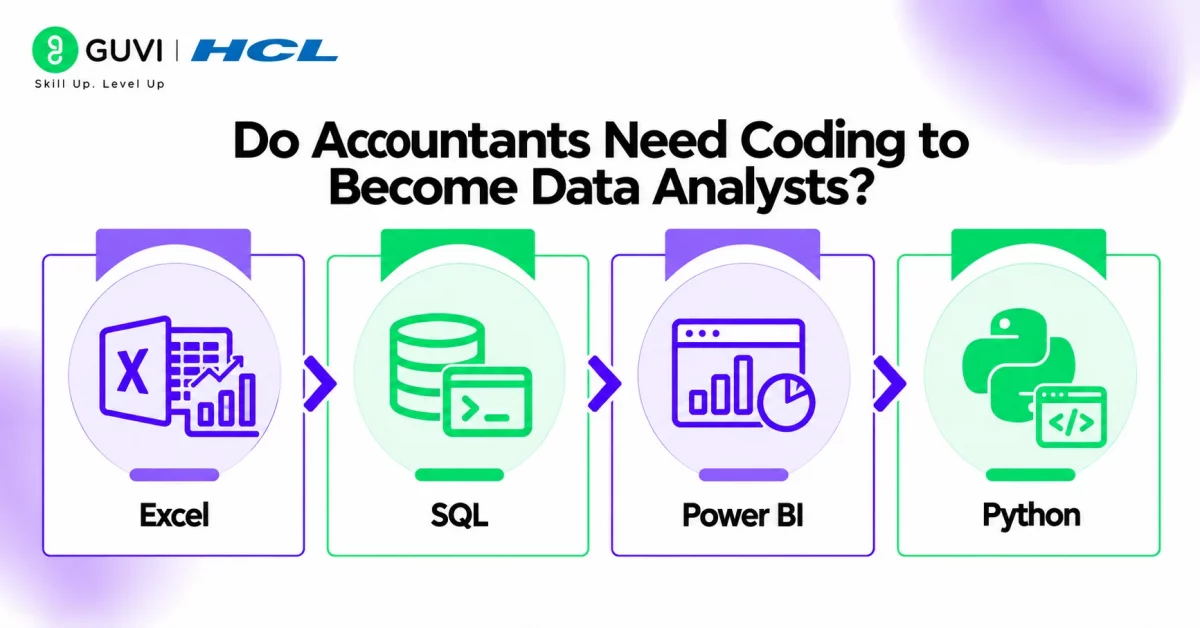
Coding is not a prerequisite for starting a data analytics career, but learning some programming can expand your opportunities.
1. Excel
Excel is often a natural starting point for accountants. Strengthening skills such as these can help in data analysis.
- Pivot tables
- XLOOKUP and other lookup functions
- Data cleaning
- Conditional formulas
- Charts and dashboards
2. SQL
SQL is one of the most valuable skills for Data Analysts because it allows you to retrieve and analyze information stored in databases.
Accountants do not need to become software developers. They should focus on practical SQL skills such as filtering, sorting, grouping, joining tables, and calculating metrics.
3. Power BI
Power BI can help accountants turn financial and operational data into interactive dashboards. This is particularly useful for reporting, budgeting, profitability analysis, and business performance tracking.
4. Python
Python is useful for more advanced data analysis and automation. Accountants can learn it after building a foundation in Excel, SQL, and visualization.
You do not need to master complex programming before applying for every Data Analyst role. The skills required depend on the position.
How Does the Data Analytics Career Path Look for Accountants?
An accountant does not necessarily have to jump directly into a highly technical Data Scientist role.
A practical data analytics career path could look like:
Accountant → Financial/Reporting Analyst → Data Analyst → Senior Data Analyst → Analytics/BI Specialist
Another route is to specialize in finance analytics, where accounting knowledge can remain directly relevant.
This could involve analyzing revenue, expenses, profitability, financial forecasts, budgets, or business performance.
Why Finance Analytics Can Be a Strong Option
Finance analytics combines financial knowledge with data analysis.
For an accountant, this can be a useful transition because your existing domain knowledge remains relevant while you develop new technical capabilities.
For example, instead of only preparing a financial report, you could analyze the data behind it to identify:
- Which products generate the highest revenue
- Why expenses increased
- Which business units are most profitable
- How actual spending compares with budgets
- Which financial trends require management attention
This combination of finance knowledge + data analyst skills can help differentiate you from candidates who have technical skills but limited financial-domain experience.

How to Transition From Accounting to Data Analytics
You can approach the transition in stages:
- Strengthen Excel: Move beyond basic spreadsheets and learn advanced analysis and dashboards.
- Learn SQL: Build the ability to retrieve and analyze database information.
- Learn Power BI: Create dashboards using financial and business datasets.
- Study statistics: Understand averages, distributions, correlations, and other analytical concepts.
- Add Python: Learn enough Python for data cleaning, analysis, and automation.
- Build finance projects: Create projects around expenses, revenue, profitability, budgets, or financial forecasting.
- Apply for relevant roles: Consider Financial Analyst, Reporting Analyst, Business Analyst, Data Analyst, and Finance Analytics positions.
Accountants already work with many of the business metrics that Data Analysts analyze. Learning modern data tools can help transform that existing financial knowledge into broader analytical capabilities.
Skills That Can Help You Stay Ahead
The strongest career transition is not about abandoning your accounting background. It is about combining it with data skills.
Instead of positioning yourself simply as someone who wants to leave accounting, position yourself as a finance professional who can analyze data and turn it into business insights.
That combination can open opportunities across accounting, finance, business intelligence, and analytics.
Conclusion
An accountant can absolutely become a Data Analyst without becoming an expert programmer first. Start with Excel, SQL, Power BI, statistics, and data visualization, then add Python as your analytical needs become more advanced.
Your accounting experience can also become an advantage, particularly in finance analytics, financial reporting, and business intelligence. The right combination of domain knowledge and technical data analyst skills can create a practical path into a growing data career.
FAQs
1. Can an accountant become a Data Analyst?
Yes. Accountants can transition into Data Analyst roles by developing skills such as SQL, Excel, Power BI, statistics, and data visualization.
2. Do accountants need coding to become Data Analysts?
No. Advanced coding is not required to start. SQL is particularly useful, while Python can be learned later for advanced analysis and automation.
3. Is SQL important for accountants moving into data analytics?
Yes. SQL helps Data Analysts retrieve, filter, combine, and analyze data stored in databases.
4. Is Python necessary for a Data Analyst career?
Not always. Requirements vary by role, but Python can improve your ability to automate tasks and perform more advanced analysis.
5. What are the best Data Analyst skills for accountants?
Excel, SQL, Power BI, statistics, data visualization, business analysis, and eventually Python are useful skills.
6. Can accountants work in finance analytics?
Yes. Finance analytics can be a natural career direction because it combines financial expertise with data analysis.
7. What is a good career path from accounting to data analytics?
A possible path is Accountant → Financial/Reporting Analyst → Data Analyst → Senior Data Analyst → Analytics or BI Specialist.
Success Stories

About the Author
HCL GUVI
This article was selected and published as part of the HCL GUVI AI Blogathon 2026, an initiative designed to encourage students, AI enthusiasts, and aspiring tech writers to simplify complex AI concepts through impactful technical content. The contest recognized high-quality, original, and insightful AI-focused blogs, with selected authors receiving publication opportunities on the HCL GUVI blog platform along with official author credits and recognition.
View all posts by HCL GUVI
Connect with me @








Did you enjoy this article?