


Career Articles
Accountant vs Data Analyst Salary in India After Switching Careers - Best Guide
Finance Managers: Could Data Science Be Your Next Career Move?
Insurance Claims Executive to Data Analyst: Is It a Good Switch?
Banking Executive (Loans, KYC) to Data Analyst: Skills and Career Path


Get In Touch For Details! Request More Information
Inside the Top 15 Tech Companies People Dream of Working At
Jul 24, 2026 6 Min Read 5224 Views
(Last Updated)
Silicon Valley and beyond, high-reliability platforms that serve millions daily are not maintained by chance. They are the result of companies that combine technical precision with organizational discipline. The most sought-after tech firms structure work around scale, clarity, and long-term impact. They offer roles that go beyond titles and perks, focusing instead on ownership, learning, and problem-solving at depth.
If you’re evaluating where serious tech careers are built, this breakdown of the top companies is worth your attention. Keep reading:
Quick Answer: Top tech companies like Google, Microsoft, Apple, and Meta offer roles in software engineering, product management, AI, and cloud. Perks include equity, remote flexibility, learning programs, wellness benefits, and structured career growth across global, high-impact platforms.
Table of contents
- Top 15 Tech Companies to Work for in 2025
- Meta
- HubSpot
- Oracle
- Capgemini
- Top Skills and Roles at Leading Technology Companies
- Tips to Land a Role at a Top Tech Company
- Conclusion
- FAQs
- What is the hardest tech company to get a job at?
- How do I choose between offers from top tech companies?
- Do tech companies like Google and Microsoft support remote or hybrid work?
- Is it better to work at a product-based or service-based tech company?
Top 15 Tech Companies to Work for in 2025
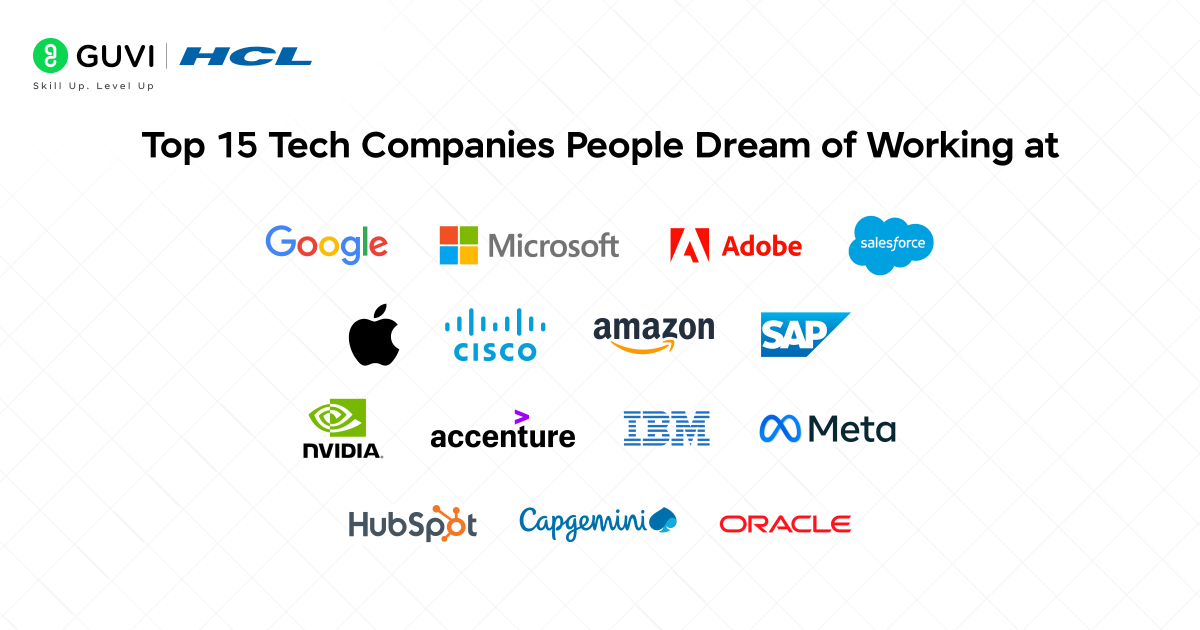
Google was founded in 1998 by Larry Page and Sergey Brin. It started as a search engine but now operates across advertising, cloud computing, operating systems, hardware, and artificial intelligence. The company is part of Alphabet Inc., its parent company since 2015. Google’s products such as Search, YouTube, Android, and Google Cloud are used across both consumer and enterprise segments. What distinguishes Google is its infrastructure depth and its integration of research with commercial product development.
Perks of Working at Google:
- Annual bonuses and equity grants based on performance and impact
- Free meals, on-campus fitness centers, and medical facilities
- Parental benefits with extended paid leave and family support
- Hybrid work structure with strong support for distributed teams
- Learning resources through internal platforms and certification paths
- Microsoft
Microsoft was established in 1975 by Bill Gates and Paul Allen. Its core products include Windows, Microsoft 365, Azure, GitHub, and LinkedIn. It operates across enterprise software, cloud services, developer platforms, and devices. Microsoft transitioned under Satya Nadella’s leadership to focus more on cloud-first strategies and AI integration. Its strength lies in delivering scalable enterprise tools while investing in long-term infrastructure growth.
Perks of Working at Microsoft:
- Competitive salary with equity grants and performance-based bonuses
- Health plans with comprehensive mental, dental, and vision coverage
- Remote-first flexibility across engineering and product roles
- Tuition reimbursement for technical and business education
- Access to internal learning academies with structured curricula
- Adobe
Adobe was founded in 1982 by John Warnock and Charles Geschke. It became known for creating PostScript and PDF, and later built flagship products such as Photoshop, Illustrator, and Premiere Pro. Adobe now operates through Creative Cloud, Document Cloud, and Experience Cloud. The company focuses on creative software, digital media, and data-driven customer experiences. Adobe is recognized for maintaining a balance between design integrity and technical precision.
Perks of Working at Adobe:
- Paid sabbaticals for employees reaching specific milestones
- Annual bonuses and long-term equity incentives
- Health benefits covering physical and mental wellness
- Learning and development stipends for creative and technical skills
- Flexible work arrangements across global offices
- Salesforce
Salesforce was founded in 1999 by Marc Benioff. It began with a focus on CRM and expanded into platforms for marketing automation, analytics, and enterprise integration. Its core products include Sales Cloud, Service Cloud, and the Lightning Platform. Salesforce also owns Slack and Tableau. The company is structured around a multi-tenant cloud architecture, making it central to many large-scale business operations.
Perks of Working at Salesforce:
- Bonuses tied to team metrics and customer satisfaction
- Paid volunteer hours and charitable donation matching
- Access to well-being programs that include mental health care
- Internal training through Trailhead for certifications and upskilling
- Equity refreshers based on performance and tenure
- Apple
Apple was founded in 1976 by Steve Jobs, Steve Wozniak, and Ronald Wayne. It is known for its hardware products like the iPhone, Mac, and Apple Watch, and also runs software and services like iOS, macOS, and iCloud. Apple’s approach to product design is vertically integrated, where hardware and software are tightly controlled to meet specific experience goals. Its emphasis on secrecy, precision, and finish differentiates it from most technology companies.
Perks of Working at Apple:
- Stock grants that scale with role impact and project performance
- Discounts on Apple products and accessories
- On-site wellness and healthcare facilities at major locations
- Defined career paths for both engineering and design roles
- Access to proprietary training in hardware and manufacturing
- Cisco
Cisco was founded in 1984 by Leonard Bosack and Sandy Lerner. It started with multi-protocol router systems and now operates across enterprise networking, cybersecurity, cloud infrastructure, and collaboration tools. Its portfolio includes Webex, Meraki, and Catalyst systems. Cisco plays a central role in enterprise connectivity and has a strong presence in government, finance, and education sectors.
Perks of Working at Cisco:
- Annual bonuses tied to both company performance and individual targets
- Employee stock purchase plan with favorable terms
- On-site medical and wellness programs at major campuses
- Generous time-off policies, including birthday and volunteer days
- Access to internal learning platforms and cross-training certifications
- Amazon
Amazon was founded in 1994 by Jeff Bezos. It began as an online bookstore and expanded into global e-commerce, cloud computing through AWS, logistics, and media. AWS powers major portions of the internet and is a key driver of Amazon’s profitability. The company also operates Alexa, Kindle, and Prime Video, making it a key player in consumer tech and infrastructure.
Perks of Working at Amazon:
- Base compensation supplemented by sign-on bonuses and stock units
- Health benefits that include virtual care, mental wellness, and fertility support
- Employee discount program for Amazon retail purchases
- Paid leave programs tailored to tenure and role
- Career development tools built into internal HR platforms
- SAP
SAP was founded in 1972 by Dietmar Hopp, Hasso Plattner, Claus Wellenreuther, Klaus Tschira, and Hans-Werner Hector. The company is headquartered in Germany and is a leader in enterprise resource planning (ERP), business analytics, and supply chain management software. Its platforms include SAP S/4HANA, SuccessFactors, and Ariba. SAP’s clients span manufacturing, retail, public sector, and finance.
Perks of Working at SAP:
- Retirement and pension plans in addition to standard compensation
- Global travel opportunities for client-facing technical roles
- Internal career marketplaces for exploring short-term projects across regions
- Comprehensive wellness offerings including mindfulness and digital therapy
- Tuition coverage for industry certifications and language training
- NVIDIA
NVIDIA was founded in 1993 by Jensen Huang, Chris Malachowsky, and Curtis Priem. Initially focused on graphics hardware, the company now leads in AI, autonomous systems, simulation, and high-performance computing. Its core platforms include CUDA, GeForce, NVIDIA AI, and the Omniverse platform. NVIDIA’s influence spans research, gaming, data centers, and scientific computing.
Perks of Working at NVIDIA:
- Performance-based equity grants and quarterly bonus cycles
- Wellness benefits that extend to mental health, family planning, and aging care
- Patent and research incentives for technical contributions
- Internal upskilling programs in AI, parallel computing, and chip architecture
- Childcare support and family leave aligned with project timelines
Technical Depth and Ownership:
- Engineering teams hold architectural ownership across software, firmware, and silicon
- Teams work in stacked layers where domain specialists solve system-level problems
- Rapid feedback is integrated from customers, academic researchers, and enterprise clients
- Design reviews focus on long-term scalability and scientific accuracy, not just speed to release
- Accenture
Accenture was founded in 1989 after splitting from Arthur Andersen’s consulting division. It provides services in technology integration, digital transformation, strategy, and managed services. Accenture works with enterprise clients across government, healthcare, finance, and telecom. It has developed proprietary platforms like myConcerto and collaborates with cloud providers such as AWS, Azure, and Google Cloud.
Perks of Working at Accenture:
- Structured promotion paths with annual performance cycles
- Paid certifications across platforms like Salesforce, SAP, and AWS
- Access to wellness support through global employee assistance programs
- Remote project work options depending on client requirements
- Relocation assistance and travel stipends for global delivery roles
- IBM
IBM (International Business Machines Corporation) was founded in 1911 as the Computing-Tabulating-Recording Company. It was renamed IBM in 1924. The company has operated across hardware, software, services, and research. IBM built early mainframes, pioneered relational databases, and now focuses on hybrid cloud, Artificial Intelligence, consulting, and quantum computing. Its flagship platforms include IBM Cloud, Watson, Red Hat OpenShift, and zSystems. The company is also known for maintaining one of the most active patent portfolios in the world.

Perks of Working at IBM:
- Defined benefit pension plans in selected regions
- Equity programs for senior technical and leadership roles
- Flexible work arrangements based on department and client geography
- Continued education partnerships with academic institutions
- Employee support programs covering mental health, family planning, and mobility
12. Meta
Meta was founded in 2004 by Mark Zuckerberg along with a team of co-founders from Harvard. Initially launched as Facebook, the company expanded into social platforms, communication tools, Virtual Reality, and large-scale machine learning systems. Its core products include Facebook, Instagram, WhatsApp, Messenger, and the Quest VR ecosystem. The rebranding to Meta in 2021 signaled its commitment to building next-generation computing platforms for shared digital experiences.
Perks of Working at Meta:
- Restricted stock units that vest quarterly over four years
- Wellness stipends for physical health, mental care, and nutrition
- Global office access with standard relocation packages for internal transfers
- Learning and development budget that scales with level and function
- Enhanced parental benefits, including surrogacy and fertility support
13. HubSpot
HubSpot was founded in 2006 by Brian Halligan and Dharmesh Shah. It began as an inbound marketing platform and evolved into a full-suite CRM provider. Its core tools include marketing automation, sales enablement, customer service, and content management. HubSpot targets small to mid-sized businesses and differentiates itself through product usability and customer support quality. It also runs an extensive ecosystem of integrations and partner services.
Perks of Working at HubSpot:
- Unlimited vacation policy governed by individual manager guidelines
- Equity grants tied to performance and internal mobility
- Global first approach to remote work with regional support hubs
- Dedicated mental wellness resources and therapy reimbursements
- Paid volunteer time and matching donation programs
14. Oracle
Oracle was founded in 1977 by Larry Ellison, Bob Miner, and Ed Oates. It initially focused on relational database technology and built one of the most widely adopted database platforms in the enterprise sector. Oracle now offers integrated cloud applications, infrastructure, and services across ERP, HCM, and database management. Its core offerings include Oracle Cloud Infrastructure (OCI), Fusion Applications, and Autonomous Database. The company serves large global clients across finance, manufacturing, and government.
Perks of Working at Oracle:
- Compensation includes performance-linked bonuses and annual stock refresh
- Health benefits that cover global mobility, second opinions, and specialized treatments
- Internal training platforms with certifications on cloud, security, and architecture
- Employee assistance programs spanning financial and career support
- Paid sabbatical options based on tenure and level
15. Capgemini
Capgemini was founded in 1967 by Serge Kampf in France. It is a global leader in consulting, digital transformation, and technology services. Capgemini operates across industries such as banking, energy, manufacturing, and public sector. Its key offerings include application development, cloud integration, cybersecurity, and platform engineering. The company has a strong delivery presence in Europe, India, and North America.
Perks of Working at Capgemini:
- Career mobility programs that allow cross-country project deployment
- Certification reimbursements across Azure, AWS, GCP, and ServiceNow
- Structured mentoring and training academies by role and industry vertical
- Employee wellness policies aligned with local employment laws and practices
- Retirement, travel, and housing support for long-term client engagements.
Top Skills and Roles at Leading Technology Companies
| Company | Top Skills | Top Roles |
| Machine Learning and Distributed Systems | Software Engineer, Research Scientist, Product Manager | |
| Microsoft | Cloud Architecture, .NET, Azure | Software Engineer, Cloud Solution Architect, Program Manager |
| Adobe | UX Design, Digital Media, JavaScript | Product Designer, Software Engineer, Marketing Analyst |
| Salesforce | CRM, Apex, Lightning Framework | Solution Engineer, Salesforce Developer, Customer Success Manager |
| Apple | iOS Development, Hardware Engineering, Embedded Systems | Hardware Engineer, iOS Developer, Industrial Designer, Software Developer |
| Cisco | Networking, Cybersecurity, Cloud Infrastructure | Network Engineer, Systems Engineer, Security Analyst |
| Amazon | AWS and Data Engineering | Solutions Architect, Data Scientist, Operations Manager |
| SAP | ERP, SAP HANA, Business Intelligence | SAP Consultant, Functional Analyst, Software Engineer |
| NVIDIA | GPU Programming, AI/ML, CUDA | AI Researcher, Systems Engineer, Silicon Architect |
| Accenture | Cloud Migration, IT Consulting, Agile Delivery | Technology Consultant, DevOps Engineer, Business Analyst |
| IBM | Hybrid Cloud, Mainframes, Quantum Computing | Cloud Engineer, Research Scientist, Solutions Consultant |
| Meta | AR/VR, Machine Learning, Infrastructure Engineering | Software Engineer, Data Scientist, Product Designer |
| HubSpot | Inbound Marketing, Web Development, CRM | Front-End Developer, Marketing Technologist, UX Designer |
| Oracle | Database Architecture, Oracle Cloud, Java | Database Administrator, Cloud Engineer, Software Developer |
| Capgemini | Digital Transformation, Enterprise Architecture, Cloud | IT Consultant, Delivery Manager, Cloud Engineer |
Tips to Land a Role at a Top Tech Company
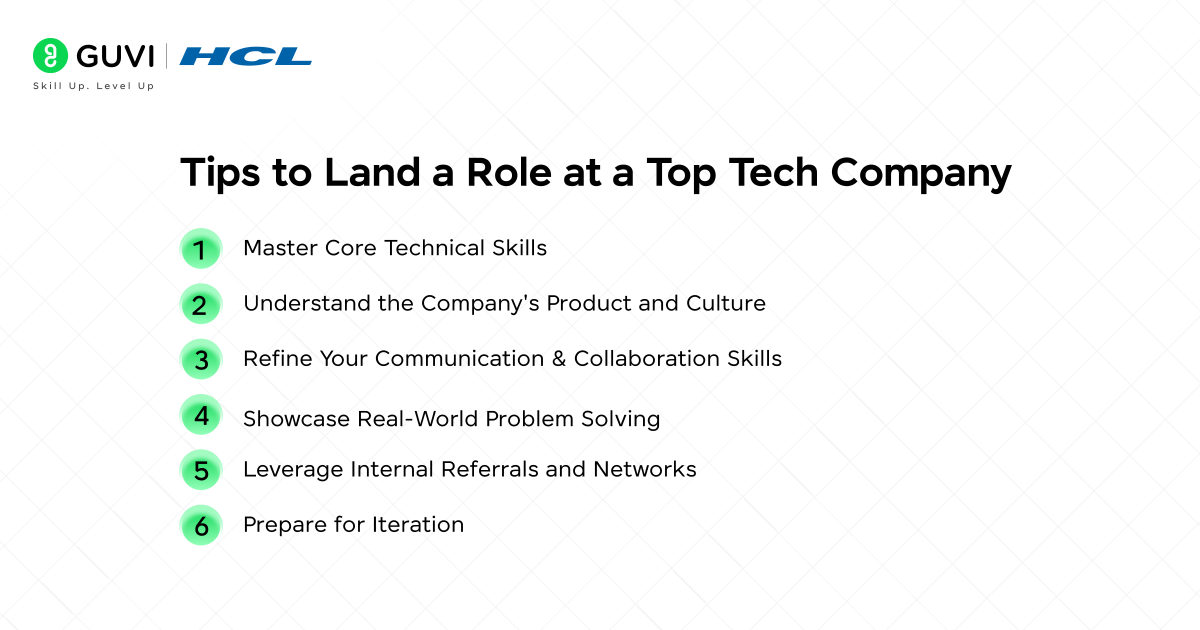
Breaking into elite tech companies takes more than just raw talent. Here’s how to strategically prepare and position yourself:
- Master Core Technical Skills
- Build deep expertise in data structures, algorithms, and systems design.
- Practice coding problems on platforms like LeetCode, Codekata, HackerRank, or Codeforces.
- For non-engineering roles, focus on core tools (e.g., Figma for design, SQL for data roles, CRM for sales ops).
- Understand the Company’s Product and Culture
- Research each company’s product suite, business model, and recent initiatives.
- Tailor your resume and interview answers to match the company’s core values and work culture.
- Refine Your Communication & Collaboration Skills
- Practice behavioral interview formats using the STAR method (Situation, Task, Action, Result).
- Demonstrate cross-functional collaboration and ownership in examples.
- Showcase Real-World Problem Solving
- Contribute to open-source, personal projects, or hackathons.
- If possible, publish case studies or write-ups that explain your thinking process.
- Leverage Internal Referrals and Networks
- Reach out to alumni, former colleagues, or community members who work at these companies.
- Attend meetups, webinars, and virtual networking sessions hosted by target firms.
- Prepare for Iteration
- Many applicants don’t land an offer on their first try. Don’t view the job application as a single event. You apply, learn from each round (even rejections), refine your resume or skills, and try again smarter.
Conclusion
Working at these companies involves more than access to high-impact products. It reflects a structure where problem-solving is tied to scale, systems are designed for reliability, and teams operate with clearly defined ownership. Career growth is shaped by internal mobility, long-term planning, and exposure to technical and strategic work. These firms set benchmarks through innovation and also by how they organize people, process, and product into sustainable business models.
FAQs
What is the hardest tech company to get a job at?
Companies like Google, Meta, and Apple are known for rigorous hiring processes. Candidates often face multiple rounds of technical interviews, system design challenges, and behavioral assessments.
How do I choose between offers from top tech companies?
Compare based on team scope, growth potential, perks like stock or flexibility, manager fit, and long-term alignment with your career goals. Not all top companies offer the same day-to-day experience.
Do tech companies like Google and Microsoft support remote or hybrid work?
Yes, many top tech firms support hybrid and remote roles, especially in engineering, product, and design. Policies vary, but flexibility has become a standard offering post-2020.
Is it better to work at a product-based or service-based tech company?
Product-based companies (e.g., Google, Adobe) often offer ownership and innovation, while service-based firms (e.g., Accenture, Capgemini) provide variety, global exposure, and fast-paced client work. The choice depends on your goals.
Success Stories

About the Author
Vaishali
I'm a seasoned writer with four years of experience across technical, non-technical, and just about every genre or niche you can imagine. Adaptable and curious, I enjoy exploring new topics and making information engaging and easy to understand. Fueled by a steady stream of tea, I approach each project with creativity, reliability, and genuine enthusiasm for storytelling.
View all posts by Vaishali
Connect with me @















Did you enjoy this article?